
Crypto trading has been subdued this summer, but Bitcoin and Zcash are not telling the same story on the charts. Bitcoin, still the market leader, is pressing into a ceiling it has failed to reclaim for months. Zcash, one of the strongest-performing altcoins over the past year, is trying to hold a recovery after its latest network upgrade.
Bitcoin spent the week dealing with two separate sources of pressure. One came from renewed talk about quantum-computing and AI risks. CNBC’s Jim Cramer said he is dumping his BTC because of fears tied to quantum computing. The other came from custody concerns after a $130 million Coldcard wallet exploit disclosed late last week added a fresh security scare.
On the macro side, the Federal Reserve kept interest rates unchanged at 3.5% to 3.75%, leaving risk assets in a holding pattern.
Zcash had a clearer catalyst. The privacy coin, co-created by NSA whistleblower Edward Snowden, activated its Ironwood upgrade, known as network upgrade NU6.3, on mainnet on July 28 at block 3,428,143. The change reworked the network’s privacy backbone. The timing mattered because the upgrade also helped calm concerns that had built after AI found a vulnerability in Zcash’s code. That issue has now been patched.
ZEC slipped when the upgrade went live, a familiar sell-the-news move, before buyers stepped back in. A 2.95% gain on Tuesday kept that recovery case intact.
Bitcoin price: the market is still looking at a rebound, not a reversal
Bitcoin traded in a $63,820 to $64,706 range and is currently priced at $64,656, up 0.94%. The price action still reads as a recovery attempt, not a trend change.
The broader setup explains why. Bitcoin topped near $80,000 in May, sold off through June, and hit a low near $56,000. Since then, it has stabilized in a $60,000 to $67,000 band through July and early August. That looks more like a base than a breakout.
Price is now pushing toward the 200-day exponential moving average, around $66,500. That level has capped every bounce since a death cross formed months ago. The structure still suggests a relief rally inside a downtrend: Bitcoin is well off the June low, but it has not yet reclaimed its long-term average.
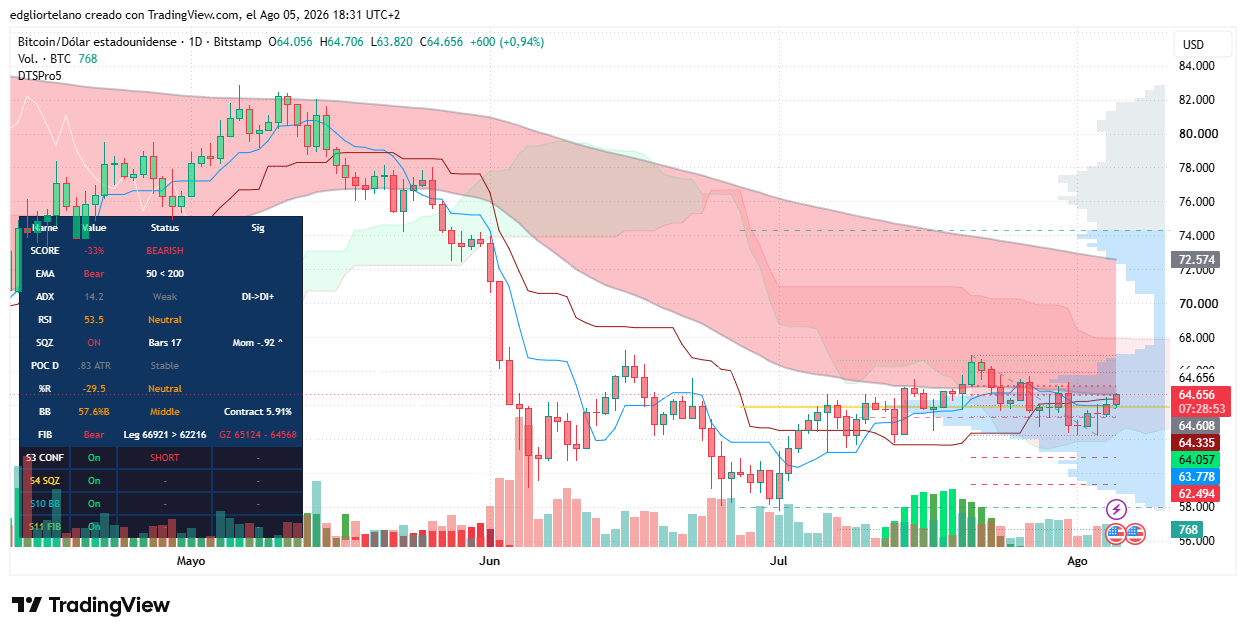
The 50-day EMA, which reflects the average price of the past 50 days, sits near $64,200. The 200-day EMA is near $66,500. With the shorter average below the longer one, the death cross remains in place and the medium-term direction is still pointed lower. BTC is currently above the 50-day EMA but below the 200-day EMA, a short-term recovery running into long-term resistance.
The Relative Strength Index, or RSI, is at 53.5. On a 0 to 100 scale, readings above 70 are usually considered overbought and readings below 30 oversold. Bitcoin is only slightly above the neutral 50 line. That is mildly constructive, but far from decisive.
The Squeeze Momentum indicator is on, showing pressure is building. These squeezes resolve in the direction of the prior trend more often than they reverse it, which leaves the setup leaning against the rally. The Average Directional Index, or ADX, stands at 14.2, a weak reading, with negative directional pressure still present. When ADX is below 24, trend confirmation is limited and false breakouts are common.
On the upside, the first resistance level is the 200-day EMA near $66,500, followed by the leg high at $66,921. Bulls need a daily close back above that zone to confirm that the squeeze can break upward.
On the downside, losing $64,057, described as the golden-zone low, opens the way to $63,778 and then to the round $56,000 shelf that marked the June bottom. A push toward $66,500 that fails there would fit the pattern of a classic bull trap.
Zcash price: recovery remains in place, but the next break still needs confirmation
Zcash offered the more constructive chart on the day. ZEC is currently trading at $520.33 with a market capitalization of roughly $8.7 billion, up 2.95% after touching a high of $525.00 and a low of $502.98. Over the last 24 hours, the token has gained more than 5%.
The path behind that move supports the case. Zcash went nearly parabolic from roughly $300 to a peak near $680 between April and early June, then dropped sharply to around $480 by mid-June.
Since then, it has recovered to $560 before pulling back to the current $520 area. That matters. The rebound has not rolled over into another leg down: price is still holding above both key moving averages, and the damage from the April-to-June swing is being absorbed rather than repeated. The recent move from $560 down to $520 looks more like a pullback within a recovery than the start of a fresh downtrend.
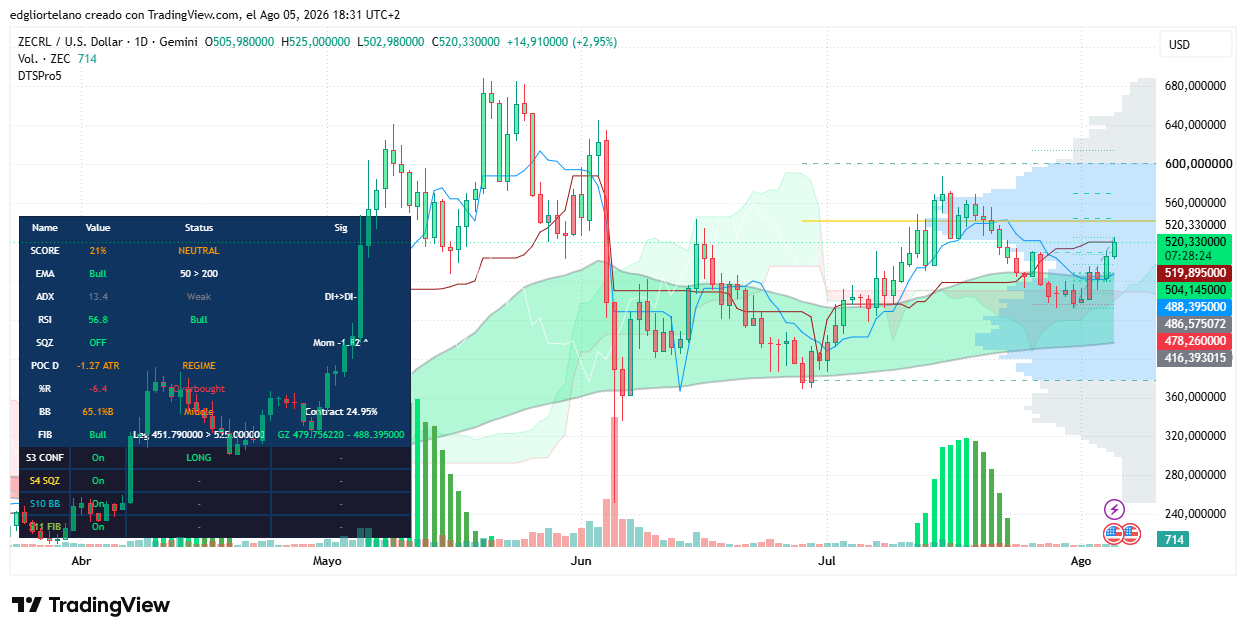
The 50-day EMA is at $504.15, above the 200-day EMA at $488.40. That leaves a golden cross in place, the bullish mirror image of Bitcoin’s death cross. Zcash is trading above both averages, so the medium-term trajectory still points higher.
RSI is at 56.8, which is bullish without looking stretched. The Squeeze indicator is off, so there is no obvious compression building here, only a steadier grind higher. ADX comes in at 13.4, still weak, which means the recovery lacks strong trend force and can remain choppy. Price is now pressing into the $525 leg high, the ceiling of the current move.
Resistance sits around $560 and $600, with the April peak near $680 beyond that. A clean move above $525 would confirm the current recovery leg. If that level fails, the most likely fade would be back toward the 50-day EMA at $504.15.
Below that, the 200-day EMA at $488.40 and the $479.76 to $488.40 golden zone form the main support floor. Additional levels under that sit at $478.26 and $416.39.
Two assets, two different tests
The bullish setup for Zcash is real, but it is not confirmed yet. A close above $525 would extend the recovery toward $560. For Bitcoin, a reclaim of $66,500 would help lift the broader complex as well. At the moment, though, neither chart has the kind of conviction the technical readings would usually need.
Right now, Bitcoin is testing a ceiling it has failed to hold for months. Zcash is holding its structure better, but it is also running into resistance of its own.
The views and opinions expressed by the author are for informational purposes only and do not constitute financial, investment, or other advice.