
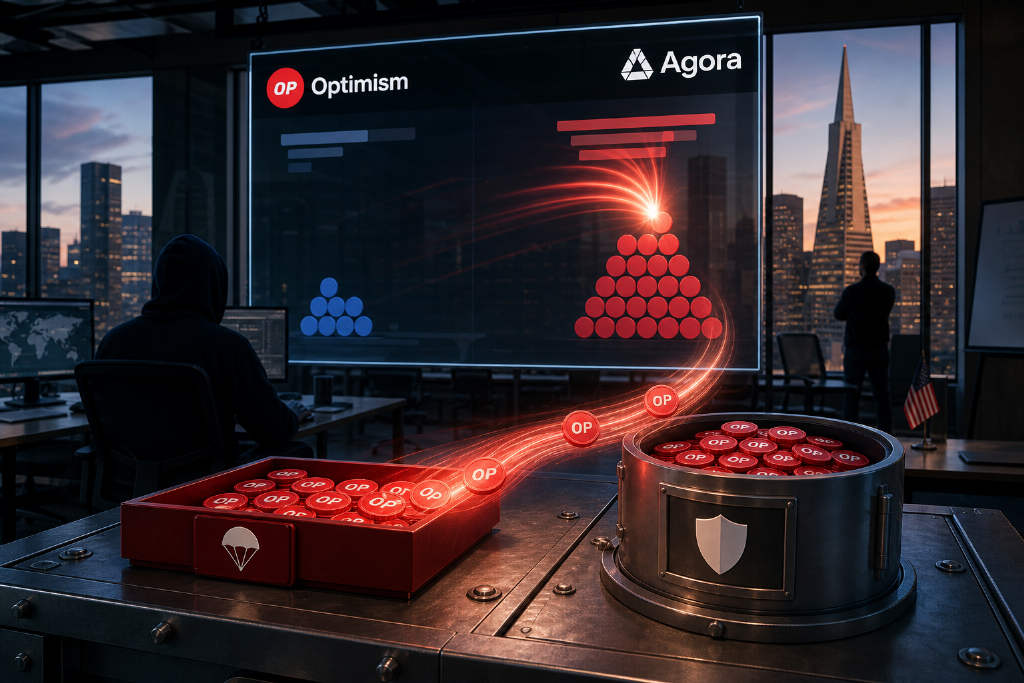
An Optimism governance proposal passed on Agora after a late vote changed the outcome just 16 minutes and 52 seconds before the deadline.
At that point, support stood at 45.77% and the measure was on track to fail. Then a vote worth 8.49 million OP came in, pushing approval to 61.84% and sending the proposal through.
The proposal moves 546.9 million OP from the project’s “user airdrop” allocation into a foundation-controlled “strategic ecosystem fund.” The article says that amount equals 12.7% of OP’s total supply and nearly 24% of circulating supply.
Test in Prod cast the vote that changed the result
The deciding vote came from Test in Prod. On Agora, the team describes itself as a core development team of the Optimism Collective.
In a 2025 Security Council nomination document, the team also wrote that it was “fully funded by the Collective.” In June this year, it secured a seat for a new 12-month term on the Security Council.
That left critics focused on a simple question: who gets to decide where these tokens go when the deciding voter is a core team funded by the same system that stands to control the reallocated tokens?
Why the foundation backed the reallocation
The foundation’s case is built around the declining impact of broad airdrops.
From 2022 to 2024, Optimism carried out five rounds of airdrops and distributed a total of 269.1 million OP to users. The article says academic analysis and on-chain data showed diminishing returns in user retention in the later rounds. Based on that, the foundation concluded that mass airdrops worked as an early customer acquisition tool, but no longer fit the project’s current stage of institutional expansion.
It now sees OP Enterprise as a strategic priority.
The article points to several examples: Bitpanda launched Vision Chain on Optimism; Dunamu, described as South Korea’s largest exchange, signed a memorandum of understanding for GIWA Chain; and Ether.fi brought $220 million in TVL and more than 70,000 active payment cards to OP Mainnet.
From the foundation’s perspective, winning enterprise clients requires a flexible token pool rather than leaving 547 million OP parked under an airdrop label that is no longer being used.
Test in Prod defended its vote in direct terms, saying enterprise bidding requires confidentiality, the window for competition can close quickly, and Optimism needs this “war chest.”
Critics say the mandate is too broad and the record is under-reviewed
Opposition came from several sides.
L2BEAT, an independent research group focused on Ethereum Layer 2, voted against the proposal. Its objections were explicit: the authority granted to the foundation is too broad, the connection between token deployment and OP holder interests is unclear, and the results of earlier partner spending have not gone through formal evaluation.
L2BEAT also argued that the system has already allocated 686 million OP to ecosystem funds across the Partner, Seed and Unallocated categories. Adding another 547 million OP to a newly defined fund with vague boundaries, it said, was not supported by enough evidence.
Independent researcher Polynya, who had long participated in Optimism governance and stepped down from a delegate role in 2025, returned for this vote. His criticism was sharper: handing nearly 24% of circulating supply to what he called a vague promise was irresponsible, especially when the foundation’s prior incentive spending had produced mixed results at best.
A community member using the name Luckyhooman.eth made a related point. Roughly 686 million OP has already been deployed under ecosystem fund categories, more than 2.5 times the total amount distributed to users through airdrops, while OP Mainnet still has not become a mainstream chain for everyday user activity. In that view, taking tokens out of the user airdrop bucket changes the original allocation promise before the user-side experiment was fully tested.
The core issue is not turnout, but independence
The article argues that this was not a case of the usual DAO problem of low turnout.
Participation was sufficient and quorum was met. The proposal passed because a voter with a specific institutional relationship altered the outcome at the end.
That opens a harder governance question. If a team’s funding source, compensation and future contract renewals all depend on foundation decisions, how independent is that team’s vote on a foundation budget measure?
The article compares that tension to a related-party transaction in traditional corporate governance, where interested parties are generally expected to abstain. In the DAO setting described here, no such rule currently exists.
Can a DAO vote rewrite an original allocation promise?
The dispute also reaches a deeper issue: whether DAO governance can revise a commitment made at the moment a token was launched.
According to the article, when OP was issued in 2022, Optimism stated that 19% of total supply would be allocated to user airdrops. That figure appeared in the tokenomics documentation, was recorded by major data platforms, and became part of the long-term expectation many users attached to participating in the ecosystem.
Renaming the remaining airdrop allocation as a foundation-controlled strategic fund may fit the formal logic of a system where governance can change parameters. What it puts at risk, the article says, is user trust in the project’s commitments.
Price collapse makes the transfer more sensitive
The article notes that OP has fallen from $4.85 in March 2024 to about $0.09 now, a drop of more than 98%.
At that price, 546.9 million OP is worth about $49.7 million, close to a quarter of OP’s market capitalization. For the foundation, that is capital that can be deployed immediately in enterprise bidding. For retail holders still holding OP, the move signals that an airdrop share they once expected has effectively been canceled.
The article closes on a broader irony: DAO governance was designed to replace closed-door boardroom decisions with on-chain voting, yet it is running into one of the oldest problems in governance all over again — who watches the watchers, and whether a majority can legitimately redefine the rights of a minority.
