Top developments
Fed pricing stays elevated ahead of ISM and payrolls
After Warsh’s Jackson Hole remarks, markets continued to price in roughly a 58% probability of a 25-basis-point rate hike in September. Two-year Treasury yields remained high, keeping pressure on growth stocks and precious metals.
This week’s attention shifts to the U.S. August ISM manufacturing PMI, expected at about 55.2, and Friday’s nonfarm payrolls report. Those releases are expected to test whether rate-hike pricing moves even higher.
Bitget UEX said the combination of the rate path and rising oil prices is reviving concerns about sticky inflation. If ISM and labor data soften, the probability of a September hike could still ease.
Oil jumps as Trump says strikes on Iran could expand
The report said U.S. forces struck two missile launchers on Larak Island over the weekend, saying Iran had been preparing to launch rockets carrying naval mines toward the Strait of Hormuz. Iran later said it had retaliated.
Trump said potential strikes could escalate and posted Khark Island-related footage on social media. Reuters, however, said Washington had not confirmed a strike on that oil export hub.
Brent crude rose back above $90, while WTI recovered toward $85, rebounding sharply from Friday’s lows. The note said shipping through the strait and the security of export facilities are back at the center of pricing, reinforcing the oil-inflation-rates loop and helping energy shares outperform.
Sanctions and strategic reserve talk move in parallel
The U.S. Treasury is still advancing secondary sanctions on Iran on a weekly-addition basis, with banks, shipping and digital-asset channels among the main targets.
Trump had previously said Venezuelan oil could be used to refill the strategic reserve, though the White House has not published verifiable details. Canada’s retaliatory tariffs are still scheduled to take effect on Sept. 8.
Bitget UEX said the policy tone remains hardline, but near-term oil pricing is still being driven mainly by battlefield developments. Trade and sanctions spillover could also affect expectations for dollar liquidity.
Market recap
Commodities and FX
- Spot gold: about $4,459 an ounce, +0.23%
- Spot silver: about $66.8 an ounce, +0.47%
- WTI crude: about $86.6 a barrel, +1.04%
- Brent crude: about $88.87 a barrel, +0.57%
- U.S. Dollar Index (DXY): about 99.4, -0.01%
The move was driven by renewed U.S.-Iran clashes and Trump’s comments about possible escalation, which brought Hormuz disruption risk back into crude pricing. Gold did not rally in the same way, suggesting that capital was trading the oil-inflation-rates sequence rather than simple safe-haven demand.
Institutional views cited in the note said commodities are likely to stay split in the short term: geopolitics supports oil, while a hawkish rate backdrop caps precious metals. If export facilities such as Khark Island are hit in a material way, oil volatility could rise sharply.
Crypto market
- BTC: about $78,750, +1.04%
- ETH: about $2,473, +1.9%
- Total crypto market cap: about $2.74 trillion, +2.1%
- 24-hour liquidations: $158 million, including $110 million in short liquidations
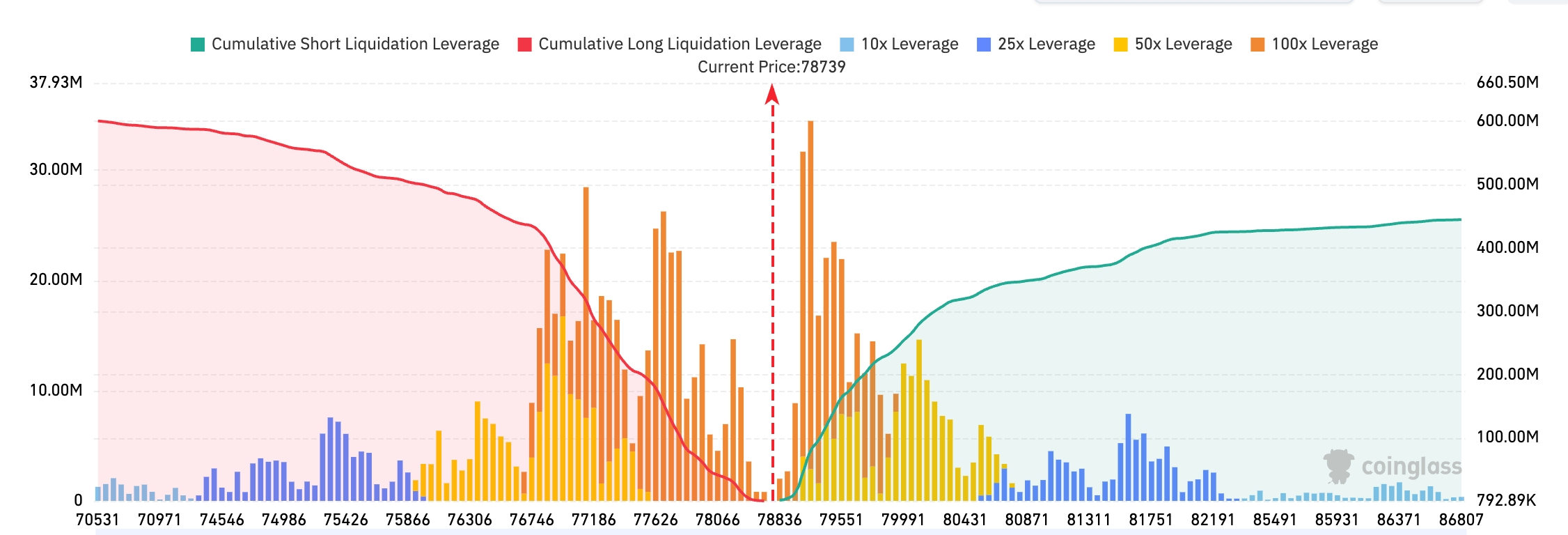
Bitget’s BTC/USDT liquidation map put spot BTC around $78,700, with a large cluster of short liquidations between $79,500 and $80,000. A break above $80,000 could trigger more short covering. On the downside, long liquidations are concentrated near $77,500 to $78,000. If BTC falls below $78,000, leveraged long positions could unwind faster, leaving near-term volatility high.
Spot ETF flows showed a net outflow of about $202 million on Aug. 28, ending a nine-day streak of inflows. Full Monday data had not yet been updated.
The note said falling U.S. equities, higher oil prices and elevated rate-hike odds are all weighing on risk assets, but Bitcoin has held up better than gold and equity indexes, still recording an August gain of about 23%. ETH lagged BTC, a sign that capital remains more focused on “hard assets” than higher-beta altcoins. The report said institutions still see geopolitics and rates as the two main short-term pricing forces, with $80,000 remaining the key line between bulls and bears.
U.S. equities
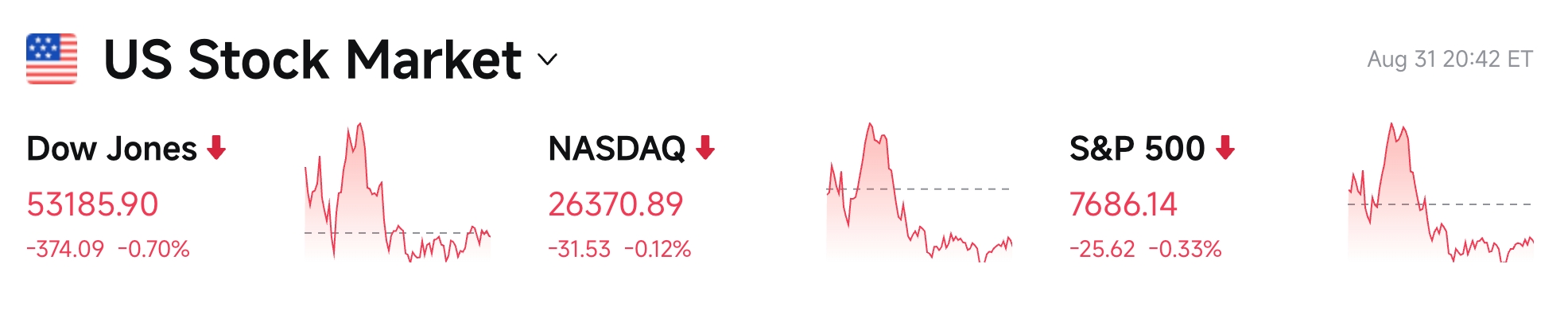
- Dow Jones Industrial Average: 53,196.54, down 0.68%
- S&P 500: about 7,677, down 0.45%
- Nasdaq: about 26,310, down about 0.35%
Energy shares and Tesla partly offset weakness in technology names. Even with Monday’s decline, all three indexes still ended August higher: the Dow was up about 1.4% for the month, the S&P 500 rose about 2.4%, and the Nasdaq added about 3.5%.
Large-cap tech moves
- NVIDIA (NVDA): $219.40, +0.85%
- Apple (AAPL): $315.40, -1.35%
- Microsoft (MSFT): $510.90, -0.51%
- Alphabet (GOOGL): $338.00, -2.48%
- Amazon (AMZN): $260.90, -2.08%
- Meta (META): $571.70, -1.09%
- Tesla (TSLA): $365.90, +4.91%
Monday’s session was broadly negative, but leadership was uneven. Alphabet was a major drag on the indexes, Amazon gave back part of Friday’s cloud-driven gain, and NVIDIA stabilized after the prior session’s sell-off, pointing to some easing in selling pressure. Tesla surged nearly 5% and was one of the main offsets inside the Nasdaq as investors leaned into its energy and grid-related story.
The broader setup remained the same: geopolitics and rates are weighing on growth valuations, while stock-specific performance depends on whether a company has its own catalyst.
Sector moves
Energy outperformed
Exxon Mobil rose about 2%, and major oil stocks broadly moved higher with crude. The driver was a larger supply-disruption premium tied to the Larak Island exchange and the prospect of broader strikes.
EV and energy technology stocks rose against the tape
Tesla led the move, gaining nearly 5%. The report linked that performance to a solar-and-grid-independence narrative, plus a rebound from oversold levels, as investors looked for exposure less directly tied to rate trades.
Big tech and internet stocks pulled back
Alphabet fell more than 2%, Amazon dropped more than 2%, and Apple lost more than 1%. Rising oil prices reinforced rate-hike pricing, leaving longer-duration growth stocks under pressure and prompting some profit-taking in cloud names after Friday’s move.
Single-stock focus
1. Tesla (TSLA): up nearly 5% against the market
Tesla rose about 4.9% on Monday to $365.90, making it one of the clearest offsets across the major indexes. Musk had previously said SpaceX and Tesla were accelerating efforts to build 100 gigawatts of annual solar capacity and were pushing in-house production of core gas-turbine components to shorten power deployment timelines.
The move was interpreted as a trade on energy independence and oversold recovery rather than a sudden shift in delivery fundamentals. With oil rising and grid constraints seen as a bottleneck for AI, Tesla’s power generation and storage story has been repriced. Analysts cited in the report also said margins and capacity execution still need to be proven.
The investment takeaway in the note was that Tesla can fit as a high-beta energy-technology position, but sizing should reflect its volatility.
2. Alphabet (GOOGL): a main drag on the indexes
Alphabet fell about 2.5% and was a notable negative contributor to both the S&P 500 and the Nasdaq. The stock had strengthened on Friday on cloud inference revenue-sharing logic, then slipped with broader risk appetite on Monday.
Institutions described the move as a broad repricing of rate-sensitive growth stocks rather than a challenge to the cloud thesis. Barclays’ view that model profits could flow toward cloud giants remains in discussion, but rising oil prices and firmer rate expectations hit richly valued internet names first.
The note said the medium-term case still rests on the resilience of cloud and advertising, while the short-term path is more closely tied to real rates.
3. NVIDIA (NVDA): stabilizes after a sharp drop
NVIDIA gained about 0.85% to close at $219.40, ending the giveback seen after Friday’s 4.57% decline. The company recently issued guidance calling for about 70% revenue growth in fiscal 2028.
The report said institutions see the move as a technical repair after crowded positioning had been reduced, rather than any change in the demand case. Rate-hike expectations are still limiting multiple expansion, and the next catalyst remains supply conditions and customer capital spending.
The stated takeaway was that the medium-term demand story remains intact, while chasing already-realized upside in the short term carries more risk.
4. Amazon (AMZN): gives back part of the cloud trade
Amazon fell about 2.1%, giving back part of Friday’s near-4% advance. Barclays’ view on AI inference profits flowing to AWS continued to circulate in the market.
Investors are still balancing the “cloud tollbooth” thesis against macro repricing. If higher oil prices continue to lift rate-hike odds, cloud names also face duration pressure, though their fundamentals provide more cushion than pure hardware companies.
The report said investors should focus more on AWS growth and capital-spending efficiency than on one-day theme-driven moves.
5. Exxon Mobil (XOM): a direct beneficiary of the oil rebound
Exxon Mobil rose about 2% as both WTI and Brent advanced. Markets returned to pricing risk around Hormuz and regional export infrastructure.
Institutions said integrated oil majors remain one of the clearest geopolitical hedges as long as the strait and Gulf export hubs face a real threat. Trump’s Venezuela reserve narrative is viewed as more medium term and not enough to offset short-term supply-disruption pricing.
The note said anyone using Exxon as oil-beta exposure should keep a close watch on shipping conditions and headlines related to Khark Island.
Market and project updates
- Bitcoin held near $78,000 during renewed U.S.-Iran clashes and gained about 23% in August, outperforming both gold and the Nasdaq.
- The U.S. expanded sanctions on Iranian digital-asset and shipping channels, raising compliance pressure, while the market also traded the idea that “weaponization of the dollar” could boost demand for hard assets.
- According to analysis cited from a16z crypto, about one in five people in Argentina use cryptocurrency, making it one of Latin America’s highest-adoption markets. Stablecoins, especially dollar stablecoins, first spread as an emergency response to capital controls and hyperinflation, but usage persisted even as economic pressure eased and gradually became habitual. In Argentine peso-denominated crypto trading, 94% flows into stablecoins, the highest share among major currencies tracked by Artemis. Even though Argentina’s monthly inflation rate has fallen from a peak of 25.5% to 2.1%, downloads of mainstream crypto wallets such as Lemon have kept rising, and stablecoin salary use has remained in place rather than disappearing. As of July 2026, the share of Argentine contractors receiving USDC and the inflation gauge had both dropped to roughly one-fifth of their respective peaks.
- Another institutional analysis in the report said Bitcoin has stayed above $77,100 despite tighter macro conditions. After Federal Reserve Chair Warsh’s hawkish Jackson Hole remarks last week, BTC fell from above $81,000, but August gains were driven mainly by spot buying rather than excessive leverage. Open interest increased gradually while basis stayed relatively contained. U.S. spot Bitcoin ETFs saw nearly $1 billion in net inflows last week, and Ethereum investment products posted 10 straight days of net inflows totaling $815.7 million. On the macro side, U.S. PCE inflation was 3.7%, core inflation was 3.3%, annualized private-demand growth in the second quarter was 4.2%, and the fiscal-year deficit for the first 10 months reached $1.8 trillion. Warsh said the 2% inflation target is a hard constraint, and markets lifted the probability of a September rate hike to 57%. Bitfinex said ETF flows and stablecoin liquidity continue to support prices, but higher rate expectations cap upside. If crypto inflows stay resilient, that would point to solid underlying demand.
Today’s market calendar
Data schedule
- 22:00: U.S. August ISM manufacturing PMI, expected at about 55.2
- Ongoing: Middle East developments, U.S.-Iran military activity, and shipping through the Strait of Hormuz
Upcoming events
Sept. 1 (Tuesday)
- U.S. final August S&P Global manufacturing PMI at 21:45 and ISM manufacturing PMI at 22:00
- G20 innovation and technology ministers’ meeting opens in Chapel Hill, North Carolina, running Sept. 1-2; Musk is scheduled to join by video, with Jensen Huang and Sam Altman also participating
- Medtronic (MDT) and NIO report before the open; Dell (DELL), MongoDB (MDB), Palo Alto (PANW), and Credo (CRDO) report after the close
Sept. 2 (Wednesday)
- U.S. August ADP employment data at about 20:15
- EIA crude inventories at 22:30
- Federal Reserve Beige Book at 14:00 Eastern, about 02:00 Beijing time on Sept. 3
- Broadcom (AVGO) reports after the close, with AI revenue and forward guidance as the core focus
- Hewlett Packard Enterprise (HPE), Snowflake (SNOW), and NetApp (NTAP) report after the close; FuelCell Energy (FCEL) reports before the open
Sept. 3 (Thursday)
- U.S. initial jobless claims at 20:30, final S&P Global services PMI at 21:45, and ISM non-manufacturing PMI at 22:00
- Federal Reserve Governor Christopher Waller speaks on the inflation outlook at 20:30 in a Reuters interview, a closely watched appearance ahead of the September policy meeting
- Tesla holds its Cybercab launch event in Austin, Texas
- Ciena reports before the open; DocuSign, Lululemon, and Zscaler report after the close
Sept. 4 (Friday)
- U.S. August nonfarm payrolls and unemployment rate at 20:30. The market expects payroll growth of about 45,000 to 55,000 and an unemployment rate of about 4.1%. July’s prior reading was -23,000, and consensus may still shift.
- U.S. August global supply chain pressure index at 22:00
- Markets will also watch comments this week from Cleveland Fed President Beth Hammack and other voting officials
The report said this week’s core themes for U.S. equities are August payrolls and September Fed hike expectations, Waller’s inflation remarks, AI capex earnings from Broadcom and Dell, the G20 technology gathering, and Tesla’s Cybercab event. Volatility is expected to increase.
Institutional view
Investment bank analysts cited in the note said Monday’s trading sequence remained “expectations of escalating strikes → higher oil prices → stickier inflation → elevated rate-hike odds.” U.S. stocks fell on the day but still finished August higher, which they said suggests the move was more a repricing of risk premium than a trend reversal. Bitcoin’s relative resilience showed that some capital still treats it as a macro hedge. Energy shares and Tesla offered structural offsets, while large internet names remained more sensitive to real rates.
The report’s strategy conclusion was to watch Hormuz headlines and incoming ISM and payrolls data closely, stay flexible on richly valued growth stocks, and retain hedges in energy and hard assets.
Disclaimer: The above content was compiled through AI-assisted search and manually checked for publication. It does not constitute investment advice. Market data in the report may contain deviations and should be checked against live market prices.
[Disclaimer] Markets carry risk and investing requires caution. This article does not constitute investment advice. Readers should assess whether any opinion, view or conclusion in this article fits their own situation. Any investment decision made on that basis is at the reader’s own risk.