Selected headline developments
U.S. inflation: September PPI rose 1.3% month over month
The U.S. Bureau of Labor Statistics said on Oct. 15 that final-demand producer prices in September increased 1.3% from the previous month and 6.3% from a year earlier. The measure excluding food, energy, and trade services rose 0.5% month over month and 5.0% year over year. Price pressure showed up in both goods and services.
In the report’s reading, higher producer prices increase the pressure on companies either to absorb costs or pass them through downstream. That also makes it harder to treat a single-day bond rally as evidence that policy is turning easier. What matters next is how much of that cost pressure reaches consumers and whether corporate margins can hold.
U.S. consumption: retail sales rose 0.8% in September
The U.S. Census Bureau reported that retail and food services sales totaled about $745 billion in September, up 0.8% from August and 6.3% from a year earlier. The figure is not adjusted for prices, so it cannot be read directly as growth in real consumption volume.
Rising sales values support corporate revenue, but the policy picture remains complicated when that strength sits alongside firm inflation. The next check is whether the increase came from underlying demand or from higher prices, using retailer volumes, discounting, and earnings guidance as reference points.
Energy: U.S. crude inventories fell as WTI and Brent diverged
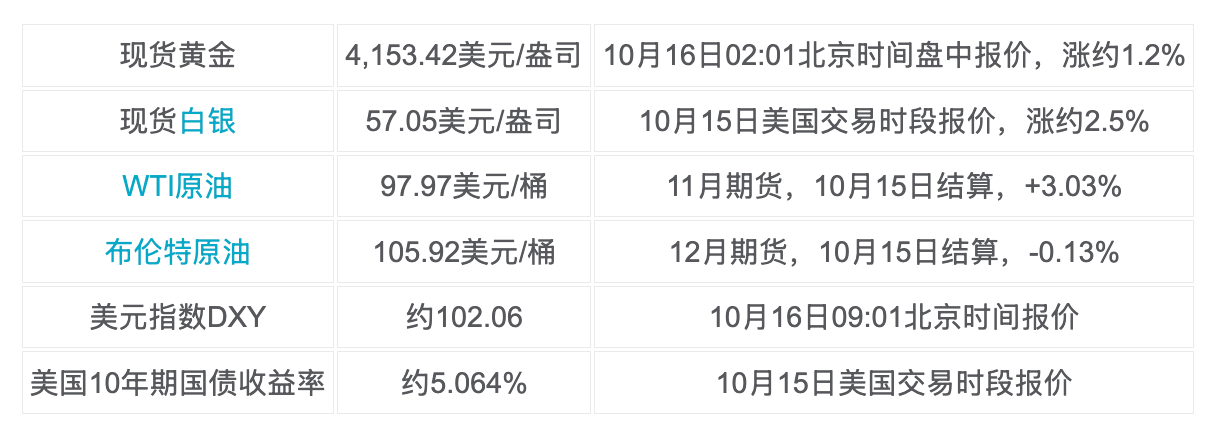
U.S. commercial crude inventories fell by 8.6 million barrels in the week ended Oct. 9. On Oct. 15, November WTI settled up 3.03% at $97.97 a barrel, while December Brent settled down 0.13% at $105.92 a barrel.
The inventory draw supported U.S. crude, but global shipping capacity, Gulf transport risk, and expectations around supply recovery affected regional pricing in different ways. The report said the key questions are whether inventory declines continue and whether transport costs keep driving regional spreads.
Market review
Commodities and foreign exchange
Gold and silver recovered while U.S. Treasury yields moved lower, even as inflation data stayed strong. For cross-asset trading, the report said the main task is to distinguish between a short-term price repair and a sustained downtrend in rates. In oil, inventories, shipping, and regional supply-demand conditions need to be tracked separately.
Crypto performance
BTC traded around 82,326.50 USDT, up 0.73% over 24 hours. ETH traded around 2,438.68 USDT, up 0.85% over the same period. Total crypto market capitalization stood near $2.78 trillion, down 2.01% in 24 hours. That market-cap figure was updated at 09:11 Beijing time on Oct. 16.
BTC liquidation zones
The more visible potential short liquidation cluster above spot was around $83,000 to $83,400, or about 0.92% to 1.40% away. The potential long liquidation cluster below spot was around $81,300 to $81,800, or about 0.54% to 1.15% away. Price was closer to the lower band, and the note said a move into that area would warrant attention to volatility tied to long leverage reduction.
ETH liquidation zones
The more visible potential short liquidation cluster above spot was around $2,465 to $2,490, about 1.18% to 2.20% away. The potential long liquidation cluster below spot was around $2,380 to $2,425, about 0.47% to 2.31% away. The nearer downside band was closer to current price. A drop toward $2,425 could bring potential long liquidation pressure into focus, while a push toward $2,465 would put short covering on watch.
Institutional cost basis: BTC
A Glassnode report dated Oct. 14 estimated the aggregate cost basis for U.S. spot BTC ETFs at about $81,500. That put BTC roughly 0.92% above the reference level. Strategy said on Oct. 12 that it held 848,250 BTC as of Oct. 11, with an overall average cost of about $75,444 including fees. At current prices, BTC was about 9.02% above that cost basis. The report treated both figures as reference spreads between market price and holder cost.
Its one-line market view was direct: BTC’s lower potential liquidation band at $81,300 to $81,800 overlaps with the ETF cost reference near $81,500. If price falls back into that area, both leverage reduction and narrowing paper gains should be monitored together. On the upside, attention was on $83,000 to $83,400. For ETH, the report pointed first to market reactions near $2,425 and $2,465.
Major U.S. equity indexes
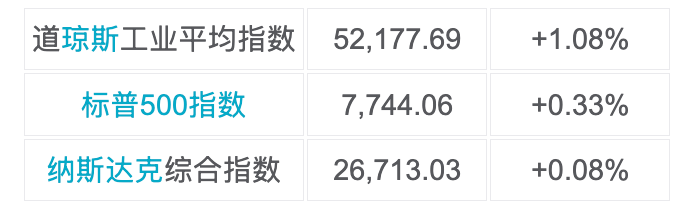
The three major U.S. indexes all closed higher, with the Dow clearly leading and the Nasdaq ending close to flat. The broader rebound in indexes came alongside continued weakness in part of the tech complex, showing that the recovery remained uneven.
The Magnificent Seven
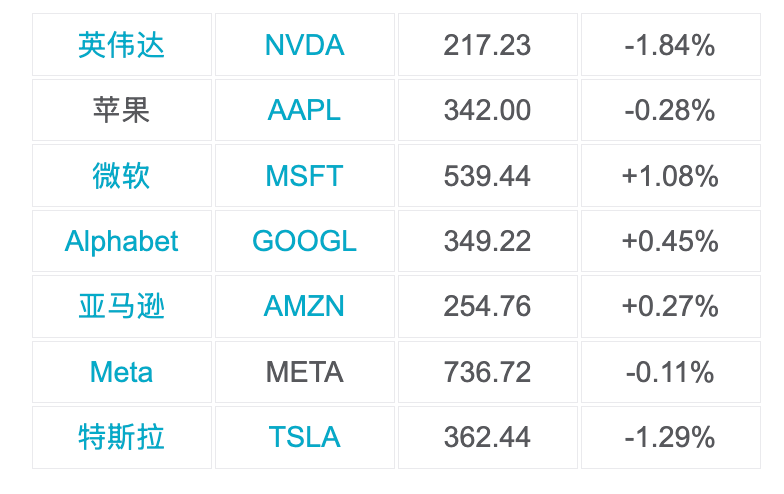
Among the seven largest tech names, three rose and four fell. Microsoft led gainers, while Nvidia and Tesla posted relatively larger declines. The report said large-cap tech has not yet moved into a uniform rebound, so earnings delivery and returns on capital spending still need to be assessed company by company.
Sector moves
Healthcare: Eli Lilly rose 3.55% and UnitedHealth gained 2.79%, while Deutsche Bank raised ratings on both companies. Their performance stood apart from weaker action in parts of tech, and the next question is whether guidance can keep supporting the group.
Semiconductors: TSMC ADR fell 1.80% and Nvidia fell 1.84%. TSMC’s profit growth and share-price weakness happened on the same day, which the report said is a reminder that earnings, expectations, and valuation all matter when reading the sector. One earnings release alone is not enough to infer the trading direction of the whole supply chain.
Commercial space: Rocket Lab fell 6.64%. After Neutron’s first launch was delayed to 2027, the market turned back to the pace of technical validation and the timing of revenue realization.
Deep dives on key U.S. stocks
TSMC (TSM): strong profit growth, restrained stock reaction
TSMC said on Oct. 15 that third-quarter revenue in U.S. dollar terms reached $46.72 billion, up 41.2% year over year. Net profit came in at NT$763.06 billion, up 68.7%, and gross margin was 66.4%. The company guided fourth-quarter revenue to $52.3 billion to $54.3 billion. Its ADR closed at $422.25 on the day, down 1.80%.
The report said the earnings release and guidance provided concrete evidence of demand in chip manufacturing, but strong operating growth and weak price action still diverged. How much growth the market had already priced in, and whether profit delivery can continue, remain central for the stock. The key checks from here are whether fourth-quarter revenue lands inside guidance, how advanced-node demand develops, and whether the high gross margin can be sustained.
Charles Schwab (SCHW): client asset growth meets post-earnings valuation scrutiny
Charles Schwab reported on Oct. 15 that third-quarter revenue was about $7.2 billion, up 17% year over year, while adjusted earnings per share reached $1.69. Core net new client assets were $190.4 billion in the quarter, up 38% year over year, and total client assets were about $13.33 trillion. The stock closed at $94.16, down 2.73%.
Growth in new assets expands the base for future fee and interest income, but asset allocation choices by clients, deposit costs, and yield shifts still affect how efficiently that growth turns into profit. The report noted that earnings growth and a same-day share decline can occur together and should not automatically be read as operating deterioration. What to watch next includes retention of new assets, client cash allocation, net interest income, and whether balance growth converts into sustained EPS growth.
Rocket Lab (RKLB): Neutron delay puts the timing of delivery in focus
In an investor update on Oct. 14, Rocket Lab said Neutron’s first launch will be delayed until 2027 and did not provide a new specific launch date. Manufacturing process revisions and follow-up testing still need to progress. On Oct. 15, the stock closed at $55.25, down 6.64%.

The delay extends the validation cycle and the revenue realization timeline for the medium-lift rocket business. Demand from orders still has to be converted into revenue through reliable launch capability, and a changed timetable also affects how the market assesses cash burn. The report pointed to first-stage structural testing, progress on full-system testing, and a new launch schedule as the main markers ahead, along with whether existing business cash flow and funding reserves can cover the development cycle.
Market and project updates
Ripple Prime launched institutional RWA perpetual swaps. A notice dated Oct. 15 said the product covers more than 100 reference markets across equities, indexes, ETFs, metals, energy, and foreign exchange, with around-the-clock trading and settlement. The contracts reference Trade.xyz perpetual futures on Hyperliquid and can use RLUSD as collateral, with availability varying by jurisdiction.
Starknet began a non-binding vote on a possible independent L1 direction. The vote, launched on Oct. 15 and running for seven days, is meant to assess whether further research should be done on an independent quantum-resistant L1 path. A positive outcome would start research and follow-up proposals, but it would not amount to approval for migration. The proposal explicitly says STRK would continue to be used and no new token would be added.
Network School acquired Farcaster. On Oct. 15, Neynar co-founder Rish said the Farcaster app, protocol codebase, and related products would be transferred to Network School, and most team members would continue contributing to development. The next issues to watch are changes in the operating model and retention among developers and users.
DeFi Development raised the dividend rate on CHAD. The company said on Oct. 15 that the annual dividend rate on preferred stock CHAD would increase from 13% to 14%, effective Nov. 2. Based on the $10 stated amount per share, annual dividends rise from $1.30 to $1.40, subject to board declaration. Proceeds from future issuance are intended to expand its SOL treasury, making the fit between financing cost and treasury return a point to track.
Canaan updated the market on mining operations and heat-reuse progress. On Oct. 15, the company said it produced 44 BTC in September and held 1,875 BTC at month-end. Its 8MW district heating project in Northern Europe is now fully operational, using computing waste heat to serve about 2,800 households. The update offered fresh data points on both BTC holdings and energy-use efficiency.
Today’s market calendar
Looking ahead, import and export price data may add to the picture on external cost pressure, while industrial production can offer a signal on the supply side of the real economy. If price pressure continues to build and output remains resilient, expectations for policy easing may face limits. If output weakens, earnings-growth expectations may need to be reassessed.
On the institutional side, Argent Capital Management portfolio manager Jed Ellerbroek said on Oct. 15 that higher financing costs affect housing and data-center construction, while defensive and non-cyclical businesses are drawing attention. The comment suggests that AI investment analysis should also examine funding costs and the ability to recover cash.
This article is for market information reference only and does not constitute investment advice.
Disclaimer: Markets carry risk, and investing requires caution. This article does not constitute investment advice. Readers should consider whether any opinion, view, or conclusion in the article fits their own circumstances. Any investment decision made on that basis is at the reader’s own responsibility.