

BitMEX has announced that it will close its exchange and stop new account registrations. Under the timetable published by the company, the platform will enter reduce-only mode on Aug. 26, 2026, begin handling open positions, and complete its shutdown on Sept. 23.

The company also said that, based on its published proof of reserves and liabilities, assets exceed customer liabilities. It added that it had not lost customer funds to hacks during more than 11 years of operation. Those statements are BitMEX’s own description of its financial and security position.
Arthur Hayes later posted a farewell message, thanking his partners, BitMEX employees, and customers. He wrote: “It was one hell of a ride, and together we built something special. I am immensely proud of what we created and that we can shut down responsibly on our own terms. Fuck TradFi, fuck banks, fuck the powers that be. Long live Satoshi!”
The contrast is hard to miss. The crypto perpetual contract that BitMEX helped bring into the center of the market is not leaving with it. Less than two months before the exchange announced its closure, the U.S. Commodity Futures Trading Commission approved bitcoin perpetual futures for a regulated U.S. market. The product moved into the mainstream. The platform that defined it is now being written into history.
How BitMEX started
Arthur Hayes graduated from the Wharton School in 2008 and moved to Hong Kong, where he worked in equity derivatives trading at Deutsche Bank and Citigroup. That same year, the global financial crisis hit. Banks cut staff and reduced risk. Hayes, who was drawn to the speed, competition, and money flows of trading floors, was laid off by Citi in 2013. Around that time, he turned his attention to bitcoin.
The bitcoin market was still primitive then. Exchanges went offline frequently, price gaps between regions were large, and most activity was concentrated in spot trading. Traditional finance already had futures, options, and established hedging tools. Crypto did not. Hayes saw a gap where others saw disorder.
In 2014, he founded Bitcoin Mercantile Exchange, or BitMEX, with Ben Delo and Samuel Reed. Hayes understood trading and market structure, Delo specialized in trading systems, and Reed knew bitcoin technology. The three did not set out to build another spot venue. They wanted to bring leveraged trading and institutional-style derivatives to crypto traders globally.
BitMEX officially launched on Nov. 24, 2014.

The product that changed its trajectory
The product that altered BitMEX’s fate arrived in 2016. Traditional futures expire. Traders have to close positions or roll them forward. Bitcoin trades around the clock, seven days a week, so BitMEX asked a simple question: why should its main derivatives contract stop every few months?
Its answer was the XBTUSD perpetual swap.
The contract behaved like a futures product but had no fixed expiry date. To keep the contract price from drifting too far away from spot bitcoin, longs and shorts exchanged funding at regular intervals. When the contract traded above spot, longs would typically pay shorts. When it traded below spot, the flow reversed.
The theoretical idea of perpetual futures existed before BitMEX, but in May 2016 the exchange was the first to turn it into a mainstream crypto market product and push leverage to 100x. In a market that never shuts, BitMEX created a contract that never expires.
Hayes later said the initial rollout was rough. The first funding-rate model depended on external U.S. dollar and bitcoin lending rates, and it could not absorb one-way long demand during bull markets fast enough. The contract price stayed above spot, user complaints piled up, and some inside the company argued the product should be scrapped. The team then switched to a premium-index method based on the price difference over the past eight hours, which gradually brought the perpetual swap back toward spot.
Once the product worked as intended, exchange network effects took over. More traders meant deeper books. Deeper books attracted larger orders. Larger volume brought in more market makers and more users. The 100x leverage model added the most dangerous, and most tempting, fuel to that loop.
In theory, a trader needed only $1 of margin to control a $100 position. If price moved 1% in the right direction, capital could double quickly. If it moved against the position by less than 1% in magnitude, liquidation could follow.
Perpetuals were not only a tool for amplifying risk. Spot holders could hedge short-term price exposure. Market makers could hedge inventory. Arbitrage traders could work the basis among spot, perpetual prices, and funding. But because funding costs change constantly, perpetuals do not fit every hedging use case. If a trader needs to lock in a price for a specific future date, a dated futures contract is often more direct.

BitMEX compressed the distance between outsized gains and a total wipeout into a single candlestick.
Peak years
By 2017, BitMEX had become large enough to show up in the broader financial press. Bloomberg, citing BitMEX data at the time, reported that the company generated about $83 million in revenue in 2017. In the 12 months through the end of January 2018, the platform processed more than $200 billion in notional order value.
In 2018, BitMEX leased the entire 45th floor of Hong Kong’s Cheung Kong Center for HK$4.52 million a month. Only months earlier, it had been working from a sparse office in a logistics and warehousing district across Victoria Harbour. Bloomberg reported that the old office rented for about HK$25 per square foot per month. After the move, BitMEX’s office space expanded to roughly 20,000 square feet, with rent hitting HK$225 per square foot, a record for Hong Kong office leasing at the time.
Hayes had once been a trader laid off by Citi. Now the crypto company he led was moving into the same tower as Goldman Sachs, Barclays, and Bank of America. That was as close to the summit as BitMEX would get.
In November 2018, the platform’s daily trading volume at one point approached 2 million bitcoin. In May 2019, daily turnover reached $11 billion. On June 27, 2019, BitMEX set another record: XBTUSD open interest exceeded $1 billion, daily turnover on that contract passed $13 billion, and daily turnover across all products topped $16 billion.
Days later, Hayes publicly debated bitcoin with Nouriel Roubini in Taipei. In the crypto industry, the event was treated as a faceoff between traditional finance and crypto finance. At that moment, Hayes had enough momentum to mock the banking system. Wall Street depended on business hours, identity checks, and layers of intermediaries. BitMEX let users around the world trade bitcoin with high leverage at any time.
Fast growth turned into a regulatory bill
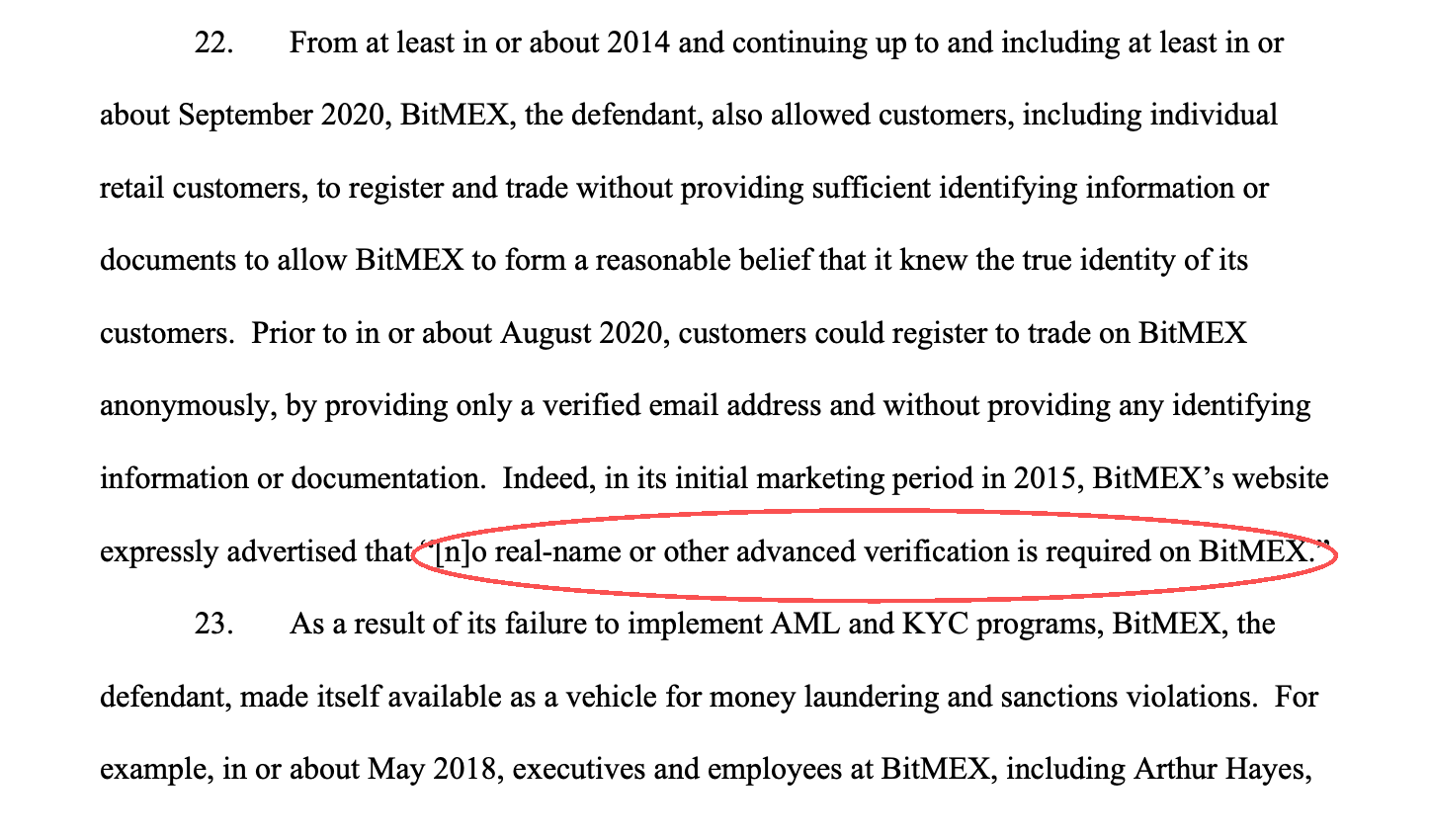
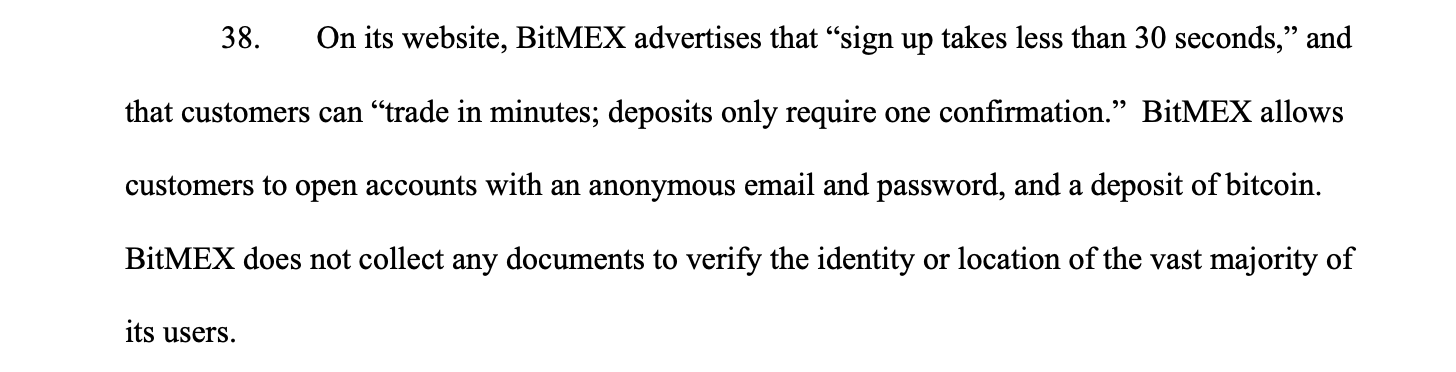
BitMEX’s early growth came from more than perpetuals. It also came from removing most of the friction around opening an account. Criminal filings later submitted by the U.S. Department of Justice said BitMEX’s website had stated on a 2015 promotional page that users did not need to provide a real name or complete advanced identity verification. Until August 2020, individual users generally needed only to verify an email address. They did not have to submit a name, identification documents, or proof of address before depositing and trading.
That model fit the crypto market of the time. A traditional financial account might take days to review. BitMEX compressed registration, bitcoin deposits, and the opening of leveraged positions into a much shorter process. Traders saw speed and freedom. The platform got growth. Questions about who sat behind an account, or whether a user came from a restricted jurisdiction, were pushed down the road.
It was a shortcut. It was also a deferred regulatory liability.
BitMEX later added formal verification requirements. In August 2020, the company announced a user verification program. From Sept. 15 that year, new users had to complete verification before depositing or trading. By Dec. 4, all users had to complete verification in order to deposit, trade, or withdraw.
But regulators moved before the process was complete. On Oct. 1, 2020, the CFTC filed a civil action against five companies operating BitMEX and against Arthur Hayes, Ben Delo, and Samuel Reed. A later consent order found that from at least November 2014 through Oct. 1, 2020, BitMEX offered leveraged crypto derivatives to traders, including U.S. customers, without the required registration and without compliant customer identification, KYC, and anti-money laundering controls.
On Aug. 10, 2021, the U.S. District Court for the Southern District of New York approved a consent order imposing a $100 million civil monetary penalty on the relevant BitMEX entities. That penalty was coordinated with an enforcement action announced the same day by the Financial Crimes Enforcement Network, or FinCEN. According to FinCEN, the combined resolution required BitMEX to pay $80 million immediately, while another $20 million was suspended subject to transaction review and compliance remediation.
In February 2022, Hayes and Delo admitted they had failed to establish and maintain an effective anti-money laundering program and each agreed to pay a $10 million criminal fine. In May that year, the CFTC ordered Arthur Hayes, Benjamin Delo, and Samuel Reed each to pay a $10 million civil monetary penalty. Hayes was later sentenced to two years of probation, including six months of home confinement.
On July 10, 2024, BitMEX operating entity HDR Global Trading Limited pleaded guilty to violating the Bank Secrecy Act, admitting that it willfully failed to establish, implement, and maintain an adequate anti-money laundering program. In January 2025, the company was sentenced to a $100 million criminal fine and placed under judicial supervision for the following two years. That criminal sentence was separate from the 2021 civil settlement.
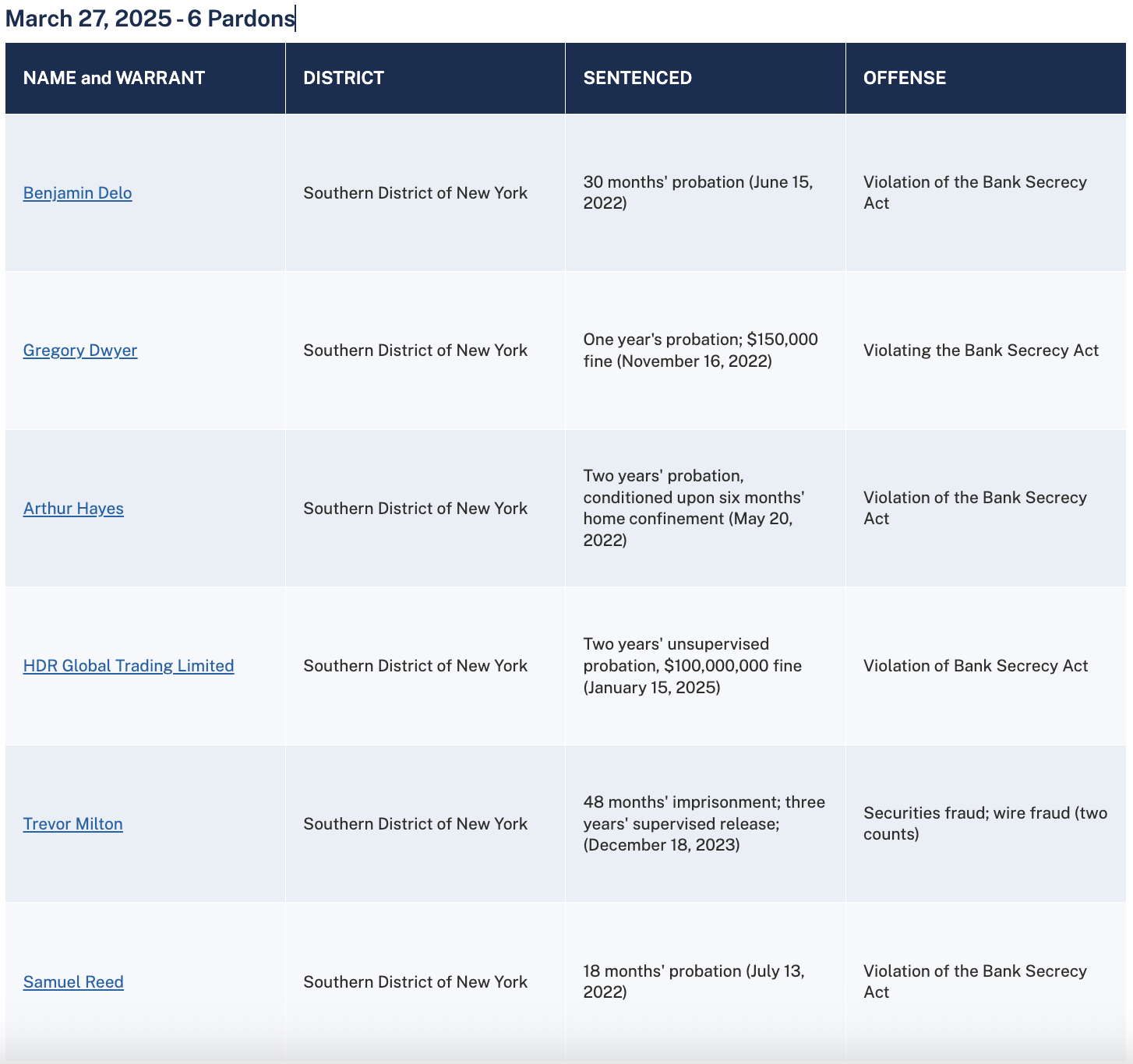
Its legal position shifted again in March 2025, when U.S. President Donald Trump granted pardons to HDR Global Trading Limited and to Arthur Hayes, Benjamin Delo, Samuel Reed, and Gregory Dwyer.
The pardons ended the continuing criminal consequences tied to those convictions, but they did not erase earlier penalties. Fines and settlement payments that had already been made were not automatically returned, and the civil penalties imposed by the CFTC and FinCEN were not wiped away by presidential pardon.
Between the 2020 case and the 2025 pardon, BitMEX went through founder exits from management, higher compliance costs, brand damage, and market-share losses. The legal situation changed. The competitive window did not reopen.
Everyone learned the BitMEX model
As BitMEX paid down its regulatory costs, another shift took hold: other exchanges learned how to do what BitMEX had done first. Perpetuals did not have lasting technical exclusivity. Once the market had validated funding mechanics, mark prices, and liquidation design, rivals could launch similar products and use their own spot user bases, token listings, and capital channels to compete for liquidity.
Binance launched futures in September 2019. By December of that year, according to a CryptoCompare report, monthly bitcoin perpetual trading volume on Binance had reached $29.4 billion. BitMEX still led with $53.1 billion on its comparable product, but the gap had already narrowed sharply.
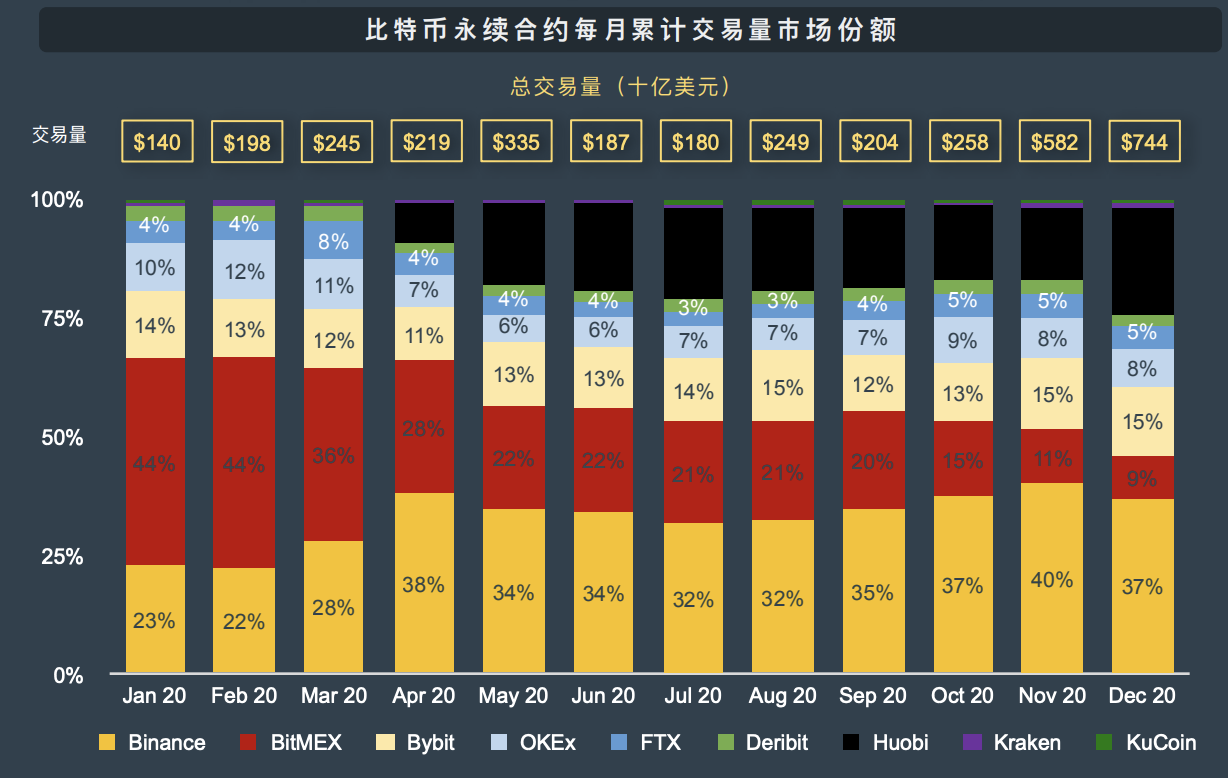
By 2020, the market had delivered a clearer answer. CoinGecko data showed that annual bitcoin perpetual trading volume across the top nine platforms reached $3.5 trillion, up 531% year over year. Within that sample, BitMEX’s share fell from 44% in January to 9% in December. Binance replaced it as the market leader, holding between 30% and 40% share, while Huobi, which pushed harder into perpetuals in 2020, reached 22% by year-end.
An asymmetry had emerged. Perpetual futures became the industry standard, so the edge created by BitMEX’s innovation faded. The compliance costs created by its early low-friction expansion remained on BitMEX’s own balance sheet. Rivals copied the product. BitMEX kept the bill.
A strategic reset that never fully worked
After the U.S. Department of Justice and the CFTC filed actions against BitMEX and its executives in October 2020, the founders stepped back. On Oct. 8, one week after the filings, Arthur Hayes and Samuel Reed stepped down as CEO and CTO, and Ben Delo left the executive management team of parent company 100x Group. From that point, the three founders no longer ran BitMEX day to day.
The exchange did not collapse immediately. New management tried to rebuild it through compliance and expansion. In April 2021, BitMEX introduced a “Beyond Derivatives” strategy, aiming to expand from a single derivatives venue into five business lines: spot, brokerage, custody, information products, and Academy.
BitMEX then launched spot trading in May 2022 and opened trading in its BMEX platform token in November that year. At one point it also planned to acquire Germany’s Bankhaus von der Heydt, a private bank with nearly 270 years of history, in hopes of creating a regulated crypto finance entry point in Europe. According to Finanz-Szene, that acquisition did not go through.
The broader exchange war proved tougher than the specialist derivatives market. Platforms had to compete for listings, market makers, user acquisition channels, and global licenses, while continuing to subsidize trading and growth. BitMEX went through several rounds of layoffs in 2022, then abandoned the Beyond Derivatives strategy and shifted its focus back to derivatives.
It ended up tracing a circle. It tried to move beyond derivatives because derivatives alone were no longer enough. It retreated back to derivatives because becoming a full-service exchange was harder still.
By the time BitMEX returned to its core, the derivatives market was crowded with rivals using the perpetual model it had validated, while also bringing more spot users, broader asset offerings, and deeper liquidity.
The return to derivatives did not stabilize the business. More than two years later, the market heard that BitMEX was seeking a sale. CoinDesk reported in February 2025 that BitMEX had hired investment bank Broadhaven Capital Partners near the end of 2024 to find a buyer.
During the same period, in May 2025, crypto options venue Deribit agreed to be acquired by Coinbase for about $2.9 billion, with the transaction completed in August. Deribit, backed by options liquidity that was hard to replicate, became a meaningful piece for a larger regulated exchange. BitMEX did not disclose that it had found a buyer.
At the end of June 2026, CoinDesk reported that BitMEX CEO Stephan Lutz had resigned and that the company’s CFO and head of growth had also departed. Less than a month later, BitMEX said it would shut down.
Arthur Hayes took a different path
While BitMEX remained stuck in an older market cycle, Hayes moved elsewhere. After stepping down as CEO in October 2020, he gradually shifted from exchange operator to macro writer and investor. Through long-form essays, he continued to track the direction of capital, writing about Federal Reserve liquidity, yen carry trades, bitcoin, stablecoins, and altcoin cycles.
At the same time, he brought his family office, Maelstrom, into view. Its investment scope spans early-stage equity, tokens, secondary markets, and private equity. In 2025, Maelstrom planned to raise at least $250 million for a new private equity fund focused on acquiring mid-sized crypto infrastructure and services companies.
Hayes once built trading infrastructure and designed market mechanisms himself. Now he looks more like a capital allocator searching for projects that might shape the next market cycle. The underlying question has not changed: where capital is going, and what infrastructure can absorb the next wave.
When BitMEX, in its closure notice, again stressed that it pioneered the 100x leveraged perpetual contract, the divergence was already clear. One side was still looking for how the next market would be built. The other could only use the invention that defined the last cycle to close its own history.
The market opened just as BitMEX reached its end date
In May 2026, the CFTC took what the article described as a historic step by opening a path for crypto-asset perpetual contracts and approving BTCPERP for listing on KalshiEX the same day. CFTC Chair Michael Selig said the U.S. would continue to lead this new field of crypto-asset perpetual contracts.
Before that, the U.S. had not provided a clear and workable regulated path for crypto perpetuals. Demand therefore moved to offshore venues, and so did liquidity and risk.
That policy change gave BitMEX an unusually ironic ending. Its decline is hard to reduce to one mistake. Regulatory liabilities interrupted its growth cycle. Rivals copied the product and used stronger distribution and ecosystems to take users. The company moved back and forth between becoming broader and returning to derivatives, but never created a second XBTUSD.
BitMEX did not misread the future. It just got the future right once.
For an exchange known for leverage, the final act was an orderly reduction of its own position.