
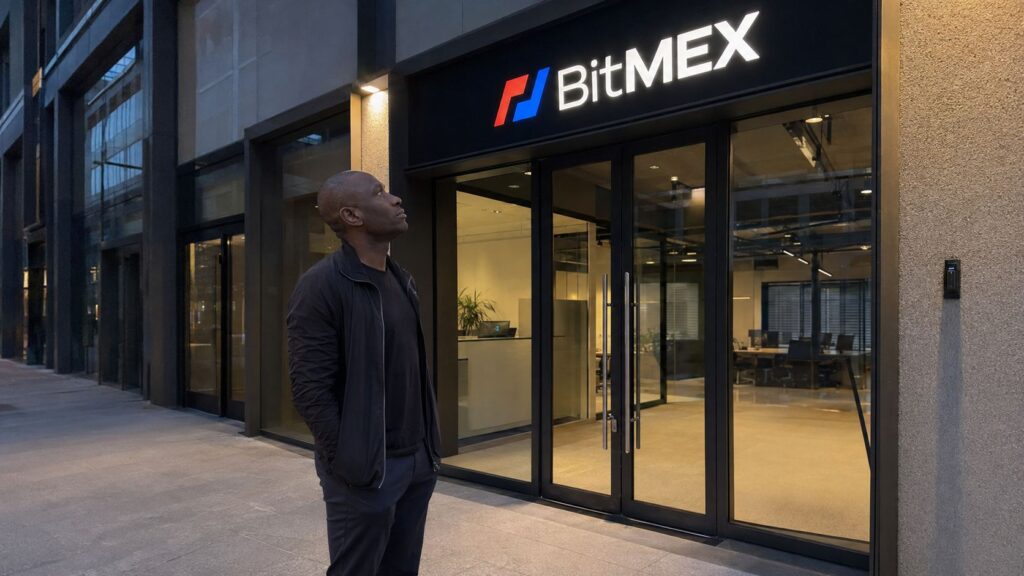
BitMEX will shut down its front-end servers on Sept. 23, 2026, bringing an end to 11 years of operations. The exchange said the move followed a strategic review by its parent company, HDR Global Trading, and said the decision was not driven by a hack or insolvency. According to the company, assets still exceed liabilities.
The closure marks the end of a venue that helped shape modern crypto derivatives trading. BitMEX introduced perpetual swaps and 100x leverage, and by the time of its planned shutdown, exchanges such as Binance, Bybit, and OKX were still built around the same core contract format that BitMEX popularized.
Founded in 2014 by Hayes, Delo, and Reed
BitMEX, short for Bitcoin Mercantile Exchange, was founded in 2014 by Arthur Hayes, Ben Delo, and Samuel Reed. The report said the three started the company without major outside funding or backing from Wall Street.
Hayes had worked as a bank trader at Deutsche Bank and Citigroup, handling equity derivatives in Hong Kong before layoffs following the global financial crisis pushed him out of traditional finance. Delo, a mathematician from Oxford, built software capable of handling high-frequency trading. Reed, an engineer, was responsible for assembling the trading system itself.
Each founder filled a distinct role: market experience, mathematics, and engineering. Hayes saw a gap in the bitcoin market at the time. Spot trading existed, but tools for leverage, hedging, and shorting were limited. Traditional brokers stayed away from crypto, and the crypto sector had not yet developed a mature derivatives toolkit.
Perpetual swaps and 100x leverage became BitMEX’s signature
BitMEX answered that gap with the perpetual swap, a contract with no expiry date. It used a funding rate settled every eight hours to keep the contract price close to spot. The exchange launched the product as XBTUSD, offered 100x leverage, and settled it entirely in bitcoin.
As the report put it, that meant a trader could use $1 worth of bitcoin to take a $100 position. Demand came quickly. BitMEX recorded $50 million in trading volume on its first day, and cumulative volume topped $1 billion in its first year.
By 2018, BitMEX had become the largest crypto derivatives exchange in the world by trading volume. Its perpetual swap model became the template for the broader industry. Binance Futures, Bybit, and later FTX all built flagship products around a structure that closely resembled BitMEX’s design. What began as one exchange’s experiment turned into the dominant contract type in crypto markets.
The original report compared that influence to Netscape in the history of technology: a company that defined a core product category without necessarily remaining the long-term winner. In that framing, the group that writes the rules is not always the one that keeps the seat at the table.
A 2019 public debate was followed by U.S. charges in 2020
In July 2019, Hayes appeared in Taipei at the Asia Blockchain Summit for a public debate with economist Nouriel Roubini, who is often referred to as “Dr. Doom.” According to the report, the exchange reflected a broader clash between a traditional Keynesian view and a strongly pro-crypto position.
Hayes argued that cryptocurrencies could move assets further from government and large corporate surveillance and give people greater financial autonomy. Roubini sharply criticized crypto as “Shitcoin” and attacked BitMEX as disorderly and underregulated, saying its high-leverage model was fundamentally corrupt.
The major legal turning point arrived in October 2020. The U.S. Department of Justice and the Commodity Futures Trading Commission charged the three BitMEX founders, along with Gregory Dwyer, the company’s head of business development and first employee. The central allegation was that BitMEX violated the Bank Secrecy Act by failing to maintain adequate anti-money laundering controls and customer identity checks.
The report said that, at the time, BitMEX allowed users to take 100x leveraged positions with little scrutiny of who they were.
Hayes stepped down, surrendered, and later pleaded guilty
After the charges were filed, Hayes stepped down as chief executive. The legal process then unfolded over the next two years.
- In 2021, Hayes surrendered to U.S. authorities in Hawaii and was released on a $10 million bond.
- In 2022, he pleaded guilty and was sentenced to six months of home confinement, two years of probation, and a $10 million criminal fine.
- Ben Delo and Samuel Reed also faced penalties of their own.
BitMEX never regained its former peak after the U.S. case. As compliance requirements tightened and identity verification became mandatory, users who had favored the platform’s anonymity moved elsewhere. The report said Binance captured much of the market share that BitMEX gave up.
In that sense, BitMEX taught the industry how to run the business, then lost ground to the next generation of exchanges.
Trump pardoned the founders in 2025, while Hayes moved to Maelstrom
On March 28, 2025, Donald Trump signed full and unconditional pardons for Arthur Hayes, Ben Delo, Samuel Reed, and Gregory Dwyer, wiping away their felony records. That closed the legal chapter.
Hayes, though, had already built a second identity outside the exchange. After stepping away from BitMEX’s day-to-day operations, he set up the family office Maelstrom. The report said Maelstrom raised a $250 million fund in 2025 to back early-stage infrastructure, DeFi, and Web3 protocols. Hayes now serves as Maelstrom’s chief investment officer.
The article also said Hayes became one of crypto’s most widely read macro commentators. His blog posts regularly tie together Federal Reserve policy, reverse repo market data, and geopolitics, then turn those themes into trade ideas and market views. That role has made him an outsized voice in the sector long after his exit from exchange management.
Wind-down schedule: reduce-only from Aug. 26
BitMEX laid out a detailed process for the shutdown. Starting Aug. 26, users will only be able to reduce positions and will not be allowed to open new ones. On the day of closure, any positions that remain open will be forcibly liquidated. Users who have completed KYC must withdraw assets before the platform closes or face account management fees. The exchange also warned users to watch for phishing scams during the wind-down.
The report described the exit as unusually orderly for a company that once brought 100x leverage into the crypto mainstream.
What ends is the exchange, not the mechanism it introduced
BitMEX is shutting its servers, but not its market legacy. The report said perpetual swaps still dominate crypto trading venues worldwide and now support daily turnover in the hundreds of billions of dollars.
Seen that way, BitMEX’s influence outlived the exchange itself. The company’s main contribution was not simply operating a trading platform for 11 years. It was embedding a product structure into the bones of the crypto industry.
Two key questions raised in the report
Why is BitMEX closing?
According to the report, HDR Global Trading decided to close the exchange after a strategic review in 2026. BitMEX will formally stop operating on Sept. 23. The company said the shutdown is not the result of a hack or insolvency and asked users to withdraw funds before the platform goes offline.
What is BitMEX’s link to perpetual swaps?
The report said BitMEX launched the XBTUSD perpetual swap in 2016. The product had no expiry date and offered 100x leverage. That contract design was later adopted widely by exchanges including Binance, Bybit, and OKX, becoming the dominant format in crypto derivatives.