

BlackRock says Bitcoin’s drop of more than 50% from its $126,200 all-time high should be treated as a positioning correction, not as evidence that the asset’s long-term investment case has broken down. In a report published this week, the firm said Bitcoin’s move below $60,000 came as an overleveraged market unwound through cascading liquidations.

The world’s largest asset manager kept its broader bullish view intact even as spot Bitcoin exchange-traded funds posted waves of outflows in 2026. BlackRock’s iShares Bitcoin Trust (IBIT) recorded $78.9 million in net outflows in the week through Aug. 14, while total outflows across all ETF products reached $267.2 million.
BlackRock ties the selloff to leverage being flushed out
The report said: 「We view bitcoin’s ~50% pullback from October 2025 highs as a positioning correction rather than a change in its investment case. A historically overleveraged market, enabled by perpetual futures, suffered cascading liquidations compounded by slowing ETP outflows and digital asset treasury demand.」
According to BlackRock, speculative positioning surged around last year’s market top. The firm pointed to Bitcoin derivatives open interest rising past $90 billion in early October 2025 as leverage use accelerated. As those positions unwound, BTC/USD moved more closely with risk assets across the broader market.
BlackRock said a macro risk-off catalyst tied to China tariff headlines triggered large-scale deleveraging across both precious metals and crypto markets. The resulting liquidation waves pushed Bitcoin down to cycle lows below $60,000 by June 2026.
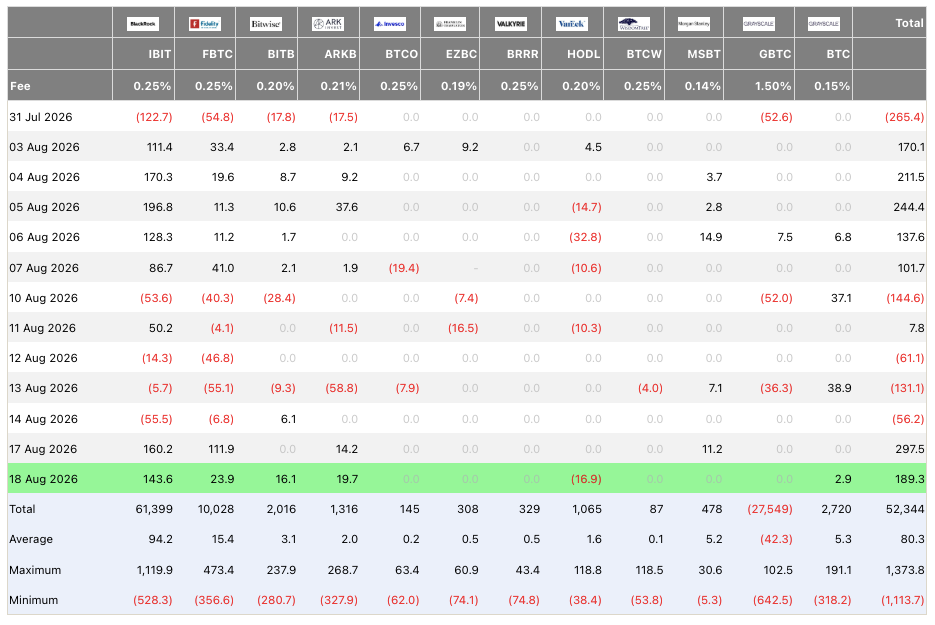
The report added that institutional demand for Bitcoin has weakened this year as geopolitical uncertainty and mounting inflation pressure directed capital toward more established risk assets, including U.S. equities. The S&P 500 hit a record high last week, while Bitcoin did not keep pace. Even so, BlackRock said that divergence may not persist.
The firm wrote: 「With speculative excess now largely purged, we believe bitcoin’s recent episodes of elevated risk correlation should normalize lower, consistent with its longer-term record as a low-correlation diversifier.」
Long-term resilience remains central to the thesis
BlackRock said Bitcoin’s longer-run return profile stands out around major political and macro events. The report listed the March 2020 COVID-19 outbreak, the 2020 U.S. presidential election, the regional banking crisis, and President Donald Trump’s repeated international trade-tariff declarations.
While Bitcoin initially struggled after some of those events, BlackRock said its 60-day returns were still strong. After the 2020 election, for example, those returns reached as high as 113%.
BlackRock wrote: 「Through multiple shocks in recent years, bitcoin often outperformed both the S&P 500 and gold in the weeks and months following the onset of disruptions.」
It added: 「This pattern has held true thus far in 2026 amid ongoing conflict between the U.S. and Iran, with bitcoin delivering positive returns and outperforming equities and gold following the onset of hostilities in February and the end of the ceasefire agreement in July.」
Correlation is still above gold’s, but BlackRock expects it to fall
On volatility, the report put Bitcoin’s 12-month realized volatility at 40%, compared with 26% for gold and 12% for the S&P 500. On correlation, Bitcoin’s rolling six-month correlation with the S&P 500, shown as a 10-year average, now stands at 0.18. Gold’s reading is 0.06.
BlackRock said: 「Bitcoin’s underlying investment case aligns more closely with that of gold — as a global monetary alternative and a hedge against inflation, global disorder, and declining trust in fiat currencies. Even for gold, which tends to be viewed as a standard uncorrelated, store-of-value asset, brief periods of high equity correlation exist, including COVID in 2020-2021 and the monetary easing cycle in 2023.」
Since October 2025, Bitcoin’s price action has led some market participants to question whether it still fits the idea of “digital gold.” In its first-quarter report, asset manager Grayscale said Bitcoin’s short-term behavior looked more like a growth stock than gold, while also noting its low correlation with the metal.