
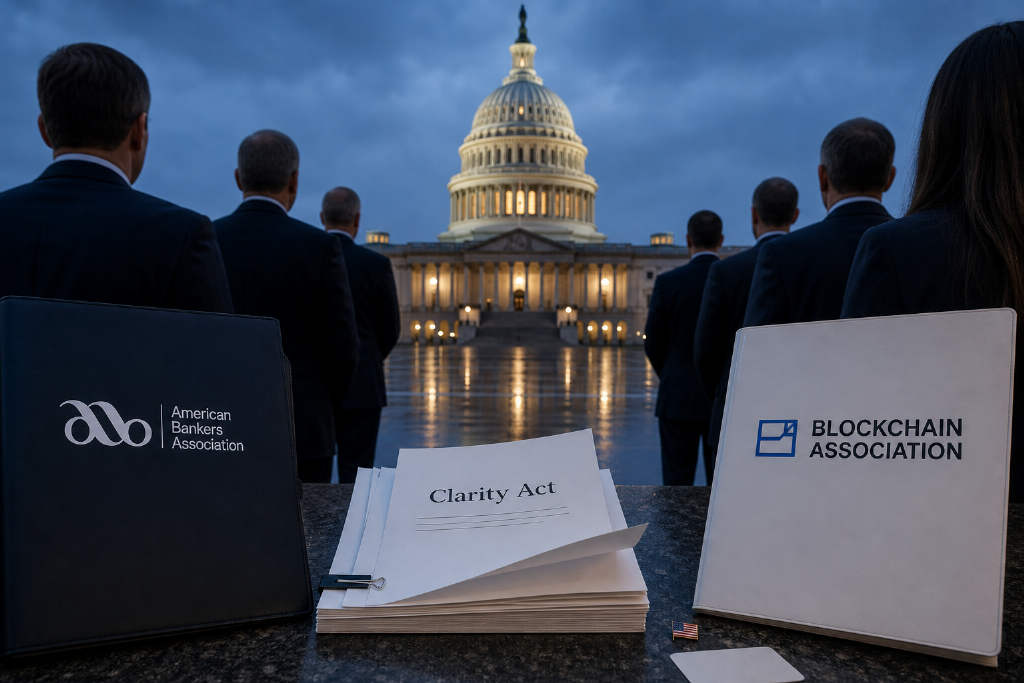
The U.S. Senate is scheduled to hold a procedural vote on Sept. 15 to decide whether the Clarity Act can move to debate, and the measure will need 60 votes to advance. With that vote approaching, the American Bankers Association, or ABA, is calling for what it describes as modest changes to language that had already been negotiated. Blockchain Association CEO Summer Mersinger says those edits would do far more than tidy up wording and could instead bog the bill down at a critical point.
Rob Nichols, CEO of the ABA, wrote that the U.S. banking industry wants to strengthen the Clarity Act, not kill it. Mersinger, a former commissioner at the Commodity Futures Trading Commission, answered publicly that the banking group’s proposed wording changes amount to major policy revisions. Reopening negotiations now, she argued, would not improve the legislation but would restart talks that lawmakers do not have time to finish.
In her response, she said the debate being framed as discussion is really a way to delay the bill until it dies.
A Sept. 15 procedural vote leaves little room on the Senate calendar
Mersinger pointed to the timing. The Sept. 15 Senate vote is a procedural motion on whether to begin debate on the Clarity Act, and it requires support from 60 senators. After that, she said, the chamber will have less than three full working weeks left before the legislative window closes ahead of the midterm elections, with fall spending fights also crowding the agenda.
She also said the provisions the ABA wants to reopen were negotiated over a period of months and that banking industry representatives were present throughout those talks. Reopening the language at this stage, in her view, would not make the bill better. It would simply launch another round of negotiations with no time to wrap them up.
- The Sept. 15 procedural vote needs 60 votes for the bill to enter debate.
- After that vote, the Senate would have less than three full working weeks before the midterm-election legislative window closes.
- Mersinger cast the push to reopen negotiations as delay under the cover of further discussion.
Two proposed wording changes sit at the center of the dispute
Nichols presented two ABA requests as narrow revisions. One would replace the current standard in the bill with the phrase “substantially similar.” The other would remove the word “solely.” Mersinger said neither can be treated as minor.
On the first point, she argued that “substantially similar to interest” is a flexible legal standard that regulators could stretch broadly if they chose. Under that reading, almost any program that returns economic value to a customer could be treated as substantially similar to interest. She noted that banks themselves run programs of that kind, including cash-back offers that rise with spending and loyalty structures tied to account balances. In her telling, no bank would accept its own rewards programs being boxed in by that phrase.
On the second point, she said “solely” comes from the GENIUS Act. That law bars issuers from paying yield “solely based on holding, using, or retaining” a stablecoin. The word limits the ban to rewards paid only for holding the asset itself. Remove it, she argued, and the restriction expands to conduct that Congress had intentionally left outside the ban, changing the bill’s real operating scope.
Mersinger used FDIC data to rebut deposit flight claims
The argument over deposit outflows is another fault line. Nichols said that after GENIUS passed, there had been no visible bank deposit exodus, making the issue less important because the regulatory framework had not yet been fully implemented.
Mersinger rejected that line of reasoning. She said it asks senators to vote on forecasts while setting aside the only real-world data currently available. Citing the latest Federal Deposit Insurance Corporation, or FDIC, figures, she said U.S. deposits increased in every quarter after GENIUS took effect. Across the first three full quarters since the law came into force, domestic bank deposits rose by more than $800 billion.
She added that if contrary evidence can always be dismissed as too early to judge, then no evidence will ever settle the question and worst-case predictions will always win by default.
Mersinger also said the real competition for bank deposits does not come from crypto. She pointed instead to money market funds, which she said have attracted trillions of dollars by paying savers real, market-competitive returns. Banks usually answer that pressure by raising their own rates, she said, and have not asked Congress to cap the yields those funds can offer.
Her consumer-protection case focused on existing stablecoin safeguards and the broader digital-asset gap
Mersinger said stablecoins are not covered by FDIC deposit insurance, but the GENIUS framework still gives holders several protections. Those include a 1:1 reserve requirement backed by cash and short-dated Treasuries, a ban on lending against reserves, monthly disclosures certified by the chief executive officer and chief financial officer, and priority claims on reserves if an issuer fails.
She then contrasted that with the wider digital-asset market. According to the information provided, 67 million Americans hold digital assets, yet outside stablecoins there is no federal framework that requires platforms to separate customer assets from house funds, disclose their financial condition, or refrain from trading against customers.
She described the Clarity Act as the vehicle for putting those standards into law. The bill would draw the line between Securities and Exchange Commission and CFTC jurisdiction, require platforms serving U.S. customers to register, mandate segregation of customer assets, and establish disclosure and conflict-of-interest rules.
Her position is that the ABA amendments would not shield consumers from any risk that current bill text fails to address. Instead, she said, they would remove options from consumers while the actual protections are already written into the same legislation awaiting a vote.
What comes next
The fight over the Clarity Act reaches beyond Washington. The source material says several Asian countries are also watching the final shape of a U.S. federal digital-asset framework. If the Sept. 15 procedural vote fails, the global reference point for crypto regulation would remain unsettled and firms would still face fragmented state-level rules in the United States.
For stablecoin issuers, the reserve, disclosure, and priority-claim structure in GENIUS has already been described as a de facto standard. The source also notes that this model could be adopted directly by lawmakers in other countries regardless of what ultimately happens to the Clarity Act.
The next points to watch are whether the Sept. 15 vote clears the 60-vote threshold, whether the ABA softens its demand to reopen negotiations, and whether the CFTC could again move to fill any legislative gap through its own rules if the bill is delayed.