
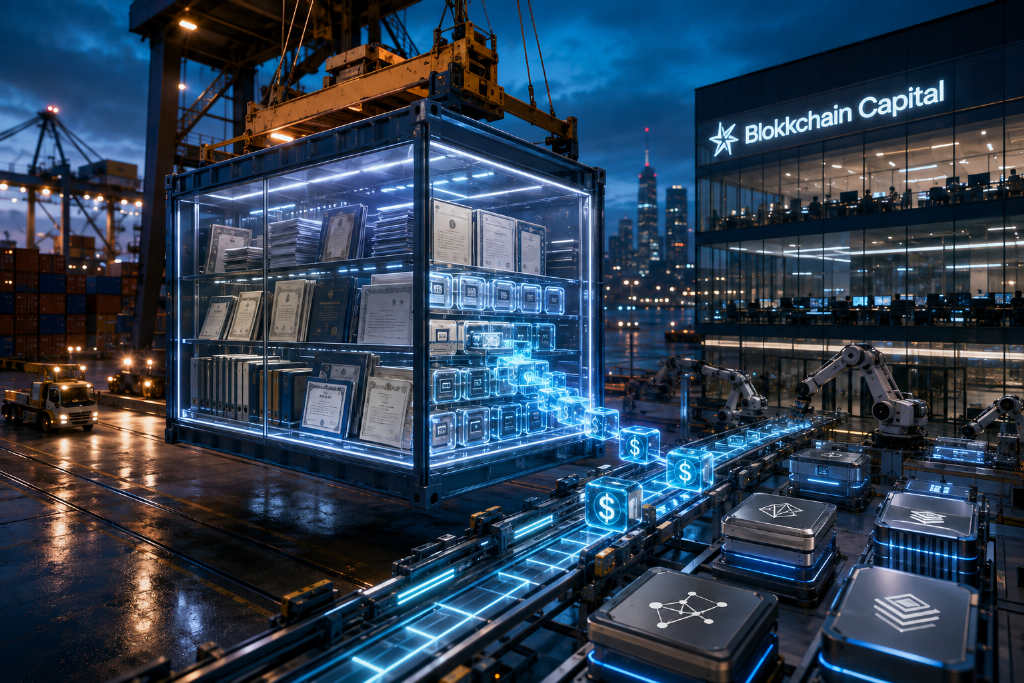
Blockchain Capital general partner Aleks Larsen says tokenization can reshape capital markets in the same way shipping containers reshaped global trade. His central argument is that finance still carries heavy asset-packaging costs, while tokens offer a standardized, machine-readable interface that lets assets move across a shared network with far less repeated reconciliation, settlement work, and system-specific reformatting.
In the piece, Larsen describes how many financial assets still live inside separate operational wrappers. A mortgage may exist across contracts, PDF files, databases, and servicing agreements. A private fund interest may be tied to a subscription agreement and an entry on a transfer agent ledger. An equity position may sit across records held by brokers, custodians, and depositories. When an asset moves from one institution to another, the receiving side often has to verify, reconcile, clear, and repackage the same claim for its own systems. Larsen says the duplication exists because different institutions maintain separate records for the same underlying asset and the same economic claim.
He argues that this fragmentation creates a large hidden social cost. Vast amounts of value sit on global balance sheets, yet most assets still require customized operating work before they can move freely across institutions. In his view, that friction slows the reallocation of capital toward startups, infrastructure, housing, and other productive parts of the economy.
Why Larsen uses the container analogy
To explain tokenization, Larsen turns to the history of container shipping.
Before the 1960s, cargo moved in many forms. Coffee went into sacks, machinery into wooden crates, cotton into bales, and oil into barrels. Each category required its own handling process, and port labor was largely manual. Dockworkers had to pack cargo tightly, balance loads, and secure goods to avoid damage at sea. The deeper problem, Larsen writes, was the lack of a standard loading unit for global trade.
That fragmentation had a direct cost. Ships spent long periods in port, often longer than at sea, while bulk cargo was repeatedly transferred, counted, and checked across ships, trucks, trains, and warehouses. Damage, loss, and theft were common.
He points to 1956, when North Carolina trucking entrepreneur Malcolm McLean converted the tanker Ideal-X and sent it from Newark to Houston carrying standardized containers. Once it arrived, trucks could haul away the containers without opening them. Larsen writes that the per-ton loading cost on the Ideal-X was far below that of the traditional break-bulk model, marking the start of modern container shipping.
Over the next two decades, ISO standards emerged and the supply chain reorganized around the container itself. Ships were redesigned with vertical cells to stack containers safely. Cranes were rebuilt for fast handling of standard boxes. Truck chassis and rail cars were manufactured to fit common dimensions and locking structures. Ports became transfer hubs built around standardized cargo units.
The first result, he says, was a sharp drop in transport costs, both in time and money. Freight cycles from Australia to Europe became much shorter, while ship carrying capacity increased fourfold. Trade shifted toward manufactured goods and intermediate products. Companies split production across countries, new logistics firms appeared, and global supply chains expanded quickly.
Larsen also says the change lifted economic activity itself. Citing World Bank estimates, he writes that bilateral trade among developed economies rose sharply in the 15 years after both trading partners adopted container shipping. Containerization and the infrastructure built around it helped scale global supply chains and support faster global growth.
Tokens as containers for financial claims
Larsen describes tokens as containers for financial claims. They do not carry physical goods. They carry economic rights and state information: ownership, transfer permissions, cash-flow rules, access restrictions, and interaction logic that software can call.
Once an asset has a machine-readable standardized interface, exchanges can list it, lending markets can finance against it, custodians can hold it, and wallets can route cash flows automatically. Software applications can recognize the asset and execute its rules without custom integrations with every separate institution.
That, he says, is the core difference between tokenization and simply digitizing documents or adding another database entry. In his framing, the token becomes the common operating interface for the asset across the market. As more participants build on that interface, the effect compounds.
Stablecoins as the clearest proof point
Larsen says stablecoins offer the most visible demonstration of tokenization’s potential. A cross-border wire transfer through the banking system can take days to move dollars, he writes, while stablecoins can move value globally in seconds at near-zero transaction cost.
He attributes that outcome to shared acceptance of the token interface by exchanges, custodians, on- and off-ramp providers, payment firms, and wallets around the world. He compares that network to the ports, cranes, trucks, trains, and container ships of a new financial system. The base infrastructure was first built for Bitcoin and Ethereum, he says, and once that network existed, stablecoins and other tokens could reuse it. In turn, stablecoin growth attracted more users, liquidity, applications, and infrastructure, reinforcing the network effects for later token issuers as well.
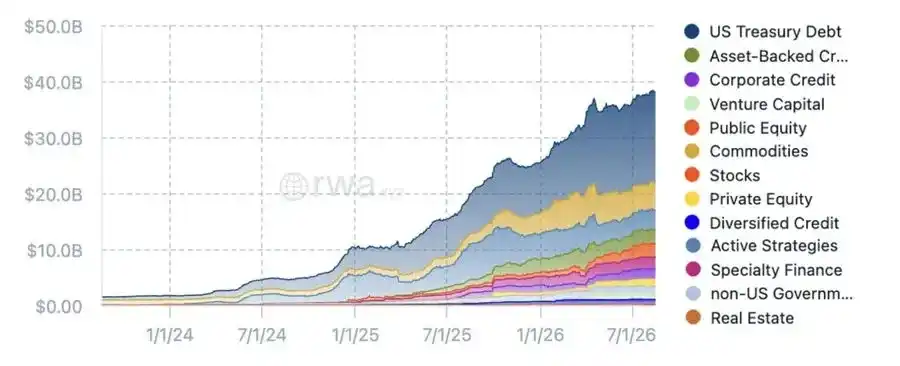
Larsen cites rwa.xyz and says the results are already visible. Large volumes of stablecoins are circulating and carrying sizable transaction flows, with turnover speeds well above those of traditional M1 and M2 money. He writes that cross-border remittance costs have fallen by an order of magnitude and that many people around the world now have more stable access to dollar payments. In his view, stablecoins have already validated the value of this dollar network by changing cost, speed, and reach, while increasing the amount of economic activity each dollar can support.
From there, he says, this highly liquid pool of dollar capital is drawing more assets into stablecoin deposit rails. Tokenized real-world assets are now about 10x larger than they were two years ago, according to the article, and growth is still accelerating. The covered asset set includes US Treasuries, money market funds, commodities, private credit, equities, and various fund interests across global markets.
How capital markets may reorganize around tokens
Larsen argues that just as supply chains were rebuilt around containers, capital markets will be rebuilt around tokens. He says decentralized finance already shows an early version of that structure.
He points to portfolio company Aave V4, which he says allows eligible token holders to stake assets and access floating-rate credit in lending markets. The protocol embeds the market rules directly, with the asset itself determining access conditions. That is a break from traditional credit markets, where an individual or business seeking a secured loan usually has to enter through a financial institution. The institution controls access, runs its own underwriting and risk processes, and distributes products through its own channels.
In the Aave model, Larsen says, the only basis for access is the asset itself. Smart contracts recognize the token and execute transparent rules while connecting directly to capital markets. In that setup, the link between the asset holder and the financial service is inverted: financial capability attaches to the asset rather than to an institution-specific relationship.
He extends that point by saying tokens give assets software-like executability. Once an asset is issued on a public blockchain and recognized across the network, different applications can compete to add services around it. Exchanges can supply liquidity, lending protocols can offer financing, and wallets can distribute cash flows automatically. The issuer only needs to place the asset onchain once instead of building a separate system for every use case.
Larsen says this would alter the business model of financial institutions. Today, banks, brokers, and asset managers tend to bundle custody, underwriting, liquidity provision, asset management, and compliance review inside closed product systems. Crypto networks, by contrast, break those functions apart and let specialized firms operate each layer independently. One institution might originate and service credit, while others provide funding, risk pricing, trading, insurance, or application-level services. Because the asset travels through a common interface, it does not need to be recreated inside every provider’s stack.
He also argues that competitive advantage could shift from large institutions to open networks. In traditional finance, large firms can support more products because they can absorb the fixed infrastructure cost tied to each asset class and customer segment. On public blockchains, much of that infrastructure is shared. New entrants do not need to build fresh ledgers, exchanges, custody systems, or settlement rails before they can connect assets, capital, and users.
Larsen says the network effects around stablecoins have already entered a positive loop. Over time, he expects capital markets to move toward open networks where specialized financial services run around tokenized assets. In that structure, firms compete on funding quality, underwriting, risk management, asset management, and distribution strength, not on exclusive control of proprietary databases or closed access to market rails.
A global balance sheet onchain
The most important consequence, Larsen writes, is the creation of a borderless global capital market.
He says today’s capital markets are constrained by institutional bottlenecks. Most people and businesses cannot connect directly to the market. They choose from a limited product set institutions decide to offer, while those same institutions determine customer coverage, geography, asset type, and transaction size.
Investors face the reverse limit as well. They cannot invest freely across the full global opportunity set. They can generally buy only what institutions have already underwritten, packaged, and distributed.
As a result, Larsen says, much of the world’s economic value remains outside the existing capital market. Small receivables, local infrastructure projects, private businesses, emerging-market credit, and non-standard cash flows may all have economic value, but they are often too fragmented, too local, or too small to justify the operating cost of traditional finance. The issue is not the absence of opportunity or capital, he writes. It is the absence of a network connecting the two.
Tokenization changes that connection by giving assets a standard interface through which they can be discovered globally, according to Larsen. As the financial system rebuilds around that interface, participation costs fall. Finance becomes a native software capability. Applications can go after niche asset classes and regional markets that traditional finance does not serve well. Business software that could not previously access high-end financial services can embed payments, working-capital financing, collateral management, and treasury functions, bringing dormant assets into onchain capital markets.
He adds one limit clearly: tokenization does not create financing value for assets that have none. But many quality assets that are cut off by today’s system could eventually become marketable.
Larsen also argues that artificial intelligence could amplify the shift by taking over operational tasks. AI agents, he says, can assess assets, price risk, allocate capital, manage collateral, and execute settlement across a global machine-readable market, driving financial service costs lower over time. Combined with crypto payment rails, that could turn customized and intermittent markets into markets that run globally, automatically, and around the clock.
He closes by describing capital allocation as one of society’s core coordinating tools. It shapes where companies expand, where technology is deployed, where homes and factories are built, and how regions develop. Assets that are currently too small, too local, too customized, or too operationally expensive for traditional finance may become commercially underwritable if the cost of connection, financing, and management drops sharply.
Larsen ties that back to containerization. Containers made entirely new production and trade patterns economically workable. Goods could be made where costs were lowest, assembled elsewhere, and sold globally because coordination costs across supply chains fell. He argues tokens can do the same for capital. Over the coming decades, the global balance sheet could move from isolated ledgers toward an open market that software can traverse directly, where capital flows according to the value of the asset rather than the institution that controls the gate. Stablecoins, in his view, have already shown the model can work and could expand capital markets into areas they have not reached before.