
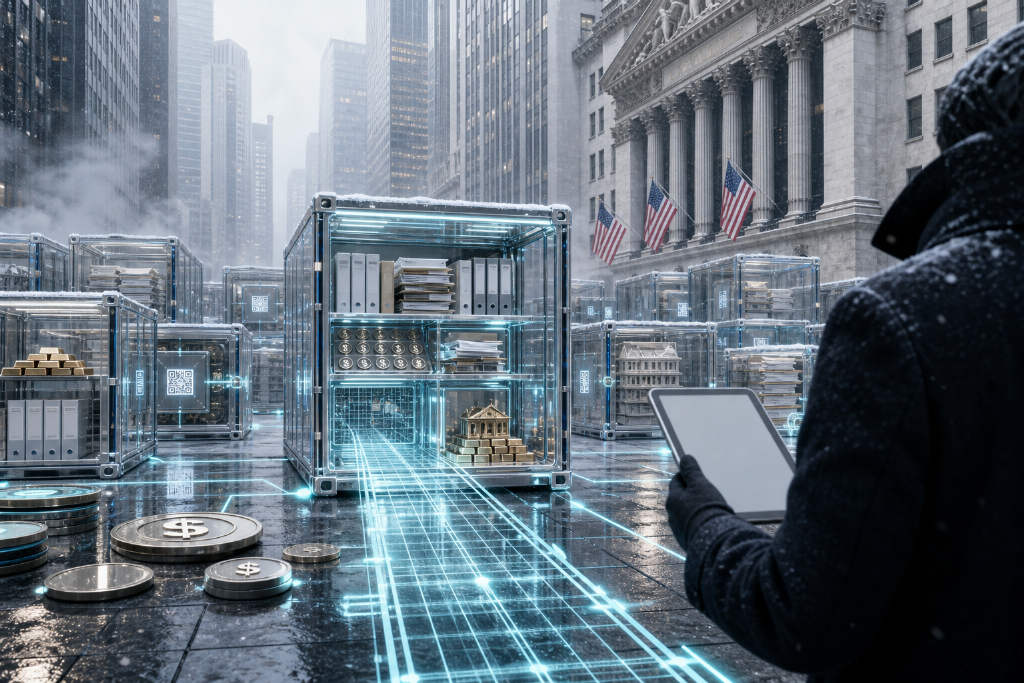
Blockchain Capital general partner Aleks Larsen says tokenization is a multiplier for capital markets because it packages and standardizes global assets in a way that cuts through compliance frictions and access barriers.
In an essay published by TechFlowPost and translated by Foresight News, Larsen argues that finance has long paid a high cost to package assets. Each asset class sits in its own wrapper and in its own system. A mortgage is tied up in contracts, PDF files, databases, and servicing agreements. A private fund interest sits inside a subscription agreement and a line item on a transfer agent’s records. Equity ownership is scattered across brokers, custodians, and depositories. He says the same pattern appears across the market.
When assets move between institutions, they often have to be unpacked, checked, reconciled, settled, and repackaged to fit the recipient’s system. The redundancy comes from the fact that different institutions maintain their own records for the same underlying asset and the same claim on cash flows. Larsen says this fragmentation creates a large hidden social cost on a global scale and slows capital from moving into productive areas such as emerging companies, infrastructure, housing, and other sectors with economic value.
Why Larsen compares tokenization to the shipping container
His core argument is that tokenization addresses this problem at the root. A token gives an asset, or a claim on financial returns, a standardized and machine-readable interface. Once an asset can be recognized and called on a shared network, exchanges, lending platforms, custodians, asset servicers, and software applications can connect to it directly instead of rebuilding financial plumbing from scratch every time. The result, he argues, is a capital market that runs on a common programmable infrastructure with lower friction in transfer, settlement, and balance-sheet use.
To explain that logic, Larsen turns to the container.
How the container changed global supply chains
Before the 1960s, cargo moved in many different forms. Coffee went into sacks, machinery into wooden crates, cotton into bales, and crude oil into barrels. Each type of cargo had its own loading requirements, and dock work depended heavily on manual labor. Skilled dockworkers had to pack tightly, balance weight, and secure cargo to stop it from shifting and breaking during ocean transport.
He says the underlying reason for that complexity was simple: global trade lacked a standardized loading unit. One direct consequence was that ships could spend more time in port than at sea. Breakbulk cargo had to be transferred and counted repeatedly between ships, trucks, trains, and warehouses, with frequent damage, loss, and theft.
Larsen points to 1956, when North Carolina trucking entrepreneur Malcolm McLean converted the tanker Ideal-X and sent it from Newark to Houston carrying standardized containers. At the destination, trucks could pick up the container bodies directly without opening them. According to the essay, the per-ton loading cost on the Ideal-X was far lower than in the traditional breakbulk model, marking the birth of modern container shipping.
Over the next 20 years, containers were standardized under ISO rules, and the supply chain reorganized around them. Ships were built with vertical cells for safe stacking. Cranes were redesigned for fast handling of standardized boxes. Truck chassis and railcars were produced to common dimensions and locking structures. Ports became giant transfer hubs built to move standardized containers across different transport modes.
The first effect was a steep drop in transport costs, in both time and money. Larsen writes that freight cycles from Australia to Europe became much shorter and ship carrying capacity quadrupled. Trade shifted toward manufactured goods and intermediate products. Companies spread production steps across multiple countries. New logistics providers emerged to coordinate increasingly complex global networks, and supply chains expanded quickly. He adds that economic activity also rose sharply. Citing World Bank estimates, he says bilateral trade among developed countries increased substantially over the 15 years after both trading partners adopted container shipping.
Tokens as the financial version of the container
Larsen says a token is the container for a financial claim. It does not hold physical cargo. It holds economic rights and operational states: ownership, transfer permissions, cash-flow rules, access restrictions, and interaction logic that software can execute.
Once an asset has a standardized machine-readable interface, an exchange can list it, a lending market can finance against it, a custodian can safeguard it, and a wallet can route cash flows automatically. Software applications can identify the asset and apply transaction rules without building one-off integrations with every institution. For Larsen, that is the difference between tokenization and simply digitizing documents or adding another database entry. Market participants can all treat the token as the shared operating interface for the asset. As that effect compounds across the ecosystem, he says, the impact becomes very large.
Stablecoins as the clearest proof of concept
Larsen presents stablecoins as the most visible demonstration of tokenization’s potential. A cross-border wire transfer through the traditional banking system can take several days to move dollars. A stablecoin transfer can settle globally in seconds at near-zero cost.
He says that works because a large number of exchanges, custodians, fiat on- and off-ramp providers, payment firms, and wallets all recognize the same token interface. In his analogy, those participants are the new financial ports, cranes, trucks, trains, and oceangoing vessels moving value across the network. Much of this infrastructure was first built for Bitcoin and Ethereum. Once the rails were in place, stablecoins and other tokens could reuse them. As stablecoins expanded, they brought in more users, liquidity, applications, and infrastructure, and later-issued tokens benefited from the same reinforcing network effects.
Citing rwa.xyz, Larsen says the result is already visible. A large stablecoin supply now supports massive transaction flows, with money turning over faster than traditional M1 and M2. Cross-border remittance costs have fallen by an order of magnitude, and many people around the world have gained more reliable access to dollar payments. In his view, stablecoins have already validated the value of this dollar network by improving cost, speed, and reach, allowing each dollar to support more economic activity.
He adds that this liquid onchain dollar pool is now attracting more assets into stablecoin deposit channels. Tokenized real-world assets are about 10x larger than they were two years ago, and the pace is still accelerating, he writes. The asset set includes U.S. Treasuries, money market funds, commodities, private credit, equities, and various fund interests across global markets.
Capital markets rebuilt around tokens
Larsen says global capital markets will be rebuilt around tokens much as global supply chains were rebuilt around containers, and he sees DeFi as an early version of that structure.
He points to Aave V4, a project in Blockchain Capital’s portfolio. In his description, eligible token holders can stake assets there and access floating-rate credit from lending markets. The protocol embeds the full rule set, and the asset itself determines access conditions. He contrasts this with traditional lending, where a person or company seeking to borrow against collateral first has to approach a financial institution. The institution controls access, underwrites the borrower through its own risk process, and distributes financial products through its own channels. Financial services are tied to institutional relationships.
Inside the Aave system, Larsen says, the only admission test is the asset itself. Smart contracts identify the token, apply transparent rules, and connect directly to capital. That flips the traditional arrangement. Financial capability sits on the asset rather than on the relationship between a user and an institution.
He takes the argument one step further: tokens give assets software-like executability. Once an asset is issued on a public blockchain and recognized across the network, different applications can compete to add services on top of it. Exchanges can supply trading liquidity. Lending markets can supply financing. Wallets can distribute cash flows automatically. The issuer only has to put the asset onchain once instead of building separate systems for every use case.
What changes for financial institutions
Larsen argues that this shifts the business model of banks, brokerages, and asset managers. Today, those firms often bundle custody, underwriting, liquidity provision, asset management, and compliance inside closed product stacks. Crypto networks break those functions apart and let specialized firms run them independently.
In the model he describes, one firm may originate loans and manage them after issuance, while others provide capital, risk pricing, trading, insurance, or application-layer services. Assets move across those modular services through a common interface, without repeated manual setup and duplicated records at every provider.
That also changes where competitive advantage sits. In traditional finance, large institutions can support a broad set of products because they can afford the fixed infrastructure cost tied to each asset class and customer segment. On public blockchains, much of the base infrastructure is shared. New entrants do not have to rebuild ledgers, exchanges, custody systems, or settlement rails before they can connect assets, capital, and users. Larsen says that sharply lowers the barrier to starting and operating a financial service.
He argues that stablecoin network effects have already entered a positive loop. Over time, capital markets will shift toward open networks filled with specialized services built around tokenized assets. In that framework, firms compete on capital quality, underwriting, risk management, asset management, and distribution, not on ownership of exclusive databases or on controlling the only route through which users can reach the market.
The balance sheet of the world moves onchain
The most important consequence, in Larsen’s view, is the creation of a borderless global capital market.
He says today’s capital markets are still constrained by institutional bottlenecks. Most individuals and businesses cannot connect to capital markets directly. They can only choose from the limited product menu institutions are willing to offer. Institutions decide which customer groups to serve, which geographies to cover, which assets to support, and what size of transactions to allow. Investors face the mirror image of that limit: they cannot invest freely across the full global asset set and instead can buy only those assets that institutions have underwritten, packaged, and plugged into their distribution systems.
As a result, he argues, most economic value in the world remains outside current capital markets. Small receivables, local infrastructure projects, private businesses, emerging-market credit, and non-standard cash flows may have economic value, but they are often too fragmented, too local, or too small for the traditional system’s operating cost structure. The investment opportunities exist. The capital supply also exists. What is missing is the network that connects them.
Tokenization changes that, Larsen says, by giving assets a standard interface so they can be discovered globally. As finance is rebuilt around that interface, participation costs fall for everyone. Finance becomes a native software capability. Applications can go deeper into niche asset classes and regional markets that traditional finance does not reach. Commercial software that could not previously access advanced financial services can embed payments, working-capital finance, collateral management, and treasury functions. Large pools of idle or “sleeping” assets can then connect to onchain capital markets.
He adds one caveat: tokenization does not make worthless assets financeable. But many good assets that are cut off by the current system could eventually enter market circulation.
AI as the next amplifier
Larsen closes by saying artificial intelligence could amplify the shift by taking over many operating tasks. AI agents, in his description, can evaluate assets, price risk, allocate capital, manage collateral, and execute trading and settlement in a globally machine-readable market, all while continuing to compress the cost of financial services.
Combined with crypto payment rails, he says, AI could turn markets that are currently customized and intermittent into markets that run around the clock, across borders, and with a high degree of automation, opening more opportunities and reducing institutional barriers around capital allocation.
He frames capital allocation as one of society’s core coordination tools. It shapes where businesses expand, how technology is deployed, where homes and factories are built, and how regional economies develop. Assets that are currently too small, too local, too customized, or too expensive to manage in traditional finance could become commercially underwritable once the cost of connection, financing, and administration drops sharply.
That, he says, is the deeper lesson of the container. Containers made new trade and production models economically viable. Goods could be produced where costs were lowest, assembled elsewhere, and sold globally because the overall cost of coordinating the supply chain fell so much. Tokens can do something similar for capital. Over the next several decades, Larsen expects the world’s balance sheet to move from isolated ledgers to an open market that software can traverse directly, where capital flows according to asset value rather than according to who controls financial access. Stablecoins, he says, have already shown what that system might look like.
