
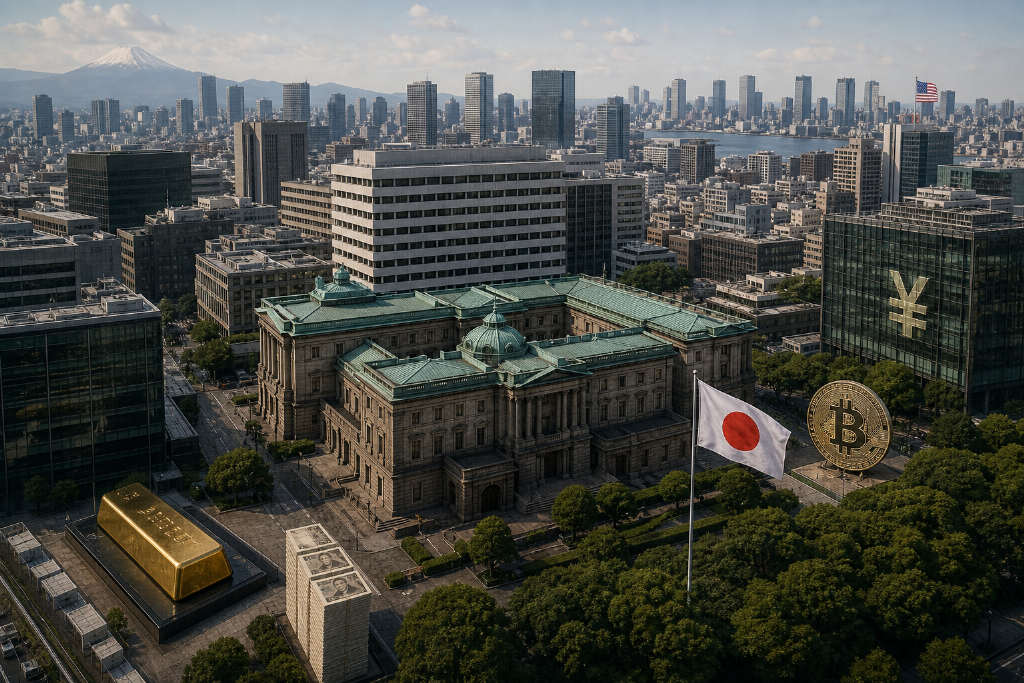
The Bank of Japan will hold its next policy meeting on Sept. 17-18, and the window is closing fast. According to the report, the overnight index swap market had already priced in about an 85% chance of a rate hike even before BOJ Deputy Governor Ryozo Himino spoke on Aug. 27, with the policy rate expected to rise from 1% to 1.25%.
The Federal Reserve is due to meet first, on Sept. 15-16, and will publish its dot plot. With the two decisions separated by only a day, the report says the yen, gold and bitcoin may all have to reprice within 48 hours.
Market levels cited in the article show the pressure points clearly. USD/JPY stood at 160.27 on Sept. 2, near a 40-year low for the yen. Gold was trading around $4,350, more than 20% below its January record. Bitcoin was at $77,534, still 38.50% below its October 2025 peak.
The BOJ’s case for a hike goes beyond headline inflation
Japan’s July core CPI, excluding fresh food, rose 1.8% from a year earlier, up from 1.6% in June but still below the BOJ’s 2% target. Wholesale prices, by contrast, were up 7.2% year over year, showing that cost pressure remains concentrated on the corporate side.
In a speech to local businesses in Saitama on Aug. 27, Himino made the central bank’s concern unusually clear. 「We should pay closer attention than before to upside risks to prices. If underlying inflation moves above the 2% price stability target, it would have a negative impact on the economy.」
He also said that timely rate hikes could help avoid being forced into rapid tightening later. In the report’s framing, the BOJ is not reacting to today’s 1.8% core CPI as much as it is trying to avoid a situation where inflation breaks above 2% and forces a sharper move that markets may struggle to absorb.
The article says the real catalyst is the exchange rate. With the yen at 160 against the dollar, import costs are feeding directly into domestic prices. At the same time, conflict involving the U.S. and Iran in the Strait of Hormuz has pushed Brent crude above $90, creating a second imported inflation channel through energy.
Political resistance appears to have eased
The report revisits Sanae Takaichi’s earlier opposition to policy normalization. In February, during a meeting with BOJ Governor Kazuo Ueda, she reportedly said it would be foolish to keep pushing rate normalization. In May, she also called on the BOJ to buy government bonds if needed to cap long-end yields, an unusual level of direct political commentary on monetary tools in Japan.
That changed in August. Citing Nikkei, the article says Takaichi has stepped back from the rate-hike debate and shifted to a wait-and-see stance, effectively removing what had been one of the main political obstacles in front of the BOJ. The reason, it argues, is straightforward: the political cost of yen weakness has overtaken the political cost of a rate increase.
Finance Minister Satsuki Katayama has still not drawn a clear line in the sand for the currency, saying only that officials would act appropriately and decisively at any time. The implication in the report is that verbal intervention is losing force.
The article describes Japan’s situation as an impossible trinity of sorts: keep the yen from weakening, keep rates from rising, and keep fiscal expansion in place. Only two of the three can coexist. Takaichi, it says, chose fiscal expansion. On Aug. 5, the cabinet decided to cut the food consumption tax rate from 8% to 1% for two years starting in April 2027. That choice, in the report’s telling, leaves the BOJ with a larger share of the adjustment burden.
The cost is already visible in the government’s debt projections. Japan’s Ministry of Finance on Aug. 25 presented an initial FY2027 budget request showing debt-servicing costs of JPY 36.6386 trillion, up 17.1% year over year, while the assumed interest rate used for calculations was raised from 3.0% to 3.8%.
Japan’s 10-year government bond yield touched 3% on Sept. 1, the first time since September 1996. That matters because the government’s long-term rate assumption for the FY2026 budget is also 3%. If that level is breached on a sustained basis, actual interest costs begin to exceed what has been budgeted. The report puts Japan’s government debt at about 204.4% of GDP.
Sept. 16 is the key point in the calendar
The September schedule is driving the setup. The Fed meets on Sept. 15-16 and releases its dot plot; the BOJ follows on Sept. 17-18. The gap is just one day.
After his Jackson Hole speech, Fed Chair Kevin Warsh sent what the article describes as a hawkish signal. FedWatch showed the probability of a September hike rising to about 66%. Warsh said high inflation should be the Fed’s top priority now. Deutsche Bank is still forecasting two more 25-basis-point increases this year, one in September and one in December.
The report draws a sharp contrast with 2024. Back then, Japan was hiking while the U.S. was preparing to cut, and the two paths were moving in opposite directions. That caused the U.S.-Japan rate spread to compress quickly, forcing carry trades to unwind at the same time. After the BOJ raised rates on July 31, 2024, bitcoin fell from $64,000 to $49,000 in two days by Aug. 5, a drop of about 23% in a week.
In 2026, the setup is different. If the BOJ hikes by 25 basis points and the Fed also hikes by 25 basis points, the spread is largely unchanged. On that basis, the article argues that a classic yen carry unwind now requires a narrower set of conditions. The scenario that most closely resembles August 2024 is a BOJ hike with no Fed hike.
- Fed hikes, BOJ hikes: the rate differential is little changed, the yen could even weaken again after a buy-the-rumor move, and the pressure on risk assets would likely be the smallest of the three cases.
- Fed holds, BOJ hikes: the rate gap narrows fastest, the yen could rally sharply, and this is the only setup the report says comes close to the August 2024 script.
- Fed hikes, BOJ holds: USD/JPY could test 165, intervention pressure would return quickly, but that would be a dollar-strength story rather than a carry unwind.
For the dollar, intervention buys time, not much more
The report says Japan and the U.S. stepped in together to buy yen at the end of July, the first such joint action since 1998, when USD/JPY was approaching 164. One month later, Japan’s total outlay had reached a record $96.4 billion, yet the yen only recovered to around 155 at best. By the close on Aug. 28, USD/JPY was back to 160.09, giving back more than half of that move.
U.S. Treasury Secretary Scott Bessent, responding to questions from Senator Elizabeth Warren, laid out what the article calls Washington’s real concern. It is not the yen by itself, but the risk that Japan, as the largest foreign holder of U.S. Treasuries, could face disorder in the FX market that forces investors to sell Treasuries, lifting borrowing costs for U.S. households and businesses.
Luo Zhengyan of State Street Global Advisors said 160 is no longer just a valuation reference point for the yen. It has become a line both sides are watching, and once a level is publicly defended, speculative positions are more likely to test it repeatedly.
The report adds that the U.S. Exchange Stabilization Fund is limited to existing positions rather than an unlimited pool of deployable capital, which helps explain why intervention effects have grown shorter-lived. A BOJ hike is framed as the only tool currently able to change the yen’s direction, but a quarter-point move cannot erase a rate gap of more than 4 percentage points versus the U.S. It changes sentiment and directionality more than the arithmetic.
For gold, the BOJ is not the main driver
Gold touched an intraday record of $5,589.38 on Jan. 28, then fell back to around $4,350 by early September, down more than 20% from the peak. The article says Japan had little to do with that decline.
At the start of the year, markets had expected rate cuts under Warsh’s Fed. But the June FOMC produced a split 9-8 vote in favor of at least one rate hike this year. As expectations shifted from cuts to hikes, real rates moved higher and the opportunity cost of holding a non-yielding asset rose with them. Middle East tensions also worked against the simple safe-haven narrative: higher oil prices lifted inflation expectations and caused the market to strip out some of its rate-cut pricing.
The report lays out two channels through which a BOJ hike could affect gold, but says neither is the main one. The first is indirect: a stronger yen and weaker dollar index would support dollar-priced gold. The second matters more for domestic Japanese investors. With 10-year Japanese government bonds yielding 3%, a yen-denominated risk-free return now exists at a level absent for decades. For much of the past 30 years, Japanese savers earned next to nothing on cash, so the opportunity-cost gap between holding gold and holding cash was close to zero. That is no longer the case.
Year-end forecasts remain widely dispersed. J.P. Morgan sees $6,000, while Goldman Sachs and some other institutions are in the $4,500 to $4,900 range, a spread of more than 20%.
For bitcoin, speed matters more than direction
Bitcoin was quoted at $77,534 on Sept. 2, with a market capitalization of $1.556 trillion. It had gained 23.92% over 30 days, but was down 29.74% over the past year and remained 38.50% below the Oct. 6, 2025 high of $126,080.
To judge whether a BOJ hike could hit bitcoin, the report starts with one figure: a 52-week correlation of -0.90 between BTC and USD/JPY.
That kind of negative correlation is easy to read as a simple yen story, but the article argues the real driver is the dollar. When the dollar is strong, the yen weakens and bitcoin falls as well.
The real danger to bitcoin is not that investors suddenly decide to sell BTC for its own sake. It is forced deleveraging. If USD/JPY makes a large move within a few days, value-at-risk models across multi-asset books can start demanding lower leverage. In that setting, the first thing sold is often the asset with the deepest liquidity and the easiest path to cash. The report notes that in August 2024, bitcoin still fell by nearly a quarter in two days even though there was no crypto-specific bad news.
That is why the key variable is speed, not the direction of the yen. If USD/JPY moves from 160 to below 155 in a matter of days, open interest and funding rates in derivatives markets become the metrics to watch closely. If the appreciation is gradual, the pressure is spread out over time and the impact is more limited.
The article adds one constructive and one negative point. On the constructive side, the pool is smaller than before. The Bank for International Settlements estimates that cross-border bank credit linked to yen carry trades exceeds $500 billion, well below the $1 trillion to $1.5 trillion peak estimated for 2021-2022. On the negative side, the buffer is thinner than it was in 2024. U.S. spot bitcoin ETFs saw about $201 million in net outflows on Aug. 28, ending a nine-day inflow streak, and flows for the year were still net negative. After Warsh’s Aug. 29 speech, bitcoin fell 3.3% in a single day, suggesting rate news is now moving the asset more than crypto-native developments.
The hike itself may already be priced in
With the market assigning an 85% probability to a BOJ hike, the article argues the increase itself is already largely in the price. The bigger question on Sept. 18 is how Kazuo Ueda talks about the next move at his press conference.
Traders are now focused on pace. The report says the market is trying to judge whether the BOJ could shift from two hikes a year to one every three to four months, taking the terminal rate toward 2.25% to 2.5%. That part, it says, has not been fully priced yet.
There is also a slower but harder-to-reverse change under way. With 10-year JGBs yielding 3%, Japanese life insurers and pension funds can now buy domestic government bonds and, after hedging costs, earn returns that are no worse than those on long-dated U.S. Treasuries. For two decades, Japanese capital flowing overseas helped support global asset prices. The report says that incentive is fading.
In the article’s closing argument, what could truly alter global capital flows is not a forced unwind by speculators, but Japanese money deciding it no longer needs to leave home. And that process, it says, is already under way.