
Broadcom’s latest earnings sharpened a trend that has been building across AI infrastructure: the money is no longer flowing only to GPUs.
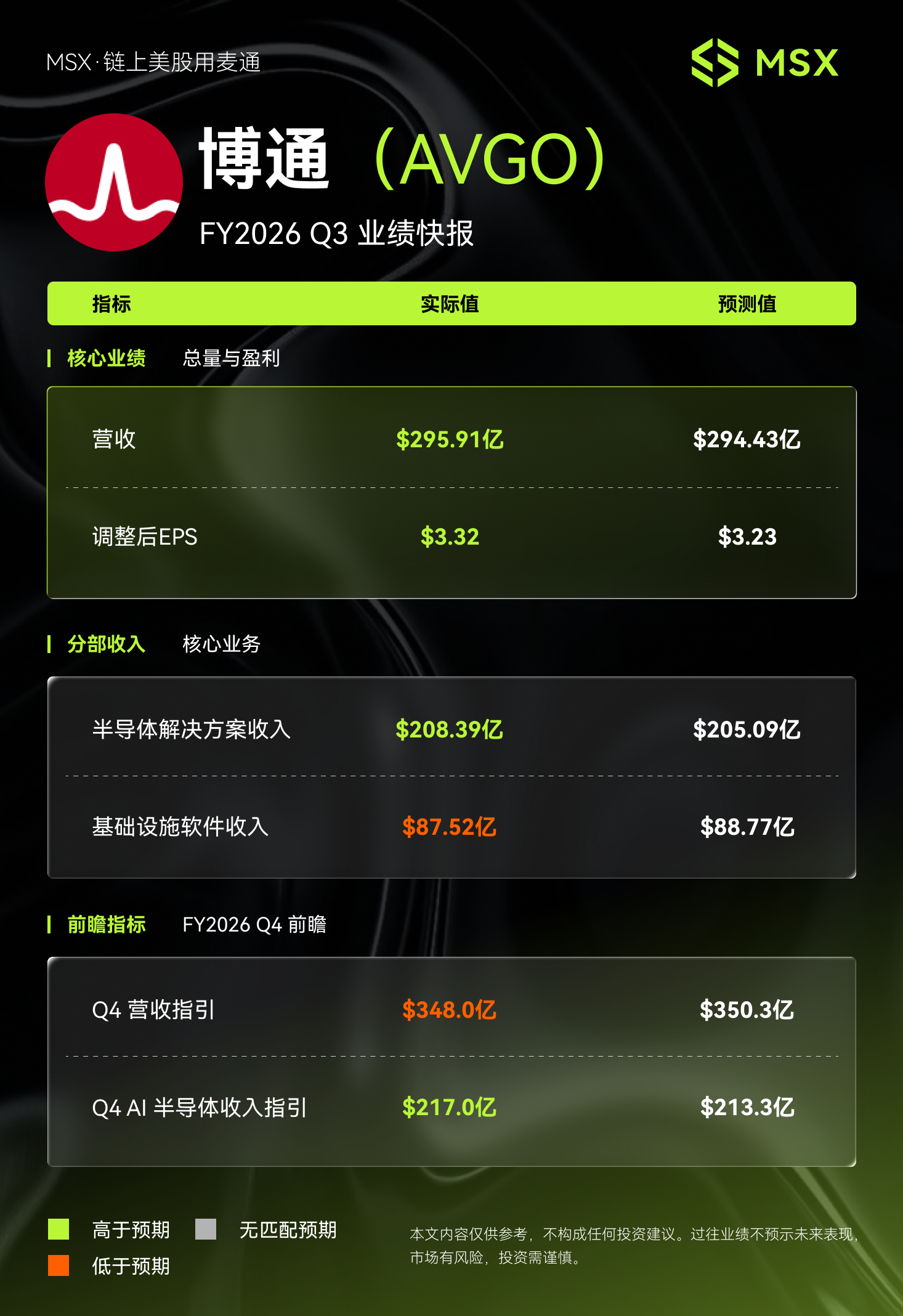
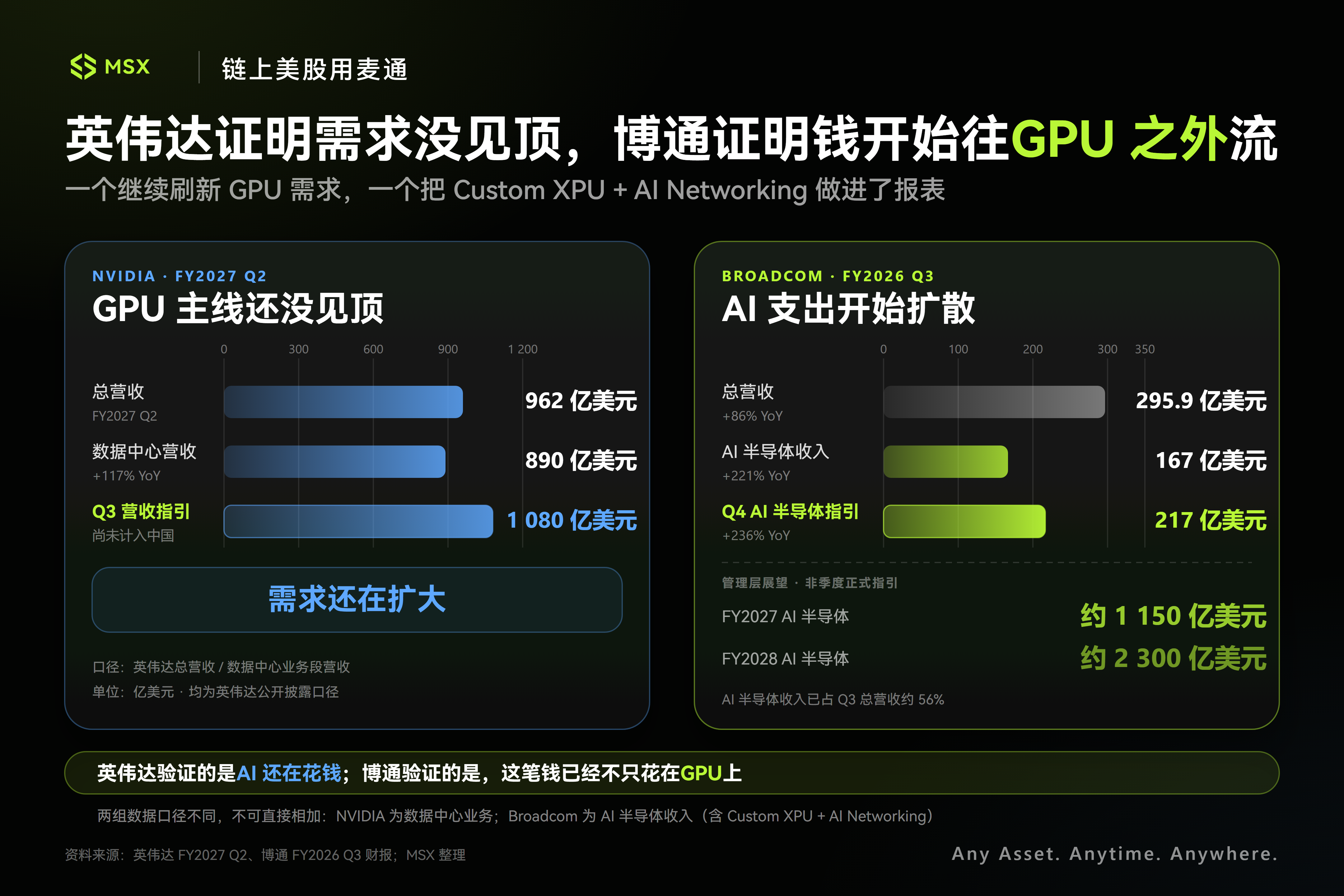
Nvidia’s results last week reinforced that demand for AI compute has not topped out. Broadcom’s report, released afterward, made another line of spending easier to see. The company posted $16.7 billion in Q3 AI semiconductor revenue, above its earlier $16 billion guidance. For the next quarter, it raised that figure to $21.7 billion. More striking still, Broadcom said it sees AI chip revenue at about $115 billion in FY2027 and as much as $230 billion in FY2028.
That leaves less room to frame ASICs as a still-theoretical second growth curve for AI. At least at Broadcom, that revenue is already showing up in the accounts, and the scale implied by management is larger than many had expected. The next questions are whether major programs at Google, OpenAI, and Anthropic stay on schedule, and how much of that spending Broadcom can capture.
GPU demand remains strong, but buyers are changing how they spend
Nvidia’s earnings suggested that cloud providers, AI companies, and model labs are still adding compute even from a very high base. But once AI capital spending moves from tens of billions of dollars into the hundreds of billions, and then toward annual spending in the trillion-dollar range or beyond, purchasing logic changes with it.
Large technology companies are starting to ask more direct questions. How much does it cost to complete the same AI workload? With the same 1GW of power, how much usable compute can be produced? If certain workloads are already highly stable, is it still necessary to run all of them on the most expensive products available?
That is the backdrop for the rising importance of ASICs. Even so, it is too simple to describe an ASIC as merely a cheaper GPU. Its actual edge comes from specialization.
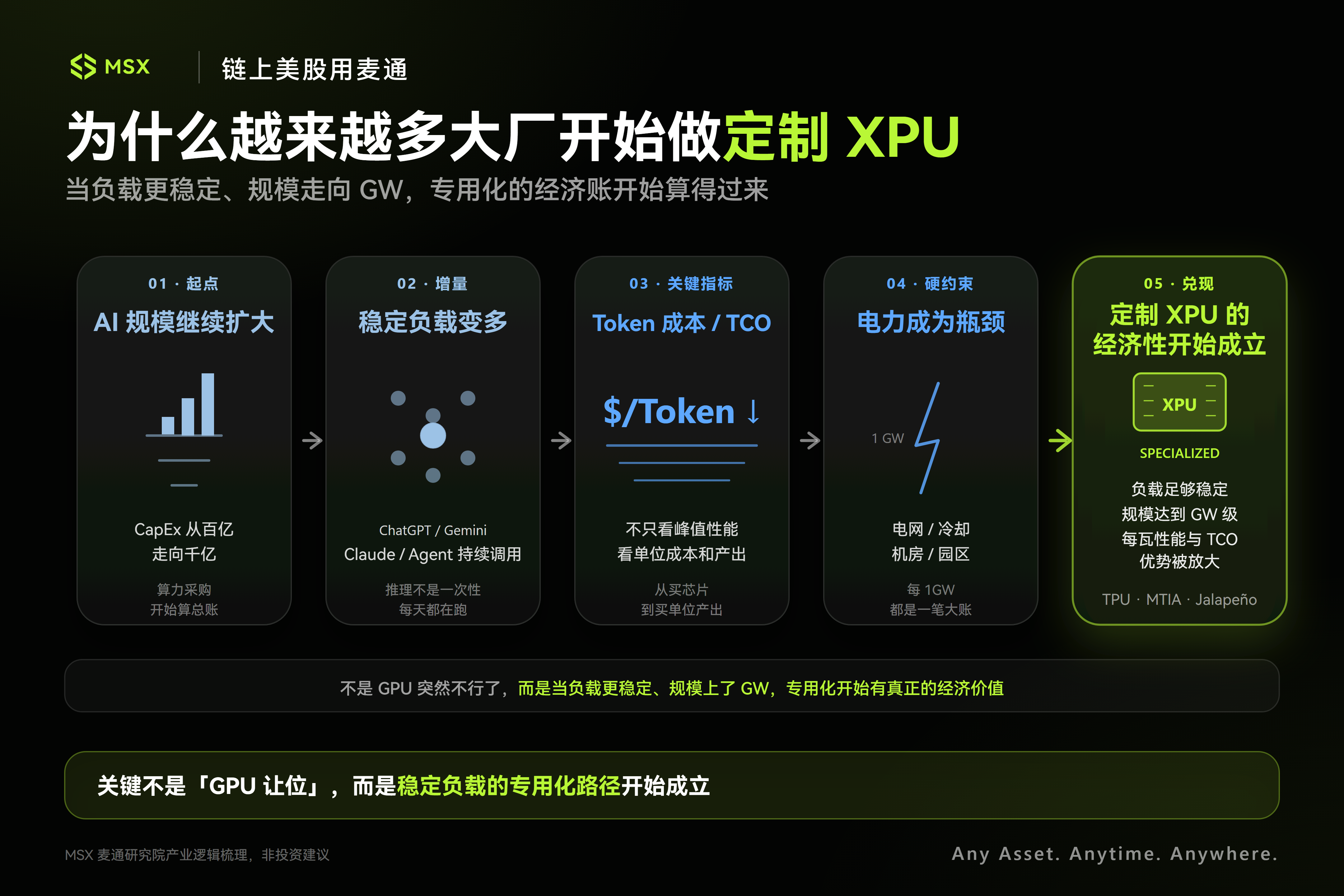
Designing a custom chip is not cheap. Upfront R&D is heavy, development cycles are long, and companies must align software, advanced packaging, networking, systems, and supply chains. But once a workload is stable enough and deployment scales from tens of megawatts to hundreds of megawatts, then to gigawatt scale, gains in unit cost, performance-per-watt, and full-system total cost of ownership can expand quickly.
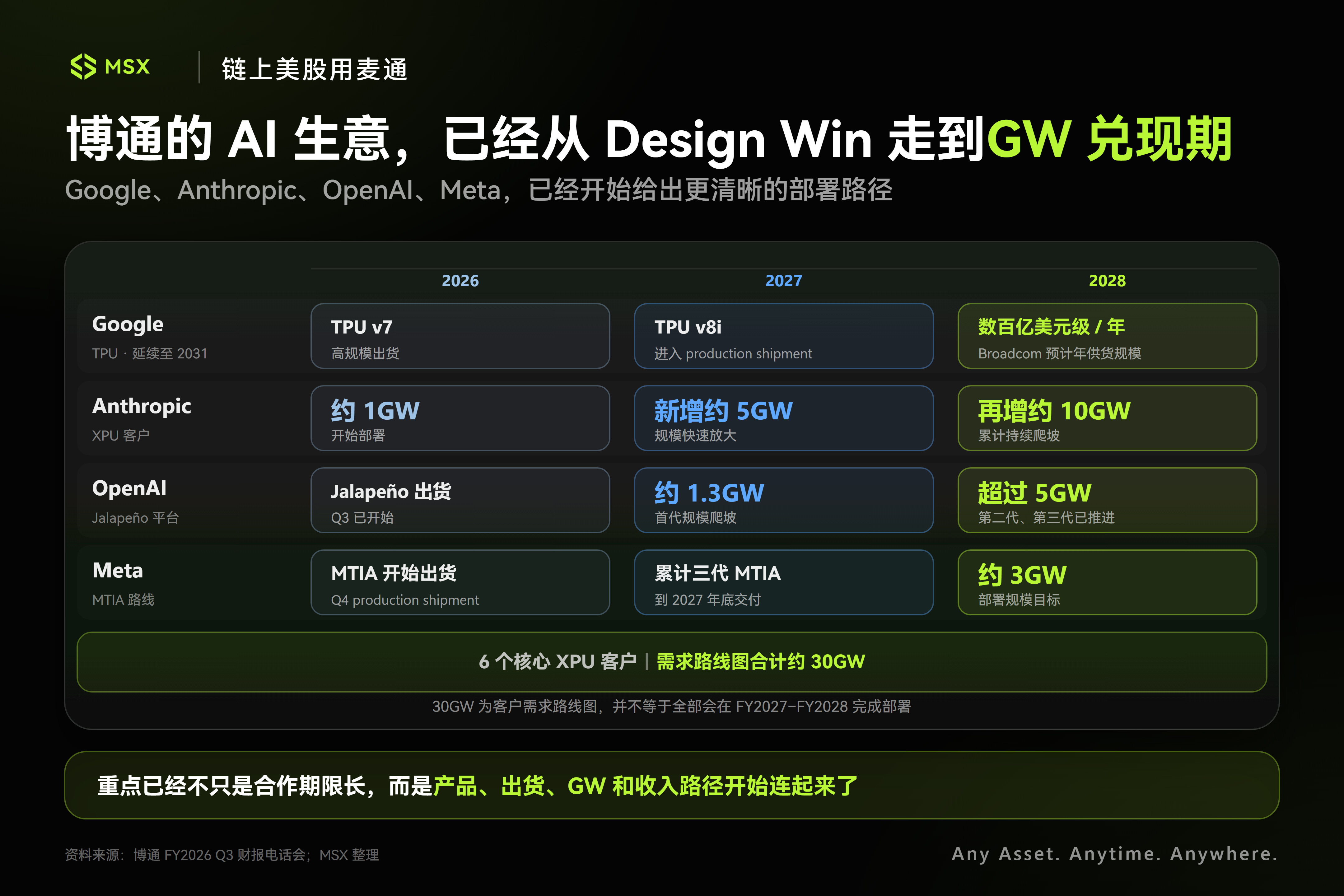
That helps explain why Google has stayed committed to TPU, why Meta is extending MTIA, and why OpenAI has started developing its own processors with Broadcom. For those companies, moving even part of their largest and most stable workloads from general-purpose chips to custom silicon can carry meaningful economic value.
Inference is becoming a key driver
The article ties that shift to several conditions maturing at the same time. The most important one is that inference is becoming a larger incremental workload.
Training often comes in phases. Inference is different once products such as ChatGPT, Gemini, Claude, and a growing number of agents enter production use. It becomes a task that runs every day. As call volumes rise and model structures and service patterns become more stable, hardware optimized for a specific workload starts to make more sense.
In June this year, OpenAI formally introduced its first jointly developed Intelligence Processor, Jalapeño, with Broadcom. The chip is positioned for LLM inference. The article says it is not a one-off design but the first product in a multi-generation compute platform, with deployment planned from the end of 2026 and future expansion aimed at gigawatt scale.
Meta is following a similar path. It is pushing through four generations of MTIA over two years, focused on recommendation, ranking, and generative AI. Several of those products explicitly follow an inference-first design approach. In April this year, Meta also expanded its partnership with Broadcom. First-phase deployment has already exceeded 1GW, with plans to scale to multiple gigawatts. Their multi-generation product cooperation is expected to run through 2029.
Together, those developments point to a change in how large AI buyers judge hardware. The goal is no longer only peak performance. The question is whether tokens can be produced more cheaply.
As AI becomes more commercial, the cost per million tokens, the amount of effective compute produced per watt, and the total cost of ownership for an entire data center all move closer to the center of the decision. In that framing, ASICs are a way for major AI companies to take back control over part of that cost structure.
Broadcom is betting on more than ASICs
That context makes Broadcom’s revenue mix easier to read.
In the prior quarter, Broadcom reported total revenue of $22.187 billion, up 48% year over year. AI semiconductor revenue reached $10.8 billion, up 143%. Guidance for the next quarter was more aggressive: about $29.4 billion in total revenue, with AI semiconductor revenue expected at $16 billion, up more than 200%.
On that basis, $16 billion would equal roughly 54% of Broadcom’s expected quarterly revenue. If the company hits that mark, AI semiconductors alone could contribute more than half of total revenue, even with infrastructure software businesses such as VMware included in the overall figure. Put plainly, AI is changing Broadcom’s revenue structure directly.
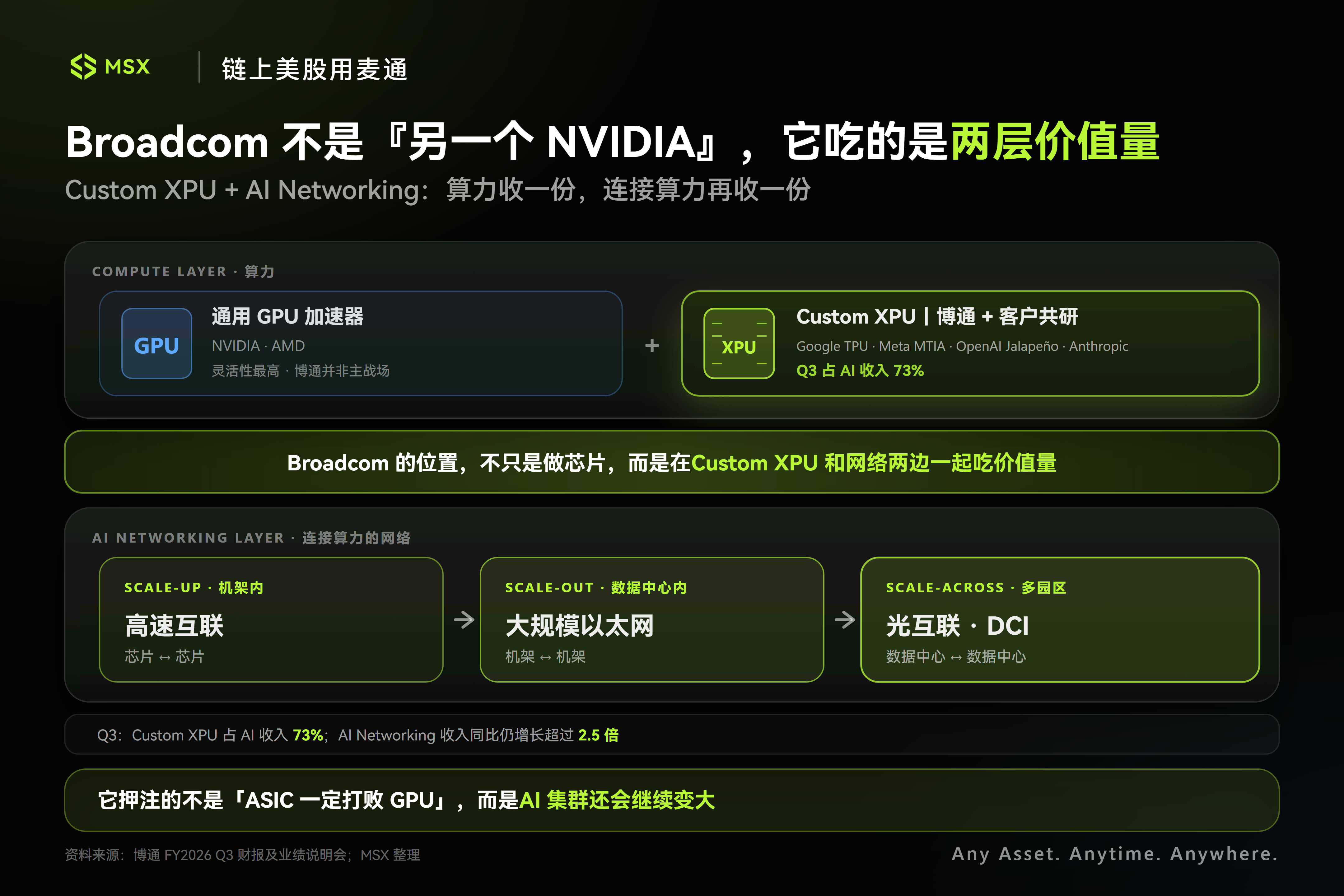
Still, the article cautions against treating that $16 billion figure as pure ASIC revenue. It also includes AI networking products such as Ethernet switch chips, SerDes, PCIe, and optical interconnect. In the prior quarter, networking was already close to 40% of AI semiconductor revenue. Hock Tan said that proportion may be near a temporary high and could settle back toward about 30% over the longer run.
That leaves Broadcom growing along two lines at once: Custom XPU and AI networking. It is one of the clearest ways the company differs from many chipmakers focused on a narrower slice of the market.
As AI clusters expand from thousands of chips to tens of thousands, then into even larger systems, the links between those processors become more important. Broadcom is dividing AI networking into scale-up, scale-out, and scale-across, covering high-speed interconnect inside the rack, large internal data-center networks, and connections across multiple data centers.
If large cloud providers keep developing their own ASICs, Broadcom can participate through Custom XPU. If GPU clusters continue to grow, the open Ethernet networking market may also keep expanding. In that sense, the company is betting on rising complexity across the entire AI infrastructure stack.
Customers are unlikely to rely on a single vendor
That does not mean competition has disappeared.
The article notes that Google has signed a long-term agreement with Broadcom to co-develop future generations of TPU and components tied to the next generation of AI racks, with the arrangement running as long as 2031. At the same time, Google has recently expanded its custom chip work with Marvell.
That alone suggests large customers are not eager to hand their future architecture to a single supplier. The same logic is likely to apply to Meta and OpenAI as well. Broadcom’s current position is real, but it is not the same as having customers fully locked in.
The next test is execution
The market had already expected Broadcom’s AI business to be strong. That is why the real question around this earnings release was not simply whether the company could hit $16 billion. The answer to that has now become clearer. The larger issue is how long this growth curve can run and how those headline numbers will be delivered.
With roughly $115 billion for FY2027 and $230 billion for FY2028 now on the table, the next things to watch are whether projects at Google, Meta, OpenAI, and Anthropic can advance to gigawatt-scale deployment on schedule; whether Broadcom can keep winning second- and third-generation products after the first generation enters volume production; and whether its networking business can grow alongside cluster size.
Those questions may matter more than whether one quarter comes in tens of billions of dollars above another.
Seen from that angle, Broadcom’s report is also a reminder that custom chips, networking, and interconnect, once treated as supporting pieces, are moving toward the center of the AI build-out. It also suggests that this wave of AI infrastructure investment may still be far from a stage defined only by replacement demand.
As long as large technology companies keep building bigger clusters, buying more power, and generating more tokens, new bottlenecks will continue to appear. New profit pools may appear with them. AI, in this telling, is growing from a single-chip story into a full infrastructure story.