

A MarsBit article by Shao Jiadian says Chinese companies doing overseas business cannot answer the stablecoin payment question with a blanket yes or no. The first issue is who is actually receiving the money, followed by how the funds are settled, booked, and used.
The article says the issue comes up in cross-border e-commerce, software subscriptions, gaming overseas, and other services aimed at foreign customers. For offshore operating entities that meet local legal requirements and service onboarding rules, stablecoin payments can be one collection option. Still, three setups need separate analysis: a mainland company receiving crypto directly, an offshore company receiving crypto, and a customer paying in stablecoins while the merchant receives fiat.
Start with the payee, not with who owns the business
The article says the phrase “we are a Chinese company” may work in a business introduction, but it is not specific enough for legal analysis.
It gives two examples. In one, a company registered in Shenzhen signs an export contract in its own name and asks the customer to send USDT to a designated wallet. In the other, a Singapore company owned by Chinese shareholders runs the overseas business in its own name, signs contracts, and receives payment. Even if the same owner sits behind both structures, the legal relationships are different.
If the seller and creditor remain the mainland company, the payment does not become offshore business just because the customer is overseas or the wallet uses an offshore platform. Mainland rules on virtual currency, foreign exchange, and tax and accounting treatment still need to be addressed directly.
If an offshore company is operating and collecting payment in its own name, the analysis shifts to the place of business, customer location, actual commercial activity, and payment arrangement. Those factors determine whether local law allows the setup, which steps must be handled by licensed institutions, and what requirements may be triggered by links back to mainland China. The article says Chinese shareholding alone is not enough to conclude that an offshore company cannot use a lawful local payment service.
At the same time, setting up an offshore company does not let a business simply relabel an existing transaction. If the contract is signed by the mainland company, the receivable belongs to the mainland company, and the offshore company only provides a crypto collection account, that is plainly different from an offshore company that actually procures, sells, and earns its own operating revenue. The article says the starting point should be the seller, the payee, and the real operating arrangement in the transaction. Where the account is opened is only one factor.
Mainland regulatory boundaries cannot be bypassed by “real trade” or “dollar stablecoins”
The article says any discussion needs an updated legal backdrop. A notice issued on Feb. 6, 2026, identified as Yinfa [2026] No. 42, replaced the 2021 “924 notice.” According to the article, the new notice keeps the regulatory stance that virtual currencies cannot circulate as money, bans related exchange business in China, and states that offshore entities and individuals may not illegally provide virtual-currency-related services to domestic parties.
Against that backdrop, the article says “we are selling real goods, not speculating on crypto” is not enough to answer whether the payment method is lawful. A genuine trade background and a compliant payment method both need to be present. Based on those rules, the author says a mainland company directly receiving stablecoins and converting them on its own should not be treated as a routine compliant foreign-trade collection model.
The piece also warns against treating dollar stablecoins as dollars. USDT and USDC aim to maintain a value peg to the U.S. dollar, but tokens in a corporate wallet are not the same asset as U.S. dollar deposits in a bank account. Receiving stablecoins is not the same thing as completing dollar export proceeds collection.
It also draws a line between using a payment tool and operating a financial service. An offshore merchant collecting payment for its own goods is different from collecting, converting, or forwarding funds for other merchants. If an e-commerce platform goes on to handle funds for merchants on the platform, payment regulation or other financial-service rules need separate analysis. The article says the conclusion for a self-operated merchant cannot simply be copied over.
The article adds that the new notice also contains specific restrictions on domestic entities and offshore entities they control issuing virtual currencies abroad. Issuance and payment collection should be analyzed separately. Rules aimed at issuance should not be stretched into a blanket ban on all offshore collections, and payment collection should not be expanded into permission to issue tokens independently.
Customers can pay in stablecoins while merchants receive fiat
The article says many companies picture only one route when they think about stablecoin collection: open a wallet, have the customer send tokens, then find a channel to sell them.
For offshore business that local law allows, direct crypto collection is one model worth evaluating. But it also means the company takes on asset-management work of its own, including wallet permission controls, choosing the correct network, converting the assets received, and dealing with depegging events or frozen addresses. The article says a company cannot hand one employee the wallet password and assume the collection process is in place.
Another model looks much closer to a standard merchant payment service. The customer chooses stablecoins at checkout, a third-party payment institution receives, processes, and converts the payment, and the merchant receives fiat settlement under the agreed terms.
The article describes the flow this way: an offshore customer pays in stablecoins, the payment institution handles payment processing and conversion, and the offshore merchant receives fiat settlement.
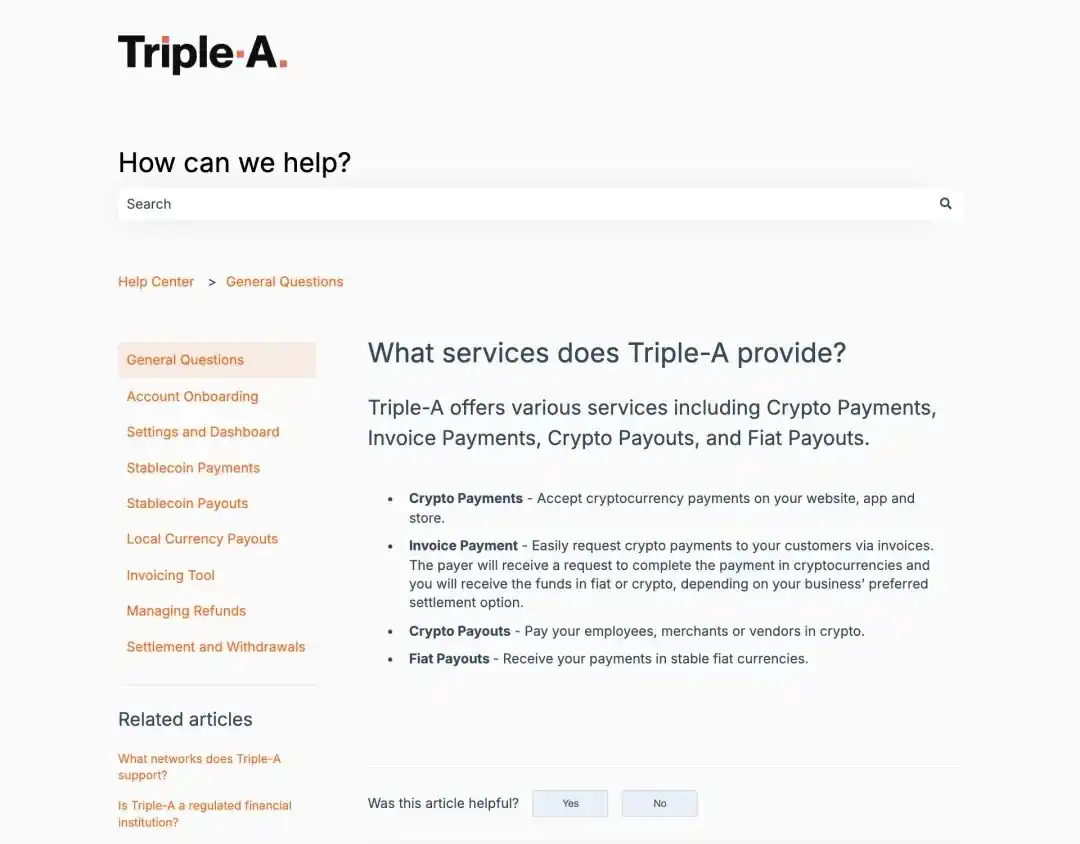
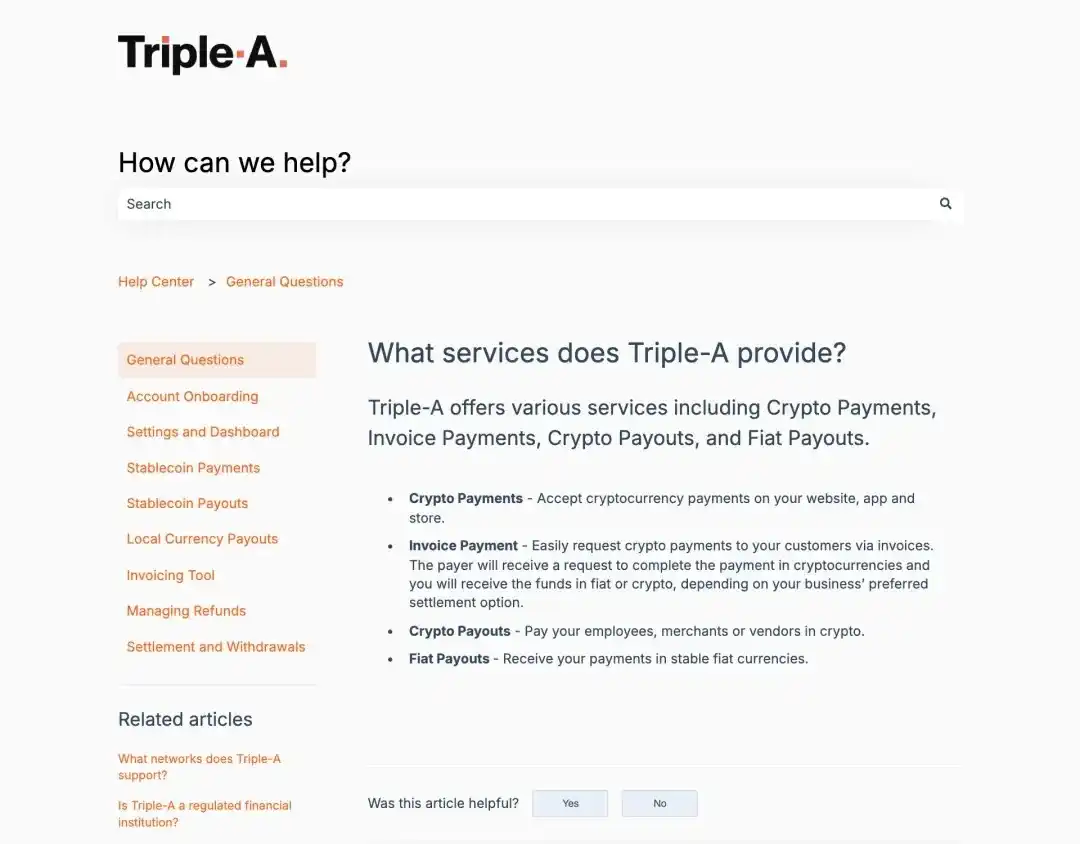
As an example, it points to Singapore payment institution TripleA, which offers crypto payment services for e-commerce sites, apps, and in-store merchants, and also supports invoicing for business collections. Customers can pay with supported cryptocurrencies, while merchants can choose fiat settlement. For companies that want to accept stablecoin payments without holding crypto themselves, the article says this is one option worth assessing. Whether onboarding is available still depends on the company’s location, business type, and the institution’s review.
The article says the value of this model is concrete. It gives customers another payment option and reduces the merchant’s burden of safeguarding and converting crypto assets.
Its basic test for whether a company can use such a service is straightforward: if the company is genuinely operating offshore business, local law permits the arrangement, the payment institution’s license and service scope cover that business, and merchant onboarding is completed, the service can be used to collect payment for the company’s own goods or services.
The article gives a specific example. A Singapore company set up by a Chinese business sells goods or software services to overseas customers in its own name and wants a payment institution to process stablecoin payments and settle fiat to the company. That setup can be assessed under this route. The article says the company should submit truthful information on the company, shareholders, and business during onboarding, confirm that customer regions, goods or services sold, and payment currencies fall within the supported scope, and agree on settlement into the company account. During operations, it should continue cooperating with transaction checks, keep order, delivery, and settlement records, and handle accounting and tax matters according to law. Passing institutional review is only the entry condition; ongoing compliance still applies.
If the contracting seller and recipient of the receivable remain a mainland company, the article says this offshore merchant model cannot simply be copied over. Borrowing an offshore account, or having an institution receive crypto first and then remit dollars, does not automatically solve mainland regulatory issues. It also says permission to collect payment for one’s own business does not mean a company may collect, convert, or forward funds for others. Using the service for reviewed, genuine business is the basic boundary.
For e-commerce and service businesses, refund terms should also be set out in advance. If goods are returned or services are canceled, the parties need to know whether the refund is made in fiat or stablecoins and which point in time is used to calculate the amount. The fact that on-chain transfers are hard to reverse does not erase refund obligations tied to the underlying goods or services.
Licensed institutions exist offshore, but the license scope still matters
The article says companies choosing these services should verify more than the fact that a provider is licensed. They also need to check whether the approved business lines actually cover the collection arrangement they plan to use.
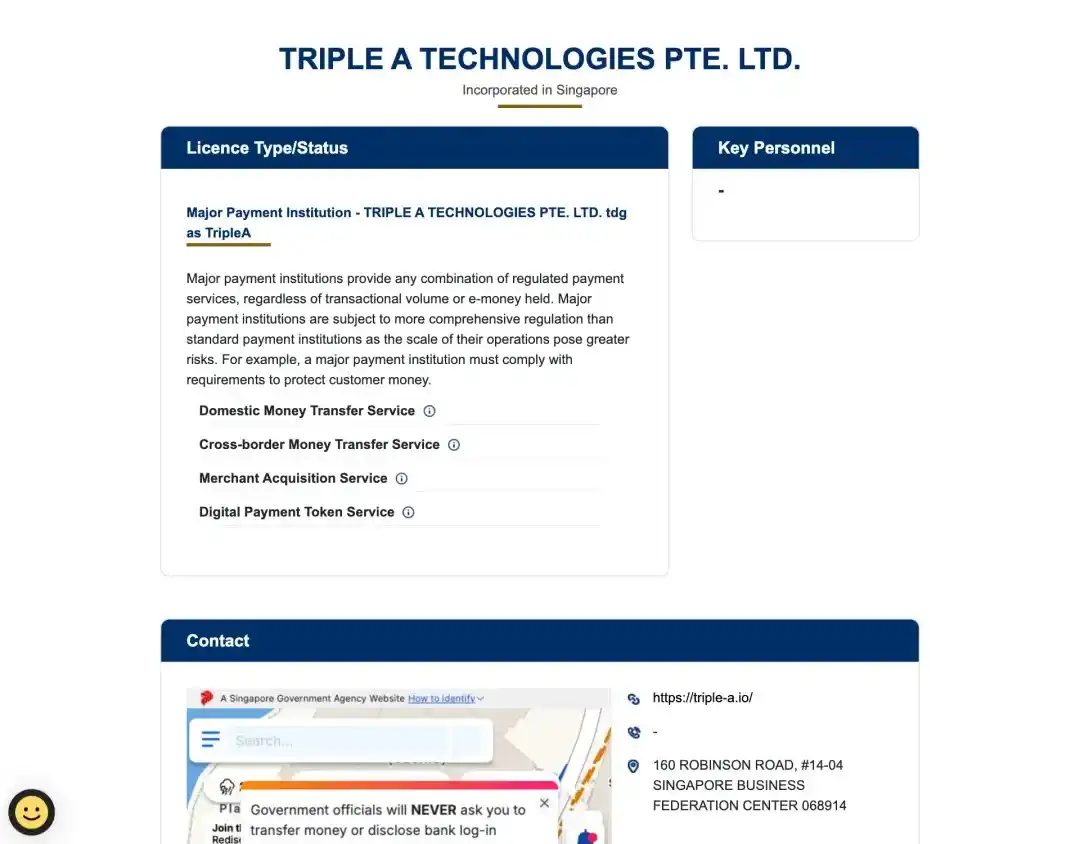
Using TripleA again as the example, the article says the Monetary Authority of Singapore, or MAS, lists several approved activities under its major payment institution license, including merchant acquisition, digital payment token services, domestic money transfer, and cross-border money transfer. Those details matter because a setup in which the customer pays in stablecoins and the company receives fiat may involve merchant collection, stablecoin conversion, and fiat remittance. Seeing the label “major payment institution” alone is not enough to determine whether the full service chain is covered.
The article says companies can verify a provider from three angles: the contracting entity, the exact service, and the regions where the service applies.
First, the actual contracting entity needs to be checked. Some brands operate through multiple companies. The website may display the license of one entity while the contract is signed by another. Different entities can divide work among themselves, but the contract and business arrangement should show which company handles which part of the service and on what basis.
Second, the actual service should be matched to the approved business lines. The provider should explain who receives the customer’s stablecoins, who performs the conversion, and who remits fiat into the company’s account. If partner institutions are involved, each party’s role and qualifications should also be made clear. One company’s approval for one activity cannot be used as shorthand for the entire payment chain.
The article also says “registration” and “licensing” should not be mixed together. It notes that the U.S. Financial Crimes Enforcement Network, or FinCEN, has specifically warned that MSB registration is not an operating license and does not amount to government endorsement of an institution’s legality or business. So when companies see marketing language such as “U.S. MSB license” or “globally compliant collections,” they should still verify the actual permissions involved.
Finally, the service must be checked against the company itself, the customer regions, and the industry involved. A lawfully incorporated offshore company will not necessarily be accepted by every payment institution, and the fact that a region allows related business does not mean every stablecoin can be used for local goods and services payments.
The author says companies should ask providers to spell out settlement currency, fees, conditions for funds arrival, and how freezes are handled before signing. They should also confirm that payment and settlement records tied to each order can be obtained. A licensed institution can handle specialized steps, but it does not remove the company’s responsibility for the underlying goods transaction, tax treatment, or source-of-funds issues.
Receiving money offshore and bringing it back onshore are separate questions
The article says finance teams usually ask the next question once the collection model is mapped out: can the money received overseas be used to pay domestic suppliers, or be remitted back to China?
Its answer starts with ownership of the funds and the legal basis for the payment.
If an offshore company is genuinely running overseas sales, receives fiat proceeds through a qualifying payment institution, and then pays a mainland factory for procurement, the analysis should focus on the authenticity and legality of the offshore sales, the onshore procurement, and the related fund flow, as well as whether the bank will accept the settlement arrangement. The article says the fact that an upstream consumer used stablecoins does not remove the need for a concrete review, and the fact that the final remittance is in U.S. dollars does not mean the front-end arrangement needs no explanation.
If the offshore company distributes profits to a mainland shareholder, that should be handled under the legal framework for dividends, together with the applicable corporate, tax, and foreign-exchange requirements. The article says that basis is different from payment for procurement and should not be switched casually just to make funds easier to receive.
Looking at the issue from the other direction, if the income belongs to the mainland company from the start but is collected through an offshore company or an individual wallet, it cannot simply be booked as the offshore company’s own operating revenue. Changing the collection tool does not change who owns the underlying claim.
The article says China’s foreign-exchange rules require a real and lawful transaction basis for trade-related foreign-exchange receipts and payments, and banks must also carry out due diligence and anti-money-laundering obligations. Contracts, orders, logistics or service-delivery records, and settlement statements from the payment institution should therefore be able to explain the funds together.
If the actual remitter is the payment institution rather than the contractual buyer, that does not automatically mean the transaction is problematic. But the collection and settlement relationship, along with supporting records, needs to be in place. Where stablecoin handling is involved, the article says the full path should be disclosed truthfully and discussed with the handling bank in advance. A bank’s willingness to process the transfer still does not replace a legal assessment of the overall arrangement.
The author also warns against using private coin exchange, offshore-onshore offsetting, or fabricated trade as a collection solution. Those arrangements may create risks tied to illegal foreign-exchange conversion or money laundering. A real order does not provide legal cover for every way of moving funds.
Accounting treatment also needs to keep pace with the business. If a company receives stablecoins directly and later converts them into fiat, the related assets and transactions need to be handled under the applicable standards. If the company receives fiat settlement, it still needs to reconcile sales revenue, fees, and net proceeds received. Holding income in an offshore wallet or payment platform does not remove the need for proper accounting and tax treatment.
The article’s conclusion
The article concludes that for Chinese companies engaged in overseas business, offshore stablecoin collection must be judged against the specific business setup. A mainland company receiving stablecoins directly, an offshore company set up by a Chinese business receiving payment, and a customer paying in stablecoins while the merchant receives fiat through a payment institution all involve different legal relationships. They cannot be reduced to a single answer.
It says offshore markets already have many institutions offering stablecoin payment and fiat settlement services. For offshore operating entities that meet local legal requirements and institutional onboarding standards, those services create a new collection option and can reduce the burden of managing wallets, holding crypto, and converting digital assets internally. Even so, the scope of the payment institution’s license, the actual service recipient, and the settlement arrangement still need to match the company’s business.
The author’s final point is that companies can actively study these payment tools and include them in their assessment of overseas collection options. But when the arrangement is put into practice, the receiving entity, payment chain, tax and accounting treatment, and use of funds all need to line up with one another before the new payment method can support order conversion and day-to-day operations.