
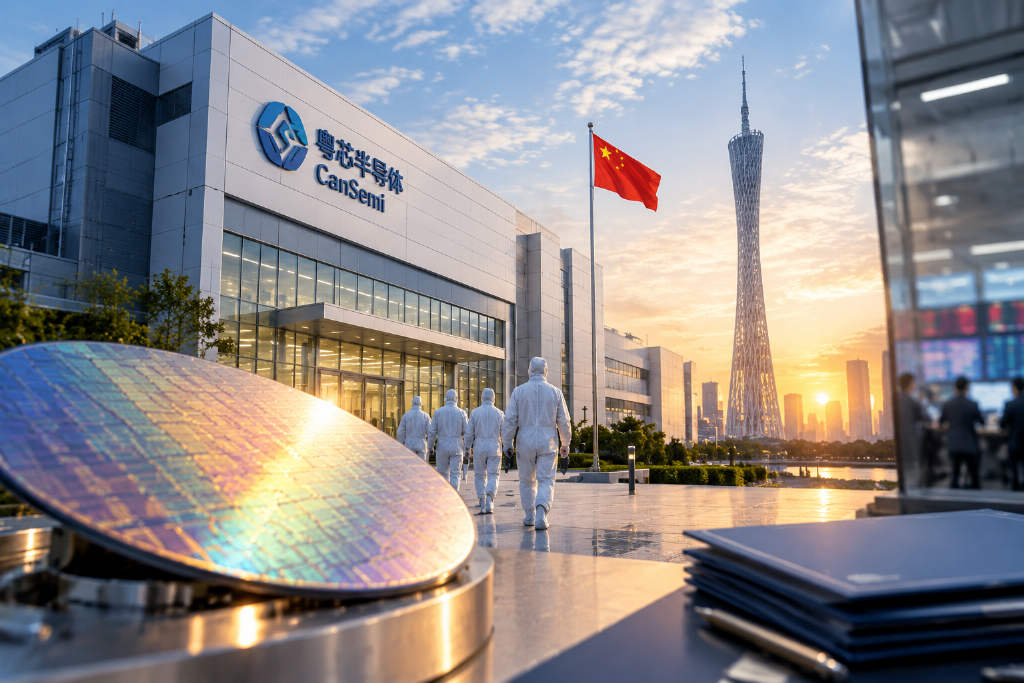
CanSemi Technology, a Guangzhou wafer foundry valued at RMB 30 billion, took just nine months to move from filing for an IPO to the verge of listing.

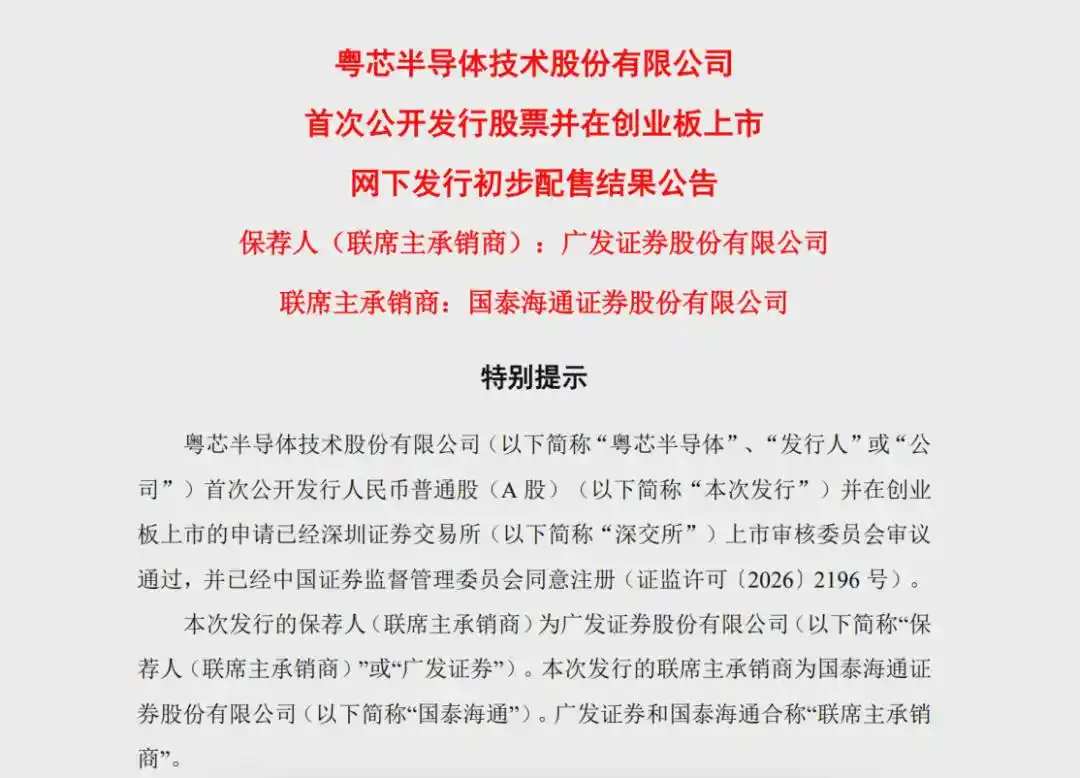
Its subscription results were released recently. The offering price was set at RMB 12.01 per share, with 179 million shares issued online. The winning rate came in at only 0.04238%, while valid subscriptions reached 2,359.68 times. The prospectus names GF Securities as sponsor and lead underwriter, and Guotai Haitong Securities as the contact lead underwriter.
According to the Hurun Research Institute’s 2026 Global Unicorn Index, Guangzhou is home to 24 unicorns with a combined valuation of more than RMB 800 billion, ranking 12th among global cities and fifth in China. CanSemi, described as Guangzhou’s “first chip,” is valued at RMB 30 billion and ranks as the city’s fourth-largest unicorn.
The company is headquartered in Sino-Singapore Guangzhou Knowledge City in Huangpu. Though it was founded relatively recently, it has quickly become a central name in Guangzhou’s semiconductor push and has drawn upstream and downstream companies into the area. It is now in an accelerated phase of converting installed capacity into volume production.
How Guangzhou moved to fill its manufacturing gap
In May 2017, China’s Ministry of Industry and Information Technology and the Guangzhou municipal government jointly organized an event in Guangzhou Development District focused on the integrated circuit industry.

The event brought together 15 participating and supporting institutions, including government departments, national and provincial electronics and semiconductor associations, and major companies such as SMIC and Haige Communications. Nearly 150 people attended, including executives from chain-leading companies, financial institutions, and research organizations. Companies named in the article include Qualcomm, ZTE Microelectronics, Spreadtrum Communications, and Advanced Micro-Fabrication Equipment.
The message was simple: integrated circuits were a strategic priority and development needed to accelerate. For Guangzhou, the practical question was how to turn that goal into local industrial capacity. The city’s approach was summed up in one line: strengthen leading firms and fill weak links.
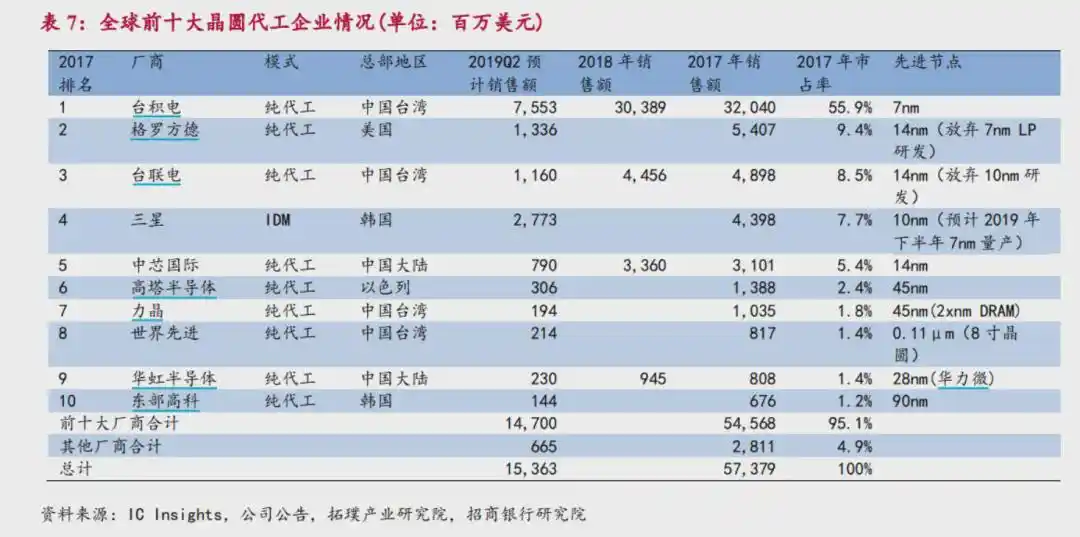
At the time, about 55.9% of the global wafer foundry market was held by TSMC, while GlobalFoundries, UMC, Samsung, and SMIC together controlled 31%. In China, 12-inch wafer capacity was concentrated in the Yangtze River Delta and North China.
Guangdong, by contrast, was already the country’s largest electronics manufacturing province, with revenue above RMB 4 trillion and more than 30% of the national total. Yet the Pearl River Delta, centered on Guangzhou and Shenzhen, was long stronger in chip design than in manufacturing. That left many high-end manufacturers sending chip designs to foundries in the Yangtze River Delta, where they faced both higher costs and capacity constraints.

Five months later, Guangzhou issued its implementation plan for building a pilot demonstration city under “Made in China 2025,” with a focus on IAB industries: next-generation information technology, artificial intelligence, and biomedicine. Around that time, under the lead of Science City Group, a state-owned enterprise in Huangpu, semiconductor veteran Chen Wei joined with Jinyu Group founder Li Yongxi to establish CanSemi in Knowledge City.
That marked the birth of what the article calls a dark horse in China’s domestic wafer foundry sector.
A Growth Enterprise Market first for wafer foundries
In December 2017, CanSemi officially landed in Guangzhou’s Huangpu district. It set up China’s first 12-inch chip fab run under a virtual IDM operating strategy, while 15 upstream and downstream projects were brought in around it under a specialty-process route.
The company moved quickly. Within two years, it completed and launched its phase-one plant: piling began in March 2018, and volume production started in September 2019. Phase one, two, and three production lines were then rolled out in sequence. Total investment exceeded RMB 30 billion, with planned capacity reaching 120,000 wafers per month. The company has also become the only enterprise in mainland China with large-scale mass-production capability for 12-inch silicon photonics wafers.

Instead of joining the race in advanced nodes, CanSemi chose specialty mature processes from 180nm to 55nm. Its focus is on analog and mixed-signal chips used for functions described in the article as sensing, transmission, computing, storage, control, and display, with plans to extend to 40nm and 22nm.
The article presents the logic in direct terms: make what the market is short of first. Analog chips cover many niche categories, serve a broad set of applications, and tend to have strong customer stickiness, while the overall market remains fragmented. Citing Statista, the article says China’s analog chip market reached RMB 198.64 billion in 2024 and is projected to rise to RMB 258.77 billion by 2028, for a compound annual growth rate of 6.83%. Texas Instruments, it adds, holds less than 20% market share.
That structure gave CanSemi a relatively clear commercial path. From 2023 to 2025, its core business revenue rose from RMB 1.02 billion to RMB 1.63 billion and then RMB 2.51 billion, representing a three-year compound annual growth rate of 57.3%. Revenue in the first quarter of 2026 rose about 72% year on year to RMB 805 million. As of the end of May this year, the company had 321,200 wafers in hand orders worth RMB 1.533 billion.
Capital followed. Tianyancha data cited in the article shows that CanSemi has completed five financing rounds. Investors include Science City Group, GAC Capital, Guangzhou Industrial Investment Group, Yuecai Fund, and Yuexiu Industrial Fund, along with ABC Investment, CCB Investment, BAIC Capital, and Winreal Capital.

After its latest funding round, the company’s post-money valuation reached RMB 25.3 billion. Hurun’s latest estimate put it at RMB 30 billion. At the end of December 2025, CanSemi formally began its push into the capital markets. In August this year, it completed registration and is now set to become the first wafer foundry listed on ChiNext, the Growth Enterprise Market.
The article says Guangzhou’s early combination of government-led investment attraction, association matchmaking, funding support, and enterprise recruitment formed a “CanSemi model” that other cities later studied. Zhuhai, for example, held a similar event in 2019 and set up the Zhuhai Advanced Integrated Circuit Innovation Research Institute, following a path built around stronger design capabilities, a fuller supply chain, and heavier emphasis on innovation. It later landed projects including the world’s first mass-production 8-inch silicon-based gallium nitride line and Guangdong’s first TSV advanced packaging line.
Losses persist, but capacity conversion is the key metric
CanSemi’s prospectus also lays out a blunt reality: the company is still loss-making. From 2023 to 2025, cumulative net profit attributable to the parent was a loss of RMB 6.51 billion. By the end of 2025, undistributed profit stood at a loss of RMB 10.08 billion.
The company says this is tied to the heavy upfront investment required for a semiconductor wafer fab, along with the period needed to ramp both capacity and yield. Its second fab, referred to as phase three in the article, is gradually entering production. A third fab, phase four, with planned capacity of 40,000 wafers per month, started construction in the first quarter of this year. Once completed, total planned capacity will reach 120,000 wafers per month. By the end of 2025, fixed assets and construction in progress together accounted for close to 60% of total assets.
The article compares that stage with ChangXin Memory Technologies, which recorded RMB 23.5 billion in net losses attributable to the parent in 2023 and 2024 during its own capacity and yield ramp-up. For CanSemi, the more important question is whether capacity can be converted into sustainable operations.
The prospectus says CanSemi has already reached 63,300 wafers per month of existing capacity. Based on that base alone, the article argues, the company has largely proven its commercial model. One core indicator is operating cash flow: it had already turned positive at RMB 690 million in 2022, then stayed positive for four consecutive years through 2025, with a cumulative four-year total of RMB 2.05 billion.
That suggests the company has started to build a cycle of “operations, investment, and renewed operations.” In its prospectus, CanSemi said it could achieve profitability at the consolidated reporting level as early as 2029. The article also notes that if its ChiNext listing goes through smoothly, support from the capital markets could pull that timeline forward.
The IPO is set to raise RMB 7.5 billion. The proceeds are mainly earmarked for the phase-three project, specialty-process technology platform R&D, and early work on a 22nm RRAM compute-in-memory chip. The use of funds points to the company’s longer-term direction: analog foundry services are the base business, while breakthroughs in domestic substitution for high-end analog, mixed-signal, silicon photonics, and optoelectronic integration chips are the bigger target.
Guangzhou’s broader semiconductor buildout
The article frames CanSemi’s rise as only the start of Guangzhou’s answer to its chip shortage problem.
On Sept. 29, the Guangxin Semiconductor advanced packaging substrate project in Guangzhou officially broke ground. Its target products are high-end FCBGA packaging substrates, and the article says its carrier-board capabilities are expected to rank in the top tier among county-level districts nationwide. With chain-leading companies such as CanSemi and Guangxin, Huangpu has gathered more than 150 integrated circuit enterprises and built a full chain stretching from chip design to end applications. In the first eight months of this year, the district’s output value rose 36.6% year on year to RMB 31 billion, already more than 90% of last year’s full-year total.
CanSemi and Guangxin are only part of the picture. Huangpu also hosts companies including Xinruiguang, Aifo Guangtong, Smarter Micro, Gowin, and Techtotop Micro. Nansha has what the article calls a “chip street,” home to projects such as Xinyueneng, Xinjuneng, Jinke, Rongjie, Lisheng Technology, and Nansha Wafer. In Zengcheng, phase one of Zengxin is pushing toward full production, while phase two is being prepared.
The article says Guangzhou’s “one core, two poles, multiple points” semiconductor layout has now taken shape. Underpinning the commercialization drive of projects such as CanSemi, Guangxin, and Zengxin is Guangdong’s role as the country’s largest buyer in electronics information manufacturing, backed by major companies including GAC, XPeng, BYD, OPPO, and Huawei.