
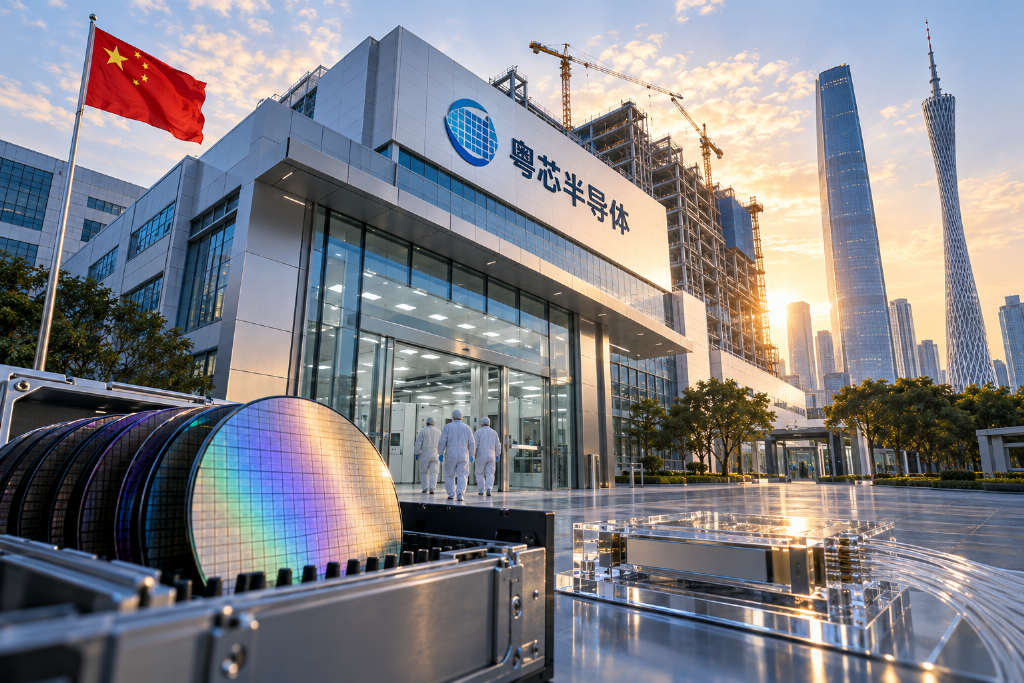
CanSemi Semiconductor made its debut on Shenzhen’s ChiNext board on Oct. 13, pricing its IPO at RMB 12.01 per share. The stock opened at RMB 45, up 274.69%, giving the company a market capitalization of about RMB 129.6 billion. It later pulled back and closed at RMB 38.80, still up 223.06% on the first trading day, with a market value of roughly RMB 111.7 billion.
That is a striking valuation for a chipmaker that has yet to post a profit. Only months earlier, the company’s financial statements painted a very different picture.
In the first half of 2026, CanSemi reported revenue of RMB 1.777 billion, up 68.76% from a year earlier. Net loss attributable to shareholders came to RMB 1.052 billion. After excluding non-recurring items, the loss widened to RMB 1.163 billion. Gross margin was negative 24.46%.
The longer record is even more revealing. Revenue reached RMB 1.044 billion in 2023, RMB 1.681 billion in 2024, and RMB 2.582 billion in 2025. Over the same period, net loss attributable to shareholders was RMB 1.917 billion, RMB 2.253 billion, and RMB 2.346 billion, respectively. Including the first half of 2026, cumulative net losses over the past three and a half years have exceeded RMB 7.5 billion.
Even so, the market assigned the company a valuation above RMB 110 billion. Based on 2025 revenue of RMB 2.582 billion, the closing market cap on listing day was more than 40 times last year’s sales. At the opening valuation near RMB 130 billion, that multiple briefly approached 50 times.
This is clearly not an investment case built on current earnings. At this stage, there is no meaningful price-to-earnings ratio to discuss. Investors are paying for what they think the company could become.
Utilization, not just losses, is the first number the market is watching
To understand CanSemi, it helps to start with the economics of a wafer fab. This is not a light-asset software business. Before the first wafer is produced, a fab has to spend heavily on cleanrooms and on equipment such as lithography, etching, thin-film deposition, and ion implantation tools.
Once those machines are installed, depreciation starts running through the income statement. According to the prospectus, CanSemi’s machinery and equipment are expected to have a useful life of six years, with an annual depreciation rate of 15.83%. For a fab still ramping capacity, that means depreciation hits costs even when the tools are not fully loaded.
That is a major reason the company has stayed in the red. But the more important operating metric may be utilization.
In 2023, CanSemi had capacity of 449,500 wafers and actual output of 248,300 wafers, for a utilization rate of 55.23%. In 2024, that figure rose to 84.79%. In 2025, capacity reached 614,800 wafers and actual production climbed to 592,600 wafers, lifting utilization to 96.38%.
Those numbers go a long way toward explaining why investors are willing to pay up. For a fab, the most dangerous situation is not high depreciation by itself. It is having expensive equipment in place without enough orders to keep the lines running. Once utilization rises, the same machines, the same buildings, and the same depreciation are spread across more wafers, pushing unit manufacturing costs lower.
That shift has already started to show up in the financials. Gross margin was negative 54.70% in the first half of 2025. By the first half of 2026, it had improved to negative 24.46%, an improvement of about 30 percentage points in one year. The figure is still below zero, but the direction is clear.
CanSemi gave a direct explanation in its prospectus. Sales of higher-priced products, including SiPho silicon photonics, BCD power management, and HV display driver products, increased and lifted average selling prices. Larger production and sales volumes diluted depreciation per unit. A higher localization rate for raw materials also reduced material costs.
That is why the first variable in the market’s thesis is not the exact date when CanSemi turns profitable. It is whether a fab already running close to full utilization can push gross margin above zero by improving pricing and product mix.
The valuation case leans heavily on silicon photonics
If CanSemi were simply another mature-node foundry, a valuation above RMB 100 billion would still be hard to justify. What the market appears to care about more is the company’s silicon photonics exposure.
CanSemi is not chasing the most advanced 3 nm or 5 nm nodes. Its two existing fabs mainly cover process nodes from 180 nm to 55 nm, which fall into the mature-node category. Its Phase IV project under construction is planned to cover 65 nm to 22 nm.
Mature nodes do not automatically mean low-end manufacturing. Analog chips, power management, automotive electronics, industrial control, CMOS image sensors, and power devices often do not require leading-edge nodes.
Artificial intelligence has added a new layer to that logic. Data centers need more than GPUs. As computing clusters scale from thousands of GPUs to tens of thousands of chips or more, data transfer between chips becomes a bottleneck. That has pushed high-speed optical modules, co-packaged optics, silicon photonics, and optoelectronic integration closer to the center of AI infrastructure spending.
CanSemi has a position in that chain. The company says it has built process platforms covering mixed-signal, HV display driver, CIS, embedded memory, BCD, and SiPho silicon photonics. Citing Frost & Sullivan in its prospectus, CanSemi said that as of the end of April 2026, it was one of the scarce participants in mainland China with large-scale mass production capability for 12-inch silicon photonics wafers. The company also said end customers for its silicon photonics business include well-known cloud service providers.
That changes the way investors look at a foundry. In the past, mature-node fabs were valued mainly on capacity, utilization, and wafer pricing. Now the market is also asking which capacity can plug into the AI supply chain.
That means two 12-inch mature-node wafers may not carry the same economic value if they are built on different process platforms. A wafer used for highly competitive traditional consumer electronics chips looks more like manufacturing. A wafer used for silicon photonics, optoelectronic integration, or high-end BCD products carries more of a technology growth profile.
CanSemi is clearly trying to position itself in the second group. In its Phase IV line, the company is prioritizing silicon photonics and optoelectronic integration, embedded memory, image sensors, mixed-signal, RF, and OLED display driver processes.
Phase IV is planned for 40,000 wafers per month. Together with the 80,000 wafers per month planned across its two existing fabs, total planned monthly capacity would reach 120,000 wafers. That is close to double the actual monthly capacity of 63,300 wafers at the end of 2025.
In other words, a large part of today’s valuation already reflects a future CanSemi running at 120,000 wafers per month, not just the company as it stands today at 63,300 wafers per month.
Doubling capacity also doubles the pressure to execute
This is where the harder part of the story begins. For a foundry, doubling capacity is a growth narrative, but it is also a risk narrative.
Every new fab means more equipment, more depreciation, and more fixed costs. If demand grows as expected and revenue rises faster than depreciation, profits can improve quickly. If new capacity runs into an industry downturn, falling wafer prices, or slower-than-expected customer qualification, losses can widen instead.
CanSemi did not avoid that issue in its listing materials. The company estimated revenue for the first three quarters of 2026 at about RMB 2.87 billion to RMB 2.97 billion, while net loss attributable to shareholders was still expected to come in at RMB 1.49 billion to RMB 1.59 billion.
That suggests the company remains some distance from profitability even if revenue growth stays above 60% this year. CanSemi’s own forecast says the earliest it expects to turn profitable on an overall basis is 2029.
To get there, the company laid out an aggressive revenue path. In responses to regulatory inquiries, CanSemi projected revenue of about RMB 3.551 billion in 2026, RMB 7.093 billion in 2027, RMB 9.278 billion in 2028, and RMB 12.470 billion in 2029. That would put 2029 revenue at nearly five times the 2025 level.
There is another detail in the prospectus that can be easy to miss. The forecast for profitability as early as 2029 is based on several assumptions: sustained revenue growth, recovering gross margin, capacity ramping on schedule, successful commercialization of new product R&D, and government subsidies at a reasonable level. The company specifically noted that the profit forecast includes income generated by government subsidies.
In the first half of 2026, non-recurring gains and losses attributable to shareholders totaled RMB 111 million, mainly from government subsidies recognized in current profit and loss.
So investors are not looking at a profit model that has already been proven. They are looking at a chain of assumptions that all need to hold: capacity must ramp smoothly, utilization must stay high, higher-value products such as silicon photonics and BCD must keep taking a larger share, wafer prices cannot fall sharply, and the depreciation burden from new capacity must be absorbed by a much larger revenue base. At the same time, the mature-node market cannot slide into a severe price war.
If any one of those pieces breaks, the 2029 profitability timeline could move back. That is why treating CanSemi simply as an “AI chip company” can lead to the wrong conclusion. It is still, first and foremost, a wafer manufacturer, and the business is ultimately decided by yield, utilization, product mix, and cost.
SMIC and Hua Hong offer a different benchmark
The tension in CanSemi’s valuation becomes clearer when it is placed alongside other Chinese foundries.
Semiconductor Manufacturing International Corp. (SMIC) posted RMB 67.323 billion in sales revenue in 2025, with monthly capacity of more than 1 million 8-inch equivalent wafers for standard logic, utilization of 93.5%, and gross margin of 22%. By revenue, SMIC was about 26 times larger than CanSemi in 2025 and had already established positive gross margin and profitability.
Hua Hong, whose specialty-process route is closer to CanSemi’s, reported second-quarter 2026 sales revenue of $717.5 million and gross margin of 16.5%. The company said it maintained high utilization in the quarter, with both volume and pricing rising.
CanSemi, by contrast, still posted a gross margin of negative 24.46% in the first half of 2026. That does not automatically mean the company is overvalued. It does show that the market is not valuing CanSemi as if it had already reached the earnings power of a mature industry leader.
What investors are paying for is closer to a growth option. They are assigning value today to a future in which the company moves from roughly RMB 2.5 billion in revenue toward RMB 10 billion, from negative gross margin to positive gross margin, and from a regional foundry to an important national player in specialty processes.
That is why the first-day pricing looked so unusual. On the income statement, it looks expensive. On industrial scarcity, the market is willing to give it time.
The real bet is on what happens after 2029
The capital logic behind China’s semiconductor sector has shifted over the past few years. The first phase was about whether the country had the necessary pieces at all: fabs, equipment, materials, and domestic chips. Capital was willing to pay a high price for that move from zero to one.
As more production lines have been built, the industry has moved into a second phase: after the fabs are built, can they make money? That question matters especially for CanSemi.
Its strategic role in Guangdong is not hard to see. Guangdong is one of China’s most important electronics manufacturing bases, yet it has long lacked 12-inch wafer manufacturing capacity that matches the scale of its downstream industries. CanSemi is a locally cultivated company in Guangdong and the first 12-inch wafer manufacturer there to achieve mass production. That gives it clear industrial significance.
But the capital market does not price industrial strategy alone. In the end, the stock has to come back to cash flow.
That is why the most important numbers to watch after listing are not just the 274% first-day jump or the intraday valuation near RMB 130 billion. The more important figures over the next three years are specific and measurable: when gross margin turns positive; whether utilization can stay above 90% as monthly capacity rises from 63,300 wafers to 120,000 wafers; how much revenue higher-value businesses such as silicon photonics and BCD can actually contribute; and whether CanSemi can cross the break-even line in 2029 as it has projected.
If those numbers are delivered, today’s valuation may prove to be the market paying early for future growth. If they are not, the near-RMB 130 billion valuation seen on the first trading day may end up looking like one of the most expensive early bets in China’s semiconductor market.
This article was sourced from the WeChat public account Alpha Workshop Research Institute, written by Beichen.



