

Input Output said Friday it will start handing control of key Cardano blockchain infrastructure to outside specialist firms in August, marking a broad shift in how the network’s core engineering work is managed. The handover covers the Haskell node, the Plutus smart contract platform, the Daedalus wallet, and Hydra scaling technology, with the transition running through 2027.

The companies named in the transition include Se7en Labs, a development agency with a Solana infrastructure background, and Teragone, a cryptographic research team that already leads development of Mithril, Cardano’s stake-based signature protocol.
Under the new structure, at least three independent node implementations in Haskell, Rust, and Go will run in parallel. Oversight will come from community bodies Intersect and Pragma. Cardano’s new slogan for the effort is, "Built by many, owned by all."
Hoskinson calls it the final Voltaire push
Founder Charles Hoskinson described the move as the last push of the Voltaire era, Cardano’s governance and decentralization phase, which Input Output said the network has been building toward since 2024.
In the IOGroup announcement, Hoskinson said, "Our partners are ready, and the ecosystem now has many diverse options." He also framed the shift as an extension of decentralization beyond protocol and governance into engineering itself.
In a social media post, IOGroup wrote: "The last stage of the Voltaire era is full decentralization of node and reference blueprint development. Since 2024, IOG and its partners have carefully managed a process that will conclude…"
Van Rossem hard fork goes live July 18
The engineering announcement comes one day before Cardano’s Van Rossem hard fork is scheduled to go live on mainnet, at 21:44 UTC on July 18.
The upgrade was ratified on July 13 with 77.63% approval from delegated community representatives. Once live, it will move Cardano to Protocol Version 11 and add new Plutus built-in functions aimed at reducing smart contract execution costs.
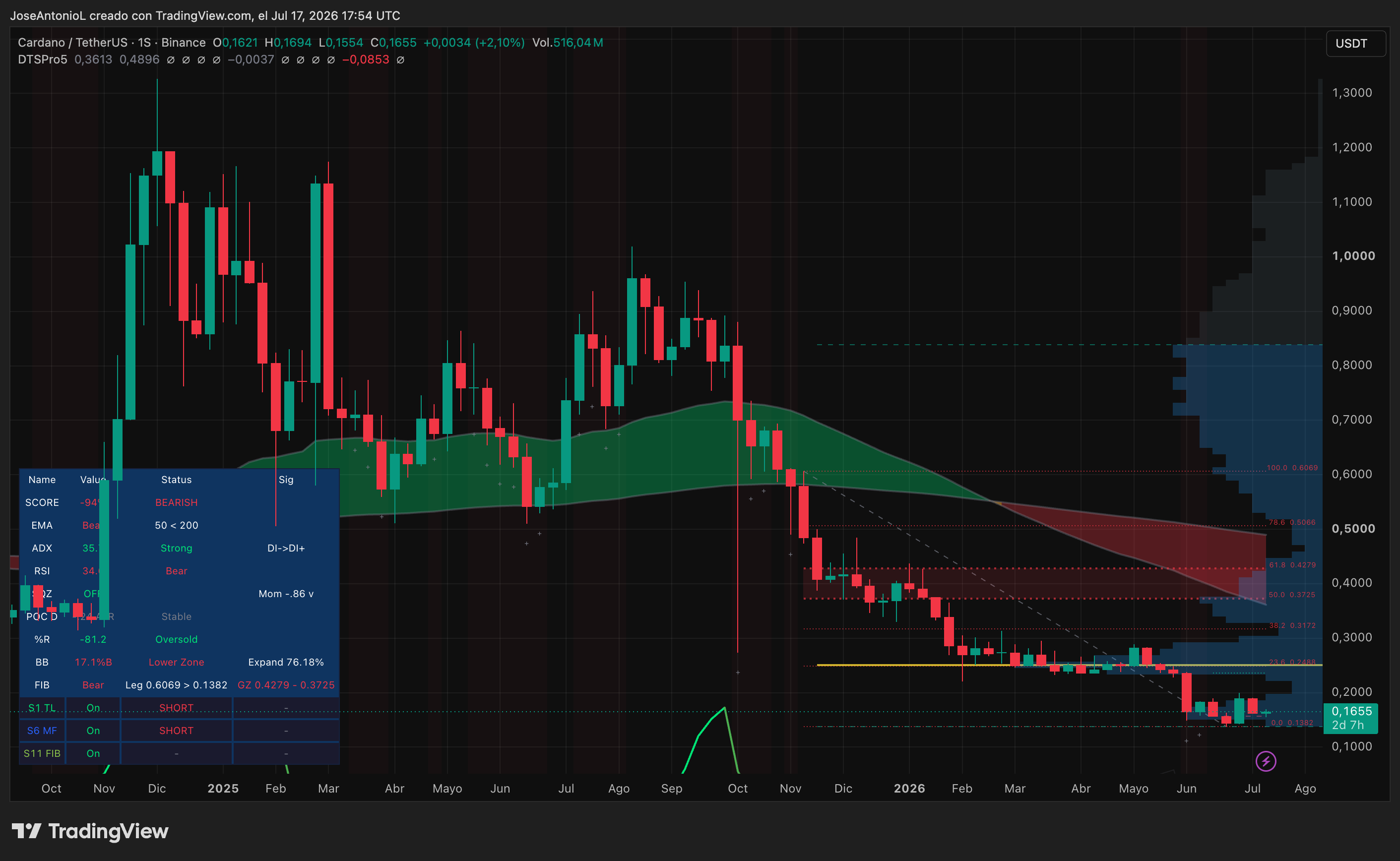
ADA price action and derivatives positioning
ADA was up about 2% on the day, trading near $0.165, giving the token a market capitalization of about $6 billion. Futures open interest stood around $193 million, while the long-to-short ratio was 2.84, indicating that most traders were still positioned for upside.
Decrypt’s chart-based view was more cautious on near-term buying. The report said ADA has not come close to revisiting its 2024 highs near $1.20, and that the token has been grinding lower since August 2025, with the 50-week exponential moving average sitting below the 200-week average.
The Relative Strength Index, or RSI, was cited at 34. The report noted that RSI tracks momentum on a 0 to 100 scale, with readings above 70 generally considered overbought and below 30 considered oversold. It also said the Average Directional Index, or ADX, was signaling a strong long-term bearish trend.
Input Output shifts to research and new ventures
For Input Output, the transition closes out one chapter. The company said it will turn its focus toward research and new ventures through IO Labs and IO Ventures, while the community takes on the task of proving whether a decentralized engineering model can move faster than the one it is replacing.
The report added that if Van Rossem delivers on lower costs, Leios arrives on schedule, and decentralized engineering proves more productive than the status quo, holders who bought around $0.16 could see meaningful upside.
Decrypt also noted that the views and opinions expressed by the author were for informational purposes only and did not constitute financial, investment, or other advice.