
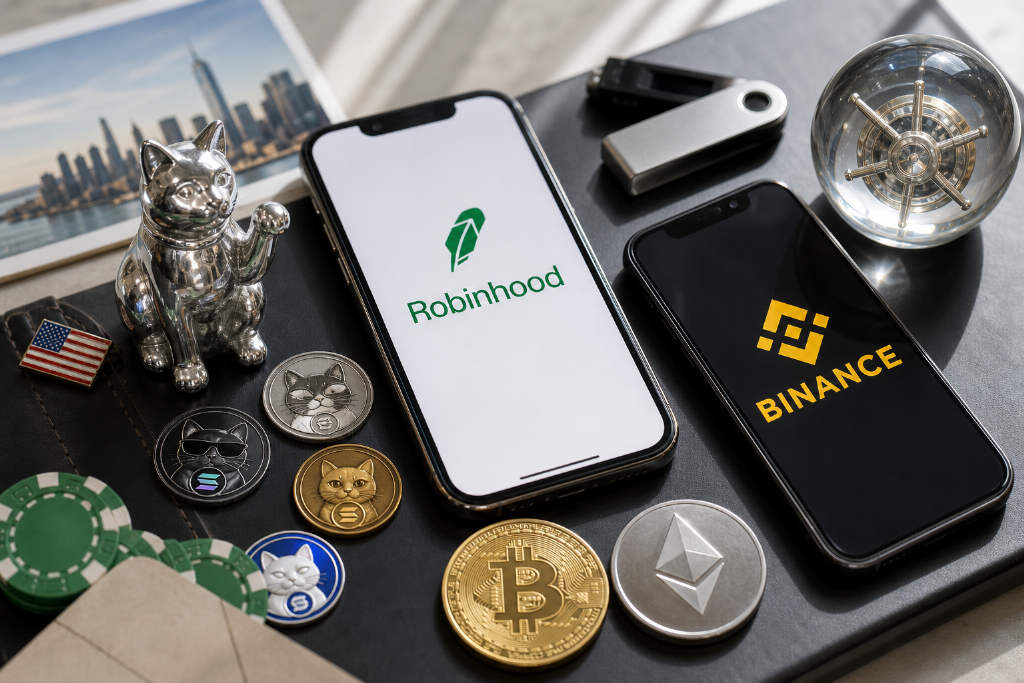
CASHCAT Breaks Records While On-Chain Opportunities Multiply
$CASHCAT, the leading meme token on the Robinhood chain, surged to an all-time-high market cap of $240 million. The milestone has drawn fresh attention to on-chain trading at a time when BTC and ETH are already running hot.
The strength of the majors has been staggering. Even the widely mocked trader known as "Machi Big Brother" managed to turn a $150,000 position into $12.72 million in just three days by going long on ETH. With that kind of backdrop, rising interest in on-chain plays is hardly surprising.
Since last week, opportunities across multiple chains have picked up noticeably. Cat-themed tokens have rallied across the board — $CASHCAT on Robinhood, $BASECAT on Base, $CATE on Solana. Even lower-profile chains have produced winners: $FOLD, a privacy project backed by Vitalik on the Ethereum mainnet, and $egg, a meme coin on HyperEVM.
More opportunities, though, do not automatically mean easy profits. The gains over the past week have clustered around relatively established tokens rather than explosive new launches. Whether traders are making money depends heavily on what they already hold.
Take $MarsCoin on BSC. The stock-meme concept is solid, and it earned Binance Alpha support — but its price action since last week has been underwhelming.
On-Chain Action Still Trails the Broader Market
Why are older tokens outperforming new ones? The pattern suggests on-chain activity is still lagging behind the majors. BTC and ETH have rallied harder than almost anyone expected, and for on-chain newcomers, neither sentiment nor capital has fully filtered through yet.
Tokens with established communities and sustained funding, on the other hand, are seeing capital test the waters. Their existing market credibility gives them a head start, which is why the old guard has moved first.
This lack of consensus extends beyond on-chain meme coins to altcoins more broadly. BTC and ETH look rock-solid. Some altcoins appear to have used the rally as exit liquidity; others have posted decent gains that still fall well short of their all-time highs — more of a probe than a breakout.
The Strongest Narrative May Be Brewing
If the majors hold steady or push higher, the on-chain cycle can barely be said to have started. Bitcoin at $80,000 is not yet expensive, and the level still needs to prove itself over a longer time frame.
Optimism about what comes next rests on several pillars.
Meme coins have been repositioned. During the $DOGE and $SHIB era, meme tokens were a quirky in-circle narrative — much like CryptoPunks in the NFT world, nobody understood the appeal until prices had already gone parabolic. The pump.fun era then overhauled issuance and trading mechanics, letting participants extract profit from attention itself.
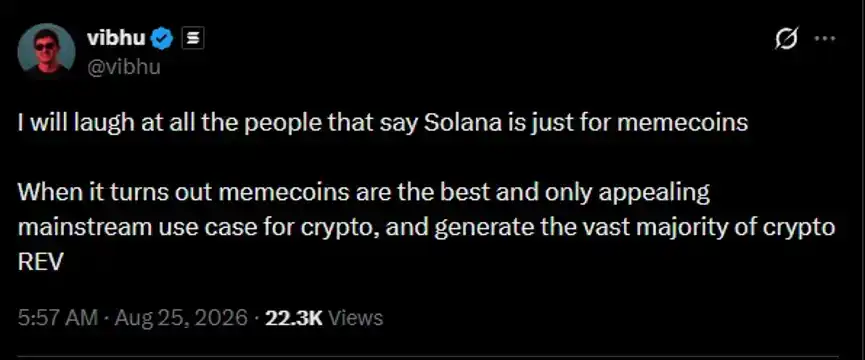
Now exchanges and Layer-1 chains alike recognize meme coins as the single most effective category for attracting new users. Solana CPO Vibhu put it bluntly: "Meme coins are the best and only crypto use case that attracts the mainstream, and they generate the vast majority of crypto revenue."
Compliance-driven ambitions to bring traditional finance on-chain are real, but scaling those ambitions requires foot traffic first. Meme coins, already a stable line of business in crypto, have become impossible for any major player to ignore. Birthing a breakout token used to take ages; the industry was immature. That has changed.
Meme coins have never received this level of endorsement — especially after the stock-meme model emerged. Robinhood CEO Vlad Tenev, speaking on The Iced Coffee Hour podcast, praised the concept: "If you hold a certain meme coin, you can receive tokenized stock airdrops. This unique mechanism ties meme coins and equities together — it's a novel asset class we never imagined before."
Tenev also noted that before Robinhood launched, roughly 50% of American households owned stocks. Robinhood pushed that figure to 65%. Tokenization, he argued, is the key lever to drive ownership to 95% and to distribute quality U.S. equities and other RWA assets globally.
He stopped short of saying stock memes alone would push ownership to 95%, but the framing still elevates the narrative — a hybrid asset with higher acceptance among younger demographics, letting people accumulate equity exposure almost by accident. Already, many on-chain traders who never touched traditional equities now hold stocks simply because they traded meme coins.
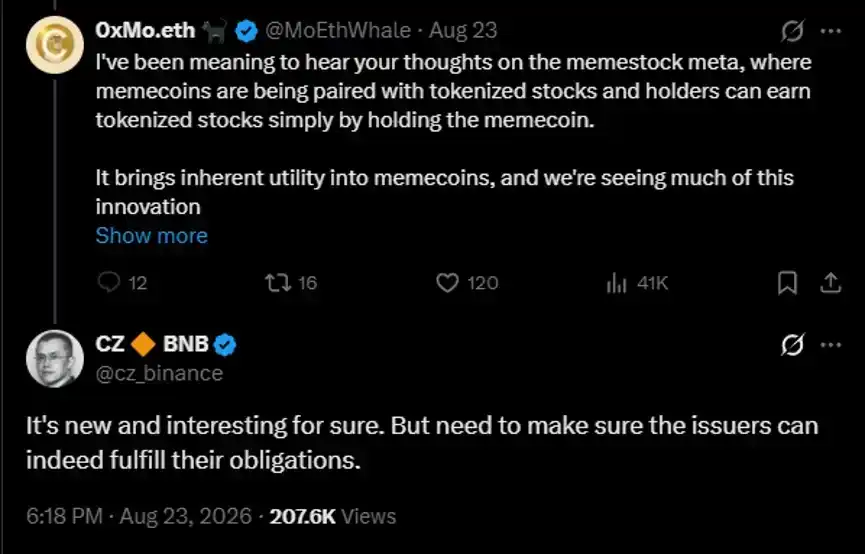
CZ, asked about stock memes, offered a notably positive assessment: "Stock memes are a novel and interesting mechanism, but we need to make sure issuers actually fulfill their obligations."
A track endorsed by both Tenev and CZ that has yet to produce a single token above the $100 million mark leaves enormous room for upside.
CZ followed Vlad yesterday. On the same day, Vlad commented on a Mars-related post by Elon Musk, closing with "See you on Mars." The gesture has ignited speculation: what if Binance and Robinhood open cross-listing channels — Binance listing $CASHCAT while Robinhood lists $MarsCoin?
The strongest script since the Trump coin may be taking shape. After more than a year of bear-market attrition, the market is not short of quality tokens. Communities, narratives, and surviving projects have all been stress-tested; what is missing is the spark.
The coming altcoin season will look very different from past cycles. Changes at the meme-coin layer are already visible, but plenty of shifts remain unpredictable. It is precisely that uncertainty that fuels optimism — regardless of past wins or losses across multiple cycles, the starting line of a new golden era may be approaching fast.