
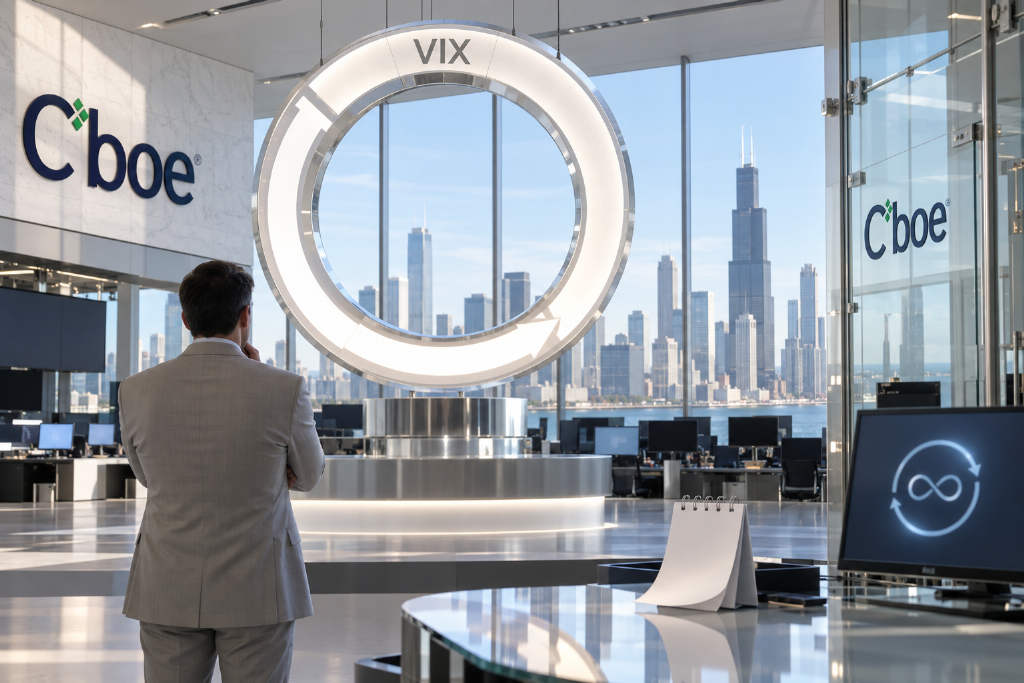
Cboe is preparing a perpetual futures contract for the VIX, bringing a structure popularized in crypto markets to one of Wall Street’s best-known volatility products. Bloomberg reported on Oct. 1 that the effort is still in its early planning stage, and Cboe has not yet filed contract specifications.
The VIX measures the S&P 500’s expected 30-day volatility based on options pricing. Because demand for protective options tends to rise when markets fall, the index is widely known as Wall Street’s “fear gauge.”
Why Cboe is targeting the roll problem
The VIX already has a well-developed derivatives ecosystem, including futures, options, and exchange-traded products linked to the index. But standard futures expire. Once a contract reaches maturity, traders who want to keep exposure must close that position and move into the next month’s contract.
That rolling process carries a cost, and over time it can drag on returns. The article points to a similar issue seen when Bitcoin futures ETFs launched in late 2021. Investors could buy BTC futures ETFs, but the underlying contracts still had to be rolled at expiry, with rollover costs feeding through to net asset value. Cboe is now trying to remove that same structural friction from VIX exposure.
A crypto market format moves into volatility products
The idea of perpetual futures was first proposed by economist Robert Shiller in 1993, but crypto exchanges were the ones that turned it into a commercial product. Unlike standard futures, perpetuals do not expire. Instead, they typically use a funding-rate mechanism to keep contract prices anchored to a spot index. In theory, that could create a trading instrument that tracks the VIX spot level more closely.
Martin Lee, head of market insights at DWF Labs, told CoinDesk: “Traders don’t have to worry about expiry and decay, and can focus on where they think the underlying asset is going. VIX is just one of many indices, assets and metrics that are likely to become perpetualized. We expect to see a strong wave of perpetualization in the coming months.”
Crypto venues have already tested versions of the idea. Gate offers a VIX/USDT perpetual contract, though the article says liquidity is low and trading volume is limited. More recently, Hyperliquid listed futures tied to Bitcoin volatility through Volmex’s Bitcoin implied volatility index.
Bloomberg said Cboe’s plan shows how quickly market structure is converging between traditional finance and crypto.
Analysts say the costs do not disappear
Marex Solutions analysts said in an email that perpetual contracts are not cost-free. Funding payments would still exist. They also noted that the VIX is a mathematical construct rather than an asset with a directly tradeable spot market, unlike Bitcoin.
That means market makers would still face hedging risk, even if the form of that risk changes. “The interesting question for us is how the funding rate anchors an index that cannot itself be purchased as a cash asset,” the analyst said. “Removing expiry does not remove hedging costs and basis risk. Until the contract terms are known, this represents a new volatility market rather than a cheap substitute for options convexity.”
What the launch could mean for the market
If Cboe succeeds in launching perpetual VIX futures, the article says the product could bring more traders into the volatility market. More two-way flow and more market makers hedging across VIX futures and other S&P 500 derivatives could narrow pricing gaps between different VIX-linked products and improve market efficiency.
Perpetual futures first took shape in crypto between 2015 and 2017 on exchanges such as BitMEX and OKCoin, then became the dominant format in digital asset derivatives trading. In that sense, Cboe’s move is more than a simple nod to crypto. It is a case of Wall Street adopting the structural features that made perpetuals popular in digital assets: no expiry, no monthly roll, and price anchoring through funding.
The article also says that for investors in Taiwan, the product could lower the barrier to volatility trading if it is launched successfully. Traditional VIX futures usually require a futures account and active management around expiry, while a perpetual contract follows a logic closer to spot-style position holding, with funding replacing roll costs as the main ongoing consideration. If Cboe finalizes the design, it could become the next step in making volatility trading more accessible.