Cboe2026-10-02 13:47:16Cboe Eyes Perpetual VIX Futures as Wall Street Borrows a Core Crypto Trading StructureCboe is planning a perpetual futures contract tied to the VIX, according to a Bloomberg report published on Oct. 1, in a move that would bring a crypto-style derivatives structure into one of Wall Street’s best-known volatility benchmarks. The proposal remains in an early planning stage, and contract specifications have not yet been filed. The key selling point is simple: no expiry and no monthly roll. Traditional VIX futures force traders to roll positions forward as contracts expire, a process that can eat into returns over time. A perpetual design aims to remove that friction, much like crypto perpetual futures did for digital asset markets. The article notes that Bitcoin futures ETFs faced similar roll-cost issues when they launched in late 2021. Market participants say the idea could widen access to volatility trading and tighten pricing across VIX-linked products if it attracts more liquidity and cross-market hedging activity. Still, analysts are not treating it as a free lunch. Marex Solutions said funding payments would still exist, while hedging a mathematically derived index such as VIX raises structural questions that do not apply in the same way to assets with a tradeable spot market. The plan, if completed, would mark another point of convergence between traditional finance and crypto market design.20
Cboe2026-10-02 11:38:32Cboe seeks round-the-clock trading model for VIX derivativesCboe is seeking to change how derivatives tied to the VIX, Wall Street’s widely watched fear gauge, are traded. According to BlockBeats, the Chicago-based options exchange is looking to move these products away from a traditional term-based structure and toward a model built for sustained trading. The effort also includes exploring a trading setup closer to what is commonly seen in crypto markets. The move points to a broader possibility: traditional financial markets may continue borrowing from the continuous trading model that has long been standard in digital asset markets. While the brief did not include implementation details, the direction outlined by Cboe suggests a rethink of how volatility-linked products could trade if market participants demand longer and more continuous access.20
Cboe2026-10-01 18:34:02Cboe weighs VIX perpetual futures, waiting for clearer U.S. rulesCboe Global Markets is considering launching perpetual futures tied to the Cboe Volatility Index, or VIX, but says it will wait for more regulatory clarity in the United States before moving ahead. Rob Hocking, Cboe’s global head of derivatives, said perpetual futures could offer a way to trade the spot level of the VIX more directly. He added that the product could provide leverage, though it would not offer the asymmetric payoff profile available through options. Cboe already lists VIX futures and options. The update was carried by Techub News and cited Wu Blockchain.20
U.S. stocks2026-09-28 13:31:08U.S. stocks open lower as AI names slide, with Atlassian down 5.15%U.S. stocks opened in negative territory, according to data from MSX.COM, with the Dow Jones Industrial Average down 0.71%, the S&P 500 off 0.48%, and the Nasdaq lower by 0.5% at the open. The VIX volatility index rose 7.67%. AI-related stocks also moved lower across the board. Atlassian posted the steepest decline among the names cited, falling 5.15%. Snowflake dropped 4.63%, ServiceNow lost 4.46%, UiPath fell 4.23%, and Twilio was down 3.4%. The report also noted that MSX is a major real-world asset, or RWA, trading platform. It said the platform has listed hundreds of RWA tokens tied to popular U.S. stocks and ETF underlyings, including Nvidia, GOOGL, MSFT, AMZN, META, TSM, and AMD. The figures were cited by Odaily in a market update on the U.S. open.250
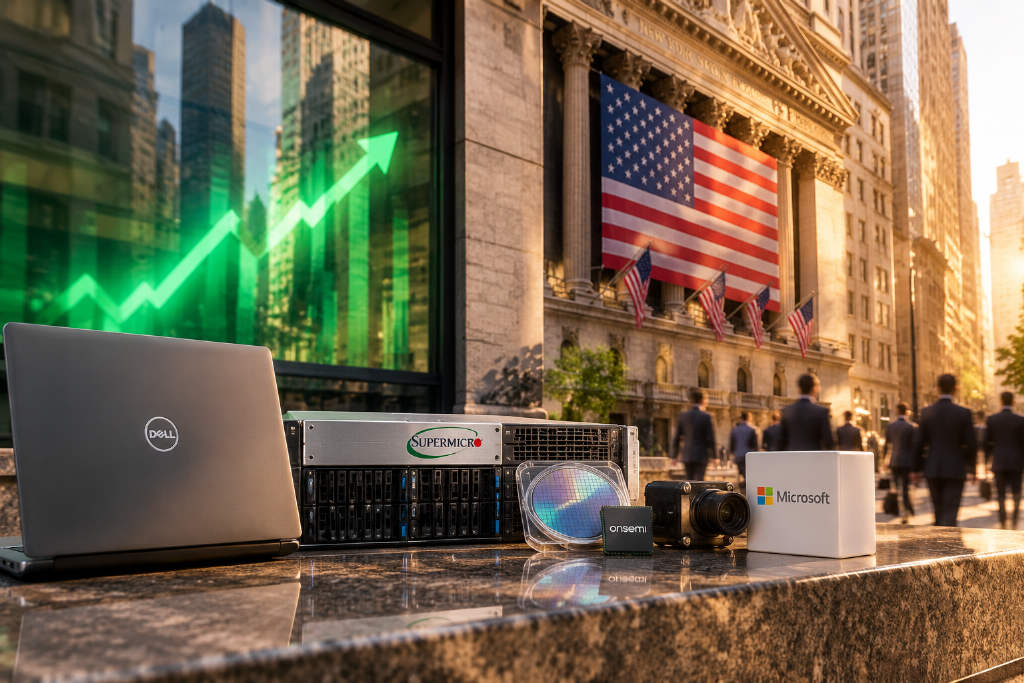
US stocks2026-09-26 01:00:08U.S. stocks close higher as AI names advance, with onsemi up 5.54%U.S. stocks finished higher, according to data from MSX.COM, with the Dow Jones Industrial Average rising 0.93%, the S&P 500 gaining 0.51%, and the Nasdaq adding 0.48%. The VIX volatility index fell 5.11% by the close. AI-related stocks posted broad gains in the session. onsemi led the group mentioned in the report with a 5.54% rise, followed by Dell at 5.01%, Super Micro Computer at 4.22%, Ambarella at 4.04%, and Microsoft at 3.66%. The report also noted that MSX is an RWA trading platform that has listed hundreds of RWA tokens. Those listings cover popular U.S. equities and ETF tokenized products tied to names including NVIDIA, GOOGL, MSFT, AMZN, META, TSM, and AMD.280
U.S. Treasuri2026-09-25 11:58:48Treasury volatility climbs while Bitcoin and U.S. stocks stay subduedVolatility in the U.S. Treasury market has risen sharply even as Bitcoin and U.S. equities remain relatively calm, according to a ChainCatcher report. The MOVE Index, which tracks expected Treasury volatility, climbed from about 80 on Tuesday to 104 on Thursday, its highest level since March. At that time, the index had briefly reached 199. In contrast, the Volmex 30-day Bitcoin implied volatility index, or BVIV, was around 37, close to its yearly low of 35, while the Cboe VIX, which measures expected volatility for the S&P 500, was also near its yearly low at 14. U.S. 10-year Treasury yields touched 5.2% on Thursday before easing back to 5.163%. Over the past 20 trading days, the correlation between the VIX and MOVE fell to -0.06, turning negative for the first time since April 2024. The correlation between BVIV and MOVE stood at -0.37, a relatively low level compared with recent years. The report said rising Treasury volatility often points to tighter financial conditions, but BTC and U.S. stocks have not yet reflected the same degree of risk seen in the bond market.240
US Treasuries2026-09-15 12:42:00Bloomberg says a move in the US 10-year yield toward 5.25% could pressure both stocks and bondsBloomberg reported that the US 10-year Treasury yield climbed above 5% this week and is nearing 5.25%, a level the article describes as historically important for cross-asset pricing. The piece argues that when the 10-year yield stays above 5.25% for an extended period, stocks and bonds tend to move in the same direction, which weakens the traditional role of Treasuries as a hedge against US equities and can increase portfolio losses instead. It also says that if yields keep rising, Treasury volatility and the VIX could move higher, while credit spreads in high-yield bonds may widen. That combination would leave markets facing greater uncertainty around discount rates and tighter liquidity conditions. The author adds that structural inflation pressure, firmer commodity prices, and uncertainty ahead of the Federal Open Market Committee meeting are key factors to watch if the 10-year yield remains above 5.25% for some time.730
U.S. midterms2026-09-11 03:48:07Wall Street Prices in a Split Congress Ahead of U.S. Midterms as Investors Brace for VolatilityWall Street is increasingly treating a split Congress as the base-case outcome heading into the U.S. midterm elections, with investors expecting Democrats to retake the House in November while Republicans keep control of the Senate by a narrow margin, according to Bloomberg. Market participants see that setup as one of the more moderate policy outcomes because it would make it harder for major legislation to pass quickly, pushing both parties toward gridlock or compromise and easing policy uncertainty. Citigroup’s Stuart Kaiser said a divided government would likely leave stocks more focused on corporate and economic fundamentals. At the same time, hedging demand has risen in futures tied to the Cboe Volatility Index, signaling that investors are preparing for election-related swings in the S&P 500. Historical data compiled by Carson Investment Research has also been cited to support the view, showing stronger average annual gains for U.S. stocks since 1950 when a Republican president faced a split Congress. Still, that consensus carries its own risk. Strategists at Bank of America and Rayliant outlined sharply different market reactions depending on whether Republicans sweep, Democrats outperform, or the vote produces the expected split, with AI, energy, financials, renewable energy, and healthcare among the sectors in focus.770