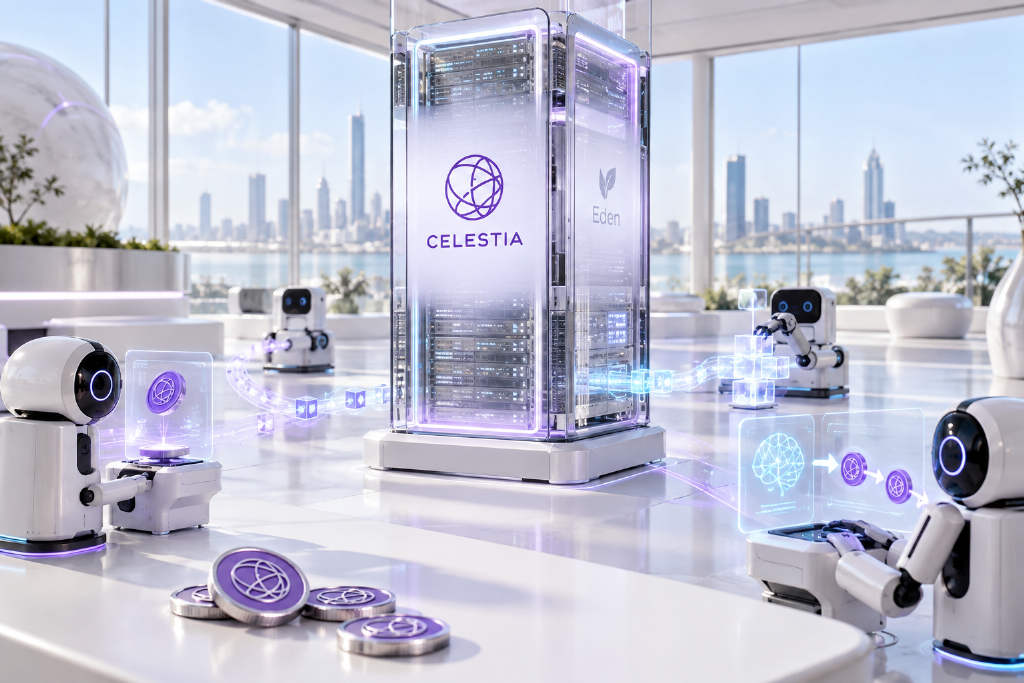
Celestia has introduced Eden, a high-performance EVM chain built on Celestia and designed as an experimental sandbox for what it calls "Agentic Commerce." The project is meant to test how AI agents behave when they make onchain payments, place trades, and call models autonomously, while also showing what kind of infrastructure those systems need.
According to Celestia, the rise of more frequent onchain activity by AI agents is likely to increase demand for blockspace, real-time settlement, and low-friction payment rails. Eden is being used to observe what type of transaction environment agents need, how they manage funds, and how their onchain behavior could shape future network design.
The first experiment on Eden is Botfun, which is currently in closed testing. Celestia said agents in that environment can issue their own tokens and trade around narratives generated by other agents. Each model inference call is paid for onchain through x402. Celestia also said the experiment briefly made Eden one of the largest x402 networks by transaction count. Technically, Eden is EVM-compatible, uses TIA as its native gas token, and supports atomic batched transactions, app-sponsored gas, and larger smart contract deployments.
Celestia has launched Eden, a high-performance EVM chain built on top of Celestia, according to BlockBeats on Oct. 16.
The company said Eden will serve as an experimental sandbox for "Agentic Commerce," where it can test how AI agents behave when they make payments, trade onchain, and call models autonomously, as well as what infrastructure those activities require.
Celestia said that as AI agents begin taking part in onchain transactions more frequently, demand for blockspace, real-time settlement, and low-friction payments is expected to keep rising. Eden is intended to help the team study what kind of transaction environment agents need, how they manage funds, and how their onchain behavior could affect network design.
Botfun is the first experiment on Eden
The first project being tested on Eden is Botfun, which is currently in closed testing. In Celestia's description, agents taking part in Botfun can issue their own tokens and trade around narratives generated by other agents. Each model inference call is paid for onchain through x402.
Celestia said the experiment briefly pushed Eden into the ranks of the largest x402 networks by transaction count.
Chain design targets lower friction for agent activity
On the technical side, Eden is EVM-compatible and supports atomic batched transactions, app-sponsored gas, and larger smart contract deployments. Its native gas token is TIA.
Celestia said those features are designed to reduce signing and fee friction when agents carry out a series of actions such as payments, swaps, and other onchain interactions.
This article was originally published by Bit.Fan. For more cryptocurrency news and market insights, visit www.bit.fan. Disclaimer:
The market information, project data, and third-party content displayed on this platform are for industry information sharing only and do not constitute any form of investment advice or return commitment.
Cryptocurrency trading carries high risks. Users should fully assess their risk tolerance and make independent decisions. All profits, losses, and legal responsibilities are borne by the users themselves.