


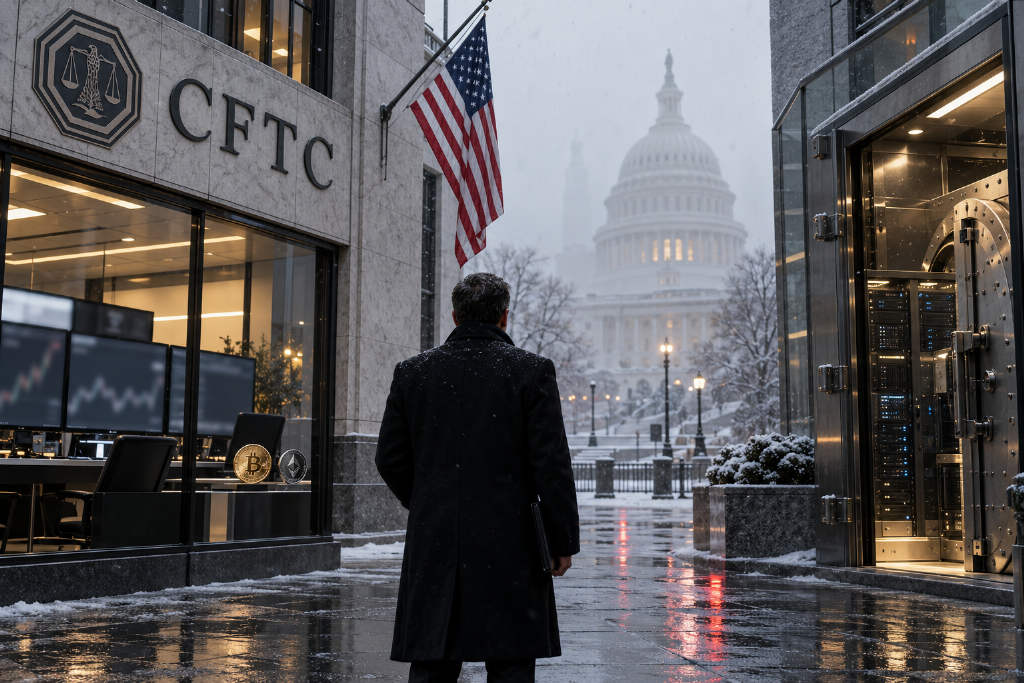
The Commodity Futures Trading Commission is preparing to act without waiting for Congress to finish a broader crypto market bill. In a Bankless podcast appearance, CFTC Chair Mike Selig said the agency plans to move ahead with two rulemaking initiatives — Regulation CTX and Regulation CAM — using its current statutory administrative authority.

The stated goal is to bring retail crypto leverage trading back onto regulated U.S. platforms and replace fragmented state-level licensing with a federal path for nationwide oversight.
CFTC steps in as CLARITY Act momentum fades
The report, written by Bankless analyst David Christopher and translated by TechFlow, said expectations for a unified federal crypto framework have weakened as the U.S. CLARITY Act has effectively stalled in Congress. Against that backdrop, the CFTC is choosing not to wait.
For years, U.S. crypto exchanges have been treated by state regulators as money transmitters. Under that model, platforms have had to seek licenses state by state. The article said companies such as Coinbase and Kraken have been forced to navigate separate approvals across all 50 states even when offering basic spot trading. New York’s BitLicense was cited as a prominent example of a particularly burdensome regime, while compliance standards differ widely from one state to another.
That structure has produced a fractured market. What a U.S. customer can legally trade on a platform may depend on where that person is physically located. The article argues that this framework no longer fits digital asset venues that run nationwide central limit order books, match high-frequency and complex trades, and custody tens of billions of dollars in customer assets.
Regulation CTX and Regulation CAM
Selig outlined a two-part approach, one focused on trading access and the other on institutional entry into a federal regime.
- Regulation CTX: would allow compliant platforms to offer retail users spot crypto margin trading, leverage tools, and financing facilities. As described in the article, users would be able to borrow against their crypto holdings within a regulated framework to increase position size.
- Regulation CAM: would create a dedicated federal registration route for platforms that offer those leveraged products. Approved firms would come under a unified national CFTC supervisory structure instead of relying on separate state licenses.
In the article’s framing, that would move a key product set now associated with traditional stock brokerages and offshore crypto venues back onto federally supervised U.S. platforms.
A challenge to the state-by-state licensing model
A central point in the report is that the current licensing system has split the U.S. market into state-based silos. Platforms must satisfy different local requirements, and users do not necessarily receive the same access across jurisdictions.
CAM is presented as the mechanism that could change that. If adopted, it would give eligible crypto platforms a direct federal registration channel under the CFTC and remove the need to maintain a patchwork of separate state approvals. The article describes that as a direct overhaul of the existing regulatory map.
Firewall provisions meant to avoid another FTX-style failure
Expanding access to leverage and related products immediately raises a familiar question: whether combining brokerage, matching, and clearing functions under one corporate umbrella could recreate the conditions that contributed to the FTX collapse.

The article points to the role of Alameda Research, which had privileged internal access to customer funds, allowing the boundaries among customer deposits, proprietary trading, and lending activity to break down.
Selig rejected the idea that the proposed framework would repeat that model. He said the federal structure under discussion would impose strict legal separation among functions, require independent custody of customer assets, and block related-party transactions and other conflicts of interest, even if multiple business lines sit within the same parent group.
As the article recounts, Selig argued that any durable reform has to preserve a hard line against the next FTX while still giving trading venues room to innovate.
Prediction markets are part of the same jurisdiction fight
The clash between federal and state regulators is not limited to crypto exchanges. The article said the same battle is now playing out in prediction markets, where platforms such as Kalshi offer contracts tied to political elections and sports events.
State authorities argue that these contracts are effectively gambling products and should fall under state gaming commissions. The CFTC takes the opposite view, saying event contracts of this kind are modern financial derivatives that belong under federal commodities law.
According to the article, the CFTC issued two major clarifications on Oct. 9. First, it said traditional sports betting wagers would be carved out of the definition of financial swaps. Second, it formally proposed that broad event contracts, including sports and political events, be treated as regulated financial derivatives.
Selig argued that the federal rule set applied to derivatives exchanges — including protections tied to market manipulation, insider trading surveillance, and liquidity oversight — is better suited to these high-frequency information markets than a state casino licensing model.
Dispute has reached the Supreme Court
The report said lower court rulings have gone both ways so far. New Jersey has already appealed the dispute to the U.S. Supreme Court.
From legitimizing compliant retail crypto leverage, to pulling licensing authority away from the states, to defending the classification of prediction markets as financial derivatives, the CFTC is trying to redraw the U.S. crypto-financial regulatory structure through administrative action. Those positions were laid out publicly by Mike Selig in his Bankless appearance.