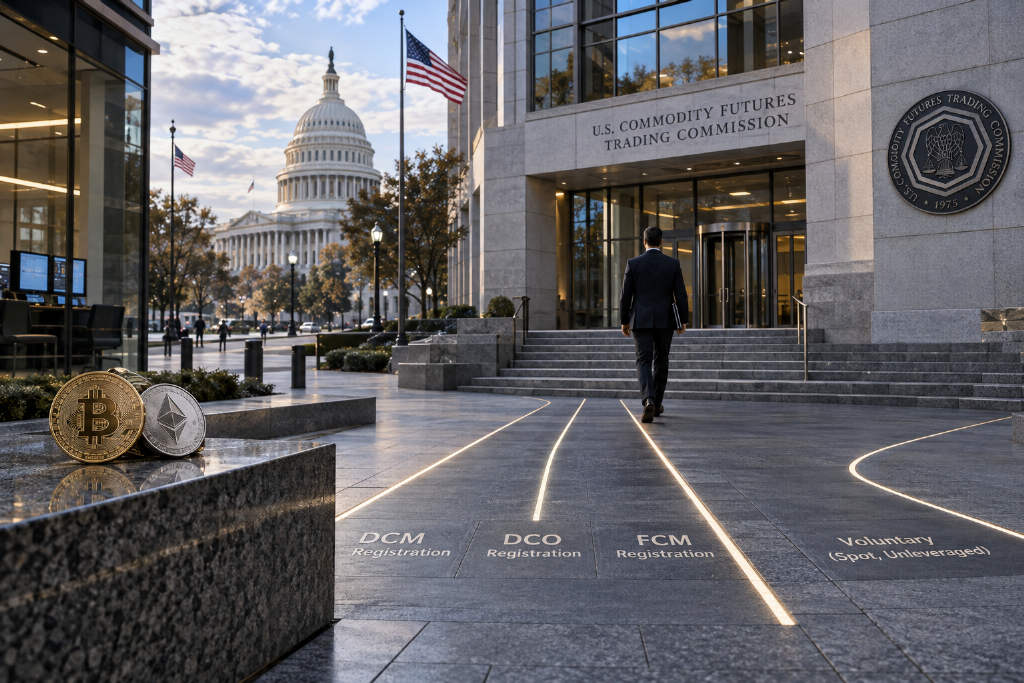
The U.S. Commodity Futures Trading Commission is seeking to use its existing authority to build a market structure framework for crypto spot trading, according to crypto journalist Eleanor Terrett. The agency’s advance notice of proposed rulemaking, or ANPRM, would build on the current registration structure for designated contract markets, derivatives clearing organizations and futures commission merchants, while adding a new category called “crypto asset markets.”
A key distinction from the Clarity Act is that the CFTC proposal explores a voluntary federal exchange registration path. Spot exchanges that do not offer leverage could choose to stay outside the framework and continue operating under state money transmitter licenses. Former CFTC Chair J. Christopher Giancarlo said the approach offers exchanges a “clear, voluntary, one federal rulebook path” when customers trade with borrowed funds, and argued the agency is acting within authority granted by Congress in 2010 and supported by court rulings recognizing assets such as Bitcoin as commodities.
Lawyers cited in the report said the ANPRM offers a “clever” or “creative” reading of Section 2(c)(2)(D) of the Commodity Exchange Act. That interpretation could reach retail crypto spot transactions involving leverage, margin or financing, even if customers do not actually use leverage. The proposal also addresses “actual delivery” under the same provision and appears to focus on whether customers own or control assets, rather than relying only on omnibus account records. Questions around bankruptcy protection for customer assets remain unresolved. Comments are due within 60 days after publication in the Federal Register.
The U.S. Commodity Futures Trading Commission has issued an advance notice of proposed rulemaking, or ANPRM, that seeks to use the agency’s existing authority to create a market structure framework for crypto spot trading, according to crypto journalist Eleanor Terrett.
The framework would be built on the current registration regime for designated contract markets, derivatives clearing organizations and futures commission merchants, while creating a new category called “crypto asset markets.”
Proposal explores a voluntary federal registration path
One notable difference from the Clarity Act is that the CFTC proposal explores a voluntary federal exchange registration route. Spot exchanges that do not offer leverage could choose not to join the framework and keep their state money transmitter licenses.
Former CFTC Chair Giancarlo said the approach gives exchanges a “clear, voluntary, one federal rulebook path” when customers trade using borrowed funds. He also said the CFTC is acting within authority granted by Congress in 2010, with support from court decisions recognizing assets such as Bitcoin as commodities.
Lawyers focus on Section 2(c)(2)(D)
Several lawyers said the ANPRM reflects a “clever” or “creative” reading of Section 2(c)(2)(D) of the Commodity Exchange Act. That reading could cover retail crypto spot transactions that offer leverage, margin or financing, even when customers do not actually use leverage.
The proposal also addresses “actual delivery” under Section 2(c)(2)(D). It appears to focus on whether customers own or control the assets, rather than relying only on book-entry records in omnibus accounts.
Bankruptcy protection questions remain
The proposal still leaves major questions about bankruptcy protection for customer assets.
Comments must be submitted within 60 days after the proposal is published in the Federal Register.
This article was originally published by Bit.Fan. For more cryptocurrency news and market insights, visit www.bit.fan. Disclaimer:
The market information, project data, and third-party content displayed on this platform are for industry information sharing only and do not constitute any form of investment advice or return commitment.
Cryptocurrency trading carries high risks. Users should fully assess their risk tolerance and make independent decisions. All profits, losses, and legal responsibilities are borne by the users themselves.