
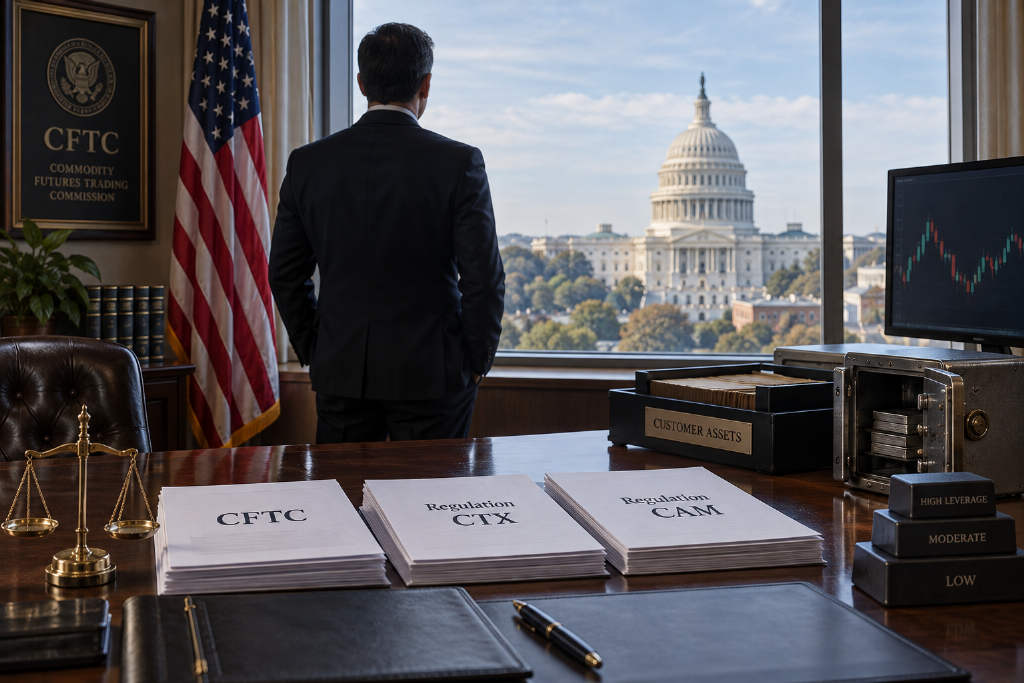
The U.S. Commodity Futures Trading Commission has published an early document laying out how crypto exchanges could be brought under federal oversight, three weeks after the Clarity Act failed in the Senate. The notice is not a final rule. It asks for public input first, with a 60-day comment period set to begin once it is published in the Federal Register.
Still, the document sketches out what Congress did not pass: a federal license for crypto exchanges, with leverage serving as a key line for deciding which firms would need one. The CFTC says crypto trading now operates either under rules built for other markets or under state licenses that differ across the country. Its proposal would create one federal option instead. The two main pieces are Regulation CTX and Regulation CAM.
How the CFTC defines the scope
The proposal mainly targets trades involving borrowed money, or trades where borrowing is offered even if no loan is ultimately used. The agency reads a 2010 Dodd-Frank provision broadly enough that even a fully paid trade could count if an exchange references leverage in its terms and keeps customer crypto on its own books.
What a federal license would permit
Under the framework, a licensed firm could match buyers and sellers, hold customer cash and crypto, settle trades, and lend. One company could seek approval for several of those functions, but each would require its own authorization.
The document also says those trades would move through brokers already subject to anti-money-laundering rules, and only those brokers or their sponsoring banks would be allowed to provide leverage.
Customer protections and the cost of compliance
The CFTC lists several safeguards for customers: separating customer money from company money, keeping records, monitoring for manipulation, verifying loans, and planning for losses. The agency is also weighing proof-of-reserves requirements and listing standards aimed at tokens that are easy to manipulate.
The tradeoff appears plainly in the document. Clearer rules could let U.S. companies offer more products, which is why traders have read the proposal as constructive for onshore perpetuals. But a federal license would also bring compliance costs, and some products may not survive those costs.
Mike Selig said the rules are meant to stop fraud like FTX before it happens rather than punish it afterward, and he posted a promotional video to make that case. The notice also rejects part of the agency’s own recent history, describing Biden-era cases against Kraken, Ooki DAO, and Uniswap as regulation by enforcement.
Why traders are watching it closely
Decrypt’s Morning Minute said the bullish argument is straightforward: a federal license could let U.S. exchanges offer leveraged products they cannot offer now, making this the clearest path yet for onshore perpetual futures. The report pointed to Robinhood’s newly announced U.S. crypto perps, Coinbase’s filing for single-stock perps, and negotiations between Kraken’s parent and Hyperliquid. All three, the article said, need a regulatory door like this to exist.
The same report said clearer rules could also make it easier for banks and brokers to engage with crypto, because uncertainty over which regulator has authority has been a blocker for years.
Macro, crypto, and market moves
Major crypto assets were mostly flat. Bitcoin rose 0.2% to $86.3k, Ethereum slipped 0.1% to $2,714, SOL fell 0.3% to $120, HYPE gained 0.6% to $93.60, and ZEC rose 4% to $1,370.
Among altcoins, the top movers included ZRO at +13%, FIL at +6%, RAY at +8%, and NEAR at +4%.
In commodities, oil fell 2% to $88 while gold added 0.6% to $4,180. U.S. stock futures were in the green as oil and yields moved lower, with Dow futures up 0.4% and Nasdaq futures also up 0.4%.
Treasury and SEC developments
The report said the U.S. Treasury scrapped two crypto surveillance proposals: a 2020 rule tracking self-custody wallet transfers and a 2023 plan aimed at mixers. Under the wallet rule, banks would have had to keep records on transfers above $3,000 and report those above $10,000.
The SEC approved six funds designed to deliver triple the daily moves of Bitcoin, Ethereum, gold, silver, oil, and gas, clearing a Cboe rule change on October 2.
Ethereum, investigations, and stablecoin cards
Ethereum executed its first transaction designed to work across the main chain and a layer-2 at the same time, moving 0.001 ETH in a test under the Ethereum Economic Zone framework. The two halves either both succeed or both reverse. The goal is to keep Ethereum’s many networks from feeling like separate places.
ZachXBT spent $349,700 of his own money posing as a client of a Chinese crime ring laundering for North Korea. He lost 5% on every order and held the story for 18 months while the case remained active. The report said the intelligence helped freeze funds tied to the Bybit hack, including $442,000 in locked Tether.
Stripe plans to roll out stablecoin cards in more than 100 countries by year-end. Spending on those cards reached $1.2 billion last month, triple the level from a year earlier.
OKX, tokenized stocks, and AI coding
OKX and the parent of the New York Stock Exchange listed more than 60 stocks they want to put onchain, including Nvidia, Tesla, Apple, Microsoft, Amazon, and Alphabet. Each token would be backed one-for-one by a real share held at a broker, and buyers would use stablecoins from a pool rather than a traditional order book.
OKX also said AI now does the main work on about 95% of its code changes, with engineers left to review and approve. Founder Star Xu said the company’s bill to AI model providers reached $10 million last month.
Corporate treasuries and ETF flows
Spot Bitcoin ETFs recorded $90 million in net outflows on Monday, while spot Ethereum ETFs saw $51 million in outflows.
Strategy booked a $20.91 billion paper gain on Bitcoin in the third quarter, its first profitable quarter in a year. It bought only 334 BTC for $28.7 million during the period, while spending $176 million to buy back STRC.
Metaplanet sold 10,000 Bitcoin for $789 million and bought back 11,000 for $949 million in a move meant to show credit agencies it can turn Bitcoin into cash on demand.
Bitmine bought another 15,112 ETH for about $41 million, bringing it to 99% of its goal of owning 5% of all Ethereum. It now holds 6,016,414 ETH worth roughly $16.4 billion.
Meme coins and protocol revenue
Meme coin leaders were lower: DOGE fell 1%, SHIB fell 1%, PEPE dropped 4%, PENGU lost 2%, TRUMP fell 2%, SPX fell 5%, and BONK dropped 6%.
On Robinhood chain, leaders were mostly flat. Pons fell 1% to $266 million, AI was unchanged at $110 million, Cashcat fell 5% to $150 million, and Boner and Orbio both dropped 20%. The biggest movers were v4, up 80%, and Bun, up 30%.
On Solana, the top movers were Higgs at +160%, Plague at +220%, Crawl at +55%, and Swordcat at +60%.
Among onchain protocols by revenue, Pump led with $2.79 million, followed by Hyperliquid at $1.49 million and Collector Crypt at $496,000. The report also said Pump.fun revenue was up 20% on the week and app usage hit an all-time high.
Protocols, token launches, and NFTs
Predict.fun teased that its token is launching soon. Polymarket unveiled Protocol V2, with settlement now drawing from both UMA and Chainlink instead of a single source.
Binance launched an AI suite that turns plain-English trading ideas into working strategies, alongside a free market assistant and a developer platform. AI Pro will cost $19.99 a month and arrive in late October, while the developer tools have been live since August.
In NFTs, leaders were mostly unchanged. CryptoPunks held at 33 ETH, BAYC stayed at 5.95 ETH, and Pudgy rose 3% to 3.07 ETH.
Long Neck Brokers, up 46x, and Quotrons, up 9%, led the top movers. A new collection called Claus debuted with a 0.9 ETH floor and is tied to the Claus AI token.