
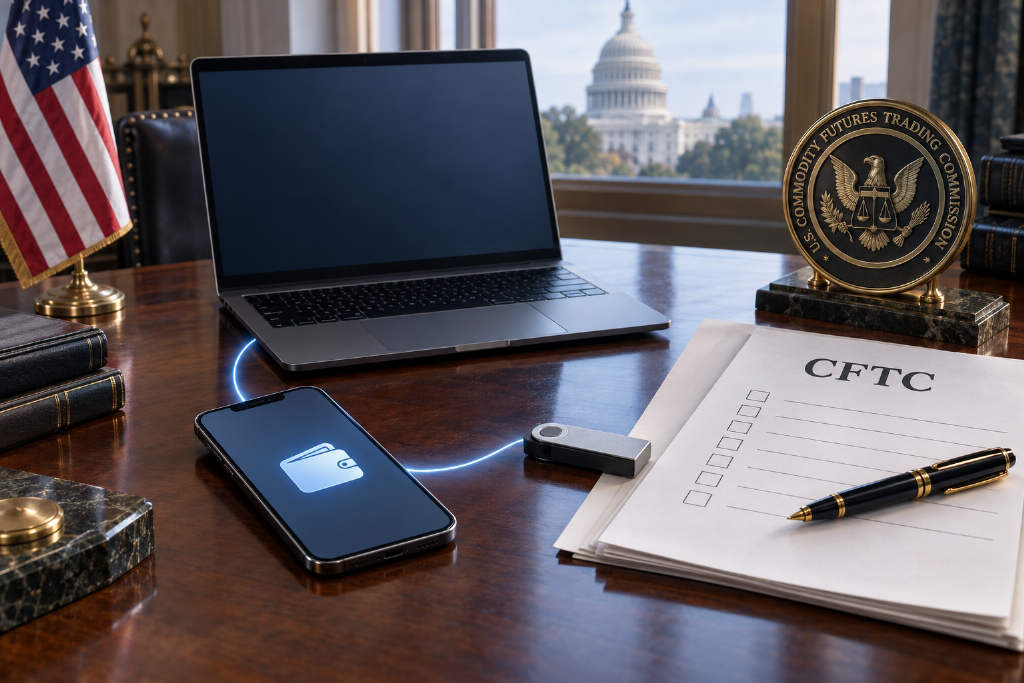
The U.S. Commodity Futures Trading Commission is widening the path for crypto wallets and financial software to plug into regulated derivatives markets. On Sept. 17, the CFTC’s Market Participants Division, or MPD, issued Staff Letter 26-25, extending a no-action position that had been limited to Phantom Technologies in March to all qualifying passive software providers.
That means crypto wallets, trading front ends, and other software developers may be able to let users trade CFTC-regulated futures, perpetual contracts, and event contracts through their software without first registering as Introducing Brokers, or IBs, as long as the software serves as a trading access point rather than acting as a broker.
The policy arrived as Bitcoin moved back above $76,000. CoinGecko data cited in the report showed BTC at about $76,955, up roughly 0.8% over 24 hours, with a market capitalization of about $1.55 trillion and 24-hour spot volume of about $23.4 billion. ETH was about $2,451.
From a Phantom-specific letter to a broader framework
In March, the CFTC issued Staff Letter 26-09 to Phantom Technologies. At the time, Phantom planned to let users connect directly from a self-custodial wallet interface to CFTC-registered trading venues and intermediaries to trade derivatives.
Under traditional regulatory rules, firms that collect transaction fees, solicit customers, or transmit orders can be treated as IBs. Phantom sought relief from the CFTC on that basis. The agency agreed that, under specific conditions, it would not recommend enforcement action solely because Phantom had not registered as an IB.
The problem was scope. The earlier letter applied only to Phantom itself. Other wallets using the same model still had to approach the CFTC on their own.
Staff Letter 26-25 changes that. The CFTC said it had received inquiries from other similar software firms and lawyers after March, and decided to make substantially similar arrangements available to all eligible passive software providers. The agency also said the relief is not limited to cryptocurrency software.
What covered software is allowed to do
The range of permitted Covered Activities is fairly broad. Eligible software can display market data, aggregate positions, show product information, and allow users to send derivatives orders directly to regulated entities for futures, event contracts, and perpetual contracts.
Developers may also receive a share of revenue from partnering registered firms, charge users transaction-based fees directly, promote specific derivatives products, and refer users to particular regulated platforms.
In practice, that opens the door for wallets such as Phantom and MetaMask, in theory, to do more than hold private keys and facilitate transfers. They could increasingly become entry points into the U.S. regulated derivatives market.
The CFTC’s limits are clear
The letter does not let wallets become exchanges. The CFTC said software providers cannot hold, control, or custody customer assets. Funds or property used to support derivatives positions must remain with a derivatives clearing organization, or DCO, or the relevant futures commission merchant, or FCM.
Software also cannot generate explicit buy or sell signals. It cannot decide order routing or execution methods either. Its role must remain at the level of passive transmission, with the actual trading relationship staying between the user and the regulated entity.
That distinction sits at the center of the new policy. The CFTC is not saying a wallet is a broker. It is saying some interface providers should not automatically be treated as IBs simply because they transmit user orders.
Not deregulation: 10 conditions still apply
Letter 26-25 lays out 10 main conditions.
For example, software providers must disclose their relationships with partner financial institutions and any potential conflicts of interest to users, provide relevant derivatives risk disclosures, and keep compliance records. Users themselves must also become direct members of a DCM or direct customers of an FCM or IB, rather than having only a relationship with the wallet developer.
One of the more important requirements is that the software provider must sign a written undertaking with each partnering CFTC-registered entity. Under that arrangement, the registered entity and the software provider would accept joint and several liability for violations tied to the software provider’s Covered Activities, and the software provider would submit to CFTC investigative and enforcement jurisdiction.
So the shift is less about removing oversight and more about moving the regulatory focus away from forcing front-end software to obtain IB status first, and toward shared responsibility between licensed trading venues and software providers.
Redrawing the line between software and financial intermediation
The biggest effect may not be tied to any single futures product. It may be the way the letter redraws the boundary between software and financial intermediation.
Under the traditional model, users usually open an exchange app, log in, and then trade futures. If wallets can embed access to regulated derivatives markets directly, users may be able to stay inside a Web3 wallet interface, review positions, choose futures or perpetual contracts, and submit orders there.
That could blur the lines between wallets, trading apps, and prediction-market front ends even more.
Phantom obtained similar treatment first in March. The September letter means the route is no longer limited to one company.
Still, firms cannot read Letter 26-25 as a permanent safe harbor. The CFTC said at the end of the letter that this is the position of the Market Participants Division only, not the full Commission, and it is not binding on the Commission. If the underlying facts change, or if the CFTC later adopts formal rules in this area, the existing relief could be modified, suspended, or terminated.