
The U.S. Commodity Futures Trading Commission released two documents on Oct. 9 that cut in opposite directions as it tries to redraw the line between prediction markets and gambling. One proposal would add event contracts tied to sports, politics, culture, and weather to the definition of swaps. A separate interim final rule would explicitly exclude licensed sports betting and casino gaming from that same definition.

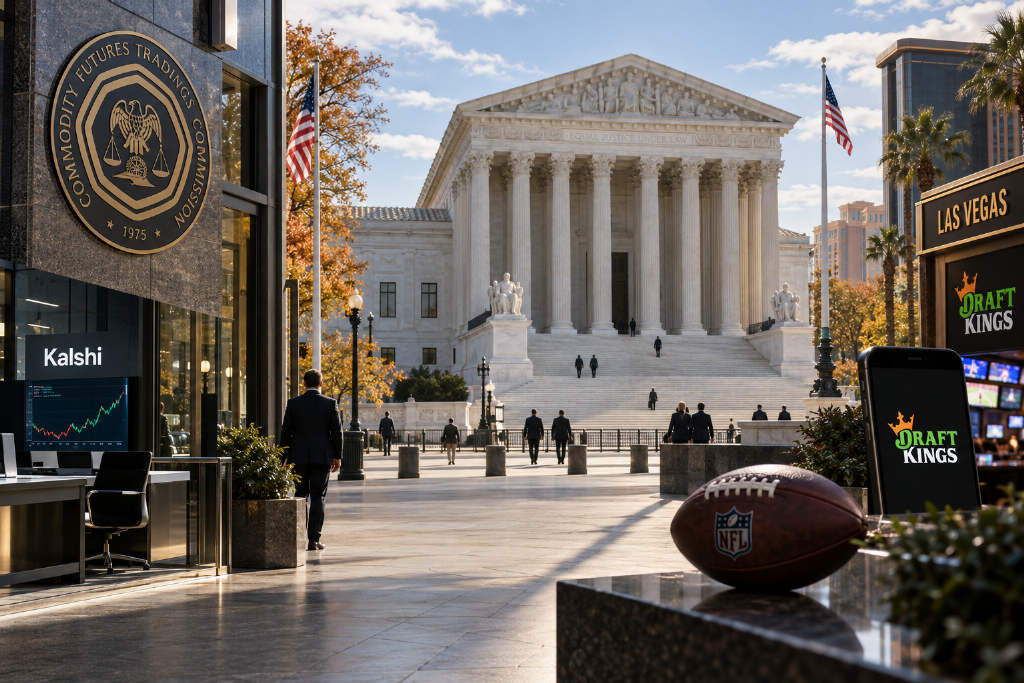
Under U.S. derivatives law, that classification carries real weight. Once a contract is treated as a swap, it generally falls under CFTC oversight, and state gambling licenses and state taxes no longer control it. That is the center of the federal preemption fight. The same NFL game can be state-regulated gambling at a Las Vegas counter or on the DraftKings app, but become a swap, in the CFTC's view, if it is listed as an event contract on a federally registered exchange such as Kalshi.
Two documents, two directions
The proposal addresses what counts as a swap. The interim final rule addresses what does not.
The interim final rule uses a two-part test. A wager is excluded from the swap definition only if it is offered by a licensed state or tribal gaming operator and is not matched on a multilateral exchange. Both conditions must be met for the product to be treated as casino-style gaming rather than a swap.
Taken together, the two lines split sports betting in half. One half stays with the states. The other can move into the federal system. In practical terms, the same sports wager is gambling at a sportsbook counter in Las Vegas, but can become a swap if it appears on a federally registered exchange such as Kalshi.
Volume growth sits behind the regulatory push
CFTC Chair Michael Selig, currently the only sitting commissioner on the agency's five-member panel, has been direct about the agency's position. Americans use event contracts to hedge, speculate, and gather information, he said, and those products belong in the commodity derivatives framework under the CFTC's exclusive jurisdiction. Casino-style products do not.
Trading volume is a major part of the backdrop. The CFTC said event contracts on U.S.-registered exchanges, or DCMs, reached about $1.5 billion in August, with roughly $1.2 billion tied to sports. Market estimates are much larger. Kalshi and Polymarket together handled about $8.56 billion over two days during one weekend in October, and sports contracts were the main driver of that jump.
States challenge the split
That divide has already drawn criticism in court filings. In an amicus brief, the American Gaming Association raised a simple question: if sports wagers are swaps, would wagers taken at sportsbook counters in Las Vegas also have to move onto DCMs?
TD Cowen policy analyst Jaret Seiberg offered another reading. States have repeatedly argued in litigation that if the CFTC writes event contracts into the swap definition too broadly, wagers offered by state and tribal casinos could also be swept into a federally unlawful category. By carving casinos out first, the interim final rule appears designed to remove that line of attack in court. Seiberg's view is that the move is mainly about improving the agency's litigation posture. Whether it works is a separate question.
If the framework fails in court, states could use the casino carve-out argument to pull event contracts back under state law as well.

The Supreme Court petition now matters most
The court system is already split. New Jersey has taken its jurisdiction fight with Kalshi to the U.S. Supreme Court, and the NFL, 39 states, and Washington, D.C. have filed in support of New Jersey.
The NFL argues that sports event contracts create new risk rather than hedge existing risk, which in its view means they are gambling rather than swaps. It also said the CFTC has not barred easily manipulated markets and has not covered injury-related markets, referee-related markets, or a minimum age threshold of 21. On the first Sunday of the current season, prediction market volume reached about $3.3 billion, with $1.8 billion tied to football.
Because the federal appellate system is divided by circuit, different courts can reach opposite answers on the same legal question. That kind of circuit split makes Supreme Court review more likely. This year, three federal circuit courts have already gone in different directions:
- Third Circuit, in April: sports contracts listed on DCMs qualify as swaps and can preempt state law.
- Sixth Circuit, in September: those contracts are not swaps, and state law can apply.
- Ninth Circuit, in August: the same conclusion as the Sixth Circuit, holding that the contracts are not swaps and that state law can apply.
That leaves the same contract open to opposite treatment depending on the jurisdiction. New Jersey has pointed to that conflict as a reason for Supreme Court review. Kalshi's response is due on Nov. 9, and the Court has not yet decided whether it will take the case.
Neither document is in force yet
For now, neither CFTC document has appeared in the Federal Register. The proposal's 30-day comment period starts only after publication, and the interim final rule also does not take effect until it is published. Describing the proposal as already in public comment, or the rule as already effective, would be inaccurate at this stage.
The larger variable is still the judiciary. New Jersey's petition has put the split between the Third Circuit and the Sixth and Ninth Circuits in front of the nine justices, but there is still no word on whether the Court will hear the case. Administrative rulemaking may strengthen the textual support behind the Third Circuit's approach, yet judges still control the final interpretation.
There is also the issue of the commission itself. Selig is the only sitting member of a five-seat panel. The agency may be able to move rules forward in that state, but the internal checks are thin. If the commission is later refilled, or if courts reject this definition, the current framework could change again.
One notable silence remains. Kalshi and Polymarket, the main platforms at the center of the dispute, have not made any public on-the-record statements so far.
