
The U.S. Commodity Futures Trading Commission is investigating incentive programs used by prediction markets, according to a report published Sept. 29. Regulators are said to be concerned that some platforms may be using misleading promotions or marketing tactics to draw traders in. One source told the outlet the review could result in targeted scrutiny of prediction markets or direct enforcement investigations. CFTC Chair Michael Selig has not settled on a specific route, but some form of action is expected before the end of the week.
Kalshi has already ended its trading-volume incentive program. Polymarket and other prediction market platforms that rely on rewards to maintain liquidity depth and user growth may now face closer attention. The report says one reason behind the CFTC’s move is a view inside the agency that prediction market companies did not take seriously the compliance advisory it issued in August.
CFTC had already warned about reward structures in August
On Aug. 12, the CFTC issued guidance on prediction market incentive programs, specifically covering filings tied to market making, liquidity, trading and rewards. In that document, the agency said prediction market operators were trying to encourage heavy trading activity and push firms to act as market makers in order to expand participation and volume, while raising potential compliance concerns.
The CFTC warned that, beyond registered trading rebates and promises of guaranteed profits, certain rewards aimed at high-volume participants could increase the risk of wash trading. It also said market-maker reward programs could encourage fraud and market manipulation.

For platforms such as Polymarket, though, maker-side liquidity incentives, holding rewards, subsidies for new users and referral payouts are core tools for deepening markets and driving user acquisition. The report says projects sometimes enter into private agreements with market makers to improve liquidity in certain contracts, including sports-related markets.
That leaves platforms in a difficult spot. In a highly competitive market, stopping such incentives can weaken liquidity and hurt user experience, which in turn can lead to user losses.
It remains unclear which companies will be directly affected by any CFTC action. Still, platforms operating in the U.S., including Kalshi and Polymarket, offer reward mechanisms that could draw regulatory attention.
Polymarket’s reward spending stands out
Polymarket may become a primary focus of the regulator, the report says. Citing polyscalping data, it notes that since Polymarket began charging trading fees in January 2026, the platform has generated $229 million in fees and paid out $128 million in rewards, equal to 54.3% of trading-fee revenue.
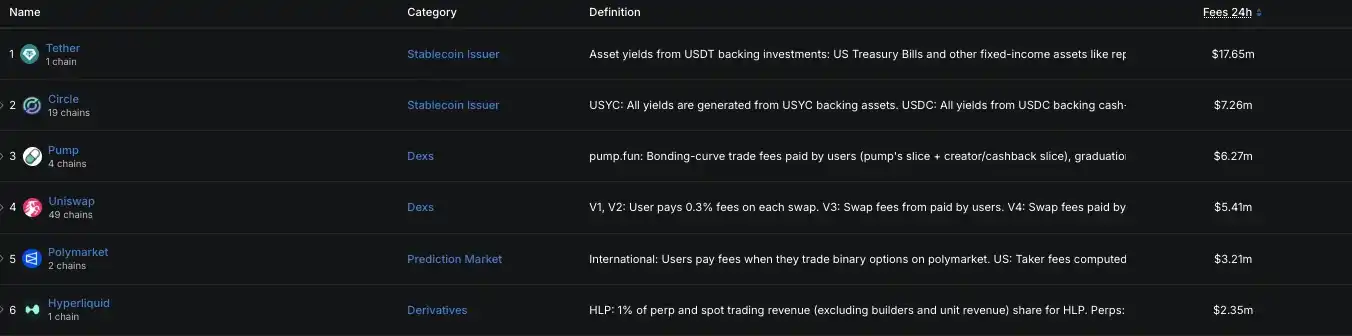
Polymarket is described as one of the most liquid prediction markets in the sector, but that depth comes at a high cost. Data from DeFiLlama cited in the report shows Polymarket ranking fifth among blockchain projects in 24-hour fees at $3.21 million, about $1 million higher than sixth-ranked Hyperliquid. Yet its 24-hour revenue was only about $400,000, placing it 16th in the industry. That implies roughly $2.8 million was distributed back to traders and market makers through various reward channels.
Five regular reward channels support liquidity and activity
The report breaks Polymarket’s incentive structure into five main categories:
- LP rewards
- maker rebates
- taker rebates
- holding rewards
- referrals
LP rewards have been in place since November 2023. The report notes that Polymarket was not yet charging fees at that time. Holding rewards began in July 2025 and mainly took the form of annualized yield for holding pUSD. Maker rebates, taker rebates and referral rewards were all introduced this year.
Together, those five channels have distributed about $128 million. The article says the share and breakdown by category are shown in the accompanying chart.
Polymarket also launched a separate Perps liquidity incentive program after opening Perps trading in May. The daily budget for that program is fixed at $75,000 and allocated across active perpetual markets. At that pace, the annualized cost for this one program alone reaches $27 million.
These are only the platform’s standing incentives. During special events and major competitions, Polymarket has rolled out extra campaigns to encourage traders and market makers to participate. The report gives several examples: during the crypto TWAP transition period in August, Polymarket offered an additional $1 million in liquidity rewards; during the World Cup and other popular sporting events, it increased event-specific incentives; and in the U.S. sports March Madness campaign on Polymarket, liquidity rewards for a single event reached $100,000.
User growth accelerated alongside new incentives
The same report, citing Dune data, says reward programs have done more than support liquidity. They also appear to have contributed materially to user growth. In the first months of 2026, Polymarket saw a sudden acceleration in new-user additions, and the timing closely matched the launch of several incentive programs.
In January 2026, monthly new users reached 233,000. That was Polymarket’s first month above 200,000 new users since January 2025, the month Donald Trump was elected president, and it coincided with the rollout of maker rebates.
In March 2026, monthly new users climbed to a record 259,000. That jump lined up with the launch of referral rewards.
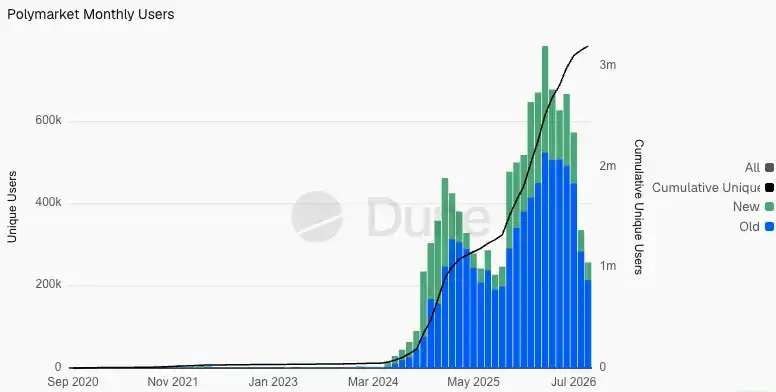
The report does add a qualification: reward programs were not the only factor behind the surge. It also points to maturing regulation, broader advertising and marketing, and external catalysts such as the World Cup. Even so, the timing suggests a strong correlation between the platform’s incentive rollouts this year and user growth.
Kalshi pulls back as Polymarket faces a harder choice
If the CFTC moves from warnings to substantive action on prediction market rewards, Polymarket could be among the first platforms to face concentrated scrutiny because of the scale of its payouts and the share of fees redirected into incentives.
Kalshi has already taken a step back. On Sept. 28, it filed with the CFTC to move the end date of its trading-volume incentive program forward from Oct. 1, 2027 to Oct. 13, 2026. The filing did not explain the reason for the change.
The report also says users had already noticed suspicious activity in mid-to-late September on Kalshi’s ETH perpetual contract. For several consecutive days, trades of about $5,500 accounted for 50% of the contract’s notional volume. That pattern matches the kind of wash trading behavior highlighted by the CFTC in its August document as a typical problem in prediction markets. Based on that, the article argues there is reason to believe Kalshi cut short the program to reduce regulatory exposure.
Polymarket may not be able to do the same as easily. The report says incentives are deeply embedded in the platform’s liquidity model and user growth system. A sharp reduction or outright halt could trigger liquidity withdrawals, shallower market-maker quotes, wider bid-ask spreads in active markets and, in thinner markets, an insufficient number of counterparties.
Its next chapter may depend heavily on how the CFTC interprets these reward programs. If the regulator decides that trades executed mainly to earn rewards are not genuine trading activity, Polymarket could again find itself pulled into a regulatory dispute, this time over wash trading and fraudulent trading tied to incentive design.