

In its annual East Asia crypto report, Chainalysis said the region is still one of the world’s most varied crypto markets, even as sharply different rules, user bases, and use cases keep pulling activity in different directions. From July 2025 to June 2026, East Asia’s crypto economy shrank a bit overall. But that top-line number hid a messy split across markets: Hong Kong logged faster growth in institutional platform inflows, Japan saw more action move toward decentralized exchanges, South Korea stayed heavily retail-driven, and mainland China’s crypto usage shifted more clearly toward peer-to-peer stablecoin transfers.

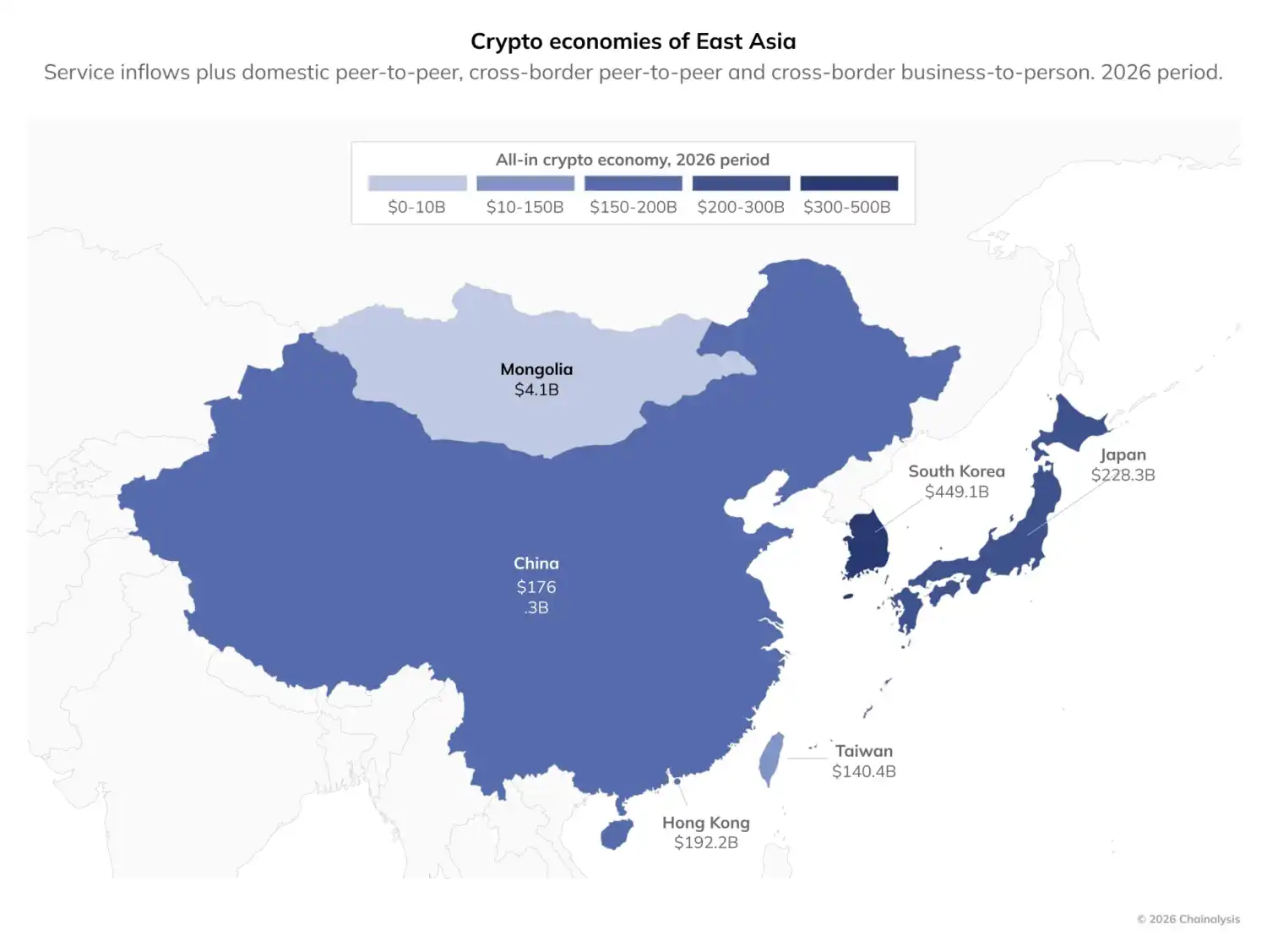
By Chainalysis’ count, South Korea ranked first in East Asia with a crypto economy of $449.1 billion. Japan came next at $228.3 billion, then Hong Kong at $192.2 billion, mainland China at $176.3 billion, and Taiwan at $140.4 billion.
East Asia is moving on different regulatory tracks
Chainalysis said the regional slowdown tracked the broader global crypto bear market. Fair enough. But that only explains part of it. Hong Kong’s institutional platforms took in 87% more funds than a year earlier, making it East Asia’s fastest-growing institutional market. Japan, for its part, posted a 36% jump in DEX inflows.
The report casts Hong Kong, and to a lesser degree Japan, as institutional centers, while other markets in the region show stronger bottom-up adoption. In South Korea, crypto is used mostly as a financial investment tool. In mainland China, it is increasingly serving as an alternative financial channel. Daniel Kim, chief executive of Tiger Research, put it bluntly: "Asia is a rare region with both deep grassroots retail participation and serious institutional firepower."
South Korea remained the region’s largest crypto economy
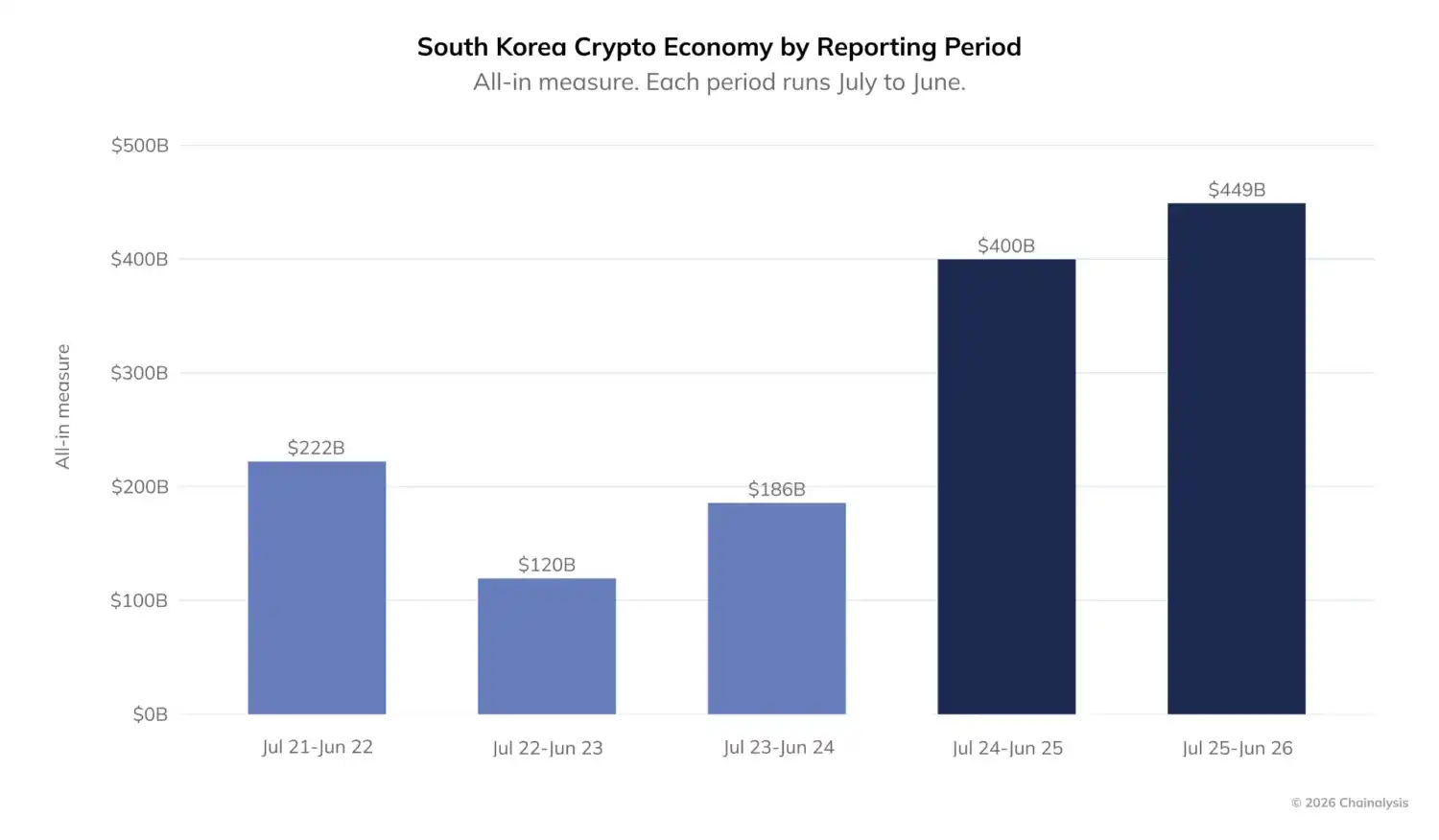
South Korea’s crypto economy hit $449.0 billion during the 2026 period, up 12.3% from a year earlier, with another $51.1 billion in exchange-related fund flows. Chainalysis linked that rise to 16.3% growth in the country’s exchange market and to a broad shift into AI-linked crypto assets.
Francis Kang, executive director of Korea Blockchain Week, said the increase came largely from South Korea’s "retail-led" crypto market. The report added that most of the growth happened before major financial institutions entered in force, partly because of legislative barriers. The government only started loosening its long-standing ban on corporate crypto trading in February 2026. Kang said, "Now every major bank and securities firm has a digital-asset team, and most are running pilots in stablecoins, tokenization, or custody."
Tax policy matters here too. South Korea had no crypto tax in effect during the full 2026 reporting period. A long-delayed 22% tax on crypto gains is set to begin in early 2027, though experts interviewed by Chainalysis said the past delays leave open the chance of another pushback. At the same time, the Financial Services Commission released a roadmap in February 2025 that opened the market to nonprofits, exchanges, listed companies, and registered professional investment firms, though corporate participation for investment purposes still has not scaled. Jinhyeong Jo, a senior reviewer at the Financial Intelligence Unit, said: "The outcome of parliamentary discussions could have a major impact on retail investor demand and on market participation."
AI crypto became South Korea’s dominant retail theme
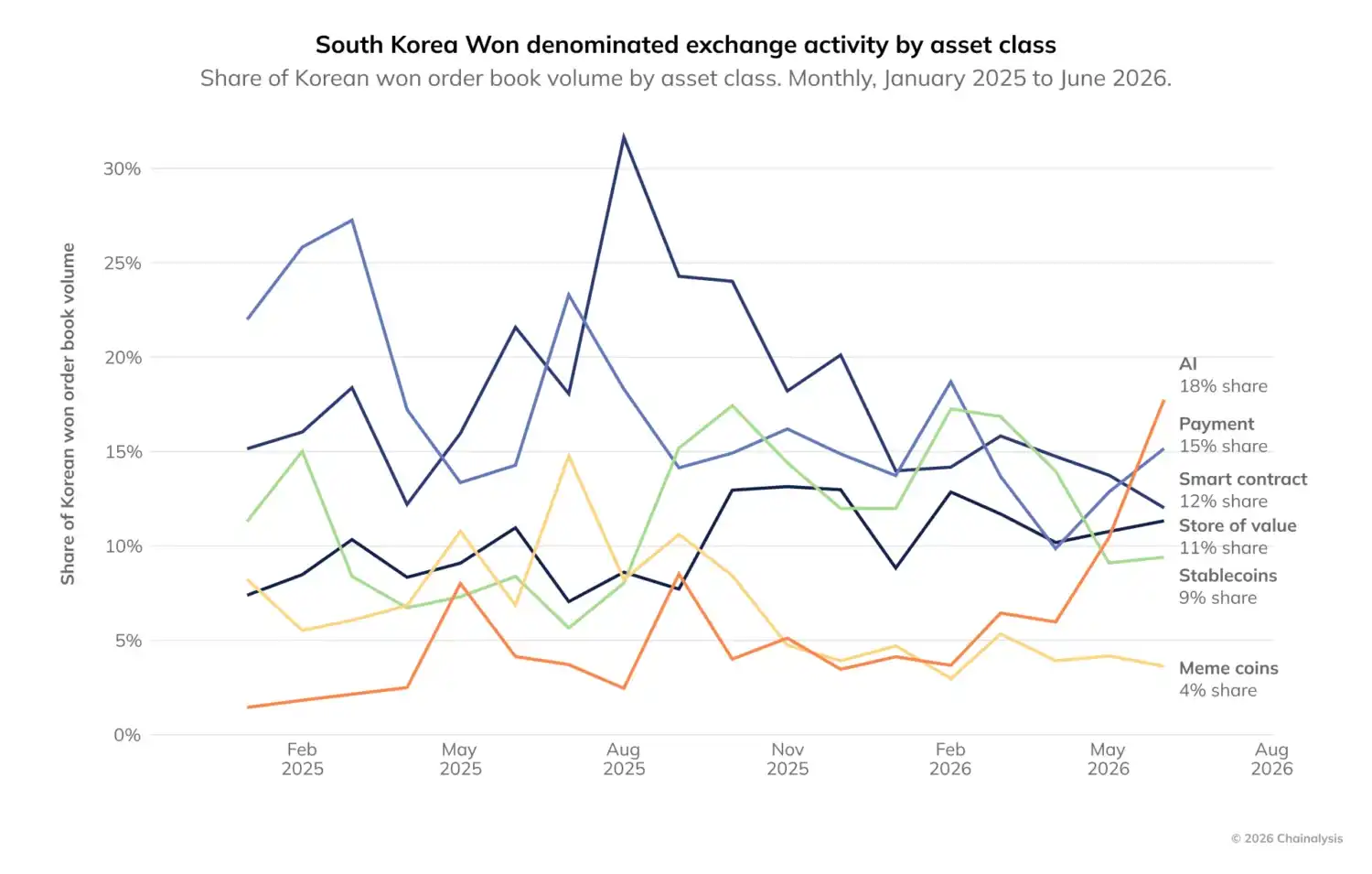
Chainalysis said South Korean retail traders still lean toward high-risk, high-return bets, and nowhere was that more obvious than in AI crypto trading. The report tied that pattern to the broader "AI trade" in Korean equities, where SK Hynix has become a key name because its memory chips are being used to support data-center expansion.
By June 2026, AI crypto assets — defined here as AI projects or digital assets tied to AI infrastructure — had become the single most popular thematic category in KRW-denominated trading, overtaking payment tokens such as XRP. The report said the themed buckets in the chart do not total 100% of KRW trading volume because the unseen remainder consists of 413 smaller or uncategorized tokens.
South Korea stood apart both in the region and globally. In June 2026, AI crypto made up just 0.91% of JPY trading activity, while KRW-denominated AI crypto activity was 19.5 times larger. Among other major currencies, the comparable shares were 0.20% for the Brazilian real, 0.03% for the British pound, and 1.02% for the euro. All of them were below South Korea’s level.
At the token level, Worldcoin (WLD) led with $7.41 billion in trading volume. SAHARA was next at $3.2 billion, followed by VIRTUAL at $2.7 billion, BIO at $2.0 billion, and NEAR at $1.7 billion. Chainalysis also said the set of AI tokens driving Korean volume has already rotated once: 2025 leaders such as VIRTUAL and KAITO were replaced by Worldcoin and SAHARA. By its data, the speed and force of that rotation were greater than in any other market it tracks.
Japan’s consumer market remains active, with DEX usage climbing
Japan’s $228.0 billion crypto economy often gets framed around institutional activity. That misses something. Chainalysis said retail users are still very much there, and the firm kept seeing their footprint in the 2026 reporting-period data.
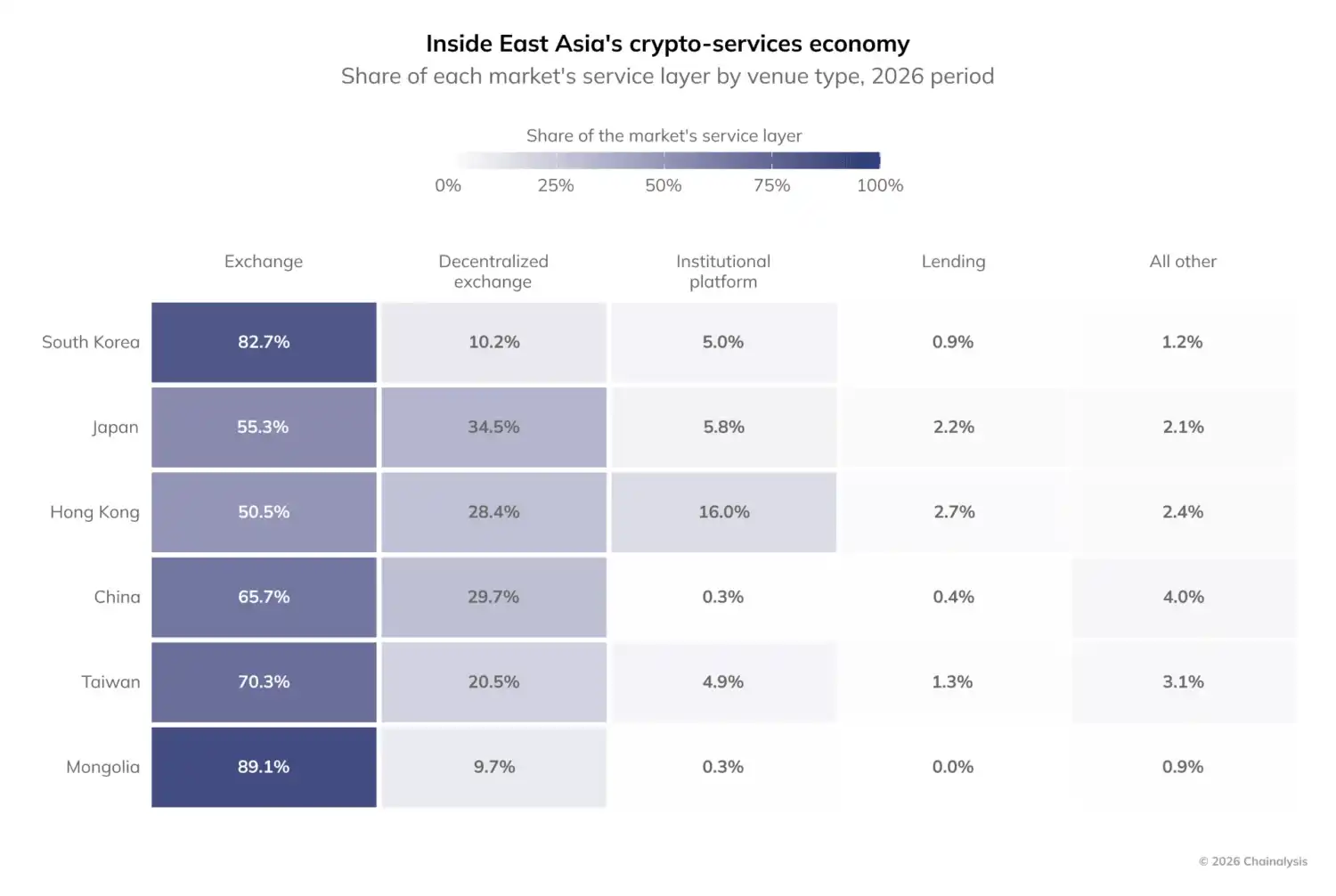
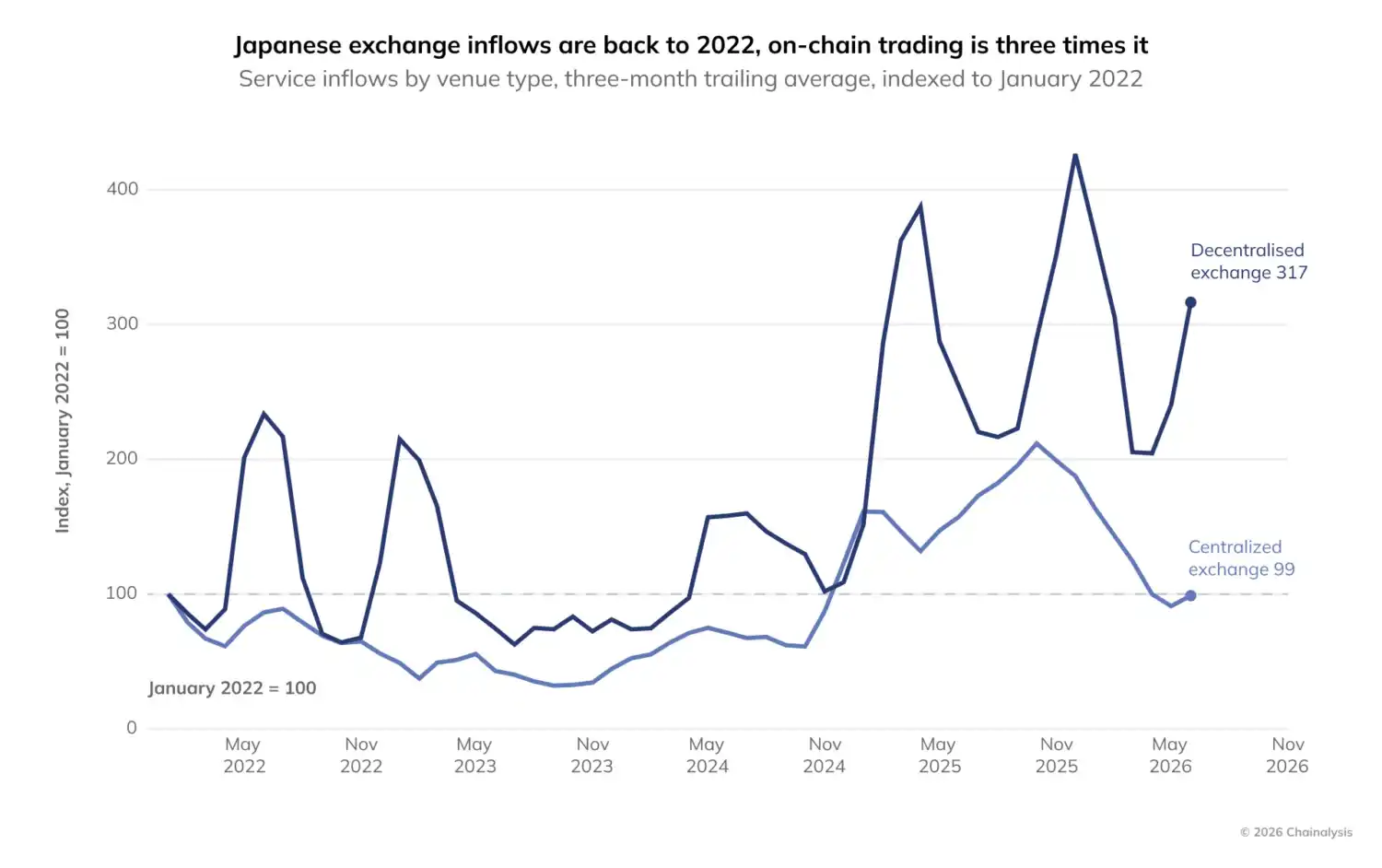
Among users withdrawing funds from exchanges operating in Japan, about one in four later deposited assets into DeFi protocols. DEXs made up nearly 35% of Japan’s service-sector crypto market during the 2026 period, the highest share in East Asia. Since 2022, DEX usage in Japan has climbed by more than 200%, while CEX activity has been mostly flat over the same period, a result the report said pushes back on the idea that Japanese consumers barely engage with crypto.
"The most striking activity is in perpetual contracts," said Taishi Sato, chief executive of DeFimans, an SBI subsidiary. He said perpetuals are popular in Japan because the local trading crowd is experienced and very familiar with foreign exchange markets. FX traders, he said, already know the hedging language needed to trade perpetual contracts. Sato added that traders use venues such as Hyperliquid alongside equity portfolios, "to manage directional exposure and macro exposure, rather than simply treating them as crypto-native trading venues."
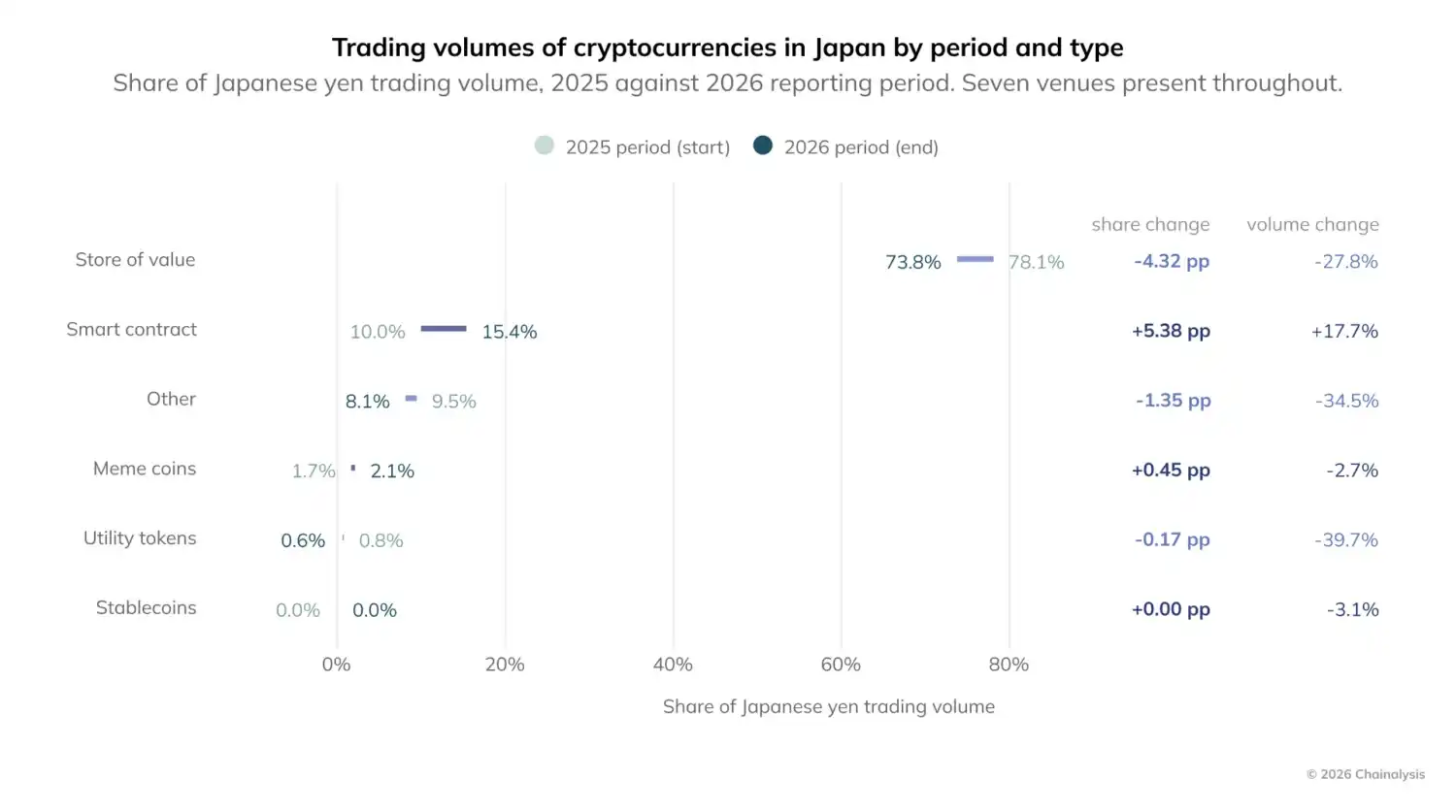
As for token preferences, store-of-value assets such as BTC stayed the most popular category in Japan, accounting for 73.8% of JPY trading volume during the 2026 period. But that share fell by 4.32 percentage points, and total trading volume in the category dropped 27%. The strongest gains came from smart-contract assets such as Ethereum and Solana. Their share of JPY trading rose from 10% in the 2025 period to 15.4% by the end of the 2026 period, while aggregate volume increased 17.7%, making them the only JPY asset category to post year-over-year growth in absolute trading volume.
Arisa Toyosaki, general manager of Binance Japan, said: "Japan has a large and active retail crypto user base, but growth has been held back by tax treatment and a relatively conservative investment culture. Still, with tax reform and strong government backing now in place, we believe retail sentiment could shift over the next 12 months."
The report said Japanese crypto traders faced a top marginal tax rate of 55% during the 2026 reporting window. A package of tax reforms moved forward in July 2026, too late to affect the period under review, but local experts told Chainalysis those changes could lift growth across Japan’s crypto market. If qualifying gains move from the current top rate to a separate tax regime of around 20%, as expected, retail trading volume could rise in a meaningful way in 2027.
Japanese institutions are still in the business-definition stage
Chainalysis said institutional participation in Japan is still earlier than the market-share numbers might suggest. Yuya Hasegawa, market analyst at Bitbank, said: "Especially for financial institutions, 'digital assets' as a broader category — including stablecoins, real-world assets (RWA), tokenized deposits, and payments — are starting to be viewed as a new line of business."
That description fits the market, the report said. Japanese banks, brokerages, and payments firms are still deciding whether digital assets deserve dedicated business lines, instead of already operating at scale.
Analysts are watching the rollout of locally tailored crypto financial tools, especially yen-denominated stablecoins. Hasegawa said JPYC, the first yen stablecoin, launched in October 2025 and can be used for international remittances as well as alongside more widely used dollar stablecoins. Another entrant, SBI Group’s JPYSC, launched in June 2026 and is intended for over-the-counter trading, RWA settlement, and FX.
Sato said: "The opportunity is not to replace the existing financial system, but to connect that existing system with on-chain markets so institutions can trade the basis between the two."
Hong Kong emerged as East Asia’s institutional hub
In Hong Kong, the story was not just market size. It was who was using the market. The city’s $192.0 billion crypto economy is being shaped more and more by institutional participation. SB Seker, head of APAC at Binance, said: "Hong Kong’s progress in recent years shows that regulatory clarity and financial innovation can move forward side by side."
Chainalysis said Hong Kong’s first five-year plan and its latest Policy Address both put stablecoins, tokenized finance, and central bank digital currencies among strategic priorities. The city issued its first stablecoin licenses in 2026 and has already moved into the market-testing phase with institutional participation. QCP Group said this direction would likely "favor larger operators with sound risk controls and proper licenses," raising the bar for smaller firms while improving the market’s overall credibility.
Institutional platforms, including OTC desks, custodians, and market makers, accounted for 16% of service inflows into Hong Kong during the 2026 period, up from about 9% two years earlier. No other East Asian market got above 6%. Custody and prime-brokerage services, together with market makers, made up 85% of that category, a pattern Chainalysis said reflects Hong Kong’s role as a cross-border institutional trading and settlement layer.
During the same period, Hong Kong drew nearly $24 billion in inbound service-to-service transfers, about six times Japan’s level and 44 times South Korea’s. Outbound flows were also heavy at about $11 billion, showing that Hong Kong works as a two-way corridor for institutional capital in Asia.
From mid-2022, cumulative net B2B inflows kept climbing and reached $17.4 billion by mid-2026. Over that same stretch, net flows through non-B2B channels stayed negative. Put simply, wallet-based capital was leaving Hong Kong while service-to-service capital was coming in. Chainalysis said that points to institutional capital not merely passing through the city, but settling inside its regulated perimeter.
Mainland China’s P2P stablecoin activity rose sharply
Chainalysis said mainland China’s crypto economy is still hard to measure. Long-running official restrictions on crypto services have depressed domestic service-based fund flows, but activity did not vanish. The firm estimated the mainland market was worth at least $176.0 billion during the 2026 reporting period, and said the true figure is probably higher.
That estimate rests mostly on the peer-to-peer economy. Unlike other East Asian markets — and unlike most crypto-using countries around the world — a large share of crypto activity in mainland China is driven by person-to-person fund flows rather than exchange inflows and outflows, because exchanges remain banned. In the 2026 period, domestic P2P activity made up 59.1% of mainland China’s total crypto economy, 3.5 times the share seen in the previous reporting period.
One of the report’s main findings is this: the number of unique wallets sending P2P stablecoin transactions in mainland China rose 43-fold from the first quarter of 2024 to the second quarter of 2026.
Chainalysis also put forward what it directly called a "working hypothesis": the timing may match the expansion of China’s social credit system. The report said authorities expanded that system into finance and internet-related domains in March 2025, a few months before the reporting period began. It described the framework as one that uses behavioral scoring and blacklists to limit access to travel, credit, employment, and financial services, and said it has gradually been integrated with bank compliance infrastructure in recent years.
In Chainalysis’ data, the pace of stablecoin adoption for domestic payments changed visibly around March 2025. After slight month-over-month declines in January and February, monthly growth turned positive and then stayed meaningfully positive for 13 straight full monthly cycles starting in March. Because each bar in the chart reflects newly added activity in that month rather than the total outstanding level, rising bars mean each month added more than the one before. The report said monthly additions grew from about $240 million in March 2025 to nearly $5 billion a year later.
Chainalysis said the pattern looks like a system-wide shift, not a one-off spike. No sudden explosion. Instead, it steadily increased the use of crypto assets inside mainland China over time.
The firm laid out two possible channels. First, people blacklisted by the social credit system and cut off from traditional payment rails may turn to censorship-resistant crypto alternatives. Second, people trying to avoid existing monitoring systems may choose to transact in crypto instead of formal payment channels, for example by listing goods for sale on domestic e-commerce platforms and then sharing a crypto address through Telegram to complete payment.
The report stressed that this is still only a working hypothesis. Even so, it said the fast rise in stablecoin use for domestic P2P payments in mainland China can indeed be traced to March 2025, when transfer value grew 996% in the sub-$100 bracket, 1057% in the $100 to $1,000 bracket, and 1321% in the $1,000 to $10,000 bracket.
Stablecoin velocity ran at more than triple the global average
To test whether this flow looked more like investment activity or payments usage, Chainalysis also measured stablecoin velocity in mainland China. It used the standard economic definition: the number of times a unit of money turns over during a given period. Higher velocity means the same dollar is moving more often among economic participants.
By that yardstick, self-custodied stablecoin holdings in mainland China turned over 33.2 times per year. That was more than triple the global average of 9.3, and above every comparable market in East Asia: 9.9 in Japan, 6.1 in Hong Kong, 5.1 in South Korea, and 3.5 in Taiwan.
Against an average balance base of $3.1 billion, mainland China moved $104.1 billion through 18.1 million transfers during the 2026 reporting period. Chainalysis said that level of velocity fits a user base treating stablecoins as working capital rather than as a store of value. If an asset is turning into a usable domestic payments channel, the report said, this is the kind of on-chain pattern you would expect to see.
Regulation is shaping East Asia’s crypto map
"In a market long driven by retail traders, the center of gravity is shifting toward institutions," Kim said. Chainalysis argued that regulation is the variable shaping that shift more than anything else.
The report presents East Asia as a rare side-by-side test of how different policy paths affect crypto markets. In mainland China, prohibition did not wipe out activity; it pushed activity elsewhere, with unique wallets sending P2P stablecoin transfers rising 43x in two years. Japan, Hong Kong, Singapore, and South Korea took another path, building regulated access frameworks meant to move activity inside licensed perimeters. The early results are uneven. Hong Kong alone has attracted $17.4 billion in net institutional inflows since late 2024, while growth in South Korea has been driven almost entirely by retail traders.
Chainalysis ended by saying the open question is whether regulated access can bring institutional, retail, and cross-border activity onto compliant rails at the same time, or whether some segments will still move offshore. Next year’s data, it said, should give a clearer answer.