
ChainCatcher on Oct. 27 published a morning roundup covering a broad mix of market, policy, company and on-chain security developments from the past 24 hours.
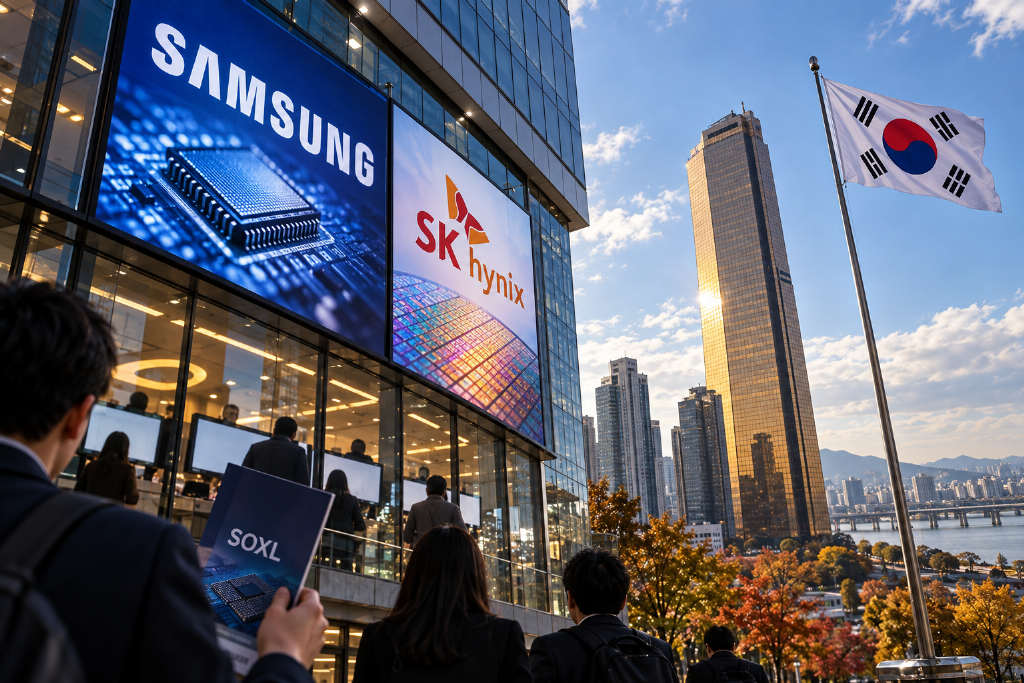
Korean retail traders return to leveraged chip products, with SOXL net buying near KRW 4.7 trillion
According to a report by Chosun Business dated Oct. 25, Korean retail investors resumed buying single-stock leveraged products tied to rebounds in Samsung Electronics and SK Hynix after a sharp sell-off in the local stock market. Data from the Korea Exchange and Koscom ETF Check showed that from Oct. 1 to Oct. 23, individuals were net buyers of KRW 315.4 billion across 14 related products. Of that total, seven SK Hynix-linked products accounted for KRW 226.3 billion and seven Samsung Electronics-linked products accounted for KRW 89.1 billion.
The same 14 products had seen net buying of KRW 2.7728 trillion in July. After tighter regulation, including a higher margin deposit requirement on July 31, flows turned negative. Net selling reached KRW 648.4 billion in August and KRW 497.9 billion in September. This month marked the first return to net buying.
Over the same period, KODEX SK Hynix Single Stock Leverage posted KRW 152.9 billion in net buying, ranking 11th among ETFs listed in Korea. Retail investors also bought KRW 1.0448 trillion of KODEX Leverage and KRW 256.4 billion of KODEX Semiconductor Leverage. Korea’s benchmark index fell 18.83% in October.
Data from the Korea Securities Depository showed that from Oct. 1 to Oct. 22, Korean investors were net buyers of $4.8009 billion in U.S. stocks, or about KRW 6.3621 trillion. Of that, SOXL, which tracks daily returns of a U.S. semiconductor index at 3x leverage, drew $3.54764 billion in net buying, or about KRW 4.7041 trillion. That represented 73.9% of total net U.S. equity buying during the period. The report also noted that leveraged products track daily returns on a multiple basis, which means losses can be magnified twofold or threefold when markets move the other way, and repeated sharp swings can create negative compounding effects.
Anthropic could make its IPO filing public as soon as Oct. 26
AI company Anthropic could publicly release its IPO prospectus as soon as Oct. 26 U.S. time, with a listing planned for mid-November. The company confidentially submitted documents to the U.S. Securities and Exchange Commission in June. Market discussion had previously centered on a $2 trillion valuation, though some investors have recently lowered expectations to around $1.5 trillion as AI-related stocks came under pressure.
The prospectus has not yet been formally published, but Reuters and The Wall Street Journal have already obtained a draft. Revenue for the first half of this year was $16.3 billion, up from $1.1 billion in the same period last year. Net loss for the same period was $80.7 billion, with about $72 billion tied to valuation adjustments on convertible debt and other financing instruments rather than cash actually burned. Third-quarter revenue reached $16.8 billion, up about 45% from the prior quarter, after growth of more than 140% in the previous quarter.
The company said it was profitable in the third quarter on an adjusted basis. Commitments tied to future cloud computing, chips and data center infrastructure have exceeded $600 billion and will be incurred over multiple years. In 2025, 47% of revenue was generated through the cloud platforms of Amazon and Google, which are also investors and compute providers.
Anthropic plans to give its seven co-founders combined control of 50.1% of voting power through a special share structure, while a long-term public-benefit trust made up of non-shareholders would still retain the power to appoint or remove a majority of the board. The final filing is also expected to provide more detail on the true revenue contribution of two major customers, the specific cost of compute contracts, and whether existing shareholders will be allowed to sell stock at the time of listing.
Electrum patches fee-bump theft vulnerability
Bitcoin light wallet Electrum disclosed on Oct. 24 a malicious-server attack targeting transaction fee bumps and fixed the issue in version 4.8.3. The issue is tracked in GitHub security advisory GHSA-6jp4-8v48-cc5v. Under normal fee-bump behavior, users could end up signing funds over to an attacker. Developers said the issue came to light after users reported losing funds after signing a fee increase.
The two reports described different outcomes. One user said that after broadcasting a payment, the transaction shown in wallet history was replaced, and the original payment never entered the Bitcoin peer-to-peer network because it had been withheld by the server. Another user, Raju-K12, fee-bumped the replacement transaction and lost funds. In the attack, a malicious server withholds a newly broadcast client transaction and inserts a conflicting transaction into the wallet history, replacing the original output with an attacker-controlled address.
That replacement transaction initially carried an invalid signature, but the light client did not verify those signatures before displaying unconfirmed transactions. Once the user manually fee-bumped the transaction through RBF and signed it, the attacker’s payment became valid. Both users said the attacker address shared the same last four characters as the legitimate recipient address. The advisory did not disclose the amount stolen, transaction IDs or the attacker address.
The patch corresponds to commit 90fe308. It verifies signatures for wallet-owned inputs before mempool transactions are written into local history, but it does not cover inputs belonging to addresses outside the wallet and does not perform full consensus validation. The advisory said users who have not upgraded should verify output addresses and amounts every time they sign. Clients connected to their own server or a trusted server are not affected. The timeline in the disclosure shows an initial private report on Oct. 11, a fee-bump loss report on Oct. 18, a tagged fix on Oct. 23, and binary release plus public disclosure on Oct. 24.
California regulator objects to SEC crypto proposal
California’s Department of Financial Protection and Innovation, or DFPI, has submitted a comment letter to the SEC opposing its proposed "Regulation Crypto Assets." The department said the proposal could weaken investor protections and limit the ability of state authorities to review token issuers. DFPI commissioner KC Mohseni said California opposes efforts by federal regulators to reduce state-level authority and protections.
The proposal would allow eligible issuers to raise up to $5 million over four years under a startup exemption. A separate crypto fundraising exemption would allow issuers to raise up to $75 million over 12 months. Covered offerings would need to disclose project details, risks and other information needed for investor evaluation. Some offerings would also need to provide financial statements and ongoing reporting.
Federal securities law would still preserve state authority to investigate securities fraud, deceptive conduct and illegal broker or dealer activity. Ripple, Coinbase and exchange operator Nasdaq have all backed changes to the proposal. DFPI said its scam tracker has added nearly 200 crypto-related fraud cases, up 30% from a year earlier.
Soneium plans native token issuance
Sony-backed Ethereum layer-2 network Soneium plans to issue a native token, $SONEIUM, aimed at linking entertainment creators, IP holders, builders, fans and investors. The plan was announced on Oct. 26, 2026. Its core idea is tokenized intellectual property, with products spanning royalty-backed assets, entertainment investment and automated revenue sharing. The network is being developed by Sony Block Solutions Labs, Sony’s blockchain unit.
Soneium said tokenized IP is meant to represent the future economic value of creative works on-chain. Creators would be able to raise funds from fans and investors and share commercial proceeds through automated revenue splits. The tokens could represent creators, studios or individual works. Formats include collectibles for fan engagement and fungible tokens circulating within an IP economy. Soneium Portal is positioned as the entry point for IP discovery, issuance and investment, with royalties paid automatically through smart contracts.
IP Vault is designed to support royalty-backed assets and provide indirect exposure to opportunities such as music catalog funds. IP Bonds will be backed by entertainment businesses. The first projects focus on Asian pop culture, with partners Super State Holdings and DayOneDream’s WAVIST platform. The former starts with the character Moriusa, while the latter targets concert-business royalties involving artists including BTOB and Lee Chae-yeon.
Soneium mainnet went live on Jan. 14, 2025, based on Optimism’s OP Stack. Transaction fees are paid in ETH, and stablecoin USDSC has already been used for settlement. The network hosts more than 250 applications, with about $9.38 million locked across them. Sony invested $13 million in infrastructure partner Startale Labs in early 2025.
Cryptex files sixth amended S-1 for multi-asset spot ETF
According to SEC filings, the Cryptex Digital Market Cap ETF submitted its sixth pre-effective amended S-1 on Oct. 23 and plans to list on Nasdaq under the ticker BAGZ. The sponsor is Cryptex Finance.
The fund intends to directly hold multiple crypto assets and build its portfolio based on the constituents and weights of the Cryptex Digital Market Cap Index, rebalancing in line with the index. Assets that could initially account for 5% or more of net asset value include BTC, ETH, XRP, HYPE, DOGE, SHIB, ADA and CTX. The filing said composition and weights may change over time. It also made clear that the submission is only an update to the registration statement and does not mean the SEC has approved the product or that trading has begun.
a16z backs U.S.-listed compute derivatives
a16z recently submitted a public comment letter to the Commodity Futures Trading Commission in response to the agency’s request for comment on listing compute-derivatives contracts. The firm said it supports the creation of a regulated U.S. market for compute derivatives.
According to the letter, such products could help AI startups and cloud providers hedge risks tied to compute pricing, utilization and duration, while lowering financing costs for AI infrastructure. a16z said the CFTC does not need new statutory authority and that the Commodity Exchange Act, Part 38 core principles and the Part 40 self-certification process are already sufficient.
The firm urged the CFTC to rely on the existing framework, support compute price benchmarks aligned with IOSCO principles, and allow exchanges to list cash-settled compute futures, including dated futures and perpetual contracts. a16z crypto is an investor in Ornn. ICE said in May that it planned to launch GPU compute futures based on the Ornn Compute Price Index, or OCPI.
Blockstream executive says institutional clients are bullish on Bitcoin
Peter Bain, chief marketing officer at Blockstream, said in a recent interview that Bitcoin holding above $81,000 despite an equity sell-off, rising 10-year Treasury yields and instability in Europe was a "very, very strong signal." He made the comment in a conversation with Grace Remington and Sean Hagan.
Bain said technical building comes before price and also discussed adoption, stablecoins and tokenized equities. He described Blockstream’s new center in Lugano and a new advisory unit for institutional clients. He also explained why treasury companies are concentrated in the U.S. while Switzerland is likely to be the next market, citing clear regulation and a deep banking base.
On quantum computing, Bain said the threat remains decades away and argued that Bitcoin’s real weak points lie elsewhere. Referring to the PHP vulnerability incident, he said the industry needs to rethink how software is released. He also discussed Blockstream’s work on quantum-resistant signature schemes, how consensus could handle a quantum upgrade, and the Bitcoin Security Alliance.
Bain also gave his first update on the Liquid Network incident, saying redemption services have resumed, the network is back online, and users can move Bitcoin back to the main chain. Looking ahead to 2027, he said institutional clients believe Bitcoin "could be heading into a major bull market."
Full-page Wall Street Journal ad warns about tokenized stocks
The Wall Street Journal has carried a full-page paid advertisement over the past two days with the slogan "YOUR STOCK. THEIR TOKENS. YOUR PROBLEM." The ad warns the public about risks tied to tokenized equities.
It was funded by the conservative U.S. nonprofit Common Sense Leadership Fund. The group argued that the crypto industry plans to tokenize company shares in venues it described as unregulated, and it listed eight risks: pricing dislocations, unclear ownership, impaired capital formation, cyber theft, market manipulation, AML gaps, missing investor protections and potential legal liability.
Earlier, 22 companies including Microsoft, Goldman Sachs, McDonald’s and Alphabet had raised objections. The related filing outlined rules for a project involving OKX and ICE and listed the companies that objected, but it did not explain their specific reasons.
Franklin Templeton registers two Bitcoin DRIP ETFs
According to SEC filings, Franklin Templeton has registered two Nasdaq-listed index ETFs that would reinvest stock dividends into Bitcoin: the Franklin US Equity Bitcoin DRIP Index ETF, or FBEQ, and the Franklin US Innovation Bitcoin DRIP Index ETF, or FIBT.
Goldman Sachs sees an October Fed pause and a possible December hike
Goldman Sachs said in a report that it expects the Federal Reserve to pause at its October policy meeting, while leaving room for what could be the final rate hike of the cycle in December.
The bank said financial conditions have tightened by about 30 basis points since September, but that is not enough to substitute for another increase. In Goldman’s view, markets should not read tighter financial conditions as a sign that the hiking cycle is effectively over. The bank expects U.S. inflation to improve in 2027 as the effects of tariffs, energy shocks and AI-related price pressure gradually fade. Under its baseline scenario, the Fed would not raise rates in March 2027. A further escalation in the Middle East that pushes oil prices higher and keeps inflation pressure elevated could still alter the policy path.
Samsung and SK Hynix earnings draw focus to HBM4 and shareholder returns
According to Cailian Press, South Korean memory chip makers SK Hynix and Samsung Electronics are due to report results for the third quarter of 2026 this week, with SK Hynix scheduled for Wednesday and Samsung for Thursday. The report said stronger AI chip demand and higher memory prices could lift combined operating profit to KRW 184.4 trillion, or about $139.1 billion.
Samsung’s preliminary results released on Oct. 8 showed third-quarter revenue rose 127% year over year to KRW 195 trillion. Operating profit reached KRW 107.4 trillion, or about $80.17 billion, versus KRW 12.17 trillion a year earlier, nearly an eightfold increase. Analysts surveyed by FnGuide expect SK Hynix to post KRW 98.2 trillion in revenue and KRW 77 trillion in operating profit for the quarter. In 2025, Samsung and SK Hynix posted operating profit of KRW 43.6 trillion and KRW 47.2 trillion, respectively, for a combined KRW 90.8 trillion.
If the forecasts are met, Samsung would become the first Korean company to exceed KRW 100 trillion in quarterly operating profit. As of the Oct. 23 close, Samsung and SK Hynix shares were down 36% and 52% from the end of June. The report said investors largely see strong earnings as expected and are instead focused on HBM4 supply, long-term contracts and shareholder returns. TrendForce expects average HBM selling prices next year to rise 121% from this year, and said Samsung and SK Hynix have already sold out next year’s output.
In second-quarter earnings, Samsung disclosed long-term agreements with five data center customers, while SK Hynix said it had signed multi-year contracts with more than 10 customers. Samsung this year announced a shareholder return plan of KRW 90 trillion to KRW 110 trillion and is set to determine about KRW 30 trillion in third-quarter cash dividends by the end of this month. SK Hynix announced a KRW 40 trillion buyback plan in August and halted its review of a Solidigm listing. KB Securities executive Kim Dong-won said that despite the sharp share-price correction, earnings expectations for both companies have been revised higher, and the key catalyst for a rerating will be whether profit growth proves sustainable and whether shareholder returns increase further.
Ansem turns bearish on BTC and ETH
Crypto trader Ansem said in a post that he is currently bearish on Bitcoin, Ethereum and large-cap equities, though he does not think retail speculation will cool in a meaningful way. He also expects large two-way swings in the fourth quarter, with some on-chain assets still likely to perform well.
Ansem said this week’s Fed rate decision and several major corporate earnings releases create significant event risk. He added that popular AI stocks have formed lower highs after their run-up and have lost their prior trend. At the same time, he said this should not be read as a bearish call on the longer-term market, which could still see a pullback before resuming its rise.
Bloomberg says Trump-linked crypto firms are hiring lawyers
Bloomberg reported that crypto, venture capital and prediction-market businesses linked to Donald Trump and his family are stepping up efforts to hire lawyers and lobbyists in preparation for possible congressional investigations.
Democratic lawmakers have asked World Liberty Financial and 1789 Capital to provide information, focusing on whether the businesses received government contracts, policy advantages or had conflicts of interest. Bloomberg said that even if Democrats win a congressional majority in the midterm elections, any investigation could still face obstacles, including difficulty compelling testimony or documents from people overseas and uncertainty over whether federal agencies such as the Department of Justice would take further action. The companies involved and the Trump family have said their business activities comply with the law.
Asia Gulf Holdings names Martin Gilbert and Maliki Osman to advisory board
Asia Gulf Holdings, the parent company of Singapore Gulf Bank, said it has appointed Revolut Group chairman Martin Gilbert and former Singapore minister in the Prime Minister’s Office and second minister for foreign affairs Maliki Osman to its global advisory council.
The two will advise on global investment strategy and geopolitical affairs, respectively. Maliki Osman will also advise on government relations and regional cooperation, while Martin Gilbert will focus on global investment strategy, asset management, and investment opportunities across Asia and the Middle East and North Africa. The council is chaired by Amy Lee, with former Federal Reserve vice chair for supervision Randal Quarles serving as vice chair. The appointments were announced on Oct. 26. Maliki Osman left politics in May 2025.
TheMarker reports $130 million raised by Pearl Research Labs
Israeli media outlet TheMarker reported on Oct. 25 that Pearl Research Labs, the Israeli research lab behind AI mining project Pearl (PRL), has raised a cumulative $130 million. That includes $55 million in equity financing and $75 million for a GPU infrastructure fund. Investors include Lightspeed, Ribbit and Square Peg.
The report said the token rose about 520% in the three months after its late-April launch, with circulating market capitalization at one point reaching $710 million. Its "AI version of Bitcoin" narrative drew market attention. At the same time, the report questioned the company’s transparency, saying it had not fully disclosed financing details or the operating structure of the GPU infrastructure fund.
SK Hynix may announce special dividend tied to Kioxia gains
The Dong-A Ilbo reported exclusively on Oct. 26 that SK Hynix plans to return 80% of gains from the sale of its stake in Japanese NAND maker Kioxia to shareholders through a special dividend. Citing investment banking and industry sources, the report said the gains are estimated at about KRW 20 trillion and the special dividend could total around KRW 16 trillion. The company is expected to announce the plan when it reports third-quarter earnings on Oct. 28.
For now, this remains an industry expectation rather than a formal company confirmation. Based on the current share count, the special dividend would amount to about KRW 23,000 per share, equal to 15 times the annual fixed dividend of KRW 1,500 per share and 61 times the quarterly dividend of KRW 375 per share. Whether the payment would be made in installments is still under review. Total dividends last year were KRW 2.1 trillion.
During its second-quarter earnings call, the company said it was studying several additional shareholder return options and would share details within the year once finalized. In 2018, SK Hynix joined the Bain Capital-led U.S.-Japan-Korea consortium that acquired the NAND business spun out from Toshiba, which was renamed Kioxia in 2019. SK Hynix invested about JPY 395 billion in total. The fund-investment portion has already been sold in stages by Bain and fully recovered. After a partial disposal in the first quarter recovered KRW 4.1178 trillion and a further disposal in the second quarter, gains net of principal are estimated at about KRW 20 trillion. Before its stock split, Kioxia shares rose from about JPY 10,000 at the end of last year to a record JPY 112,700 on June 22.
Immunefi CEO warns PHP flaws raise wallet risks
Immunefi CEO Mitchell Amador warned that internet users still face cyberattack risks stemming from PHP vulnerabilities, especially on smaller websites that are slow to complete emergency upgrades and may need weeks to patch. He said the "bug apocalypse" is arriving on schedule, meaning the cost of finding vulnerabilities is becoming cheap while the cost of fixing them remains high.
He advised users to treat any site they log into over the coming weeks as potentially compromised, avoid reusing passwords, be cautious when connecting crypto wallets, and revoke token approvals they do not recognize. Earlier, the PHP Foundation acknowledged that a severe vulnerability first discovered in 2024 had not been fixed sooner because of limited resources. PHP developers released emergency patches for two severe flaws the same day, but websites still need to upgrade on their own.
Cloudflare CEO Matthew Prince said the network recorded millions of exploitation attempts within 24 hours of public disclosure, with thousands of attempts even before disclosure. W3Techs estimates PHP powers about 69% of websites with a known server-side programming language. The flaws could allow attackers to spread malware or inject malicious scripts into websites.
The FBI’s cyber division also warned that the vulnerabilities could allow malicious actors to "remotely execute code in the PHP core, potentially compromising sensitive data and networks." In a June interview with Cointelegraph, Amador had already warned that the spread of frontier AI models was changing the cybersecurity balance in favor of attackers, bringing about a "bug apocalypse" and contributing to a rebound in DeFi hacks. Immunefi says it is the world’s largest bug bounty platform and has paid out $140 million in rewards to 650 protocols so far.
Securitize tokenized stock market cap falls by more than half
Token Terminal data showed that the market cap of Securitize’s tokenized stock SECZ fell from a peak of $430.4 million on Sept. 28 to $208.6 million in less than a month, a drop of more than half. Over the same period, the market cap of tokens tracking Circle stock rose about 20% to $383.6 million, reclaiming the top spot in the $3.3 billion tokenized-equity market.
The decline in SECZ tokens tracked a sell-off in the underlying stock on the New York Stock Exchange. Securitize shares jumped on Oct. 8 after the company launched a stock-trading platform on Solana, but those gains later disappeared. On Oct. 13, Citi downgraded SECZ from buy to neutral, citing concerns about tokenization-related revenue.
Last Friday, SECZ stock closed down 2.1% at $7.8 per share, implying a market cap of $1.27 billion. Securitize is a platform that helps asset managers including BlackRock issue securities on blockchain. It listed on the NYSE on July 2 and tokenized its own common stock, becoming the largest tokenized stock at the time. Even though Circle-related tokens lead in aggregate market value across multiple issuers, SECZ remains the largest single tokenized stock. Among Circle-linked products, Binance-issued CRCLb on BNB Chain is the largest at $154.1 million.
Markets price a 90% chance of no Fed move
Markets are pricing a 90% probability that the Federal Reserve will leave rates unchanged. Analysts at Monex Europe said the foreign-exchange reaction will depend on the tone of the Fed statement. The central bank may keep the possibility of a December hike alive, but is unlikely to offer formal guidance.
Dogecoin Foundation ends exclusive licensing deal with House of Doge
According to SEC filings, the Dogecoin Foundation has terminated its exclusive trademark licensing agreement with Nasdaq-listed House of Doge, effective Oct. 19.
House of Doge and its U.S. subsidiary must change their names by the end of 2026 and stop using labels such as the Dogecoin Foundation’s "official commercial partner." The subsidiaries must also pay the foundation a $400,000 termination fee. Under a new agreement, House of Doge retains non-exclusive trademark rights for three existing 21Shares DOGE investment products.
House of Doge plans to transfer assets related to Such App to Dogecoin Labs in exchange for shares valued at about $4 million, though that transaction has not yet closed. Dogecoin Labs has become the foundation’s new official commercial partner.
Study finds sharp split between Grok 4.7 and GPT-6.1 in candidate recommendations
TechCrunch reported that Convovo, a conversational AI research and design lab led by Cornell professor Tapan Parikh, published a study showing that when asked to recommend only one candidate in upcoming U.S. midterm elections, SpaceXAI’s Grok 4.7 chose Republican candidates in 92% of responses, while OpenAI’s GPT-6.1 Sol chose Democratic candidates in 97% of responses.
The study covered nearly 500 races, and the two models agreed less than 10% of the time. Researchers used APIs to ask both models the same question, requiring them to name one candidate and not refuse or present both sides. The report said consumer-facing apps declined to answer. An OpenAI spokesperson said ChatGPT is designed by default to be objective and that political conversations should not carry directional bias. The spokesperson added that the study tested the developer API with prompts explicitly requiring a recommendation, which does not represent the user experience in the chat app.
SpaceXAI did not respond to a request for comment in time. The report said Grok often cited conservative sources along with Ballotpedia, OpenSecrets and VoteSmart. Of Grok’s answers, 39% included a Christian conservative voter guide, 23% included Turning Point Action and 41% included X. GPT’s results relied heavily on Wikipedia, the Associated Press, Axios and Reddit. The study also said each Grok call through the xAI API included about 1,240 additional input tokens that researchers did not write and could not view or remove. After disabling web search and sampling 30 races, Parikh found GPT chose Democrats in 24 cases, while Grok refused to choose in 27 cases.
Musk says SpaceX completed $40 billion debt financing for GPUs
Phoenix Technology, citing Reuters, reported that SpaceX founder Elon Musk said on Oct. 26 Beijing time that the company had completed $40 billion in debt financing for graphics processor purchases. Musk wrote on X that the financing would mainly be used to buy GPUs scheduled for delivery in the first and second quarters of next year. He added that the debt can be redeemed early and will not have a material impact on this quarter.
Musk also said SpaceX’s investment-grade credit rating, along with revenue from Starlink satellite internet and launch services, has helped the company maintain access to credit financing. Reuters had reported earlier this month that SpaceX was in talks with banks and asset managers to raise $40 billion for Nvidia AI chips.
For the three months ended Sept. 30, SpaceX revenue rose 161% year over year to $14.58 billion. Capital expenditure on compute infrastructure nearly tripled over the same period to $19.6 billion.
Galaxy says about 11.1 million BTC cannot be linked to known holders
CoinDesk reported that Galaxy Research’s October snapshot found that of roughly 20.10 million mined Bitcoin, about 11.10 million BTC, or around 55%, sit at addresses that cannot be linked to exchanges, funds, governments or other known entities. Galaxy research head Alex Thorn said the figure suggests that even as institutionalization increases, a large share of Bitcoin may still be self-custodied by individuals.
Xapo Bank said the data also reflects the fact that retail participants have been in the market for more than a decade. At the same time, not all unattributed Bitcoin necessarily belongs to long-term self-custody holders. It may also include coins lost because private keys were misplaced or holders died, positions held by institutions or OTC desks not yet identified by Galaxy, and custodial assets spread across many addresses. The remaining 45% has known attribution, including exchanges, ETFs issued by firms such as BlackRock, and the U.S. government. The single largest holder among known clusters is "Satoshi Nakamoto (Patoshi pattern)," with 1,123,658 BTC.
LinX HK raises $4 million in Pre-A round
AI recruitment technology brand LinX HK, which focuses on the Asian market, said it has completed a $4 million Pre-A round. Institutional investors including Aipollo and Lingfeng Innovation Fund contributed a combined $3 million, while individual investors contributed $1 million.
The company said the proceeds will be used mainly for product and AI technology development for its flagship product, Luminpath. LinX HK co-founder Shuo Shan said, "This round gives LinX HK support to keep refining its product and technical capabilities. We hope to continue advancing Luminpath’s AI job-search agent so users can discover opportunities more efficiently, better understand roles and companies, and approach career choices with stronger preparation."
LinX HK describes itself as an AI recruitment technology brand for the Asian market, with Luminpath as its flagship product. Luminpath is currently in a gray-release testing phase and provides AI-driven job-search support across job discovery, resume optimization, customized application materials and application assistance within authorized scope.
Volvo Cars adds 2,500 layoffs and posts operating loss
On Oct. 23, Swedish automaker Volvo Cars announced an additional 2,500 job cuts, equal to 6% of its workforce. Financial results released the same day for July through September 2026 showed an operating loss of SEK 5.5 billion, compared with an operating profit of SEK 6.4 billion a year earlier. Revenue fell 23% year over year to SEK 66.8 billion. Net result was a loss of SEK 4.8 billion, versus a profit of SEK 5.1 billion in the same period last year.
The company’s stock at one point fell 30%. The report showed sales in China dropped 41% and global sales fell 11%, mainly because of weak demand in China and the U.S. Profitability was hurt by weak sales of higher-end models, a rising share of lower-priced vehicles, and impairment losses tied to fuel-efficiency credits after the U.S. eased decarbonization rules. CEO Hakan Samuelsson said at a press conference the same day, "The old strategy of developing global models in Europe and then selling premium cars in China no longer works. That era is over."
Ondo Finance to open subscriptions for OpenAI pre-IPO tokenized note
The Block reported that RWA protocol Ondo Finance will open subscriptions next week for a tokenized pre-IPO note tied to OpenAI. Private clients will be able to subscribe directly, and the product is already trading in the secondary market. Expectations for an OpenAI listing have been pushed back to 2027 after CEO Sam Altman ruled out a 2026 IPO last month, citing AI safety.
S&P Global completes acquisition of OpenZeppelin
S&P Global (NYSE: SPGI) said it has completed its acquisition of on-chain financial security standards provider OpenZeppelin. The deal was first announced on Sept. 17. Financial terms were not disclosed, and S&P Global said the transaction is not expected to have a material impact on its financial results. OpenZeppelin was founded in 2015 and has completed more than 900 security service projects, identifying more than 10,000 vulnerabilities before products went live.
Its open-source smart contract library, OpenZeppelin Contracts, has supported more than $38 trillion in value transfer across major stablecoins and tokenized funds. The acquisition extends S&P Global’s risk assessment capabilities into on-chain technology risk, and the two sides plan to develop a new generation of on-chain security assessments and benchmarks.
After the acquisition, OpenZeppelin will continue operating under its existing brand as an independent business unit. Founder Demian Brener will remain in charge and report to Yann Le Pallec, president of S&P Global Ratings. OpenZeppelin Contracts will remain open source, free and publicly maintained.
Empery commits $65 million to AI data center deal
Bitcoin treasury company Empery Digital (NASDAQ: EMPD) plans to invest $65 million to acquire a 25% stake in a private entity buying an AI data center property in the U.S. Midwest. The facility currently has about 150 MW of power capacity and its own substation, with potential expansion to about 300 MW.
Based on the company’s earlier disclosures, the project is expected to use a 15-year triple-net lease structure, with total potential lease payments of about $1 billion. Under the prior plan, the lease income attributable to Empery’s 25% stake could exceed $440 million over the term, with payments potentially beginning in early 2027. The lease arrangement still depends on final executed agreements.
The investment shows Empery expanding beyond a Bitcoin treasury strategy into AI infrastructure. The company has previously said its funding obligation for the project is capped at $65 million, while the prospective tenant would bear the cost of data center retrofits, electricity and operations.
Meme token leaderboard
According to data from meme-token tracking and analytics platform GMGN, as of 08:00 on Oct. 27, the top five trending ETH tokens over the past 24 hours were DACITY, EVMZONE, PEPINA, ZERO and cirBTC.
On Solana, the top five were STONK, LAUNCH, Nothing, carti and REMUS. On Base, they were XDP, ELSA, STONKEX, PROS and worth. On BSC, they were BNCB, 불개미, GANG, Copper and 7AGENT.
Articles highlighted by ChainCatcher
The roundup also listed several featured reads from the past 24 hours, including pieces on the eight risks of tokenized stocks highlighted in a Wall Street Journal ad, a profile of SGB between large banks and crypto, a breakdown of Anthropic’s prospectus, Goldman’s 25% cut to its South Korea equity target, commentary on Anthropic CEO Dario Amodei and coding jobs, IOSG’s investment thesis on Fun, an interview with Anthropic president Daniela Amodei, a discussion with SC Ventures on digital assets and AI, Meta’s $95 billion stock fundraising, BNB Chain’s new L1 plan, SemiAnalysis founder Dylan Patel’s view on AI investment and memory supply, and a piece on what makes crypto market making legitimate.



