ChainFeeds’ Oct. 16 research briefing bundled five separate reads on crypto markets and infrastructure: the economics of crypto AI inference networks, Bitcoin’s defense of the $80,000 area, Eigen Labs’ use of AI in quantum-security research, the abrupt reversal at perpetual DEX StandX, and trader Ansem’s framework for buying weakness in the current pullback.
Crypto AI inference networks are still leaning on subsidies
A Blockworks piece included in the roundup said the buildout of global AI compute infrastructure has already reached into the trillions of dollars, yet demand still exceeds supply. Against that backdrop, the market capitalization of liquid crypto AI tokens sits at roughly $24.9 billion, below Crusoe’s $30.9 billion valuation alone. The report added that no decentralized compute network has disclosed verified annual revenue above the lower tens of millions of dollars.
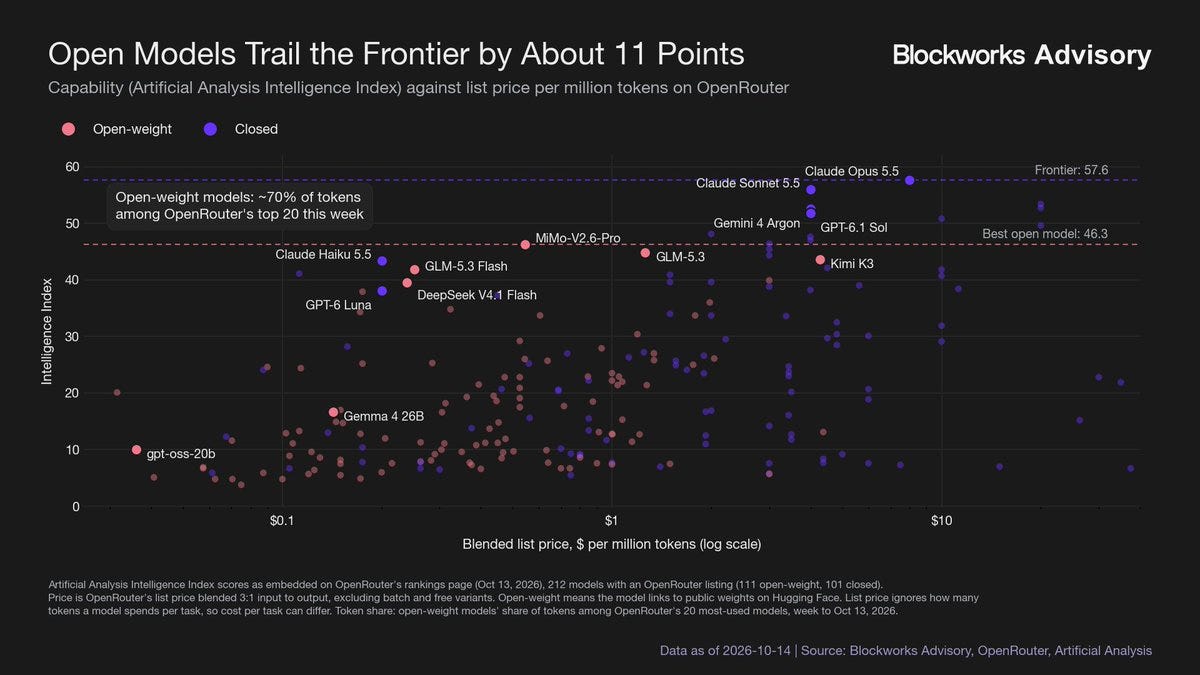
The article framed inference providers as a critical layer in the stack. Open-weight models are moving closer to the performance of frontier closed models, and for many real-world tasks they are already good enough. That gives users a reason to route workloads toward cheaper and faster inference vendors. The business model resembles a conventional API service: users send prompts to a chosen model, receive outputs, and pay based on token consumption or subscriptions. Crypto-native providers are trying to stand apart by using token incentives to aggregate distributed GPU supply, offering inference through other hardware such as Macs, supporting stablecoin and x402 payments, providing privacy-preserving or censorship-resistant models, and using token rewards to pull in users.
Whether those edges can last is still unclear. Over the past month, the seven crypto-native providers on OpenRouter processed a combined daily average of about 211 billion tokens, only around 1% of the platform’s 21.9 trillion-token daily average. OpenRouter itself represents only part of global inference demand, but the article said its public vendor and model data still make it a useful benchmark.
On OpenRouter, Venice is currently the largest crypto-native inference provider, handling about 86.8 billion tokens per day on average, up 63% over the past 30 days. Phala ranks second at roughly 54.6 billion, up 150%, and carries the highest blended token pricing among the seven providers tracked. Darkbloom, io.net, AkashML, NEAR AI, and Chutes process about 15.3 billion, 14.8 billion, 13.2 billion, 12.6 billion, and 5.7 billion tokens per day, respectively.
The report said Venice’s main strength is not a single flagship model but breadth of product and consumer branding. Its catalog includes about 400 models spanning text, image, video, music, and voice, while also offering closed models such as Claude and Grok alongside open alternatives. Venice said publicly in July that annual recurring revenue had reached $100 million, though less than 10% of that came from OpenRouter. Higher-margin revenue, the team said, comes mainly from its own applications.
Phala operates cloud services based on Intel TDX and NVIDIA confidential-computing GPUs and is also building the open-source confidential runtime dstack. It both runs compute directly and resells other providers’ inference capacity through a gateway. Based on its published upstream-provider list, about one-third of OpenRouter volume last week came from Chutes’ confidential-computing hardware, 15% came from NEAR AI, and another 40% was routed through RedPill without confidential-computing hardware protection. Phala has not disclosed revenue. At listed prices, its OpenRouter volume points to an annualized value of as much as $17 million, though that figure excludes cache discounts and payments to upstream suppliers.
Token incentives remain a major dividing line. The article said most of these networks are not relying solely on customer payments to sustain supply or demand; instead, they use token issuance, staking rewards, or direct cash subsidies. Chutes, a Bittensor SN64 inference subnet, runs on about 4,350 GPUs, roughly half of them H200s. Based on the subnet’s current emissions share and the TAO price, annual token incentives work out to about $21 million to $33 million, with 41% allocated to miners. DefiLlama, by comparison, tracks about $4.5 million in annualized onchain revenue, implying incentive levels roughly five to seven times revenue.
Akash follows a different model. It currently has 283 active GPUs, down from a peak near 897, and generates about $3.7 million in annual rental-fee revenue. The research did not find evidence that it continued a GPU incentive program in 2026, and AKT inflation rewards primarily go to stakers rather than compute suppliers. Darkbloom has taken another route by paying cash to operators of 1,143 Macs and using Apple Silicon devices to run smaller, cheaper models. It does not depend on extra token subsidies for supply, although it has struggled with higher latency on OpenRouter.
The article also highlighted Yukon, a platform linked to Darkbloom, as a way to improve model performance through open research competitions. In one example, the Gemma 4 26B A4B model posted a 130.3% performance gain in about five days. For Darkbloom, that means it may be able to raise token output per device and operator revenue without adding more hardware.
Glassnode sees realized-loss selling fading as Bitcoin tests the $80,000 area
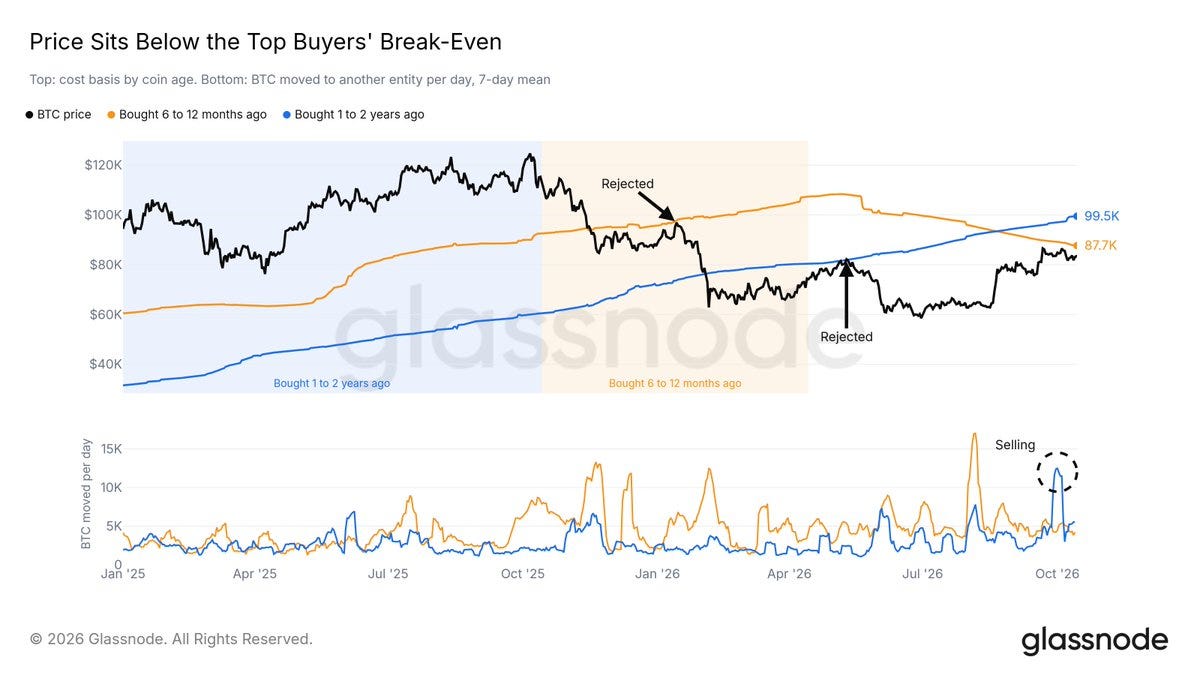
Glassnode’s contribution to the roundup argued that Bitcoin is facing heavy selling pressure from buyers who entered over the past two years. Coins acquired six to 12 months ago, largely during the later stage of the 2025 rally and the decline that followed, carry an average cost basis around $88,000. Buyers from one to two years ago are even higher, near $100,000. Both bands have acted as resistance this year.
The report said Bitcoin rallied to the six- to 12-month holder cost basis in January and then fell by more than one-third. In May it reached the one- to two-year holder cost basis and later pulled back by about one-quarter. During the early-October rebound, one- to two-year holders also sold more. Even so, Bitcoin remains above the true market mean near $78,000, a metric that reflects the average cost basis of active investors.
The average cost basis of U.S. spot Bitcoin ETF holders is about $81,500. Glassnode said price briefly slipped below that level on Oct. 8 and Oct. 13 but closed back above it both days. Since Sept. 21, Bitcoin has held daily closes above the ETF cost basis. A daily close below it would push ETF holders back into aggregate unrealized losses and break what the report described as the nearest onchain support.
There has also been a clear change in long-term holder behavior. Realized losses by long-term holders have dropped about 85% from the Aug. 12 peak, pointing to a sharp reduction in capitulation selling. In the 2022 bear market, Glassnode noted, realized-loss peaks among long-term holders came around the cycle bottom. As that pressure faded, the share of profit-taking transactions onchain moved back above loss-taking transactions.
Historically, since 2011, the amount of Bitcoin spent at a loss has tended to exceed the amount spent at a profit in bear markets, with the pattern reversed in bull markets. At the June low this year, the amount sold at a loss was about 12 times the amount sold at a profit. That ratio flipped in late August. At present, for every 1 BTC sold at a loss, about 4 BTC are being sold at a profit. Glassnode said profit-taking can cap upside, but similar structures also appeared throughout prior bull runs.
ETF demand has not kept pace. When Bitcoin moved above $85,000 in late September, spot ETFs showed clear buying interest, drawing nearly $3 billion in net inflows from Sept. 21 to Oct. 6, the fastest pace of buying since November 2025. Since Oct. 7, however, ETFs have turned into net sellers with cumulative outflows of about $760 million. With ETFs back on the sell side and underwater or near-cost holders selling into rebounds, the market has been left without enough fresh buying support.
Futures liquidation maps show similarly sized clusters below $80,000 and near $88,000. A move under $80,000 could trigger long liquidations and deepen a downside move. A rally toward $88,000 could squeeze shorts and briefly push price higher.
Binance spot order-book data point to a nearby area of interest as well. Glassnode said the biggest concentration of bids has shifted from around $81,000 down to $80,000. After Bitcoin broke through bids near $81,000 on Oct. 8, buy orders around $80,000 quickly increased and held there. Because that level sits just below the roughly $81,500 average cost basis of U.S. spot ETF holders, the $80,000 to $81,500 band now combines visible order-book demand with onchain cost support. If that zone fails, the market could test the liquidation cluster below $80,000 and the true market mean near $78,000.
Glassnode also pointed out that, unlike the 2018 and 2022 bear markets, Bitcoin in this cycle has never posted a daily close below realized price, the average onchain cost basis of all circulating coins. Even at the lowest daily close on June 30, price was still about 10% above realized price and well above the long-term holder cost basis.
On the macro side, U.S. CPI for September came in above market expectations, with headline inflation at 3.7% and core inflation excluding food and energy at 2.6%. Bitcoin fell after the release, and interest-rate futures traders raised the probability of another Federal Reserve hike at the meeting ending Oct. 28. The Fed had already raised rates by 25 basis points on Sept. 16, its first hike since 2023. The report added that leverage risk in altcoins is concentrated in individual names rather than the market as a whole: since Sept. 28, the single-asset leverage overheating indicator has remained in the top historical 20% range, while aggregate altcoin leverage still looks relatively subdued.
Eigen Labs is using Yukon to open up quantum-threat research
A Bankless article in the briefing examined how AI and quantum computing are reshaping the debate around cryptographic security. It said discussion accelerated after a widely circulated post by Justin Drake, with the idea of a one-week “Bunker Mode” quickly becoming a hot topic and tokens marketed as quantum-resistant posting double-digit gains. But the article argued that one major detail has been missed: some projects are already trying to use AI to defend against these threats, and Eigen Labs’ Yukon is one of the clearest examples.
In March, Google published quantum-computing research suggesting that the cryptography used by Bitcoin and Ethereum might require far fewer quantum resources to break than previously expected. Google released resource estimates and a verification program, but not the optimized quantum circuits themselves. Eigen Labs responded by creating ECDSA.fail, which turned the core problem in Google’s work into a public challenge. Researchers can use Google’s verifier, design and improve their own circuits, and study the computational bottlenecks that matter for a possible quantum attack.
Since then, researchers and AI agents have cut the challenge’s composite quantum-resource-cost metric by about 88% from the original baseline. Those improvements are still theoretical. No quantum computer has executed an attack at that scale in practice. The article said Yukon’s logic is simple: it is better to understand how low attack costs can go before an attack happens than to discover the weakness too late. Hiding quantum circuits does not remove the threat; it only leaves defenders less prepared.
Eigen Labs began running a series of open research challenges over the summer and expanded the model into the Yukon platform in August. The process is straightforward. Technical problems are opened to the public, participants use their own engineering skills and AI agents to search for better solutions, each submission is tested automatically, and every successful improvement becomes the new starting point for the next round.
The article said the model has already delivered results beyond quantum security. The Lighter.fast challenge was designed to improve performance of Lighter’s trade-proof software, with benchmark tests showing roughly a 10x gain. After the first optimizations were deployed in August, the exchange cut real-world proof times in half. MLX.fast used multiple challenge rounds to improve model runtime efficiency on Apple hardware, roughly doubling speed for models such as Qwen and lifting Poolside AI’s Laguna model by about 2.6x. Those upgrades were later integrated into Eigen’s private inference network Darkbloom. Another challenge, SNARK.fast, was run with participation from Succinct and the Ethereum Foundation to optimize an important computation used in post-quantum cryptographic proofs. Early benchmarks showed about a 3.5x gain, and Succinct folded the work into its codebase.
As Yukon moved into formal launch, its challenges expanded into cryptographic security itself. The platform is not just probing existing systems for weak points; it is also trying to build safer alternatives and lower the cost of using them in practice.
On Oct. 5, Yukon joined Zcash, Shielded Labs, and Project Eleven to launch HashSmash, inviting researchers and AI agents to search for weaknesses in common hash functions such as SHA-256. The article noted that SHA-256 is central to Bitcoin’s security and underpins several quantum-defense approaches. So far, accepted attacks apply only to simplified versions of SHA-256 rather than the full algorithm, and some of the more advanced submissions are still under review.
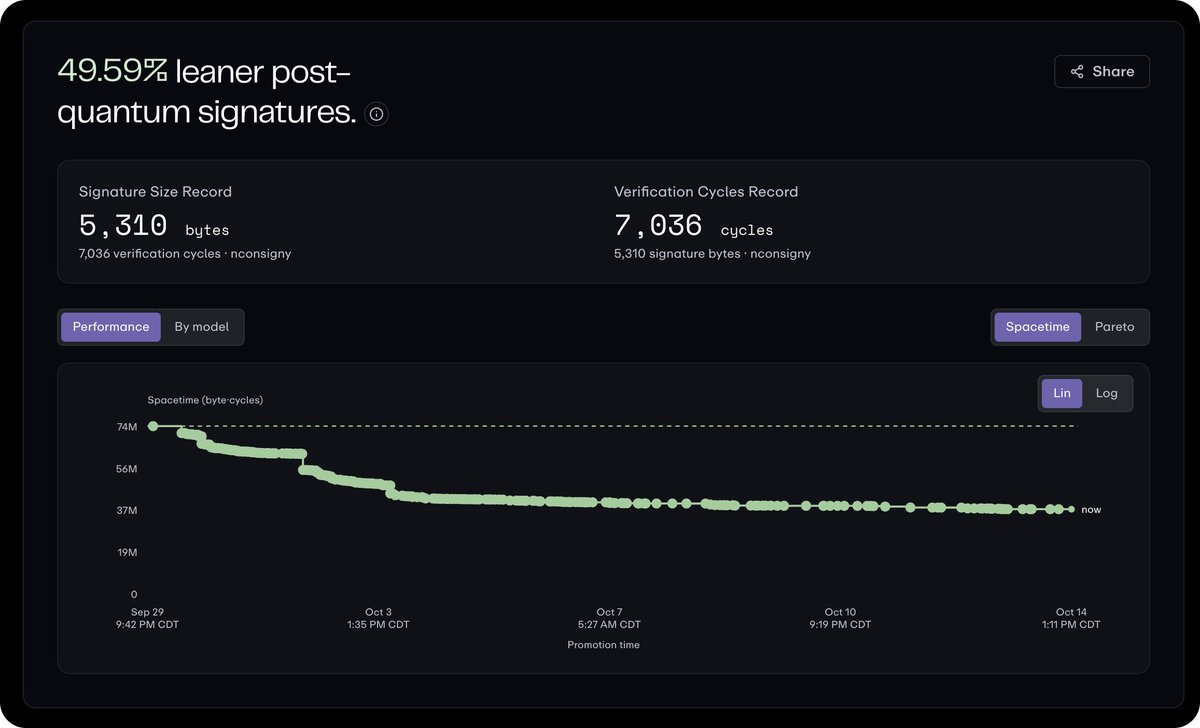
Another effort, sig.golf, developed with the Ethereum Foundation, is focused on optimizing hash-based signature schemes that could replace transaction signatures vulnerable to quantum attacks. The aim is to preserve mathematical security proofs while shrinking signatures and lowering verification costs. The leading approach has already reduced the combined signature-size and verification-cost metric by nearly half. StarkWare’s Quantum Safe Bitcoin challenge is trying to cut the GPU cost required for quantum-safe Bitcoin transfers without changing Bitcoin’s existing rules. When the scheme was first demonstrated on Bitcoin mainnet in August, the compute cost was about $320. After optimization by Yukon participants, the estimated cost dropped to $59, an 82% reduction, though the optimized version has not yet been validated through another live mainnet transaction. A separate Ethereum Foundation collaboration, better.codes, uses AI agents to strengthen mathematical proofs for post-quantum cryptography. It has raised provable security from 64 bits to about 68 bits, with a target of 128 bits.
StandX abandoned its token after pre-market valuation neared $350 million
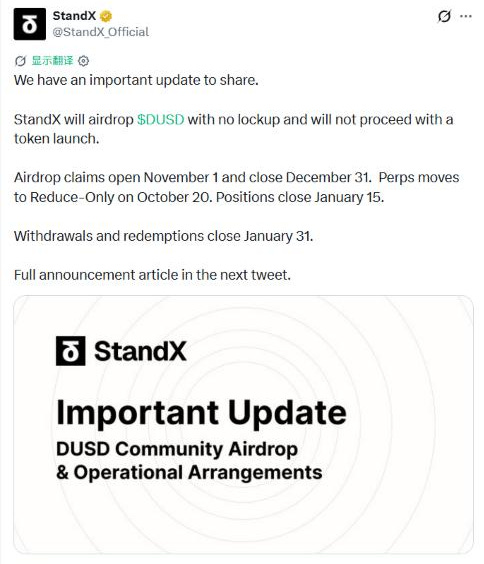
Foresight News’ postmortem on perpetual DEX StandX was one of the most closely watched project stories in the roundup. On Oct. 15, StandX said on X that it would not conduct a token issuance, would instead make a one-time DUSD airdrop to the community, and would gradually wind down the platform. Just two days earlier, on Oct. 13, StandX had gone live on Aspecta’s pre-market, where its implied fully diluted valuation briefly approached $350 million. Many users who had spent months farming points took that as a sign that token issuance was close. After the announcement, the StandX pre-market price on Aspecta fell about 98.8%.
CEO AG later wrote that StandX had reached a peak total value locked of $200 million without outside capital but still fell short of its goal of becoming a top-three player in the sector. He said the project “could indeed still issue a token” based on its current fundamentals, but doing so without the ability to deliver long-term value would amount to extracting profits from short-term speculation and “leaving the cost to users and the community.” Co-founder Justin, who had been largely silent for more than eight months, also posted: “I’m sorry I couldn’t make everyone money.”
The project originally drew attention because of its founding team. Of the three co-founders, current CEO AG previously oversaw Binance’s entire futures business, Justin had been head of growth for Binance Futures, and another came from Goldman Sachs’ trading-systems team. In an earlier interview, a co-founder said the team joined Binance in March 2019, launched Binance Futures six months later, and surpassed BitMEX in trading volume in the first half of the following year. Foresight News said that background was enough to put StandX on the map a year ago with little extra promotion.
On funding, official documents said the project was entirely self-financed and took no external investment. Still, according to longtime users in the project’s Discord, StandX may have run a KOL-only fundraising round about a year ago.
The points system changed repeatedly over the past year. During the pre-deposit phase, holding 1 DUSD earned 1 point per day. The Alpha phase raised that to 1.2 points, and the period around Thanksgiving after mainnet launch applied a 1.5x multiplier. On Dec. 10, 2025, trading points went live with retroactive accounting. On the first day, together with a 10% points bonus from Binance Wallet, StandX’s daily trading volume topped $81 million. In January 2026, the platform introduced Maker Points, which awarded points for orders resting more than three seconds even if they were not filled, and later added Loser Points that counted losses toward rewards.
After that aggressive expansion, emissions were tightened quickly. On May 24, emissions for trading, maker, and position-holding points were all cut in half. On Aug. 10, they were halved again, with the team calling it the final adjustment. After two rounds of cuts, holding 1 DUSD earned just 0.3 points per day.

Foresight News said the core redemption logic never became clear even as points got harder to earn. The StandX points page listed current rates and described the campaign as an acceleration phase toward the “next major milestone,” but never disclosed total point supply, network-wide emissions, the campaign end date, or the share of total token supply reserved for the airdrop. In the end, those answers never came.
Under the shutdown notice, StandX will not launch a token. The project will distribute a one-time DUSD airdrop with no lockup, with allocations based on pre-deposits, Alpha participation, mainnet trading, market making, and referrals. The airdrop will be filtered for sybils and wash trading, and suspicious accounts may see allocations reduced or canceled. Funding comes from the project’s retained surplus and AG’s personal contribution. All DUSD yield stopped accruing from Oct. 15.
The article also looked back to late 2025, when StandX was often discussed alongside Aster, Lighter, and edgeX. Less than a year later, outcomes had split sharply. Aster held its TGE on Sept. 17, 2025; Lighter issued its token at the end of 2025; edgeX completed its TGE on March 31, 2026. StandX alone remained stuck at the points stage and eventually abandoned token issuance altogether.
Projects that did issue tokens are now widening the gap through protocol revenue. According to DefiLlama data cited by Foresight News, leading perp DEX Hyperliquid generated about $71.6 million in protocol revenue over the past 30 days and carried about $7.77 billion in open interest. Lighter has been using protocol revenue to buy back LIT, with about $4.85 million in 30-day revenue and about $730 million in open interest. At the same time, newer challengers are taking share through fresh mechanics and clearer airdrop expectations. Variational uses a zero-fee RFQ model on Arbitrum and has expanded into stock and commodity contracts, with a TGE planned for the fourth quarter of 2026. Arcus, incubated by dYdX Labs and linked with Robinhood Chain, is focused on 24/7 tokenized stock trading. Extended is pushing a final pre-token trading competition with a total prize pool of 250,000 USDC.
As of Oct. 15, StandX had just $13.6 million in open interest, down 54% over the prior 30 days. Its 30-day trading volume was still $11.17 billion, but average daily turnover was about 27x, far above the roughly 1x seen at Hyperliquid and Aster. The article’s conclusion was blunt: much of the platform’s volume was points-driven and did not translate into sticky capital.
Ansem calls the pullback a healthy deleveraging event
In the opinion section, Ansem said the latest decline is the first real correction since the market bottomed in late June. In his view, pullbacks are a necessary deleveraging phase in any healthy uptrend. He said highly leveraged longs were liquidated in the drop, but that process also cleared excess risk from the market.
Ansem said he is currently in Singapore for an event and can feel strong institutional participation on the ground. He also said many of the top operators and smart-money participants who stayed active through the last bear market are still engaged, while infrastructure work around tokenization and stablecoins continues. In his telling, the broader fundamental picture has not been shaken.
His portfolio framework remains the same: a 70/30 structure. He said 70% of capital stays in long-term core spot holdings such as Bitcoin and Solana, positions he does not want to touch even through repeated 20% pullbacks. The remaining 30% is reserved for higher-beta short-term opportunities, MemeFi participation, and emerging ecosystem alpha. He argued that this structure preserves psychological control in volatile conditions by avoiding overexposure to small, high-risk tokens while still leaving room to capture market hotspots.
On specific names and ecosystems, Ansem highlighted Pump.fun and Hyperliquid. He described Pump.fun as one of the most remarkable killer apps of this cycle, essentially a lean protocol-level cash-flow machine generating annualized revenue in the hundreds of millions of dollars. Critics say it intensifies PVP trading, but he argued that it has reduced token-creation friction to an extreme and concentrated a huge amount of onchain retail activity in a short time. That flywheel, he said, has reinforced Solana’s network effect as the primary chain for retail users. In competition among blockchains, his view is simple: value follows users and liquidity. On that basis, he remains highly constructive on Solana’s long-term valuation ceiling.
On Hyperliquid, Ansem said it is one of the clearest examples in recent years of an onchain product delivering an experience close to a centralized exchange. He described the community and trading volumes as solid, and said HYPE is an obvious market catalyst. At the same time, he warned that traders need to stay disciplined when consensus becomes too strong around a momentum asset. His approach is to follow confirmed strength, but only with predefined laddered take-profit levels. When an asset doubles or reaches a key resistance area, he said, traders should at minimum pull out their principal and let profits keep running.
ChainFeeds’ headline summary also singled out STRK, PUMP, HYPE, and GRASS as tokens Ansem still sees as undervalued during the current drawdown.