ChainFeeds on Oct. 14 published a new edition of its research briefing, covering five themes: the future shape of exchanges, AI agents and crypto payments, the rebound in older altcoins, Blur’s frontend shutdown, and a broader shift in crypto venture and M&A activity.
The next exchange may sit above both DEXs and CEXs
WhiteForest argued that users do not naturally think in terms of decentralized exchanges and centralized exchanges when they trade. The example in the piece was simple on the surface: a user sees an on-chain wallet buy a newly launched Solana token and wants to follow, then wants to add some BTC spot on Binance, open a hedge short on Hyperliquid, and close everything once a related event on Polymarket resolves. The idea takes only a few lines to describe. Executing it can require more than a dozen steps across seven or eight apps and websites.
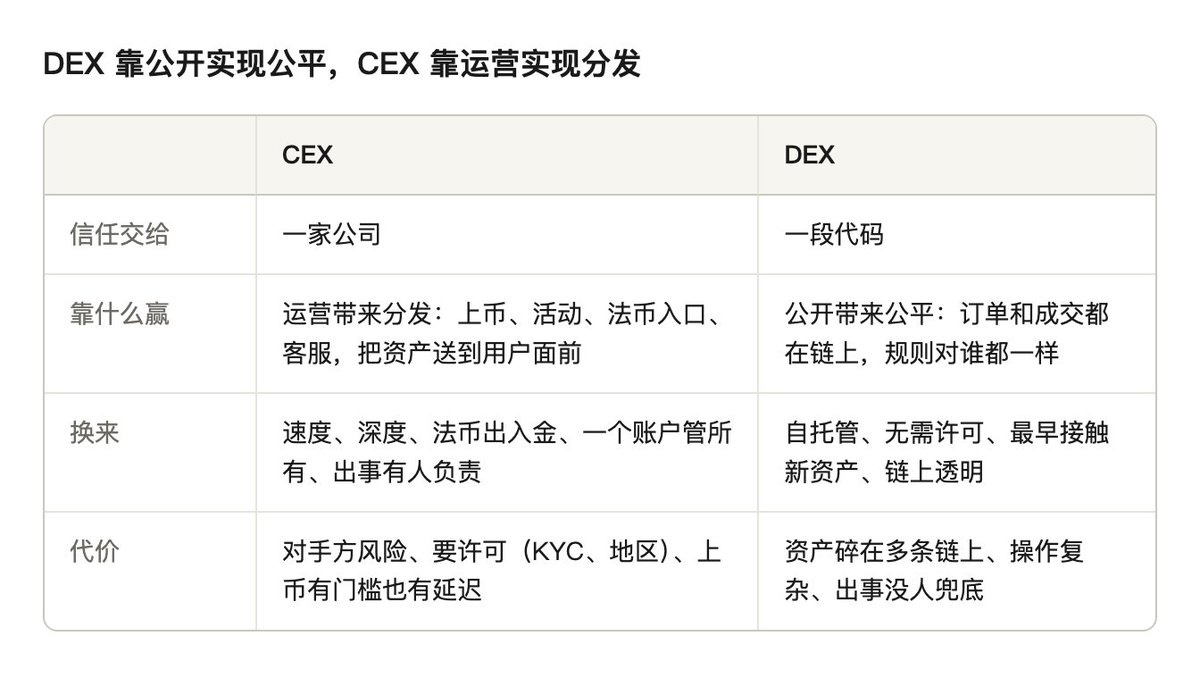
That, WhiteForest wrote, is the real problem. Users are forced to decide where each leg should happen, where funds should be moved from, and in what order the trade should be built. In that framing, the DEX-CEX split is not just about trust assumptions. DEXs win through openness and fairness. CEXs win through operations and distribution. Those strengths do not transfer easily.
A centralized exchange depends on company-led operations, screening, and KYC, and its ledger is not public, so it cannot offer the same kind of fairness a DEX can. A DEX, on the other hand, loses its defining character if it adds a center that can freeze assets, handle appeals, or run campaigns. That leaves fairness on one side and distribution on the other, with users moving back and forth between them.
WhiteForest said existing aggregators mostly solve routing within the same type of venue. DEX aggregators compare prices across DEXs. Brokers route orders across exchanges. A system that spans both DEXs and CEXs has to understand what the user is actually trying to do, then translate that intent into actions across very different systems. Until now, that job has largely been done by people. In a practical sense, the user has been the router between DEXs and CEXs.
The report said users are reaching their limit. Asset life cycles have become much shorter. WhiteForest said it counted one day of data in late September and found that several major launchpads produced more than 5,000 newly graduated tokens in a single day. A token can launch on Solana in the morning, get a perpetual market on Hyperliquid a few days later, and by the time it reaches a large exchange, the fastest part of the move may already be over. Opportunities now move across venues faster than a person can switch apps.
WhiteForest said software can finally take over that work. Exchange APIs and on-chain contracts have existed for years. What was missing was a system that could understand instructions such as “follow a bit, hedge it, and close when the event lands,” then break them into concrete actions. Current agents can now do that, the piece said.
The report added that exchanges still compete on liquidity, and liquidity follows order flow. Today, order flow starts with the user choosing a venue, which is why platforms fight to keep users inside their own apps through listings, product expansion, and retention. If the user’s entry point becomes a plain-language instruction and a middle layer decides where execution happens, order flow would pass through that layer first. Competition between venues would shift more toward execution quality: price, depth, and fees.
WhiteForest said the next exchange will likely sit in that position. Trading starts there, not at a specific venue. It used Mojo as an example. A user describes what they want in one sentence, Mojo’s agent writes it into a strategy, and the system lays out what to watch, what conditions trigger action, where orders should go, how much to trade, and when to take profit or stop out. Once the user confirms, the strategy keeps running in the background.
The hard part is execution. User funds may be spread across exchange accounts, Hyperliquid, and wallets on several chains. Before placing an order, the system has to know what is actually available, which means combining real balances, margin tied up in open orders, and capital already reserved by other strategies. WhiteForest said Mojo uses a five-layer capital ledger. If any layer is missing data, it does not place the order, and it does not fill gaps with zeroes.
The piece also separated responsibilities. Position size and take-profit or stop-loss conditions are confirmed by the user on the strategy card. The agent turns user intent into a strategy. Whether balances are sufficient, how order size should be converted, and how a stop price should be implemented under exchange-specific rules are handled by deterministic software, not by the model.
Authorization was another point. WhiteForest said that connecting to a user’s exchange account means Mojo must hold execution authority, so it does not claim it “cannot touch your money.” Assets remain where the user already keeps them: on-chain assets stay in the user’s own wallet address, with no pooled platform treasury, and exchange assets stay in the user’s own exchange account. API credentials are encrypted through a dedicated key management service, and every action is logged.
WhiteForest’s bottom line was that DEXs and CEXs still differ in custody, counterparty risk, and listing quality. “No distinction” does not mean those differences disappear. It means users no longer need to organize trades venue by venue. The system should still show clearly where each trade is executed, where funds sit, and what authorization is being used.
Haseeb says agents did not wait for crypto rails
In a separate interview, Dragonfly managing partner Haseeb Qureshi discussed AI agents and payments. He said TOKEN2049 is probably now the world’s largest retail crypto conference, with roughly 25,000 attendees this year. But if he had to pick one signal that best captures the state of crypto today, he would look at Marquee at Marina Bay Sands.
In previous years during Token Week, Haseeb said, Marquee was almost always booked out at night by crypto projects. This year was the first time he had seen it remain a normal nightclub for an entire week, with no crypto project taking it over. To him, that says the industry has changed. Retail activity, volatility, and hot narratives are still there, but the speculative energy that defined earlier cycles is much weaker.
At the same time, one of the most important events around TOKEN2049 this year was a closed-door institutional gathering attended by hedge funds, asset managers, founders, and regulators who flew into Singapore for it. Haseeb pointed to that contrast as another sign of the market’s shift.
He said that earlier this year many people, himself included, believed crypto would become necessary infrastructure for AI. The logic was straightforward: an AI agent has no driver’s license and no Social Security number, so how would it pass KYC, open a bank account, or use traditional payment rails? From there, it was natural to conclude that stablecoins would become the main payment method for agents.
But that was when agents were still mostly theoretical. Now they are not. Enterprise and consumer adoption have both started to grow quickly, which means the market can finally observe what they are actually using. The answer, Haseeb said, is cards. Visa, Mastercard, and companies built on card networks such as Rain, Ramp, and Stripe moved quickly to provide what agentic payments need. Spending limits, risk limits, and permissions can all be built directly into existing card rails.
Haseeb said the industry expected traditional finance to adapt more slowly than it did. Instead, it solved the problem faster than many in crypto expected. “We got that wrong,” was his conclusion on that point.
He still sees the biggest change happening at the interface layer. Today, users still bridge assets, watch gas, search for yield, compare Aave with Morpho, rebalance portfolios, and hunt for the lowest trading fee. In the future, he said, much of that work disappears. The user simply tells an agent what they want done. That agent becomes their “crypto guy.”
In Haseeb’s description, the agent can find the best yield, the lowest fees, and the best route to buy. It can also handle due diligence. Before every smart-contract interaction, it can inspect the contract, review the team, check LinkedIn, search X, and assess whether there is honeypot risk, Ponzi risk, or rug risk. It does not skip checks out of laziness, and it does not get pulled into FOMO.
That leads to a different conclusion from the one many expected at the start of the year. Haseeb said the interesting point may not be that AI makes crypto better suited for machines. It may be that AI finally makes crypto safe enough and simple enough for ordinary people to use.
A rebound in old tokens is not the same as altcoin season
Route 2 FI used its market note to separate the recent rebound in older tokens from the idea of a full altcoin season. Since Aug. 19, the piece said, crypto has been in a fairly simple up-only mode, with green candles across the market. Even so, many participants have not made money and some are still down.
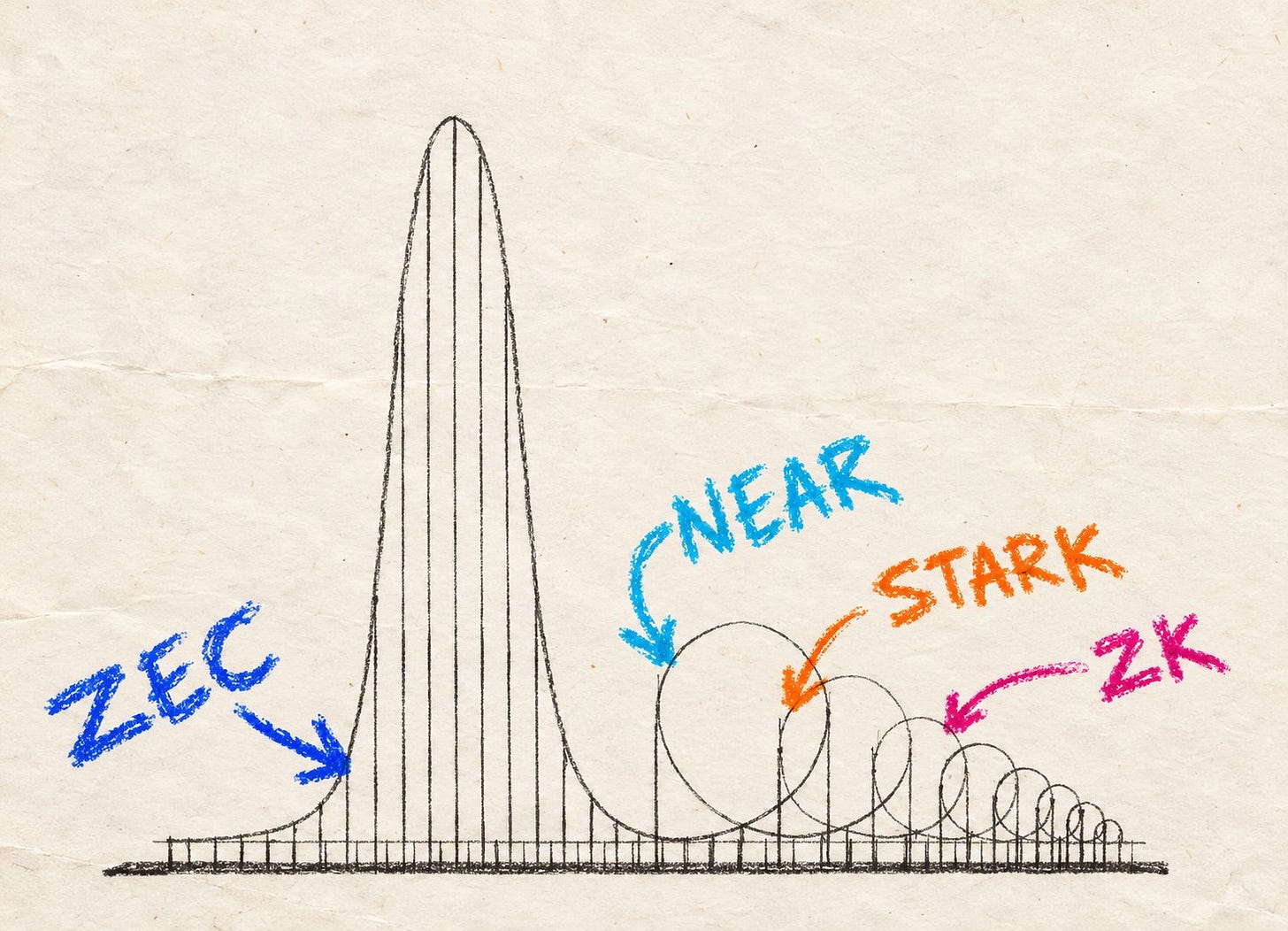
The explanation offered was familiar behavior: chasing whatever is hottest that day. When traders see one token already up sharply, many do not buy that token itself. They look for related names that might “catch up,” the beta trade. Route 2 FI used ZEC as the example. A year ago, it said, ZEC traded at $50. It has now reached $1,300, a 26x move. A $100,000 position would have become $2.6 million. But many traders did not buy ZEC. They looked for beta in names such as NEAR and STRK and went long there instead. STRK may be up 5x from its August low, but it is still down 23% over the past year.
That leads to the central question: what counts as a real altcoin season? Route 2 FI said altcoin season is one of the most anticipated phases in crypto because it marks a period when Bitcoin no longer captures all of the market’s attention and other assets begin to outperform it. But a handful of explosive token moves is not enough. A real altcoin season has to be broad. A large share of altcoins must outperform Bitcoin over a sustained period, not merely rise against the U.S. dollar.
The piece cited BlockchainCenter’s altcoin season index, which uses a clear rule: over the past 90 days, at least 75% of the eligible top 50 cryptocurrencies by market capitalization must have outperformed Bitcoin. Stablecoins and asset-backed tokens are excluded.
Route 2 FI also revisited the classic altcoin-season narrative. Bitcoin leads first. Confidence returns. Investors then move out along the risk curve in search of higher returns. Attention shifts to large-cap altcoins, then to smaller and more speculative trades. That rotation is the standard description, the piece said, but the market does not have to follow that exact sequence.
The benchmark still has to be Bitcoin. An altcoin can rise in dollar terms and still underperform BTC. If that is true for most of the market, then the broad relative outperformance required by the altcoin season index is not there. By the same logic, a few spectacular winners do not say much about the health of the altcoin market as a whole.
Even so, Route 2 FI said a new trend has appeared: investors are buying older crypto projects again. One reason is that early projects did try to solve real problems. Zcash, for example, aimed to create a cryptocurrency that works like Bitcoin while adding privacy.
The market has also started paying attention again to Starknet’s quantum-resistance angle, especially after articles last week argued that supercomputers and AI could break cryptocurrencies that are not resistant to quantum attacks. Route 2 FI said Starknet has some quantum-resistant properties, and that feature is now being repriced by the market.
The note said that in the past, when these so-called dinosaur coins started moving, traders often joked that the market was near the end and that it might be time to sell everything. This time, the buying case is different. Many of these tokens are already fully unlocked or close to fully unlocked, and the projects did attempt to address specific problems.
Route 2 FI added that Starknet’s Eli Ben-Sasson has floated the idea of leaving Ethereum and turning Starknet into an independent Layer 1, with the goal of making it the first fully quantum-resistant network, targeting next year for that vision. With fear, uncertainty, and doubt around quantum threats rising sharply, investors have started to buy into that narrative.
The piece also referenced Justin Drake’s earlier “Bunker Mode” post, which said the cryptographic systems protecting crypto wallets could face the risk of being broken in months rather than years. Whether or not the market believes that outcome will happen, Route 2 FI said, that is the reason these tokens are attracting bids now.
Blur to shut down its frontend while keeping the protocol on-chain
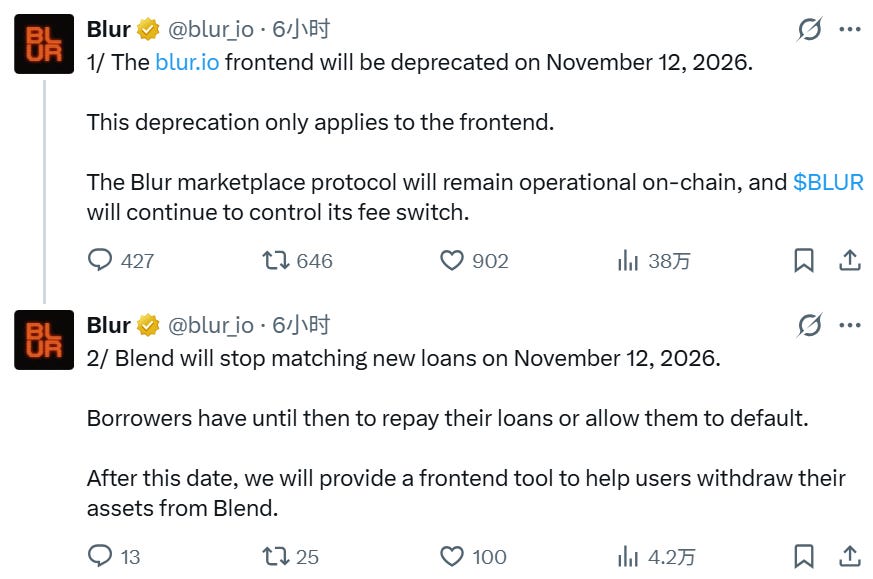
Foresight News reported that on Oct. 13, Blur said the blur.io frontend will be shut down on Nov. 12. The announcement said the change is limited to the interface. The Blur marketplace protocol will continue to run on-chain, and the BLUR token will still control the protocol fee switch.
On the same day, Blend, Blur’s NFT lending protocol, said it will stop matching new loans. Borrowers must repay before the deadline or accept default. After that, the team will provide frontend tools to help users withdraw assets.
After the announcement, BLUR fell from $0.018 to $0.0127, a drop of more than 30% over 24 hours. Its market capitalization now stands at more than $37 million, with a fully diluted valuation of $38.69 million. South Korean exchange Upbit then said it had placed BLUR under a trading warning designation and suspended deposit and withdrawal services.
Blur launched in October 2022. Founded by Pacman, it positioned itself as an NFT marketplace for professional traders, built around zero platform fees, batch operations, and aggregation, with backing from firms including Paradigm. In February 2023, the platform completed its first airdrop season, distributing about 360 million BLUR tokens. Trading volume climbed quickly after that. The Block data cited in the report showed monthly volume peaking at about $1.43 billion in March 2023, with market share reaching roughly 80% at one point and OpenSea’s share compressed sharply. OpenSea later changed its fee and royalty policies in response.
On May 1, 2023, Blur and Paradigm launched Blend, a peer-to-peer perpetual lending model with no oracle dependency and no fixed term. Blend quickly became a major protocol in NFT lending and expanded Blur’s influence among professional traders.
Volume started to slide in the second half of 2023. Once the airdrop season ended, incentives weakened and organic trading did not replace them. At the same time, the broader NFT market kept shrinking after the 2021-2022 peak, with blue-chip floor prices and trading activity both falling sharply.
The report used several collections to show the scale of the decline. Bored Ape Yacht Club now has a floor near 5 ETH, down more than 95% from its 2022 peak of about 153.7 ETH, or more than $400,000. Azuki has fallen to around 0.5 ETH, or about $1,500, down more than 98% from a peak above $100,000. CryptoPunks has held up better, with a floor around 31.5 ETH, or about $80,000, but that is still far below its peak and daily trading is extremely thin, often only a few sales a day. Even Pudgy Penguins, one of the stronger recent performers, has not generated enough absolute volume to reverse the broader market slump despite short-term boosts from events such as bulk buying by billionaires.
Dune data cited in the report showed Blur’s monthly trading volume near $12 million in September this year, with daily volume down to roughly $400,000. Pacman’s Layer 2 network Blast had also drawn large amounts of capital on airdrop expectations, with total value locked once topping $2 billion, but activity and revenue kept falling after mainnet launch. Blast announced a gradual shutdown on Oct. 2, 2026.
Foresight News said Blur and Blast together show the weakness of a model driven by airdrop expectations. In the short run, that flywheel can create the appearance of extreme prosperity. Once incentive expectations run out, locked capital leaves and active addresses fall, and the mechanism stops working.
Of BLUR’s total supply of 3 billion tokens, core contributors, meaning the team, received 29%, or about 870 million tokens. Early investors, including Paradigm and other venture firms, received 18.8%, or about 564 million. Together they account for nearly half of the total supply. On unlocks, about 97% of supply is already circulating. The remaining releases continue until mid-2027, but the monthly amount has fallen to a little over 1% of total supply, meaning the structural sell pressure from unlocks is close to its end.
The report also said that on April 18, 2025, Blur transferred 23.8 million unlocked tokens for that month to Coinbase Prime, bringing cumulative transfers to about 1.068 billion tokens, or about 35.6% of total supply. At the then price, that was worth about $340 million, with an average transfer price of about $0.318. SpotOnChain later tracked multiple additional transfers to Coinbase after unlocks. Using a conservative weighted average price of $0.35 to $0.4 during the main distribution period, the report estimated that the project team and its venture backers extracted roughly $350 million to $400 million in actual profit from the protocol.
DeFiLlama data cited in the piece showed cumulative historical protocol fees of about $70 million, but fees over the past 30 days were close to zero and annualized revenue was negligible. The report said a fee switch only matters if there is enough real trading volume behind it. With monthly volume already down to a low level and the frontend about to close, even turning fees on would be unlikely to provide meaningful support for the token’s valuation. The contracts may remain live on-chain and token holders may still control the fee switch, but without an active user entry point and sustained trading demand, the practical value of that switch is very low.
Crypto capital is moving toward cash-flow businesses and real-world rails
Tiger Research used its English-language report to describe a broader shift in crypto investment during the third quarter of 2026. Market sentiment moved from fear to greed, it said. After falling for two straight quarters in the first half, Bitcoin rose 43% in the third quarter, its strongest third-quarter performance since 2017. U.S. spot Bitcoin ETFs recorded $6.34 billion in net inflows. The crypto fear and greed index, which had stayed in extreme fear through the first half, entered greed on Aug. 20 and remained there for most of September.
Even so, disclosed deal values showed that the market rebound did not translate into more investment in crypto companies. Capital returning with rising prices went directly into crypto assets, while long-duration company investments did not recover in step with short-term market sentiment.
M&A deal count in the third quarter was broadly in line with the first half, but deal size fell sharply. The number of transactions was 39 in the first quarter, 36 in the second, and 37 in the third. Architect Partners, an advisory firm that independently tracks crypto M&A, said third-quarter crypto M&A volume fell 7% quarter over quarter, while deal value dropped 83%.
Tiger Research said the reason was a change in acquisition targets. In the first half, the market was driven by large deals to buy entire companies and build new business lines, such as Mastercard’s $1.8 billion acquisition of BVNK. In the third quarter, acquisitions were used more to fill capability gaps in existing businesses. The report cited Circle’s agreement to acquire Singapore-based cross-border payments company Tazapay, MoonPay’s agreement to acquire North Capital, which holds U.S. securities licenses, and BitGo’s acquisition of NYDIG’s institutional trading business.
The report also said the influence of major lead investors weakened noticeably. Since 2024, the five most active lead firms — Polychain, Pantera Capital, Hack VC, Paradigm, and a16z — averaged 2.0 lead deals per month in the third quarter, down from 3.7 in the first half. Those firms had previously led 50% to 75% of the deals they joined and played a major role in setting market valuations. Their control over funding rounds is now weakening.
By contrast, YZi Labs, formerly Binance Labs, participated in 14 deals in the third quarter, at a monthly pace nearly three times that of the first half. Coinbase Ventures followed with 12. Tiger Research said exchange-linked venture arms are more active because their incentives are structurally different. Traditional financial VCs seek capital gains through equity or asset appreciation. Exchange-linked investors can also benefit when portfolio companies use their exchange or chain, such as BNB Chain or Base, for trading and settlement, generating more volume and new users. That gives them a clear reason to keep investing even when asset prices and valuations are uncertain.
In Tiger Research’s view, the third-quarter funding market reflected the growing influence of strategic investors trying to expand their own platform businesses, rather than financial investors setting market prices. Crypto venture capital is moving away from pure financial bets aimed at outsized capital returns and toward strategic investment that creates business and ecosystem synergies.
Investors also became more cautious about unproven risk. Seed deals fell to 15.0% of all transactions, the lowest quarterly share since 2024. The average monthly number of seed deals dropped 28%, more than twice the 13% decline in overall deal count.
Capital in the third quarter flowed mainly into sectors that connect traditional finance with crypto rather than into new Layer 1 and Layer 2 protocols. Infrastructure’s share of disclosed investment rose from 8.1% in the first half to 18.2%, more than doubling. That increase came mainly from AI-related deals rather than new blockchain mainnet projects, including Ionic Digital’s shift toward AI data centers and AI training infrastructure company Prime Intellect.
Within the category labeled “other,” about half of the capital went to tokenized securities infrastructure projects such as Securitize and Alpaca. Payments and stablecoins were the only segment to keep a stable share of investment. Areas with weaker ties to traditional finance drew much less capital. In prediction markets, a roughly $300 million round for Polymarket accounted for 91% of the sector’s total funding in the quarter. DeFi investment fell 71%, and deal count fell as well. The sector represented only 3.0% of total third-quarter investment, with the largest DeFi round going to Cari Network, a deposit-token network backed by U.S. regional banks.
Custody drew no new investment. Activity there was concentrated in consolidation among mature firms, such as BitGo’s acquisition of NYDIG’s trading business. Tiger Research’s conclusion was that capital in the third quarter clustered around mature companies with licenses, regulatory approvals, or ties to banks and other traditional financial institutions. The focus is shifting away from building entirely new crypto ecosystems and toward the distribution channels and infrastructure that traditional financial capital uses to enter crypto. In its words, the market is gradually moving away from a model driven by short-term expectations and toward one that has to prove real value and real-world utility.