ChainFeeds puts three topics at the center of its Oct. 15 research brief
ChainFeeds’ Oct. 15 research roundup pulled together five in-depth pieces from Oct. 14, with the heaviest focus on a conversation with NEAR co-founder Illia, a review of projects building around Uniswap v4 Hooks, and a valuation discussion around Pump.fun. The same roundup also listed a set of daily headlines: a16z cut most members of its portfolio recruiting team, Ledger said no signs of tampering were found in devices held by German retailers and distributors, the White House confirmed that Patrick Witt had stepped down as executive director of the crypto council, StarkWare launched OffMarket for private trading by Polymarket users, and Kraken parent Payward planned to acquire European bank Saldo Bank.
Illia says NEAR is trying to turn market attention into a product flywheel
In the interview carried by the newsletter, Illia said NEAR has been under construction for nearly nine years, or nine years including earlier AI research. He framed the project around a long-running view: the world is changing, decentralized technology is needed, privacy is needed, private AI is needed, private money is needed, and Web3 needs to connect in a real way with broader traditional markets.
He said it was exciting to see more people entering the space and that price swings bring in more resources and attention. Still, his emphasis was on turning that attention into products and value rather than leaving it at the level of market emotion. Referring to the kind of market talk that casts Zcash as this cycle’s Bitcoin and NEAR as this cycle’s Ethereum, he said the team was more concerned with building around the attention than leaning into the sentiment.
Illia described NEAR Intents, in its broadest form, as a market of markets and a universal aggregator for any trading intent. A user submits an intent, and the system looks across the network for the best counterparty to complete it. He said the idea is not limited to crypto and not limited to digital assets. In his framing, even something like booking a hotel room, or in a more extreme example building a base on Mars, could fit inside this wider intent market as long as a counterparty is willing to take the other side.
He pointed to Quantus as a working example. According to Illia, Quantus is listed only on SafeTrade and has no centralized exchange listing, yet still has good liquidity on NEAR Intents, with fast swaps and smooth execution. He said he uses Druckbot as an AI workstation and near.com as an on-chain workstation, where speculative assets can be traded, borrowed against, and bridged with little friction.
NEAR’s account model and the move to post-quantum cryptography
Illia said NEAR had considered quantum risk back when the network was designed in 2018. His point was that cryptography will eventually change, so the system needs to be able to adjust and upgrade to whatever cryptography is required. He said NEAR’s account model allows users to rotate keys, add keys, and use multiple cryptographic schemes, adding that he personally wrote part of the relevant code and that adding a new cryptographic curve takes roughly 200 lines of code.
He also said the team began pushing a post-quantum scheme to mainnet earlier this year after new algorithms for recovering private keys from public keys began to appear. There is now a standardized implementation, he said, and NEAR added the first Dilithium, or ML-DSA, post-quantum curve to mainnet in July. Under that setup, users can upgrade their accounts to post-quantum resistance without moving assets, without making a withdrawal, and without triggering taxes, simply by pressing a button in Meteor Wallet. He contrasted that with other chains, where entering a similar defensive mode would require re-deriving keys and manually managing the entire process.
Beyond privacy coins, the brief points to Nillion’s encrypted execution model
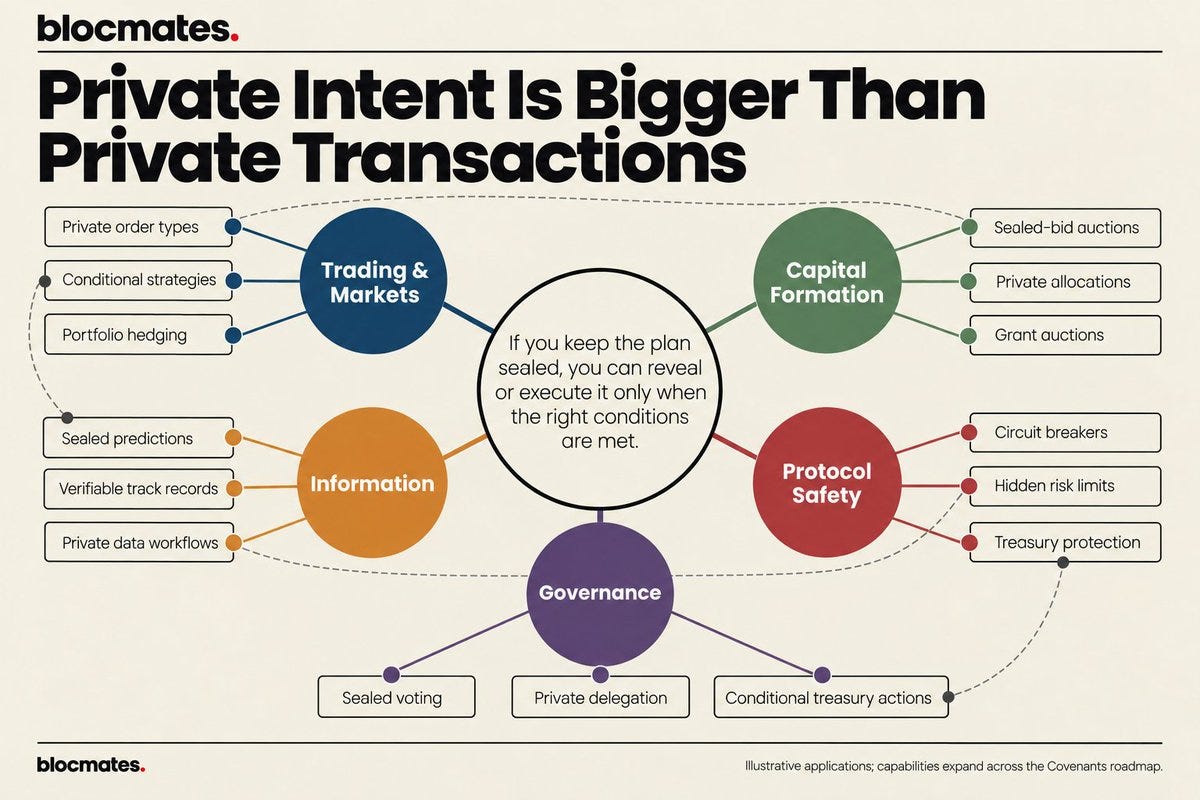
Another featured piece in the roundup looked at privacy opportunities beyond privacy coins. Citing blocmates., the article said privacy has always sat near the center of crypto’s original ethos, but most on-chain transactions still happen on public ledgers. That leaves users’ holdings, trading strategies, preferred venues, and even their most active trading windows visible to outside observers.
The piece said Monero and Zcash proved there is demand for private money, but private value transfer alone is not enough. Existing privacy tools usually cover only one part of the lifecycle. Renegade, for example, lets orders fill at the midpoint of Binance bid-ask spreads while hiding execution details. Aster hides orders and positions so some data stays out of public feeds. Private RPC tools such as Flashbots Protect and MEV Blocker focus on pre-trade information, keeping pending transactions out of the public mempool.
Those products can help traders protect strategies and reduce front-running risk, but the article said there is still no general mechanism that can hide a user’s trading intent, trigger conditions, and sensitive parameters such as price, size, and timing all at once. Nillion is trying to address that gap with a primitive called Covenants.
Covenants were described as encrypted instructions that say, in effect, if something happens, execute a given action. Until the preset conditions are met, the contents remain hidden. A Covenant contains a trigger condition, an execution action, and the parameters that constrain the two. The examples in the piece included executing a trade when BTC on Hyperliquid reaches $100,000, or triggering a particular action when a wallet sells UNI, with added restrictions such as weekend-only execution or stablecoin depegs.
On Nillion’s roadmap, those conditions are not meant to stay on one chain. Events on Solana could trigger actions on Hyperliquid, while oracles and conventional Web2 APIs could bring real-world data into the same structure. A user submits an encrypted trading plan to Nillion, the decentralized network keeps monitoring the conditions, and only when the conditions are met does it release the authorized execution instruction. Before that point, the trading intent stays private.
The article said Covenants are not meant to force developers into a brand-new execution environment. The goal is to add privacy on top of existing programmable blockchains so sealed-bid auctions, private conditional orders, encrypted prediction products, and automated risk protection become easier to build. Nillion calls that direction encrypted markets, aiming to preserve DeFi composability while shielding user strategy.
One of the examples was a sealed-bid token auction. Suppose a protocol plans to sell 1 million tokens and let the market determine the final clearing price. Alice wants to buy 400,000 tokens at up to $0.05 each, Bob is willing to buy 300,000 at up to $0.045, and Charles is willing to buy 600,000 at up to $0.06. If allocations are made from the highest bid downward, Charles and Alice would receive the full 1 million tokens, while Bob would be cut off below the clearing threshold. In a uniform-price auction, both winning bidders would pay the lowest winning bid, or $0.05 per token. The article’s point was that if bids are visible on-chain during the auction, participants can react to each other’s quotes. With Covenants, bid information can be registered on-chain in encrypted form and kept hidden until the deadline expires.
The piece also mentioned nilSwap, a testnet application that swaps between Ethereum and Monero using test assets across Ethereum Sepolia and Monero stagenet. Nillion’s broader pitch is that developers should be able to build privacy-preserving financial products on existing chains without having to become cryptography specialists themselves.
Hook projects are drawing attention, but the brief stresses product and security checks
The third section of the roundup looked at the rising ecosystem around Uniswap v4 Hooks. The article said Uniswap has long had imitators in DeFi, but a newer group of projects is trying to build something distinct on top of its trading infrastructure. Some are experimenting with fee design, some want to redistribute arbitrage profits, some are reworking liquidity management, and some want token trading to follow more complex rules. The shared technical layer is the Hook model.
The article noted that Hooks are not a newly introduced feature. They were already a core innovation when Uniswap v4 launched in January 2025. Put simply, Uniswap provides the base trading rails, while Hooks let developers attach extra rules to specific pools. In Uniswap v4, a Hook is an external smart contract attached to a liquidity pool, able to run custom logic before or after pool creation, liquidity adds and removals, and trades. That allows developers to implement dynamic fees, reward-linked trades, and pools that use special pricing or order logic.
The report also added a clear caveat. Many of the Hook projects now drawing attention are still in product and market validation. Hooks can insert custom logic into trading flows, but they also widen the code surface that needs review. Uniswap v4’s core infrastructure going through development and testing does not mean third-party Hooks inherit the same security by default. Custom accounting, external oracles, dynamic fee settings, and upgradeable permissions can all affect trade and liquidity safety.
Hookr: a toolkit for launching, combining, and discovering Hooks
According to the article, Hookr is focused on making Hooks easier for developers and project teams to combine, deploy, and use. The platform runs on Robinhood Chain. It supports new token launches and also supports creating new Uniswap v4 pools for existing assets. Pool creators can choose Hook Blocks such as dynamic fees, anti-sniping, auto-burn, and LP rewards, then apply different rule sets to different pools.
Its product scope already extends to Builder, a Hook directory, an SDK, and HookrScan. The article argued that Hookr’s real test is not only whether it can launch tokens but whether it can lower the barrier to using Hooks in practice: traders need to understand the rule sets, developers need reusable modules, and outside products need a way to plug into these markets. At the same time, more composability means more parameters to verify. The article added that Hookr’s website says the contracts have undergone adversarial review but have not yet received an external audit.
GMGN data cited in the piece put HOOKR’s current market capitalization at $26.5 million, with a peak market capitalization of $31.43 million.
StonkBrokers: merging two assets into one pair token
StonkBrokers was described as a DeFi infrastructure and experimentation suite on Robinhood Chain, focused on stock tokens, Uniswap v4 Hooks, and liquidity pools. On Oct. 14 Beijing time, StonkBrokers used Uniswap v4 Hook functionality and worked with Hookr to create a new token format called the Pair Token, described as a merged, auto-compounding ERC-20.
The mechanism merges two tokens into a new one, with examples including ETH + NVDA = ETHNVDA and NVDA + TSLA = NVDATSLA. Each pair token represents a proportional share in a corresponding full-range Uniswap v4 liquidity pool. Minting and redemption are free, while auto-compounding takes a 10% fee on LP fees, with that fee used for STONKBROKER buybacks.
What The Hook: redirecting who receives arbitrage profits
What The Hook, or WTH, takes a narrower angle. Its product thesis is to redistribute arbitrage profits between pools. In AMM trading, different liquidity pools can show temporary price gaps after trading activity. Arbitrageurs profit by trading those gaps, and the process pushes prices back toward alignment. What The Hook is not trying to eliminate arbitrage itself. It is trying to change who ends up with the profits.
According to its official documentation, cited in the article, WTH uses a Uniswap v4 Hook on Robinhood Chain to check price differences across linked pools. If execution conditions are met and there is still profit left after costs, it executes the arbitrage and distributes the realized gains.
The article listed two revenue-sharing models. In WTH’s own trading pools, traders receive 10% of captured arbitrage profits and the WTH treasury gets 90%. In third-party integrated pools, the default split is 5% to traders, 45% to the liquidity pool, 40% to the WTH treasury, and 10% to a referral partner. Those percentages apply to successfully captured arbitrage profits, and the article said custom partner deployments can adjust the split.
The business logic is straightforward: if more outside pools plug into WTH’s Hook, the protocol could earn from a broader stream of arbitrage activity. But the article also pointed to limits. Arbitrage opportunities do not appear in every trade, and the final outcome depends on competitive arbitrage, transaction costs, market depth, and the number of integrated pools. It also noted that treasury income for WTH does not automatically mean direct profit-sharing for WTH token holders.
GMGN data cited by the article valued WTH at $6.4 million.
Raoul Pal says most general-purpose chains may not survive
The fourth featured thread came from Real Vision founder Raoul Pal. He argued that successful blockchains make their block space more attractive through technology, narrative, or a combination of the two, drawing in users and capital. For that reason, he said, general-purpose blockchains should not be treated simply as companies or tokens. Ethereum, Solana, and Sui are closer to sovereign economies with their own GDP, money supply, and monetary policy, and they should be evaluated through the economic activity inside those systems.
Pal reduced the main survival paths to four. One is to become a sovereign economy. He placed Ethereum, Solana, and Sui in the small group that may have enough throughput, composability, and developer density to support a global token economy. A second path is to become a specialized platform. His example was Hyperliquid, which he described as a vertically integrated exchange using a blockchain as its execution layer. A third path is to become a Layer 2, building a business on top of a Layer 1 while renting its security. Those projects can become strong companies, he said, but their value capture model differs from the base chain. The fourth is BNB, which he said the market prices like a sovereign economy even though, in his view, its continued operation is ultimately supported by Binance’s balance sheet because it lacks decentralization.
As for the large set of general-purpose chains without durable competitive moats, he said they may end up approaching zero in value if they cannot compete with leading platforms or dominate a specialized niche.
Pal also described his own effort earlier this year to build a valuation framework for Layer 1 networks. He first used the same kinds of metrics many analysts use, comparing fully diluted valuation with total value locked, fee revenue, DEX volume, and stablecoin market capitalization. Those variables looked highly correlated, but he said the exercise was circular. TVL is denominated in the same token whose price he was trying to explain, DEX volume rises with speculation, and fees rise with volume, so price was being explained with derivatives of price.
He then removed the direct price effect, converted the data into ratios, and examined 12 blockchains at the market high in January 2025 to see whether the metrics could predict which chains would fall the least over the next 13 months. Fee yield had no predictive value. TVL-to-FDV had no predictive value either. The only signal that predicted returns was capital velocity, and in the opposite direction from what many might expect.
His example was that in January 2025, Solana’s capital turnover was about 200 times its TVL, while Ethereum’s was about 7 times. Over the following 13 months, the fastest-turnover chains performed the worst, while chains where capital stayed the longest performed the best. In his framing, a chain where money rushes in and out looks more like a casino. Capital that stays for lending, trading, and restaking forms longer-lasting economic relationships.
From there, he narrowed his focus to three indicators, none of them price. The first is whether economic density per user holds steady when the token price collapses. He gave an example of one chain he tracked from the December 2024 high to February 2026: the token fell 83%, TVL dropped 78%, and active addresses fell by about three quarters, yet the capital deployed per active user stayed near $2,100 from peak to trough. In his Layer 1 work, he said only Ethereum, Solana, and Sui maintained economic density through that drawdown.
The second metric is whether stablecoin supply keeps growing even while the native token falls. A dollar on-chain does not shrink because the chain’s token loses value, so continued dollar inflows and retention during a market break imply that outside capital is still choosing that network.
The third, and the one he said matters most, is whether developers keep coming. Users can remove funds in minutes, but developers commit years of accumulated expertise and cannot easily jump to a different programming language and technical architecture. If developers are still moving to a chain during a bear market, he said, they are making a long-term choice with high switching costs. Sustained growth in wallet counts and transaction value, combined with developer migration that holds even during market stress, is in his view the clearest sign that a chain has long-term staying power.
Pump.fun posts stronger seven-day revenue than Hyperliquid as buybacks remain in focus
The final piece in the roundup, from Odaily, asked whether Pump.fun is being undervalued. It began by contrasting Pump.fun with the recent Robinhood Chain frenzy. Token launch platform PONS briefly became a hot venue for meme trading as activity rose in that ecosystem, but after sentiment cooled, its protocol revenue over the last seven days was only about $550,000, with average daily revenue down about 74% from the prior 30-day average.
Pump.fun, by contrast, has remained highly profitable even as meme trading cools. Based on the latest DefiLlama data cited in the article, Pump.fun generated $65.63 million in protocol revenue over the last 30 days, close to Hyperliquid’s $71.05 million. Over the last seven days, Pump.fun generated about $16.63 million, above Hyperliquid’s $14.3 million.
The article then compared those revenue figures with circulating valuation. PUMP’s circulating market capitalization was put at about $2.325 billion, versus about $18.198 billion for HYPE, a gap of nearly eightfold. Using a simple annualization of the last 30 days of protocol revenue, the ratios of circulating market cap to annualized revenue were about 3x for PUMP and 21x for HYPE. The piece noted long-running complaints from the community, including the lack of an airdrop to early participants and the team’s sale of SOL taken from platform revenue, but said those disputes had not meaningfully stopped users from launching memes and trading them.
Buybacks were cut from 100% of net protocol fees to 50%, then climbed back
The article said that after buybacks began in July 2025, Pump.fun at one point used 100% of net protocol fees to buy PUMP. In September of last year, monthly buybacks reached $55.3 million, even above that month’s protocol revenue of $42.8 million. In April this year, Pump.fun said it would cut the buyback allocation from 100% to 50%, leaving the other half to the company for hiring, marketing, and acquisitions.
Monthly buybacks then fell to $9.2 million in June. They have since recovered. Over the last 30 days, buybacks rose back to $30 million, about 3.2 times the June level.
Official data cited in the article showed Pump.fun had cumulatively bought back and burned about $484 million worth of PUMP, destroying about 171.52 billion tokens, or 17.15% of total supply. Recent daily spending on buybacks and burns has held near $1 million. DefiLlama data in the same article put the last 30 days of PUMP buyback-related spending at about $29.48 million, or around $980,000 a day. Based on the current circulating market capitalization of roughly $2.325 billion, one month of buyback spending equals about 1.27% of market value.
The article’s core point was that even with the buyback ratio halved, Pump.fun’s current income base can still support roughly $1 million in token demand per day. That links the platform’s cash generation more directly to the token: revenue funds buybacks, buybacks absorb circulating supply, and burns reduce supply further.
After the first major unlock, most tracked tokens were not sold during the sample period
The largest PUMP unlock took place on July 12 this year. Team members and early investors completed a one-year lockup, and 82.5 billion PUMP were unlocked, equal to 8.25% of the initial total supply and about 20.23% of pre-unlock circulating supply.
After that concentrated unlock, crypto research firm Four Pillars tracked the movement of 52.7 billion PUMP and found that those tokens were ultimately distributed to 84 addresses. In research published on Aug. 12, Four Pillars said those addresses sold about 4.03 billion PUMP over the following 27 days, cashing out about $6.97 million, or 7.6% of the tracked allocation. Of those addresses, 62 sold nothing and 13 sold all of their allocations. Eighty-four percent of sold tokens were sold before July 20. Within that sample, more than 90% of unlocked tokens were not sold during the observation window, and the first unlock did not trigger broad-based dumping.
That said, later unlocks are still feeding some tokens into the market. On Oct. 13, on-chain watcher Ember reported that three wallets tied to the team or early investors transferred 1.458 billion PUMP, worth about $7.58 million, to Coinbase Prime. Those three wallets together hold allocations totaling 70 billion tokens. The article said the transferred amount reflected this month’s unlocked tranche and may already have been sold.
It also noted that the July 12 unlock of 82.5 billion PUMP accounted for one quarter of the total allocation earmarked for the team and early investors. The remaining 247.5 billion are scheduled to unlock monthly over the next three years, with about 6.875 billion released each month, just one-twelfth of the first concentrated unlock. On that basis, the article said the single largest unlock for the team and early backers has already passed and the potential overhang from future releases is materially lower.
Future valuation expansion still depends on product breadth and user demand
The piece ended by saying that high revenue and steady buybacks are the current supports for PUMP, while any further re-rating would depend on whether Pump can bring in more trading users. Pump.fun founder Alon recently said the platform would reduce the reward weighting for recommending low-market-cap tokens, place less emphasis on trading volume, focus more on actual profitability for followers, and cut incentives for low-quality calls. The article framed that as an attempt to address a core tension in social trading, where promoters collect rewards while followers may be left with losses.
It also cited market talk from Oct. 10 that Pump is developing a perpetual futures product powered by Hyperliquid. The article said that should not yet be treated as a live product. If it does launch, users would be able to trade perpetuals inside the same app where they issue and trade meme tokens, giving Pump.fun a chance to capture a wider set of trading demand.