ChainFeeds’ latest research roundup, published on Oct. 23, brought together five themes: DeFi token performance during bitcoin’s range-bound stretch, onchain market making for tokenized equities, the Office of the Comptroller of the Currency’s final GENIUS Act rule, the rebranding of a16z Crypto to a16z Frontier, and the revenue model behind crypto trading front ends.
DeFi tokens that beat BTC while bitcoin moved sideways
In an English thread, Edgy wrote that bitcoin entered a range after rising 21% in August. Since Aug. 22, BTC’s daily close has stayed between $75,600 and $86,600. From Aug. 22 to Oct. 20, BTC gained 5.6%, while ETH fell 2.7%.
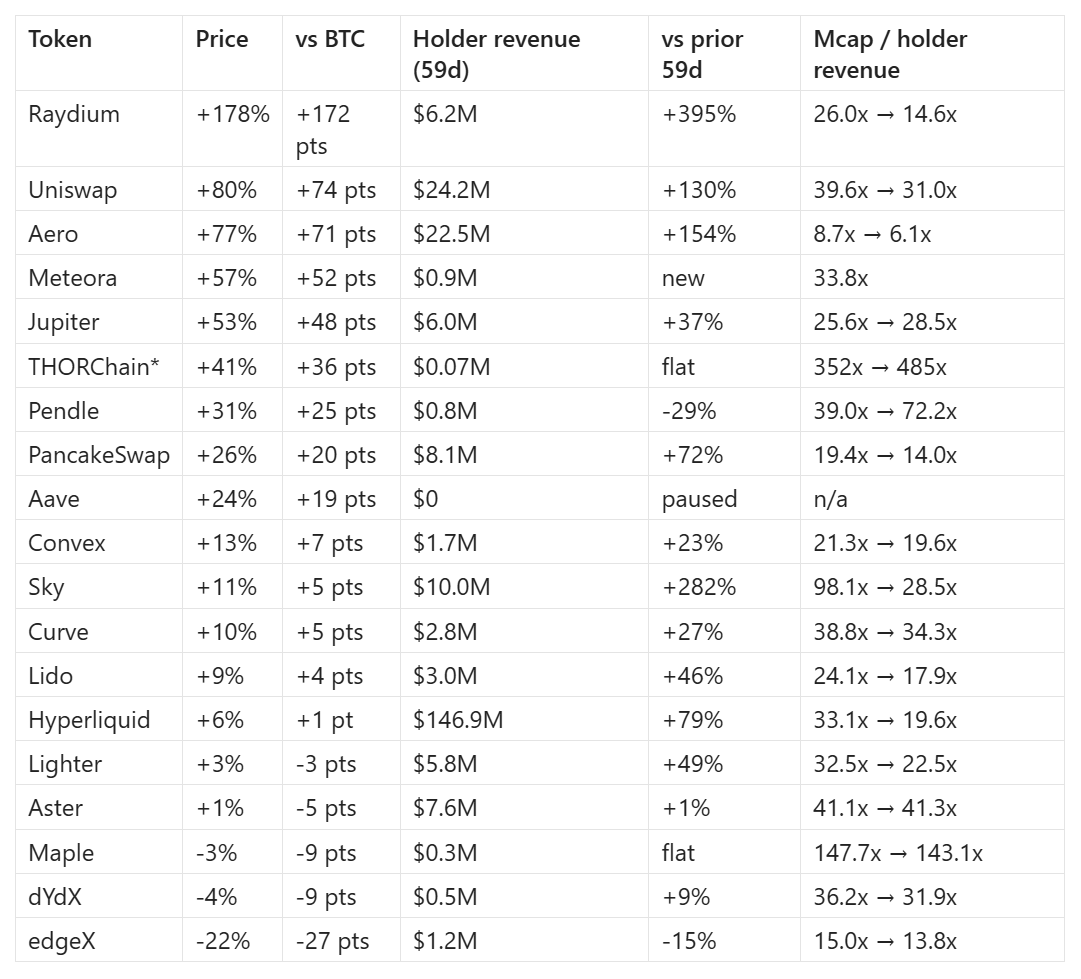
Against that backdrop, 14 of 19 major DeFi tokens that distribute revenue to token holders outperformed BTC. Raydium led with a 178% gain. The median return for the group was 12.9%, more than double bitcoin’s return over the same period. The analysis focused on holder revenue rather than protocol revenue, arguing that protocol income can be misleading if it does not actually reach token holders. The definition used matched DeFiLlama’s holder-revenue framework, which includes buybacks, burns, and direct distributions.
The sample was limited to core DeFi protocols, including DEXs, perpetuals, lending, CDPs, liquid staking, yield protocols, and aggregators. It excluded blockchains, oracles, and launchpads. Tokens also had to have a market capitalization above $100 million on Aug. 22 and to have distributed revenue to holders at some point in the past year. Once a token qualified, all holder revenue was counted, including Raydium buybacks tied to its launchpad activity and Hyperliquid gas burns. That left a final sample of 19 tokens.
When the sample was split into two groups based on whether holder revenue was growing, the revenue-growth group posted an average gain of 18.3%, versus 6.9% for the other group. The three strongest performers each had a clear revenue driver.
- Raydium: On Sept. 5, tokenized-stock launchpad StonkFun migrated to LaunchLab. That pushed RAY buybacks from $360,000 in July to $3.94 million in September, roughly an 11x increase.
- Uniswap: The fee switch was on, and Robinhood-related trading activity added volume. In September, Robinhood Chain accounted for about half of protocol revenue.
- Aero: After Aerodrome and Velodrome merged, voters could receive not only trading fees but also payments from projects seeking liquidity. In September, that revenue reached $14.9 million, above the $10.5 million in AERO paid to liquidity providers.
At the other end of the sample, edgeX saw holder revenue fall 15% and its token price drop 22%, making it the weakest performer. The piece also argued that a lower valuation multiple on its own says little about upside. Aero traded at 8.7x market cap to annualized holder revenue, the lowest in the sample, and rose 77%. edgeX traded at 15x, the second-lowest multiple, yet delivered the worst performance.
Hyperliquid, Sky, and Aave broke the usual pattern between holder revenue and token price action. Hyperliquid’s holder revenue rose 79%, but HYPE gained only 6%. On a fully diluted basis, its valuation multiple was about 85x, and roughly $800 million worth of HYPE unlocks each month, compared with about $75 million in buybacks over the same period. Sky approved a governance vote on Aug. 13 to direct 55% of each distribution cycle to buybacks and 45% to stakers. Holder revenue then climbed to nearly four times its previous level, but SKY rose only 11%. Aave moved the other way. Since the rsETH exploit in April, Aave buybacks had been paused, leaving holder revenue at zero across the full observation window, yet AAVE still rose 24%.
Over 59 days, Hyperliquid distributed $146.9 million to token holders, equal to 59% of total holder revenue across the sample. At the same time, the team was unlocking about 9.9 million HYPE per month. Based on a circulating market cap of $18.1 billion, Hyperliquid traded at 19.6x holder revenue. On a fully diluted valuation of $77.8 billion, that figure rose to about 85x. Sky’s multiple, by comparison, fell from 98x to 28.5x.
Standard Reserve’s attempt to build liquidity for tokenized stocks
Another English thread by Ponyo and FP examined Standard Reserve, or SR, and its onchain finance experiment. SR borrows from earlier DeFi designs. Olympus inspired its token issuance and protocol-owned liquidity structure, while other elements came from AMM experiments in the previous cycle.
The piece said Beans was interested in a simple question: what happens if market mechanisms once sustained by newly issued tokens can attract assets with real-world value from outside crypto? In his view, if those mechanisms could run for years on internally generated incentives, then improved versions might also support liquidity for stocks such as SK Hynix or Alibaba.
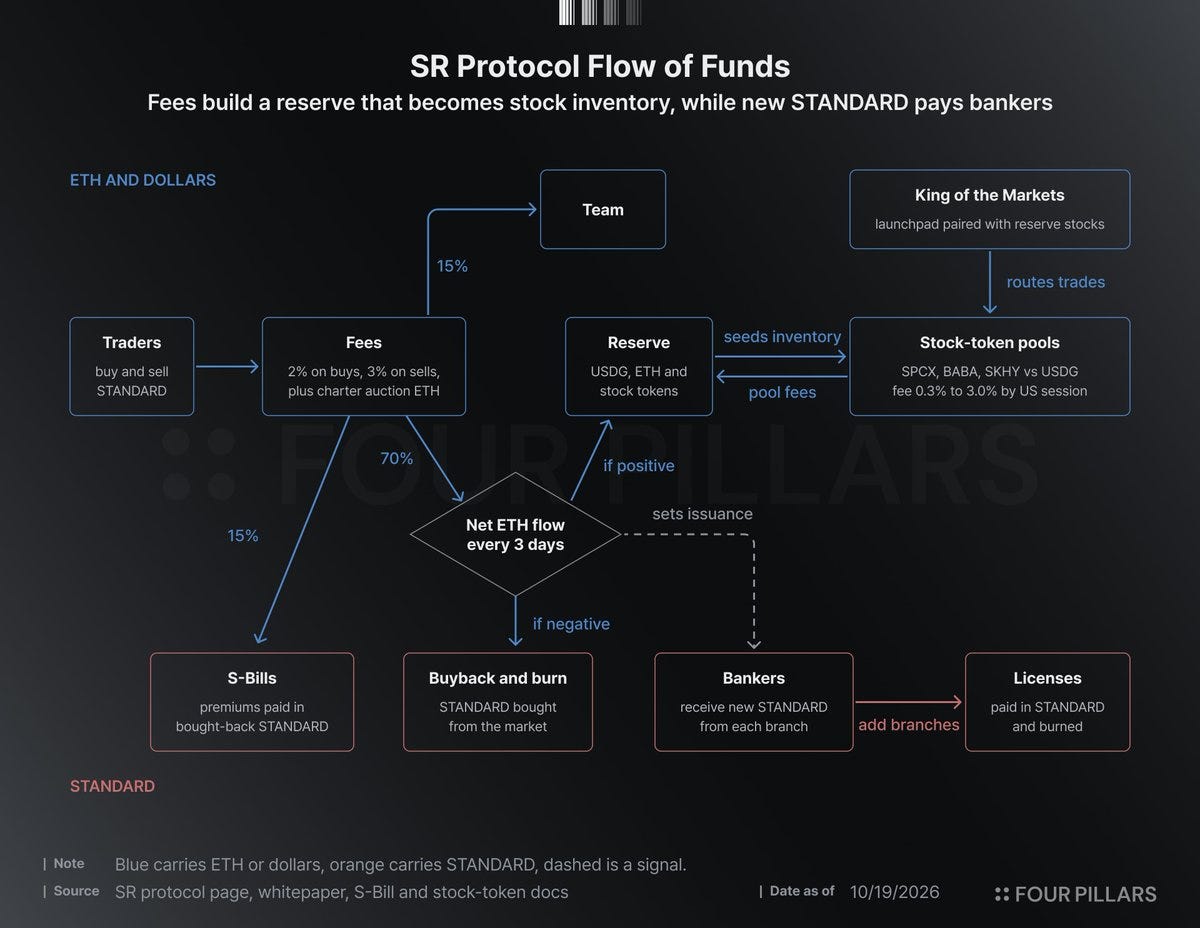
That argument treats tokenization and liquidity as inseparable. Without deep markets for tokenized equities, it is hard to build useful derivatives, lending markets, or trading pairs on top of them. SR wants to fill that gap. Issuers would bring stocks onchain, SR would create the initial market, attract outside liquidity, and collect fees from trading in those pools. Over time, Charter holders could launch financial products on top of those markets and share in fee income, while reserves could also support lending backed by tokenized stocks.
Robinhood Chain, only about three and a half months after launch, had already become the third-largest onchain spot venue by volume. In the 30 days through Oct. 19, DEX volume reached $34.6 billion and total value locked stood at $1.05 billion. Most of that activity did not come from stocks, but the chain’s distinguishing feature is that Robinhood has issued 188 stock tokens on it, allowing users in more than 120 countries outside the U.S. to trade them continuously.
On Robinhood’s July 29 earnings call, Vlad Tenev described Robinhood Chain as the first blockchain built specifically for real-world assets and said the company wants those assets to become fully compatible with DeFi. The value of onchain stock tokens rose from $14.2 million in mid-July to $148.4 million in mid-October. For comparison, Robinhood users traded $335 billion in U.S. equities in August 2026.
The report stressed that issuing stock tokens is not the same as building a market for them. Liquidity has to come from somewhere, and someone has to be willing to hold the assets when trading gets difficult. SR’s core view is that the cost of making markets in stocks should vary by time of week. During regular U.S. trading hours, liquidity providers can price and hedge against an active underlying market. At night and on weekends, those reference markets are closed.
SR therefore designed a time-based fee schedule:
- 0.3% during regular trading hours
- 0.6% in pre-market and after-hours sessions
- 1.5% overnight
- 3% on weekends
SR currently has three stock trading markets live. According to its documentation, each time the reserve adds a new stock token, it uses reserve funds to create a USDG market for that asset. If the token also receives launchpad approval, it can gain extra order flow through a newly issued paired token. Each new stock market follows the same repeatable pattern: deploy inventory, generate trading activity, and route fees back to the reserve.
Beans’ strategy is to build deep liquidity pools that other products can use, then earn revenue from the trading that passes through them. SR plans to seed initial liquidity, bring in outside capital through pools managed by its Hook mechanism, and eventually disclose what share of stock-token trading volume those pools capture.
In Beans’ five-year plan, a larger reserve base would also support lending. The protocol could extend USDG loans to well-run Charter holders, allowing Banker to avoid closing Branch positions to source liquidity, and eventually support loans backed by tokenized stocks. That last step depends on liquid markets, because lenders need to be able to sell collateral during liquidation. The trading pools have to come first.
Based on currently disclosed stock-token volume on Robinhood Chain, the chain is doing about $150 million in daily turnover. If SR were to capture one-third of that flow at a 0.3% fee, the pools would generate about $150,000 in gross daily fee revenue, roughly three times the current daily fee income of the token mechanism.
What changed in the OCC’s final GENIUS Act rule
Foresight News said the OCC’s draft had offered two alternatives. Option A relied on principles-based requirements, asking issuers to diversify reserves and manage concentration risk while offering an optional quantitative safe harbor. If an issuer met all safe-harbor conditions, it would be deemed compliant with that requirement. Issuers that did not use the safe harbor would still need to satisfy the principles-based standard. Option B would have made the quantitative metrics in Option A’s safe harbor mandatory.
Those metrics included at least 10% in designated immediately available funds, at least 30% in five-business-day liquidity, and a reserve portfolio weighted average maturity of no more than 20 days. The final rule blended the two approaches. It kept the principles-based framework, added adjusted mandatory metrics, set the minimum share of designated immediately available funds at 5%, removed the 30% five-day liquidity requirement and the 20-day weighted average maturity cap, and added stress testing plus a requirement to hold extra reserve buffers when necessary.
That gives issuers more room in reserve allocation, but Foresight News said meeting the 5% floor does not by itself satisfy the full reserve-management obligation.
On capital, the OCC kept the $5 million minimum capital floor and extended it from the initial phase for newly approved issuers into the ongoing operating phase. For a new issuer, the capital requirement is the higher of the amount specified in its licensing conditions and $5 million. Once in ongoing operation, the issuer must still maintain capital appropriate to its scale and risk profile, and it cannot fall below $5 million.
The GENIUS Act says permitted payment stablecoin issuers, as well as foreign payment stablecoin issuers that meet the relevant statutory conditions, may not pay any form of interest or yield to holders solely because they hold, use, or retain a payment stablecoin. That includes cash, tokens, or any other consideration. The OCC’s final rule kept that ban in place and did not open the door for issuers to pay yield directly to holders on that basis.
The draft had created a rebuttable presumption for certain affiliate and third-party yield arrangements: the arrangement would first be presumed to violate the rule, and the issuer could then try to rebut that conclusion. The final version removed that mechanism. Instead, the OCC will review specific arrangements during application review and ongoing supervision, and it will act against transactions that violate or evade the prohibition. Simply changing the paying entity does not automatically avoid the ban. The OCC said that if an agent pays interest or yield on behalf of an issuer solely because a holder owns, uses, or retains the stablecoin, that still falls within the prohibition. Other third-party reward structures will be judged based on the actual payment relationship and the reason for payment.
The report said the gap between banks and crypto-native firms will show up in practical questions such as how to obtain issuance approval, manage reserves, and structure distribution partnerships and rewards. USDC, Open USD, and USDT all face those requirements, though the points of focus differ based on current disclosures.
Circle, for example, has disclosed that USDC reserves include bank deposits, short-dated Treasuries, and overnight Treasury reverse repos, along with regular disclosures and monthly third-party attestations. Foresight News said those arrangements provide an operating base for adapting to the new framework, though it remains necessary to watch how the actual issuing entity aligns with the relevant operating requirements. The report also noted that in February 2026, Circle received OCC approval to establish a national trust bank that will provide federally regulated custody services for USDC. But USDC issuance and trust-bank custody are separate businesses, so that banking charter alone does not mean USDC has already obtained issuance approval under the GENIUS framework.
Why a16z Crypto is becoming a16z Frontier
In another English thread, Chris Dixon said the firm is expanding the investment scope of its new fund from crypto startups to a broader set of frontier technology startups. These are companies building new technologies and creating new markets that may take years to mature. To reflect that shift, a16z Crypto is being renamed a16z Frontier.
Dixon said the move is an expansion, not a retreat from crypto. The firm will continue investing in crypto and related companies and will keep advocating for sensible crypto regulation.
He wrote that when a16z first invested in crypto, the sector was still relatively self-contained. As blockchain has spread into wider use, those boundaries have blurred and the underlying infrastructure has moved further into the background. Wall Street firms and fintech companies now regularly launch products built on blockchains. In that setting, Dixon argued, it makes more sense to define companies by what they do than by the technology stack they use.
The broader mandate also fits a long-running investment approach at the firm: backing technologies that look like they belong to the future before they reach the mainstream. Dixon said that when he joined a16z in 2013, one of his focus areas was long-duration investing in emerging technologies. At the time, one major theme was new computing devices. Smartphone adoption drove better and cheaper cameras, sensors, and chips, making products such as drones, AR and VR headsets, and wearables possible. That thesis led to investments in Oculus, Skydio, and Zipline.
Now, he said, the industry is in another major technology wave centered on artificial intelligence. AI models and infrastructure will keep advancing, but the technology is already mature enough to produce a new generation of products and services. No one knows exactly what those products will look like, though early signs are already visible. a16z is especially interested in the new products and markets created by technical progress, including opportunities that do not fit neatly into existing categories.
Dixon argued that the most important of these will be native use cases, activities that were not previously possible at all. Early applications of new technologies often focus on doing familiar things better. So far, AI has mainly been used to make programming and other knowledge work faster, better, and cheaper. But he expects AI-native applications to produce very different and sometimes surprising experiences. Many early experiments may look odd or unserious at first, more like toys or hobbies, yet some of them can grow into mainstream products over time.
He said the key is understanding how quickly those experiments can improve and what can turn seemingly minor gains into exponential growth. In his view, technology progress is accelerating rapidly, and people are beginning to see what a post-AGI world could look like. One consequence is that software, and increasingly hardware, is becoming easier to create. Just as smartphones powered the last computing wave, a new generation of devices could support this one.
Dixon also said AI will create new kinds of networks connecting humans with intelligent agents that can learn, coordinate, produce, and transact. The large networks people use every day were built for humans. Networks built for machines will look different. Many will begin as single-user tools and then evolve into multi-user networks.
Blockchain, he said, will still matter in that transition. Crypto has already given the internet fast, low-cost, global, programmable money movement infrastructure. Stablecoins are quickly becoming a standard tool for fintech firms, traditional institutions, and others. Because blockchains are programmable, both centralized and decentralized financial services can be built on them. Crypto can also give new networks native economic capabilities, enable machine-to-machine transactions, and create new ways to solve cold-start problems.
Dixon added that these are examples, not hard boundaries on the fund’s mandate. In previous technology waves, the companies that ended up defining an era were rarely the ones people predicted in advance. He said he expects founders to surprise the market with categories that are hard to imagine today.
He will lead the fund alongside firm founders Marc and Ben, as well as general partners Eddy Lazzarin and Guy Wuollet. The operating team will continue supporting portfolio companies on regulation, go-to-market work, talent, marketing, and technical development.
Why crypto trading front ends are making more money
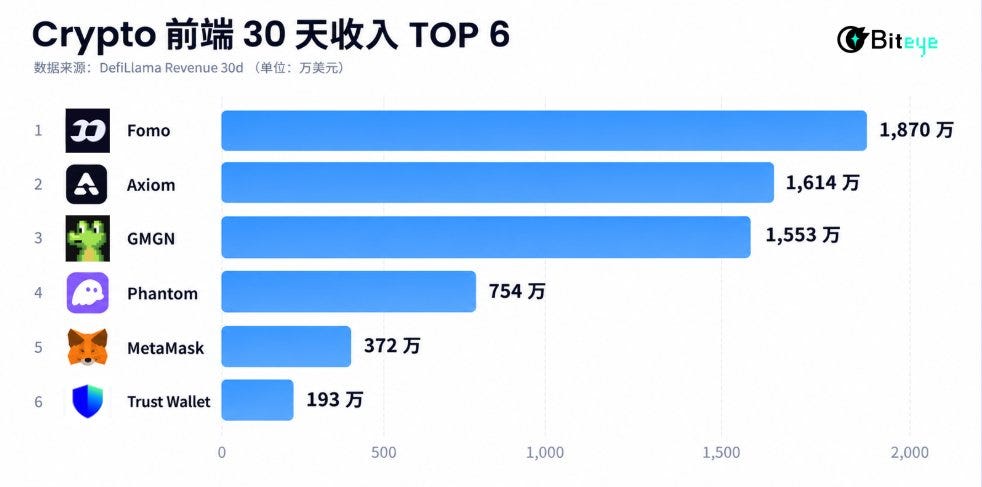
Biteye’s long thread reviewed 20 representative crypto trading front ends. The main screening criteria were integration with third-party trading infrastructure and at least $100,000 in revenue over the past 30 days. By category, meme-focused products were the largest group with seven entries, including GMGN and Axiom. Perpetual DEX front ends accounted for five.
The piece said crypto founders spent the past few years racing to build blockchains and protocols in order to control the underlying technology and fee rails. As infrastructure matured, another business model started to stand out: instead of building a full trading stack, teams could plug into existing protocols and focus on product experience and user acquisition. Some of these front ends now generate tens of millions of dollars in monthly revenue, in some cases more than platforms that run their own trading systems.
Wallets, trading terminals, and social apps are now competing for the same users. Meme trading remains one of crypto’s hottest segments. Prices swing and narratives rotate, but the terminals selling the “picks and shovels” can keep earning from order flow. Perpetual trading is another large market, and active traders open and close positions frequently, creating recurring fee income. As platforms such as Hyperliquid open up trading capabilities, third-party front ends are getting a share of that market too.
Fomo was described as a social trading app aimed at mainstream users, with the main selling point of lowering the barrier to onchain trading. Users do not need to understand different chains, wallets, or gas fees. They can deposit USDC and trade assets across chains directly. The product also folds in social features, letting users follow other traders’ activity and copy their trades.
Biteye said Fomo also changes how crypto creators make money. In the past, KOLs mainly monetized through advertising and project promotion. On Fomo, they can also earn a cut of the fees generated by follower trades. That gives newcomers an easier way to trade and gives creators a direct path to turn influence into trading revenue.
Axiom, meanwhile, is a leading meme trading terminal in the Solana ecosystem. It built a large active user base through fast execution and token discovery tools. As competition in meme trading intensified, especially with the rise of newer social trading platforms such as Fomo, Axiom started looking for new growth. Over the past two to three months, its expansion has accelerated. It launched a new portfolio management page in August, upgraded BNB Chain trading in September, and expanded into ecosystems including Base and Ink, moving beyond a Solana-only focus. Biteye said Axiom no longer appears satisfied with being just a meme trading tool and is trying to combine market data, social features, and trading into something closer to a super app.
The thread also noted that Phantom earns more trading revenue through Hyperliquid than TradeXYZ does. Biteye described Fomo as the clearest expression of this cycle’s front-end innovation because it combines cross-chain trading, social feeds, and creator revenue sharing. The trend has drawn in newer entrants such as SmartX, while older terminals including GMGN and Axiom are adding social features of their own.
The competition is not only about the fee on a single trade. It is about controlling a user’s future trading demand. One entry point can support many businesses. A product may attract users with meme trading today, then add perpetuals, prediction markets, payments, or wealth products later. Each new business line creates another chance to earn from the same user base.
According to research from Re7 Capital cited in the piece, third-party front ends’ share of perpetual futures trading rose from less than 1% at the start of 2025 to about 20% in August 2026. Biteye said that helps explain why wallets, terminals, and social platforms all want this entry point. Wallets control user assets, terminals own trading habits, and social platforms have creators and followers. They start from different positions, but all want users to complete more of their trading activity inside their own products.