ChainFeeds on Sept. 30 published a new research roundup covering five topics across crypto and AI: stablecoin revenue sharing, Anthropic’s IPO push, the IMD onchain AI agent network, meme-coin-driven liquidity for tokenized stocks, and methods for finding informed flow in prediction markets.
Stablecoins: Circle issues, Coinbase controls distribution
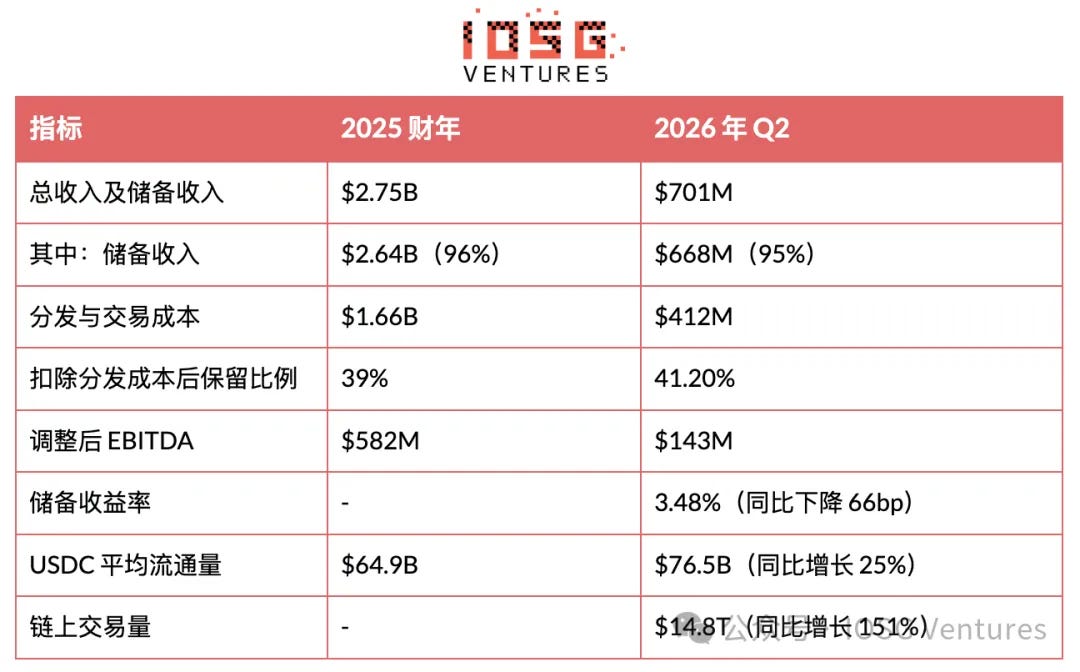
In the first featured piece, IOSG Ventures argued that the party controlling users also controls the revenue split. Under a 2023 agreement, Coinbase receives most of the reserve income generated by USDC held on its platform and also takes a share of reserve income from USDC held off-platform. Circle paid Coinbase $324.6 million in related distribution costs in the second quarter of 2026, while payments to major distribution partners totaled about $1.66 billion for full-year 2025.
That three-year agreement entered its renewal window in August 2026. On its Aug. 5 earnings call, Circle said the deal had been renewed through 2029 on the same terms. IOSG Ventures treated that renewal as the clearest signal in the story. Circle had already secured a federal trust bank charter, its payments network was expanding, and the market had seen other distribution arrangements that handed 90% to 100% of reserve income to channels. Even so, the terms did not change.
Two months earlier, Coinbase had joined the Open USD alliance, which competes with USDC, and Circle shares fell about 17% that day. The report said that still did not alter the renewal outcome. Its explanation was straightforward: the customers sit with the distributor. Whether a contract gets renewed depends mainly on performance thresholds, not on the issuer having the power to reprice the relationship.
In Q2 2026, average USDC balances inside Coinbase products reached a record $20 billion, accounting for more than 30% of USDC in circulation at quarter-end. The report said nearly one-third of Circle’s revenue base was concentrated on a single counterparty platform, and the next full renewal window will not come until 2029.
IOSG Ventures reduced the issuer model to a simple formula: float multiplied by yield, minus the distributor’s contractual share, minus relatively fixed operating costs. Using a hypothetical issuer with $100 billion in float, a 50% revenue share to distribution, and $600 million in annual operating costs, a 300 basis point drop in yield would erase about 79% of operating profit if float stayed flat. To keep earning $1.9 billion at a 2% yield, float would need to rise to about $250 billion, or 150% above the starting point.
The report said this was no longer just a thought experiment. Circle’s actual reserve yield in Q2 2026 was 3.48%, and the 50% distribution-share assumption may even be conservative. Circle posted $701 million in total revenue for the quarter, against $412 million in distribution, transaction and other costs.
Circle has also been trying to build non-reserve revenue. At quarter-end, annualized transaction volume on Circle Payments Network reached $14.7 billion, up 76% from the prior quarter, and had climbed to $23 billion by July 31. The company raised its full-year non-reserve revenue guidance to $310 million to $330 million, but $242 million of that came from a one-off token presale rather than recurring business. The report said the key variable to watch was pricing, not volume, because the payments network had not yet started charging fees.
Its broader conclusion was that stablecoins may become commoditized, but access points will not. Regulatory requirements are pushing issuers toward similar reserve assets and similar disclosure rules, meaning each regulated dollar stablecoin promises the same thing. In that setup, differentiation shifts above the token itself. Falling rates are already compressing float economics: a 66 basis point decline in reserve yield translated into only 5% reserve revenue growth despite 25% average circulation growth. Distribution still holds the bargaining power.
Anthropic’s IPO case rests on growth outrunning cost
A separate article from Tencent Technology examined Anthropic’s revenue trajectory, cost structure and valuation. The company generated $386 million in revenue in 2024. In 2025, revenue rose to $4.59 billion, up 1,088% year over year and nearly 12 times the prior year. Growth accelerated again in 2026. According to foreign media reports cited in the piece, Anthropic’s annualized revenue run rate had exceeded $65 billion by the end of July.
Anthropic expects revenue to reach roughly $190 billion to $200 billion in 2028. At a $2 trillion valuation, that implies a price-to-sales multiple of about 436x on 2025 revenue, falling to around 10x on projected 2028 revenue. The article said the gap between those two numbers captures the central IPO bet: revenue would need to expand more than 40-fold from the 2025 base over the next three years for the valuation logic to hold.
Costs remain enormous. In 2025, Anthropic spent $7.33 billion on compute and infrastructure, nearly triple the prior year. That represented 58% of total operating expenses and 1.6 times annual revenue. Put simply, revenue for the year did not cover compute spending alone.
The filing also disclosed $518 billion in cloud, compute and infrastructure obligations, a figure the article said had been widely misunderstood. It is not a one-year compute budget. It is the total value of contracts to be signed over multiple years, many of them long-term. Based on disclosed allocations, $100 billion went to Amazon Web Services, $200 billion to Google Cloud, $80 billion to Lambda and Nscale, $50 billion to Fluidstack, and $30 billion to Microsoft Azure, with smaller contracts spread across additional cloud providers. Anthropic is also deploying its own software infrastructure in WULF colocation facilities.
Those contracts span different time frames, in some cases three to five years or longer, so annualized spending is far below the $518 billion headline number. Even so, the article said the scale remains striking. Starting from $7.33 billion in compute spending in 2025, annual outlays could move into the tens of billions quickly if triple-digit growth rates continue.
The filing also highlighted customer concentration. Anthropic’s two largest direct customers each accounted for 12% of revenue, or 24% combined. For a company generating $4.59 billion in annual revenue, the article said that level of dependence is already high. Anthropic also warned in its risk factors that many of its largest customers are not locked into long-term contracts and could reduce or stop spending.
On competition, the article listed OpenAI, Google, Meta and SpaceXAI as major rivals, with OpenAI described as the most direct competitor across enterprise accounts, talent and influence in Washington. Anthropic’s position is unusual because Amazon and Google are both strategic partners and infrastructure suppliers, while also being investors. Amazon has invested about $8 billion and Google about $2 billion. They provide the cloud resources needed to train and run Claude and are tied to the company through equity as well. The article said that arrangement is an advantage, but it may also create conflicts of interest.
IMD and the idea of an onchain labor market for AI agents
A Bankless long-form post focused on IMD and asked whether it is building a real onchain labor market for AI agents. The project’s goal, according to the report, is to create a company run entirely by AI agents and owned by the community.
The system has several moving parts. The 2,000 identity.md NFTs are not standard profile-picture assets. They function as work seats inside the AI agent network. Holders must register the NFT as an agent under ERC-8004, run an open-source worker client on their own device, and connect it to Claude or Codex. Each NFT can authorize only one active device.
Tasks are posted by a master orchestration agent. Other agents can claim them, complete them and submit results. Validators then reconstruct the submitted work inside an isolated environment, while other seats perform adversarial review. Work that passes is written into an onchain reputation system. The network can already handle coding, website building, oracle responses, audits, reports and image-related tasks.
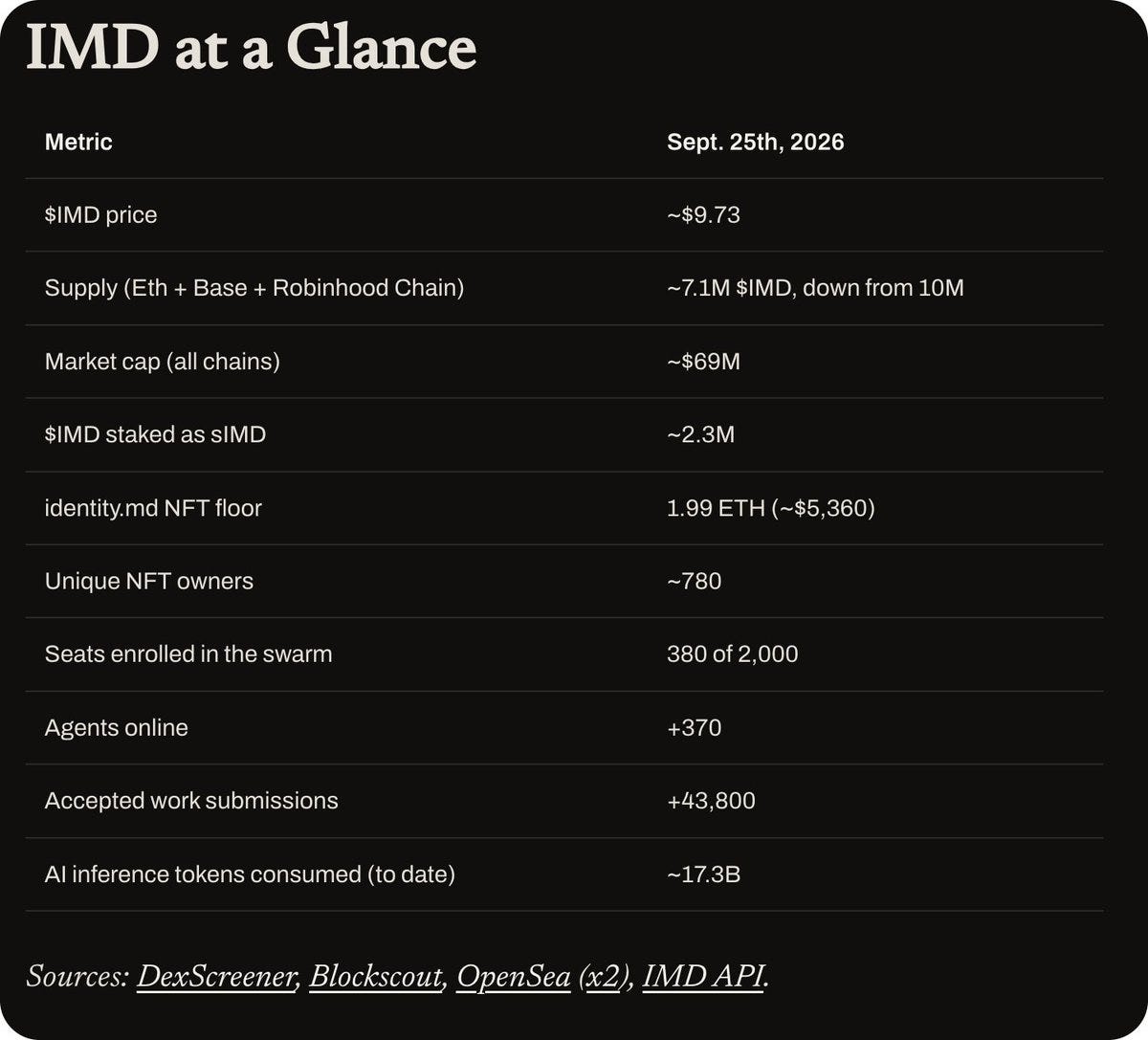
When the network opened to NFT holders on Sept. 20, only a few dozen agents were online. Five days later, that figure had grown to more than 370. External users can now pay to call this AI workforce, with each task priced at 0.5 IMD and settled through x402. Most deployments are still happening on Sepolia, though mainnet deployment is planned.
IMD is the system’s circulating currency. The same supply exists across Ethereum, Base and Robinhood Chain, can move 1:1 across chains, and is designed only to shrink. Ongoing burns since the Fren Pet period have reduced supply from the original 10 million tokens to about 7.1 million, meaning roughly 29% has already been removed.
The protocol also controls the main ETH/IMD liquidity pool, POOL4, on Uniswap V4 and uses a CappedBurnHook to set an upper limit on the amount of IMD inside the pool. If selling pushes pool IMD above that cap, the hook trims the excess after the trade. Of that amount, 85% is burned, 6% goes to reserves used for agent orchestration compute, 4.5% goes to stakers and another 4.5% goes to NFT seats. At the same time, the ETH released by the trim is redeployed below the current price to form a buy wall, while the pool’s IMD cap falls by about 1,000 tokens per day.
The report said that means selling itself drives token destruction while also creating income for stakers and NFT seats running agents. About 2.3 million IMD is currently staked, equal to roughly 32% of total supply.
The central question is whether the AI agent swarm is actually working. Public data from Sept. 25 showed that 380 of the 2,000 NFT seats had registered and 372 agents were online. Among them, 334 seats had at least one accepted job, 267 had more than 50 accepted submissions, and 193 had more than 100.
Work was not heavily concentrated. The top 10 seats accounted for only about 8.5% of accepted work, while the top 50 represented about 32%. By that point, the network had logged about 50,700 task attempts in total. Roughly 86% were accepted, only about 1% were directly rejected, and the rest were either failed or pending. Growth was fast: about 29,600 accepted submissions were recorded in the previous 24 hours alone.
Paid external demand, however, was still small. The public x402 payment channel had processed 115 paid orders at 0.5 IMD each, for a total of about 57.5 IMD, or roughly $560. Bankless concluded that the labor network is operating in practice, but commercial demand is still at a very early stage.
How meme coins are pulling liquidity into tokenized stocks
A Decentralised.Co article looked at a different source of liquidity for tokenized equities on Robinhood Chain. Tokenized stocks are not new. The article traced attempts back at least to 2018, when projects such as Binance and Terra’s Mirror Protocol created synthetic tokens for names like Apple, Tesla and Google. Mirror never developed deep liquidity, though. If traders could buy Apple shares in a brokerage app with tighter spreads and actual shareholder rights, the synthetic version had little obvious edge.
The article argued that the old assumption was flawed: better infrastructure and easier access do not automatically create a market. Speculation is part of what makes financial markets trade in the first place, and crypto has long shown that clearly.
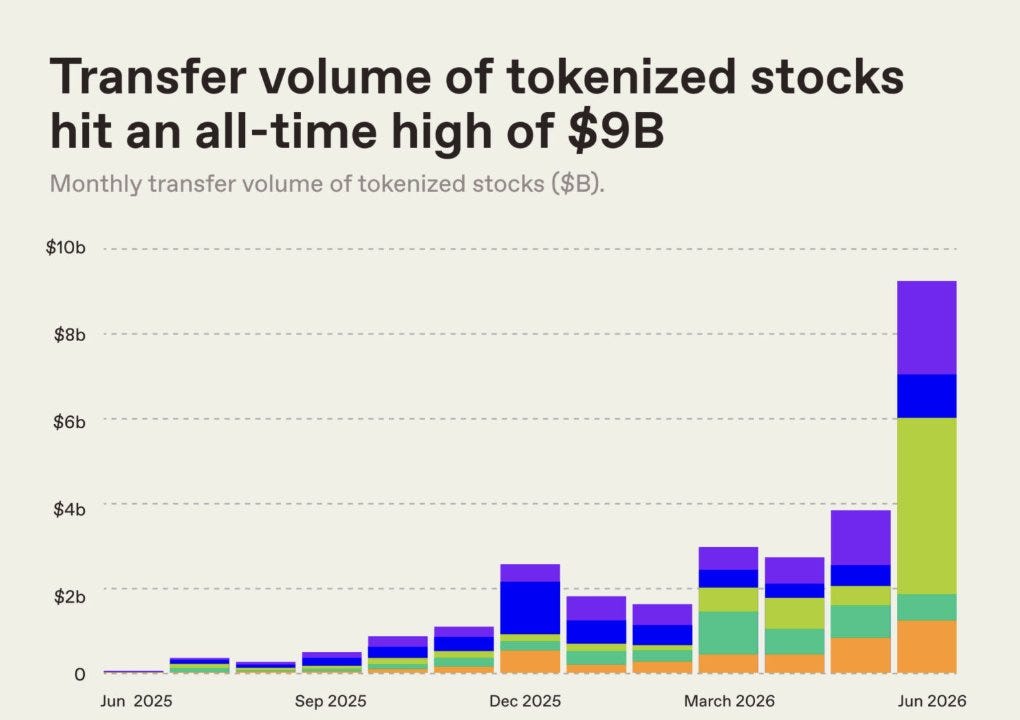
After Robinhood Chain launched, a launchpad called long.xyz began letting users issue meme coins paired with tokenized stocks instead of ETH or stablecoins. That creates a specific liquidity loop. When a user buys a meme coin paired with tokenized Nvidia, the router must first buy NVDA to complete the trade. At the protocol level, every meme-coin buy becomes a buy order for the stock token on the other side, and those stock tokens are then locked into the liquidity pool as reserve assets backing the meme coin.
$BONER was one example in the article. It was paired with tokenized Hims & Hers stock. At the time, total circulating tokenized HIMS on Robinhood Chain was about 73,685, and the $BONER pool held roughly 39,136 of them, or about 53%. Because new stock tokens could not be minted outside U.S. equity trading hours while meme-coin demand kept rising, onchain HIMS briefly traded at a 37% premium to the New York Stock Exchange close.
Robinhood’s Jersey entity later expanded HIMS supply by 4.8x to ease the pressure, but 53.1% of the new supply still flowed back into meme-coin pools. The article said the added supply did not weaken meme coins’ grip on float. It gave them more liquidity to absorb.
Another example was Artificial Inu, paired with tokenized Nvidia. When users buy $AI, 80% of the fee goes into a permanent NVDA vault that can only grow and cannot be withdrawn. On sells, the fee is used to burn $AI while permanently locking more NVDA. In both directions, each trade increases the amount of stock assets held by the system.
That mechanism has already locked about $3 million worth of NVDA permanently and at one point represented 16% of all tokenized NVDA open interest on the trading venue cited in the article. A BNB Chain study also found that 8.6% of users entering through meme-coin speculation eventually became tokenized stock holders, compared with 0.6% when stocks were offered directly. That implies a conversion rate roughly 14 times higher.
Finding informed flow in prediction markets
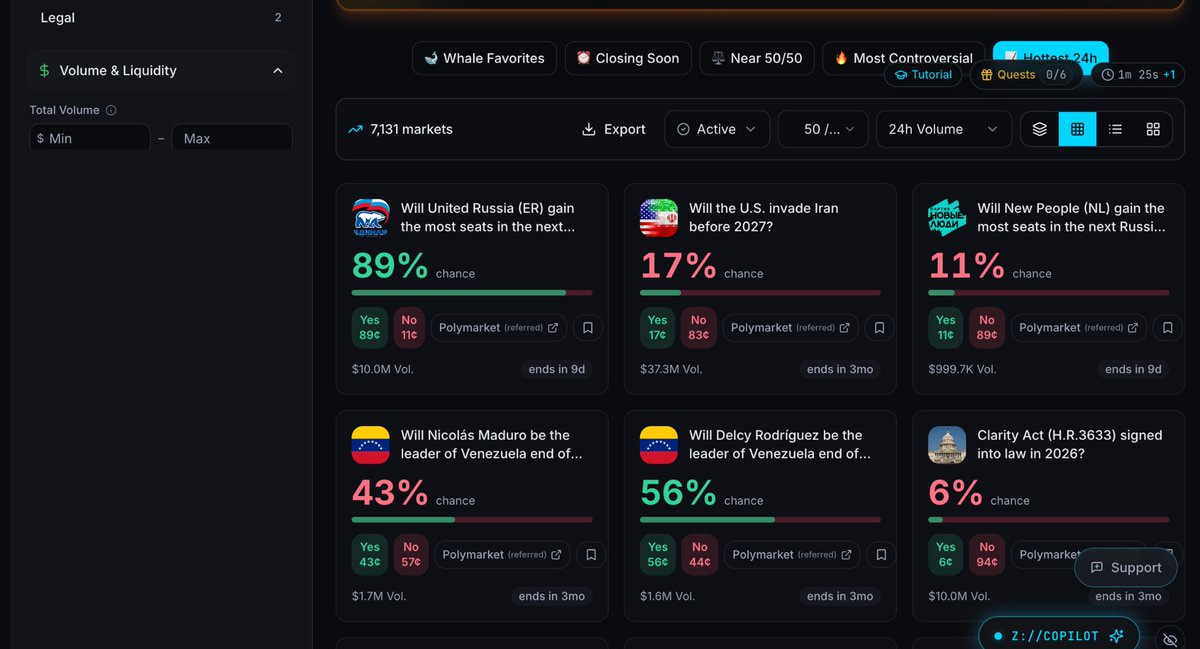
The final piece, from blocmates., compared prediction markets with meme-coin trenches and argued that the trading psychology behind them is closer than it looks. Prediction markets can be thought of as meme coins with probabilities attached. Meme-coin prices are driven by narrative, attention and speculation. Prediction markets work in a similar way, except traders are pricing whether an event will happen.
If a contract trades at $0.55, for example, the market is implying about a 55% chance of that outcome. Like meme coins, those prices can move on news, attention, whale trades and retail panic. The common enemy in both markets is information overload. New narratives, new markets and new opportunities keep appearing, and it becomes easy to mistake frequent trading for real progress.
The article said strong traders usually build a system that filters noise, spots unusual activity early and then waits. Once a trader has identified a market worth watching, the next step is to understand why the price moved. In prediction markets, a price move means the market has changed its view of the probability of an outcome.
Two areas matter most. The first is whale activity: whether a price move is accompanied by large trades, whether size is entering or exiting, and whether the market is liquid enough for that size to matter. In a thin market, one large order can move price sharply, so whale activity is only a starting point for research. Trade size alone does not prove the trader has better information.
The second is trader profiling. The article said it is more useful to investigate the wallet itself than to stare at the large trade. What markets does it usually trade? Has it participated in similar events before? How did its settled positions perform? Is the large position part of a broader strategy? Looking at wallet history, market participation and past results can help determine whether the behavior carries signal worth studying.
The piece also recommended reviewing settled markets rather than focusing only on live ones. Historical data can show how probabilities changed as an event approached, when major price swings occurred, how volume behaved before settlement, how wallets performed across market categories, and how far early pricing diverged from final outcomes.
PolymarketScan’s research tools were cited as one way to study those patterns, allowing users to search settled markets by keyword or market description and to use AI tools to structure the work. The article’s conclusion was practical: the goal is not to trade every market. It is to build a repeatable process for filtering noise, identifying unusual activity, understanding the narrative and forming a trade thesis before taking a position.