ChainFeeds on Oct. 9 published a new edition of its daily research brief, combining five project and market deep dives: memecoin lifecycles, the shutdown of Abstract, NEAR’s AI-agent strategy, post-quantum chain Quantus, and Lido’s move into lending.

Memecoin lifecycles remain brutally short
A study cited from Coin Metrics said memecoins can quickly concentrate attention and liquidity around emerging ecosystems, but the same viral, attention-led mechanics also give most of them very short lives. The report linked Solana’s recovery after the FTX collapse with a memecoin wave that began in late 2023, then said that trend spread to Base in 2024 and more recently to Robinhood Chain, where memecoins were paired with tokenized stocks.
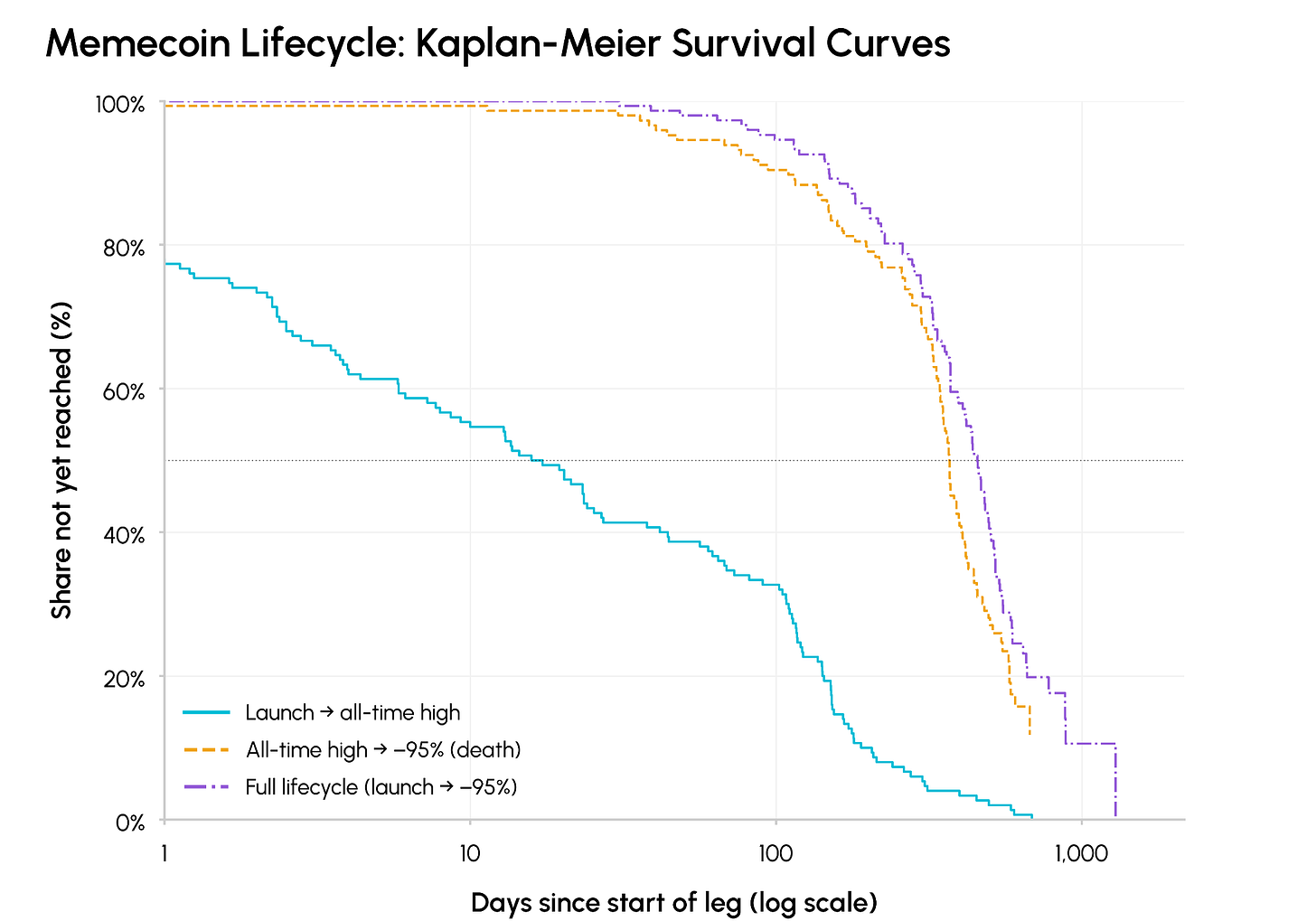
Launch platforms such as Pump.fun and PONS sharply lowered the barrier to issuing new tokens, producing millions of new memecoins. Only a small fraction reached centralized exchanges, and even fewer showed long-term survival. Based on a lifecycle analysis of 150 memecoin samples, the median time from first trade to all-time high was just 17.2 days. One quarter peaked within 1.6 days of launch. The median time from all-time high to a 95% drawdown, which the study treated as a crash state, was about 370 days.
The longer-term picture was harsher. More than half of the memecoins in the study were down over 95% from their all-time highs. Among 151 samples, only five tokens still traded above their first-day price. After 300 days, most had fallen to roughly 10% of their initial level. The report said this was not limited to smaller assets. Among the top five tokens by market capitalization launched during the “Solana memecoin era,” TRUMP, PUMP and PENGU were all trading below their launch levels.
The study added that 50% of memecoins launched during that period had already completed the full cycle of launch, all-time high and a 95% decline from the peak, taking about 456 days on average. By around day 1,000, roughly 90% had fallen 95% from their highs. A return to peak levels after a deep collapse was rare. Only 19% of memecoins avoided a drawdown of more than 90% from their all-time high. The remaining 81% dropped at least 90%, and only about 3% of those later recovered to their previous high.
Price structure showed a similar pattern. About two-thirds of tokens that emerged during the Solana memecoin surge never had a meaningful second rally. They usually spiked within days of launch, formed a top, and never came close to that level again. On-chain activity followed the same path. Using active Solana addresses with at least $1 in balance as the metric, the report found that most memecoins failed to recover activity after their first peak. Even major names were left with no more than 7% of their peak active address count.
Abstract had wallets, users and apps, but still shut down
A separate piece summarized from TechFlow said Igloo had been funding Abstract for 18 months and had accumulated losses in the “tens of millions of dollars.” In July 2024, Igloo raised more than $11 million in a funding round led by Founders Fund, aiming to use Pudgy Penguins’ brand and distribution reach to bring more consumers on-chain. Abstract later launched its mainnet in January 2025.
Once live, however, the network never built a DeFi ecosystem strong enough to sustain itself. The report said liquidity on-chain remained thin, institutional participation was limited, and the operating budget was well below that of rivals. CEO Luca Netz said Igloo could have extended the project’s lifespan by issuing an Abstract token or even running an ICO, but chose not to. In his view, token value needs real demand behind it, and launching a token the team itself lacked confidence in would let down the community.
On the surface, Abstract’s user metrics did not look weak. The article listed more than 4 million Abstract Global Wallets created, more than 400,000 users, over 3.25 million transactions processed, and 144 deployed applications. But there was a large gap between 4 million wallets and roughly 400,000 users, implying around 10 wallets per user on average. The report said that likely included many empty wallets, inactive wallets, and wallets created in bulk for possible future airdrops.
The bigger issue was how many of those users were actually generating repeated on-chain activity and gas fees. Abstract positioned itself as a consumer-friendly chain, with users coming more from NFT collecting, branded campaigns and casual applications than from heavy DeFi trading and borrowing. That exposed a basic L2 business problem: revenue comes from transaction fees, not wallet count or headline user numbers. A chain can post a large registration base and still fail to cover sequencer, infrastructure and team costs if each user makes only a small number of transactions each month.
Blast and Abstract both announced shutdowns in the same week, and Bitcoin L2 Botanix had already closed in June. That brought the number of venture-backed L2 closures in 2026 to three. The article argued that this is testing a hard assumption about the sector: many L2s may not survive for long as standalone businesses.
With dozens of Ethereum L2s now live, most share similar rollup architectures, the same EVM compatibility, and the same link back to Ethereum mainnet. That leaves little room for durable differentiation. The piece said the strongest moats at this stage come in two forms: native distribution, as in the case of Base through Coinbase, or early ecosystem advantage, as with Arbitrum’s accumulated DeFi base. Abstract had neither. Pudgy Penguins had real brand power, but brand recognition did not naturally convert into sustained on-chain transaction demand.
NEAR is building from cross-chain execution toward AI agents
In a long-form post cited by ChainFeeds, Matt Hougan said NEAR is positioning itself as a blockchain for AI, with the goal of serving as the infrastructure layer for transactions between AI agents, other software agents, and the real world. NEAR was founded by Illia Polosukhin, one of the co-authors of the 2017 paper Attention Is All You Need, which introduced the Transformer architecture and is widely credited with helping launch the large language model era.
Hougan’s account traced NEAR’s origin back to Illia’s effort after leaving Google to build NEAR.ai and teach machines to write code. To support that work, he hired people around the world to label training data, but traditional payment systems were inefficient for paying workers spread across countries. That pushed him toward crypto. Existing blockchains at the time were too slow and too expensive, so he decided to build one himself. Over time, NEAR’s trajectory shifted from a general-purpose blockchain toward AI infrastructure.
The long-term vision, as the piece described it, is for NEAR to become a primary platform through which AI agents interact with the world. Rather than unveiling a complete master plan from day one, NEAR has been adding the capabilities that vision would require. If AI agents are going to support large-scale commerce, they need a high-throughput blockchain. If they are going to operate across a complex multi-chain environment, they need a way to move assets and execute transactions across chains, which is where Intents comes in. If they are going to manage funds and projects, privacy also matters, so NEAR has been building private AI infrastructure that runs AI inside encrypted hardware, keeping the data hidden even from NEAR itself.
Intents is the product the market has recognized most clearly so far. It allows users, whether human or AI, to execute trades through a network of market-making bots called Solvers, while abstracting away the complexity of cross-chain trading and bridging. The main criticism facing NEAR today is straightforward: it is not yet a blockchain used primarily by AI agents. Its current users are still mostly ordinary people.
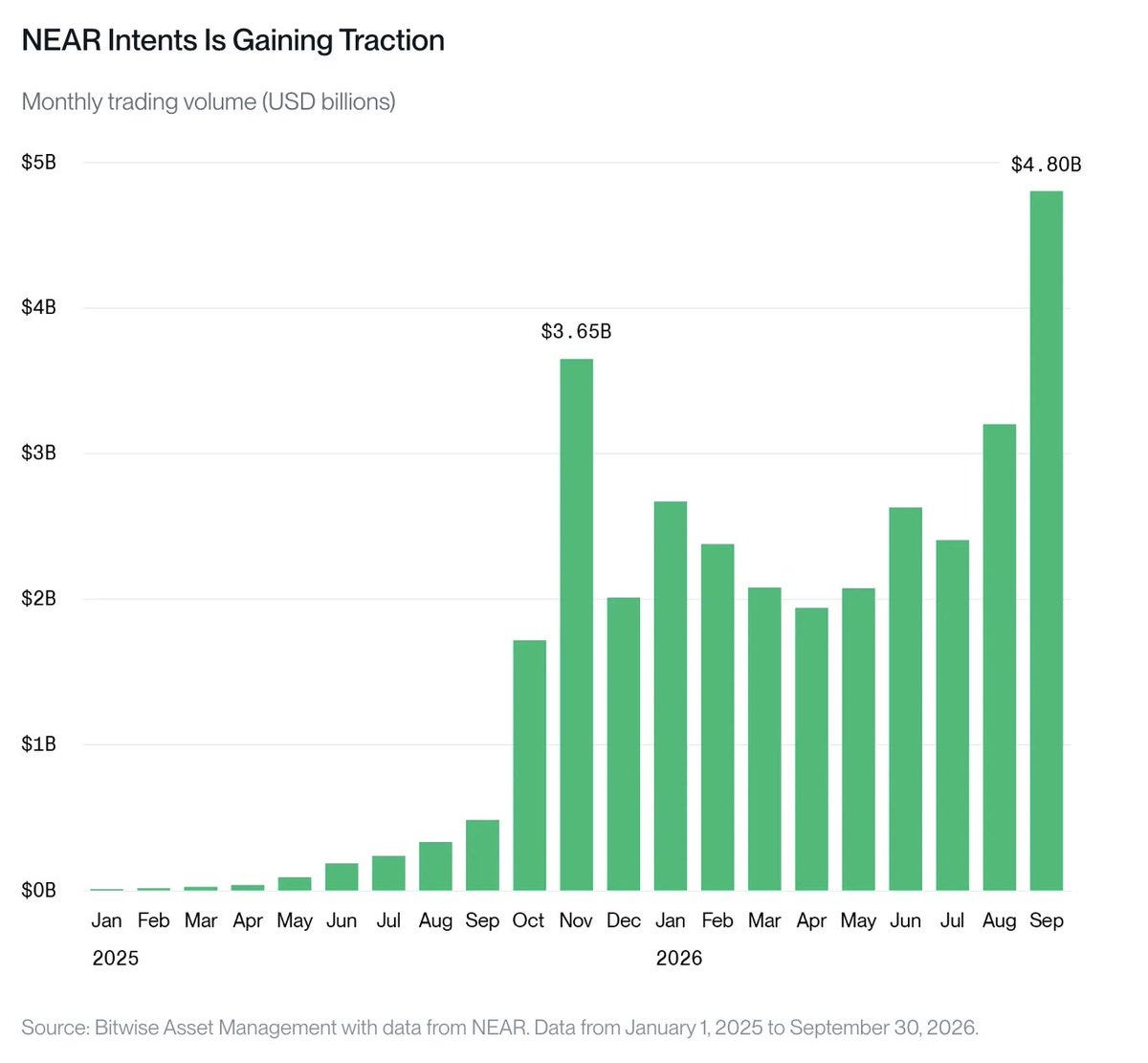
Hougan argued that this does not prevent Intents from standing on its own as a real business. Cumulative volume has just exceeded $30 billion. At the current pace, he said, the product could generate about $45 million in fee revenue this year, with part of that returned to token holders through buybacks. For him, that is proof that parts of NEAR’s infrastructure are already producing operating activity, not just future-facing promises.
He added that NEAR has also begun to make progress in private AI infrastructure, while its core blockchain continues to improve. More independent products could emerge over time. Even if AI agents do not become a massive market, or NEAR fails to capture the full opportunity, he wrote that the project still has strong conditions for growth. His framing was simple: buying NEAR means buying a blockchain business that already exists, while also retaining exposure to a much larger AI upside if that market develops.
Quantus draws attention with post-quantum security and privacy, but tokenomics are under scrutiny
Nancy wrote that Quantus, a newly launched proof-of-work public chain, has quickly gained attention as rising interest in privacy assets such as ZEC met renewed discussion around quantum-computing risk. The project presents itself as peer-to-peer electronic cash for the quantum era and centers its pitch on post-quantum cryptography, privacy and zero-knowledge proofs.
The article said Quantus believes the elliptic-curve signature schemes used across Bitcoin, Ethereum and Solana could, in theory, be vulnerable to Shor’s algorithm once sufficiently powerful quantum computers arrive. To address that, Quantus uses ML-DSA, also known as Dilithium, as its core signature scheme. That algorithm is one of the digital signature standards selected during the U.S. National Institute of Standards and Technology’s post-quantum cryptography standardization process.
Co-founder Christopher Smith said in a recent interview that Bitcoin’s proposed BIP-360 offers one possible post-quantum upgrade path by introducing new address types and letting users move their assets voluntarily into a safer framework. But he argued that this still leaves a practical problem: only assets that are actively migrated would be protected. Bitcoin held by Satoshi Nakamoto, or coins that are lost, forgotten, or left unmanaged after the holder’s death, may never move, even if an upgrade is adopted. In that case, those coins could remain theoretically exposed if powerful quantum computing arrives.
Privacy is the project’s second major narrative. The article said Quantus resembles Zcash in that both use zero-knowledge proofs for privacy, but their models differ. Quantus uses Wormhole addresses for private transfers. Users send assets to an encrypted address where the assets are provably burned, then use a locally generated zero-knowledge proof to remint them at any exit address, breaking the direct on-chain link between sender and recipient. Zcash, by contrast, uses zk-SNARKs and shielded pools to conceal sender, receiver and amount while preserving transparent addresses as an option.
Post-quantum security also creates engineering tradeoffs, the clearest being data size. According to the piece, ML-DSA-87 signatures are far larger than traditional elliptic-curve signatures. If every transaction wrote a full post-quantum signature directly to chain, signature data would quickly consume block space and weigh on throughput. Quantus addresses this with a “ZK plus signature aggregation” design. Using a STARK-based proving system and Plonky2, it aggregates proofs across multiple transactions, compressing what would otherwise be a large amount of post-quantum signature data into a smaller aggregate proof.
Public information cited in the article showed Quantus has raised about $2.42 million across two rounds. The first brought in $1.65 million at a $40 million token valuation. The second raised $770,000 at a $100 million token valuation. Balaji led the second round, with participation from AngelList co-founder Babak Nivi and Helius founder Mert, among others. Co-founder Joseph Mattia had also said earlier that Balaji serves as an adviser to the project.
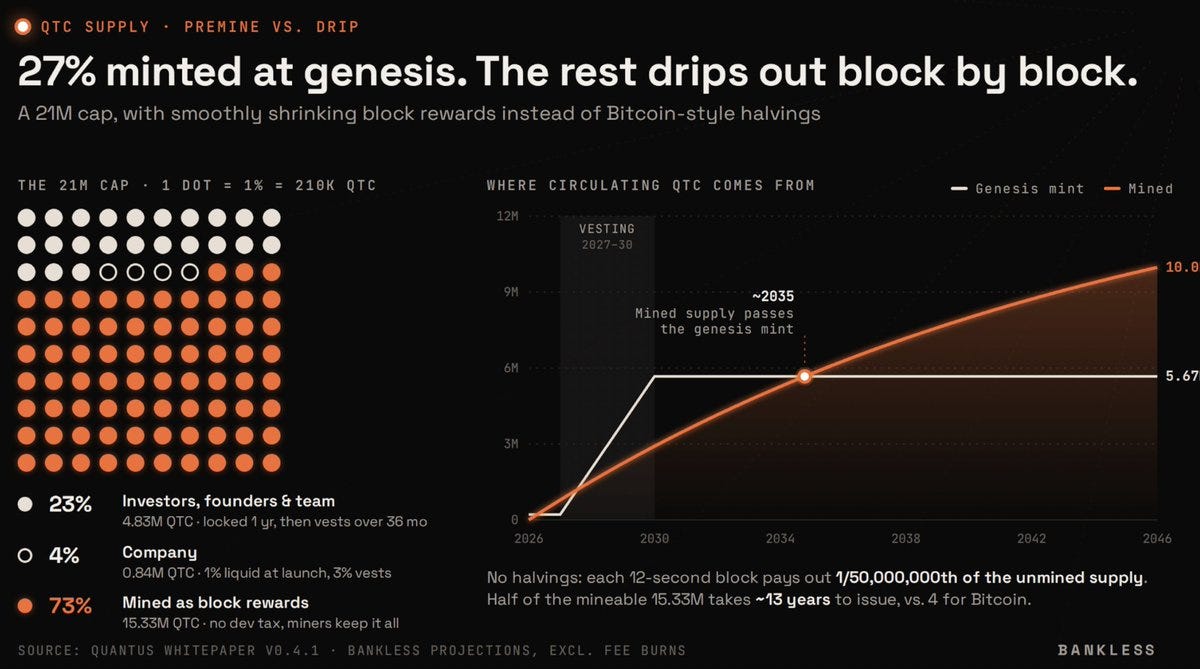
Its token model has become a point of debate. According to the disclosed tokenomics, 27% of QTC’s total supply was minted at genesis. Of that, 23% went to investors, founders and the team, locked for one year after mainnet launch and then released linearly over 36 months. Another 4% was allocated to the company, including 1% that was liquid at genesis for initial liquidity and roughly 3% for later operations, also subject to a one-year lock and a 36-month linear unlock. The article said this large genesis allocation has become a central criticism from the community and leaves the project exposed to years of token unlock overhang.
Lido turns from liquid staking to lending
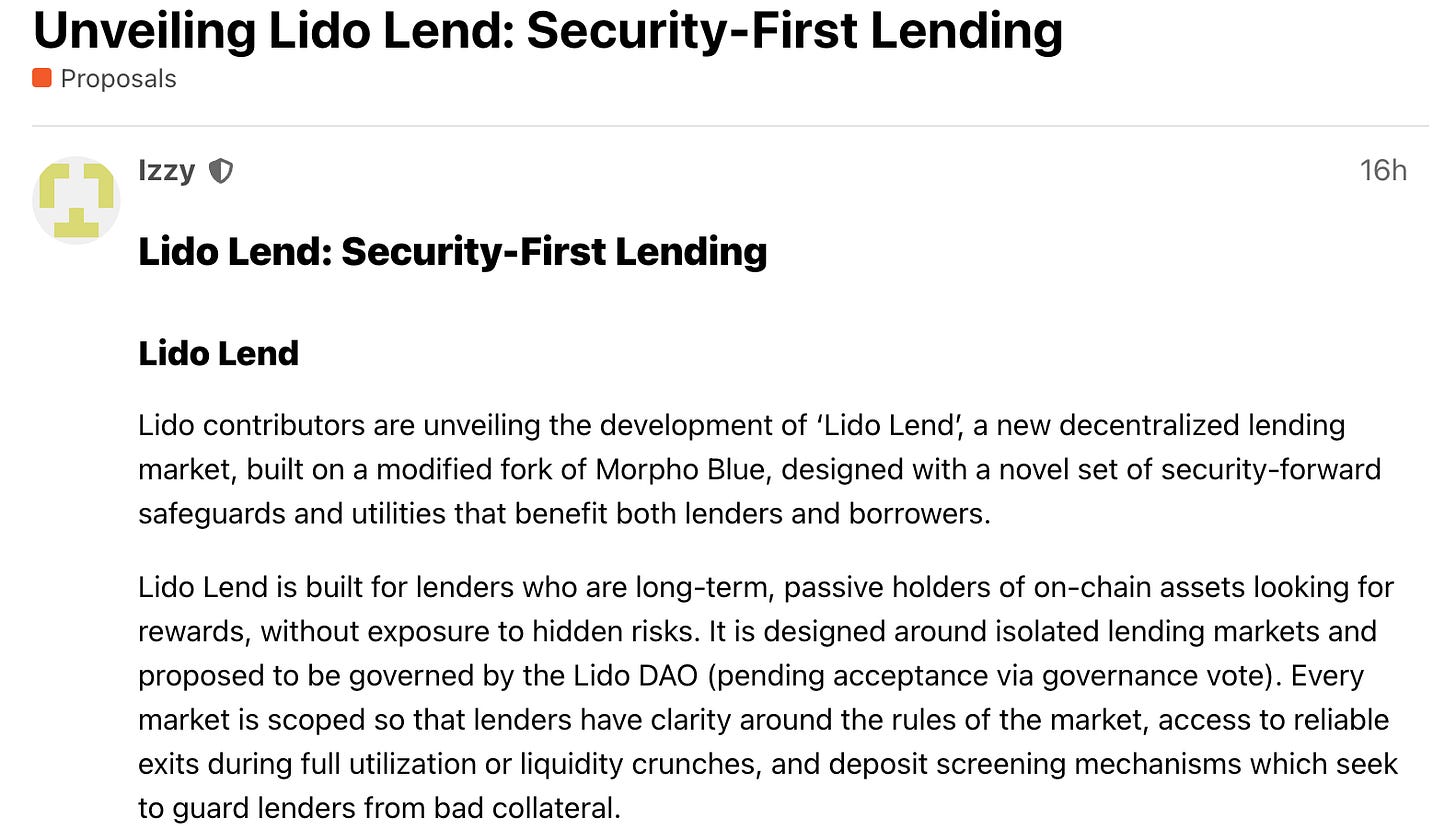
Foresight News, as summarized in the brief, reported that Lido contributor lzzy posted a proposal titled “Unveiling Lido Lend” on Oct. 7. The proposal said Lido is developing a new decentralized lending market built on a modified fork of Morpho Blue, with a target launch in the fourth quarter of this year.
Lido co-founder Konstantin Lomashuk publicly backed the proposal. He said Lido had created the safest staking solution in crypto and that more than $24 billion in token value is now staked through the protocol. In his phrasing, staking as a market has been solved, and lending comes next.
Morpho Blue, launched in 2024, is a minimalist lending framework that does not rely on shared giant pools. Instead, curators create isolated markets with independent parameters. That gives users multiple options around the same collateral while isolating risk if a market is attacked. On top of that structure, Lido made clear that it is not trying to serve every borrower and lender. The proposal targets long-term, passive on-chain asset holders who want yield without hidden risk on the lender side, and professional borrowers running recursive leverage strategies on the other.
The article described the looping trade familiar to stETH holders: use stETH as collateral to borrow ETH, restake the borrowed ETH, and repeat. Yield is amplified at each turn, but so is liquidation risk. Based on data as of Aug. 7 this year, Aave’s e-Mode borrowing positions accounted for about half of the total, estimated at between $5 billion and $7 billion.
Lido’s plan is to focus on blue-chip collateral and require pairs with correlated pricing, with stETH-ETH given as the example. The idea is to keep directional volatility as low as possible. On the security side, Lido Lend said it would screen and filter deposits tied to hacked funds to keep contaminated collateral out. It also promised that stretched looping positions could still be unwound in an orderly way during stress, and that users would retain a reliable exit path even at full utilization, when almost all funds in the pool have been borrowed. The proposal did not explain how these promises would be achieved. lzzy said that detail would be provided in later technical posts.
The article linked these design choices to the KelpDAO cross-chain bridge exploit in April, when about $292 million was stolen. Bad debt traveled through collateral chains, and Aave was at one point estimated to face a shortfall of about $124 million before a rescue effort by DeFi United and multiple project teams. Full-utilization withdrawal problems, contaminated collateral and cascading liquidations in recursive positions have appeared repeatedly in major incidents, and the report said Lido Lend’s design principles map closely to those failure points.
For Lido itself, the lending push also reflects the need for a second growth engine. The article said the core staking business has likely topped out, with limited room for another step change beyond its roughly $25 billion scale. Products such as Lido Earn and stVaults are part of that search. The proposal openly said low-risk DeFi is what Lido knows how to build best, and that Lido Lend is meant to complement the stETH flywheel and Lido Earn while adding a new growth vector to the ecosystem.
Under the proposed process, technical specifications, market parameters and audit reports will be posted separately in the same forum thread before the DAO votes on launch and protocol adoption. Community feedback was mixed. Ginsing said DAO spending remains too high relative to the value created by new products and that the existing buyback plan contributes almost no direct value to LDO holders. His recommendation was to cut costs sharply, prove the return profile of current products and establish a sustainable profit path before expanding further. Another community member, jack1, took a milder view and supported lending exploration, but only if annual operating expenses are kept within a $30 million cap and if the DAO clearly defines what share of new business revenue will be used to buy back and burn LDO.
On the same day as the Lido Lend proposal, the DAO also released its GOOSE-2026 first-half report. It showed annualized revenue of only $540,000 for the Lido Earn product line, which the project itself said fell short of target. Of the $32.10 million in TVL in the EarnUSD vault, $19.50 million came from internal transfers from EarnETH. In the first quarter, Lido DAO posted $9.42 million in net revenue, $6.44 million in expenses and $2.98 million in book surplus, while a single Kelp rescue nearly wiped out the equivalent of two quarters of surplus. stVaults held just 5,768 ETH in TVL, the AI product Wisp had generated no revenue, and Lido’s share of ETH staking had slipped from 23.93% at the start of the year to 21.18%.