ChainFeeds’ Aug. 25 Daily research briefing brought together a set of market-focused reports on Robinhood, a potential Zcash ETF, AI agent payments, U.S. sovereign debt and Ethereum issuance design.
Robinhood CEO ties memecoins to tokenized stocks and onchain finance
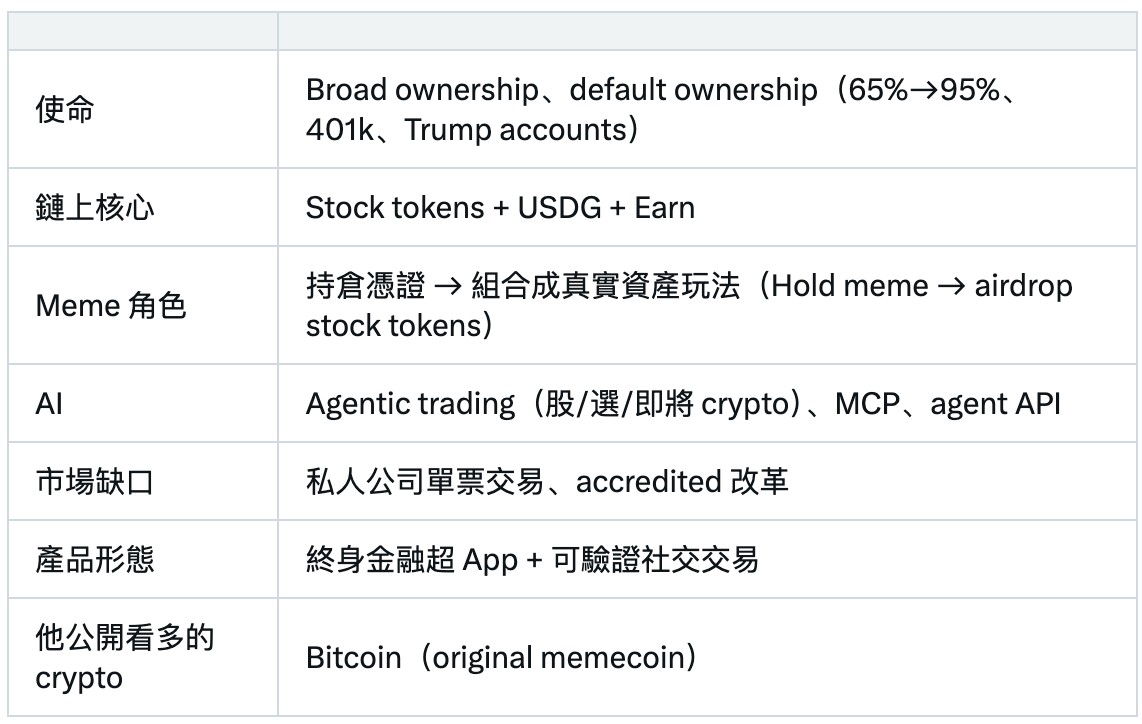
In a featured post titled “A conversation with the Robinhood CEO: Memecoins are becoming a new gateway linking stock tokens and onchain finance,” AlexWong summarized remarks from Robinhood CEO Vlad Tenev. The main point, Tenev said, is not to push more people into short-term trading. It is to get more people to actually own assets.
Tenev said that before Robinhood, the share of U.S. households holding stocks was only a little above 50%. He put the current figure at roughly 65%, and said his goal is to move that rate closer to more than 95%. In his view, many people are not unwilling to invest; they lack enough capital to start. That is why “automatic ownership” mechanisms such as 401(k)s, Trump Accounts, charitable subsidies and default allocations matter.
He also argued that tokenization can lower the barrier for global users to gain access to U.S. financial assets. Stocks and similar assets could become easier for investors around the world to hold. In that framework, Robinhood’s long-term aim is not to get more users to “play crypto,” but to widen actual participation in asset ownership through lower-cost, broader financial infrastructure.
Tokenization, in that setup, functions as infrastructure. It lets traditional financial assets move, trade and combine the way onchain assets do, while extending global access to those assets.
Tenev said developers on Robinhood Chain have already built products that even the Robinhood team did not initially expect. One example he gave was a setup in which users holding a specific memecoin can directly receive a stock-token airdrop. Developers have also combined meme assets, major crypto assets and stock tokens into new onchain products.
That gives memecoins a role beyond price moves and community sentiment. In the report’s framing, they can serve as a community entry point, a user credential or a distribution tool for assets. Robinhood Chain’s stock tokens provide exposure to real financial assets, large crypto assets provide liquidity and bridge functions, and protocols such as Uniswap add trading and composability.
Tenev described Robinhood Chain as an attempt to rebuild financial infrastructure from scratch. Non-U.S. users in more than 120 countries and regions can trade stock tokens and use them much like crypto assets, including transfers, swaps, collateralization and lending. For ordinary users, he said, the value proposition is straightforward: with a smartphone and internet access, they can trade tokenized equities around the clock at relatively low cost.
On AI, Tenev said his focus is less on chatbots and more on AI agents that can participate directly in trading. Robinhood is building what he called Agentic Trading, where users can let Claude Code, Codex or other AI agents call trading tools through Robinhood’s MCP Server.
Those capabilities already cover stocks and options. Crypto trading functions have also been announced and are expected to roll out further. Tenev said more than 100,000 users have already opened related agentic accounts. He described one of AI’s biggest uses as making algorithmic trading tools, once largely limited to professional institutions at scale, more broadly accessible.
He also pointed to a practical limit: many current AI agents are not naturally strong at active trading because that behavior is not richly represented in training data. He expects AI to have a clearer impact on active trading than on long-term holding or passive allocation. Robinhood is also testing a workflow in which one human supervises multiple agents, allowing agents to keep running tasks even while the human is away. In that environment, assets that can be operated directly through APIs, MCP and onchain tools become better suited for AI participation.
Grayscale’s amended filing moves the Zcash ETF process forward
Another highlighted piece, from TechFlow, examined the latest step in a proposed Zcash ETF structure. The fifth amended filing, the report said, settles key items that had been reviewed through four prior rounds. The annual management fee is set at 2.5% and charged daily in ZEC.
Bank of New York Mellon is listed as administrator and transfer agent. Coinbase Custody is the custodian, and Coinbase Inc. is the prime broker. The product supports cash creations and redemptions, and it also supports in-kind creations, meaning authorized participants can deliver ZEC directly in exchange for shares. In-kind redemptions are not supported for now.
A key detail first disclosed in the fourth amendment remains in place in the fifth. DCG International Investments, a subsidiary of Grayscale parent Digital Currency Group, is in talks to contribute about 200,000 ZEC to the trust, valued at about $110 million at the time. The report noted that no binding agreement has been signed and that the final contribution could be higher, lower or even zero.
As of June 30, the trust held about 388,700 ZEC with a fair value of about $155 million. By Aug. 21, the date the fifth amendment was filed, assets under management had climbed past $260 million. The report said that jump came almost entirely from the surge in ZEC’s price. From around $250 at an April low, ZEC moved above $800 by the weekend of that week, marking its highest level since 2018 and pushing it into the top 12 crypto assets by market capitalization.
Bloomberg Intelligence ETF analyst James Seyffart said the filing shows Grayscale is getting closer to converting the trust into an ETF.
The whole Zcash narrative still turns on privacy. The report said Zcash uses zk-SNARK zero-knowledge proofs to enable shielded transactions, allowing the network to verify validity without disclosing the sender, receiver or amount. That feature sets Zcash apart from Bitcoin and also helps explain the regulatory pressure it has faced over the past decade.
ETF buyers, however, are not purchasing that privacy function. They are purchasing dollar-denominated price exposure to ZEC. The filing says Coinbase Custody will hold all of the trust’s ZEC in cold storage through segregated custody accounts, with asset movements auditable, traceable and reportable. Authorized participants in the creation and redemption process must demonstrate lawful source of funds and compliance with risk controls.
In practice, the report said, the trust’s ZEC is likely to sit mainly in transparent addresses because shielded addresses are difficult to reconcile with existing KYC, OFAC screening and transaction monitoring workflows. The result is a product that offers ZEC exposure, not access to Zcash privacy features. That is also a structural compromise. Because Zcash supports both transparent and shielded addresses, existing anti-money-laundering frameworks can still apply as long as trust-held ZEC moves through transparent channels.
That sets it apart from Monero, where privacy is enabled by default and is mandatory. In the report’s reading, Zcash’s optional privacy has become an important condition for entering traditional finance.
ZEC has risen more than 200% in four months, and its market capitalization now stands at about $13 billion. The piece said the market is pricing the idea of institutional access, but several questions remain unresolved. About 22% of circulating ZEC sits in the shielded pool. If an ETF ends up absorbing large amounts of ZEC from transparent addresses while the shielded share stays flat, the base narrative around Zcash as a privacy coin could come under pressure. If most holders do not use the privacy function, the value basis of the asset as a standalone privacy play becomes open to debate.
The report also pointed to privacy systems emerging on Ethereum Layer 2 networks, including Aztec, which are bringing programmable privacy to the smart contract layer. If onchain privacy becomes a general feature rather than the exclusive property of a dedicated asset, the investment case for a standalone privacy Layer 1 could also face pressure.
At the same time, ZEC’s move from about $250 to $800 over four months means momentum traders have already built positions, while the final ETF timetable remains unsettled. The signal from Grayscale’s fifth amendment, the report said, is that traditional finance is using custody, compliance and ETF structures to repackage crypto assets that were once difficult to fit into mainstream investment accounts.
AI agent payments move from standards to real-world distribution
Tiger Research’s English-language feature, “The next war for AI agents: who controls the machine payment gateway?” argued that practical commercial use of agent payments is still early, with adoption roughly in the 1% to 10% range.
The piece looked back at how the internet content industry has largely relied on advertising for the past three decades. Users receive free services in exchange for seeing ads, and advertiser spending helps fund platform operations. That works because people visit websites, read content and naturally encounter commercial placements along the way.
As AI agents become one of the main consumers of internet content, that structure starts to weaken. Humans and AI agents do not browse in the same way. A person lands on a page, reads the content and sees banner ads or other sponsored material. An AI agent usually extracts only the information needed to complete a task and then leaves. It does not browse or consume advertising in the same way. That undercuts a system built on traffic-based ad exposure and directly pressures the revenue model of content and data companies.
If content platforms want to charge AI agents for access, the report said they need to solve at least three things: the payment rail, the payment funds and the payment authorization.
First, platforms need machine-to-machine payment infrastructure so agents can receive bills and settle them automatically without human intervention, potentially down to instant charges for each API call. Traditional financial institutions are trying to adapt existing card and payment networks into APIs for agents, but those networks are relatively complex and are not well suited to situations where an agent may issue dozens of data requests per second.
That is one reason crypto-based x402 has gained attention. As described in the report, it can interact directly through wallet addresses, cut out some intermediaries from legacy payment networks and enable atomic pay-per-call style settlement. Stablecoins are another major option for agent payments. A traditional credit card is poorly suited to micropayments as small as $0.0001 because fees can exceed the payment itself. Stablecoins, being programmable, fit automated and real-time high-volume small-value payments more naturally.
During 2025, the competition mostly centered on technical standards from crypto-native firms, traditional financial groups and technology companies. Examples included Coinbase’s x402 and Visa’s Trusted Agent Protocol, or TAP. At that stage, though, many products remained at the specification or developer SDK layer. Completing an actual agent transaction still requires identity verification, a payment channel, final settlement and counterparty matching to work together. Most companies were only providing one piece of that stack.
By 2026, according to the report, the contest had shifted from standard-setting to distribution and practical use. Ant International and Mastercard are using existing merchant networks to connect agent APIs with traditional commerce. Crypto infrastructure firms are approaching agent commerce through wallets and blockchain networks. Coinbase has integrated wallet and MCP payment functions so developers and agents can complete micropayments directly inside AI client environments such as Claude. Circle has expanded stablecoin payment infrastructure across multiple blockchain networks. In Tiger Research’s framing, agent payments are starting to move out of the technical concept stage and into real AI platforms and business use cases.
Ray Dalio focuses on deficits, interest costs and refinancing pressure
ChainFeeds’ roundup also included Ray Dalio’s comments on U.S. debt. Dalio said the way a central government runs debt is fundamentally similar to how a person or business does, with one major difference: the government has a central bank that can print money, even though printing money devalues the currency, and it can also raise funds through taxation.
He compared the credit and market system to the body’s circulatory system. If credit is used well, it raises productivity and income, leaving borrowers able to repay debt and interest. If it is used badly, debt service builds up and crowds out other spending.
When principal and interest obligations become too large, Dalio said, the first issue is debt servicing and the next is refinancing. Creditors become less willing to roll maturing debt and more inclined to sell bonds, leading to weak demand and selling pressure in debt instruments.
He put current U.S. government revenue at about $5.5 trillion and spending at about $7.5 trillion, leaving a budget gap of about $2 trillion. In his framing, that means spending is running about 40% above revenue. He added that there is little room to cut spending because most of it is either previously committed or essential.
Dalio said total debt stands at about six times annual revenue, or roughly $32 trillion, which he translated into around $240,000 per U.S. household. Annual interest expense is about $1 trillion, or about 20% of revenue, and also about half of this year’s budget deficit. That deficit still has to be financed with additional borrowing.
On top of interest, the government must also refinance about $10 trillion of principal that is coming due. In total, principal and interest needs add up to about $11 trillion, equal to about 200% of annual fiscal revenue.
His proposed answer is what he called a “3% three-part solution,” aimed at bringing the fiscal deficit down to 3% of GDP through a balance of spending cuts, higher tax revenue and lower interest rates. He said all three need to happen together so no single adjustment becomes too large. He also warned that forcing rates lower in an unnatural way would have bad consequences.
In his estimate, adjusting government spending and tax revenue by about 5% each relative to the current plan, while bringing rates down by about 1 to 1.5 percentage points, could reduce interest expense by the equivalent of 1% to 2% of GDP over the next decade. He said that would also lift asset prices and economic activity and generate more government revenue.
For portfolio allocation, Dalio said investors should diversify across asset classes and countries, stay underweight debt assets such as bonds, overweight gold and hold a small amount of Bitcoin. He added that putting a small share of funds, perhaps 10% to 15%, into gold can reduce overall portfolio risk.
IOSG’s quantitative review of EIP-8363
The final major item in the digest was IOSG Ventures’ review of Ethereum proposal EIP-8363. The piece framed the proposal as a network-security and issuance-policy question rather than a simple supply headline.
It began with EIP-1559. In 2022, EIP-1559 burned 1.48 million ETH. What it burns is the base fee, and the base fee is effectively a form of congestion pricing. Once blob space moved rollup data away from Layer 1 and the gas limit increased, congestion faded. Gas usage doubled, but the average base fee fell 96%, and the amount burned dropped 98% from 2022 levels.
Over the past 12 months, only 25,660 ETH has been burned through EIP-1559. Over the most recent 30 days, the pace has been lower still, at 39 ETH per day, or roughly 14,300 ETH annualized. Against total issuance of about 1.08 million ETH per year, that burn offsets only 2.4% of new supply. IOSG’s conclusion was blunt: as a mechanism, “ultrasound money” is over.
The report said the fee base has shifted away from Layer 1 because of Layer 2 migration and blob scaling. Over the same period, Layer 1 gas usage actually doubled, while the average base fee fell from 4.00 gwei to 0.17 gwei. That makes the change a price effect rather than a demand effect.
Across the 47 months since the Merge, only 13 months were deflationary, and the last of those was March 2024. ETH has now been inflationary for 28 straight months, and that inflation rate roughly tripled over the period, from +0.26% a year to +0.87% a year.
Before getting into the design, IOSG said the key motivation behind EIP-8363 has to be stated clearly: defending network security. The proposal’s author argues that if the network staking ratio moves past the 50% line, Ethereum could lose the ability to rely on “social-layer defense” and face a systemic parasitic risk from LST oligopolies becoming too big to fail. The proposal therefore tries to hard-cap staking incentives through a forced rate reduction.
Mechanically, validators would still earn their full gross task rewards at first. The system would then burn a portion of those rewards according to a formula. The amount burned is calculated from theoretical full rewards rather than actual realized rewards so that offline validators do not face a double penalty. If the network enters an inactivity leak state, the burn applied to attestation rewards would pause. The proposal only adjusts consensus-layer rewards. MEV and priority fees are left untouched.
At the current staking level of about 42.2 million ETH, the burn ratio would be about 58.6%. To drive net issuance all the way to zero, staked ETH would have to rise to about 60.25 million. IOSG therefore said a more accurate description today is that the proposal would cut issuance by roughly half, not take it straight to zero.
Because issuance has never stopped growing and the burn offset is fading quickly, the report argued that issuance policy has become Ethereum’s last major lever for managing ETH supply. Applying EIP-8363 at today’s staking level, and ignoring behavioral responses for the moment, would reduce issuance by 58.6% and cut staking APR by 56.4%. That would reduce dilution by about 633,000 ETH per year, equivalent to about $1.55 billion or about 0.53% of ETH’s market capitalization.
But stakers do not just absorb lower yields passively. If returns fall below their required rate, some will exit, which in turn raises gross APR and lowers the burn ratio. IOSG’s model said that with a 2% required-return threshold, staked ETH would stabilize around 31.2 million, equal to a staking ratio of about 26%. With a 1.25% threshold, the figure would be about 40.9 million ETH.
The report’s conclusion was that both extremes in the debate are overstated. “Issuance goes to zero” and “staking collapses” are both exaggerations. By design, the mechanism limits itself: the lower rewards go, the more stakers leave, and the lower the actual burn ratio becomes.