
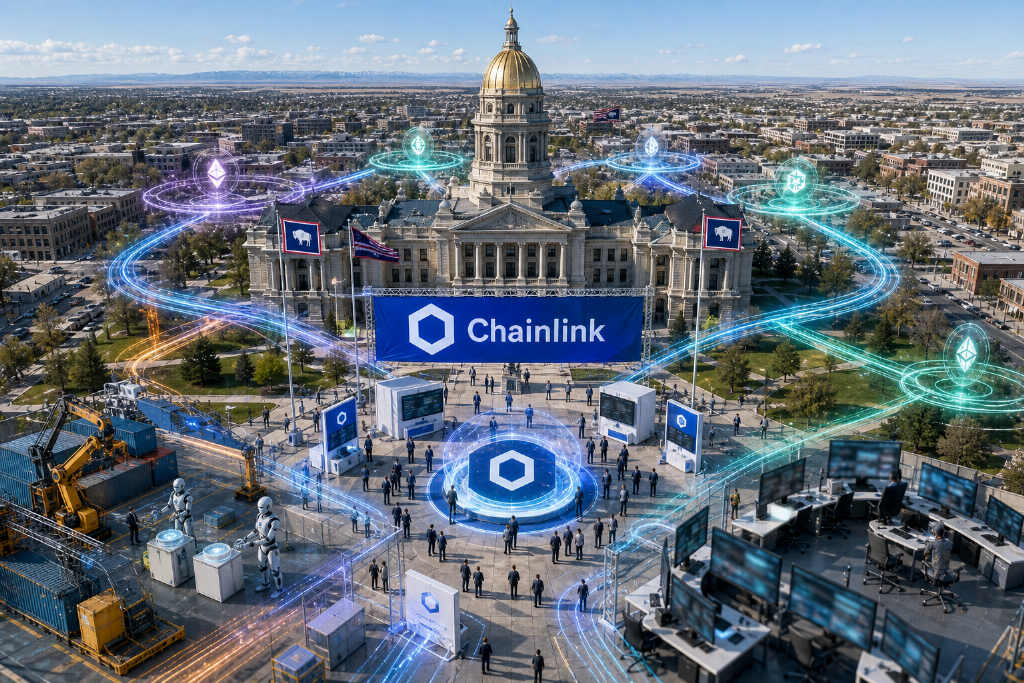
Andrew McCormick, head of institutional strategy at Chainlink Labs, said AI is set to lower the cost of building and engineering blockchains, a shift he believes will support a multichain world. In an interview at the 2026 Wyoming Blockchain Symposium, he said the next growth driver for on-chain activity may come from AI agents and robots rather than human-only trading.
McCormick centered his argument on cost. As AI improves, he said, the barriers to launching a blockchain and handling the related engineering and technical work will fall. "We believe we will live in a multichain world," he said. "Especially with AI, the cost of building chains, engineering, and technology will be lower and easier."
He linked that view directly to interoperability. If the number of chains keeps rising, communication between them becomes a basic requirement. McCormick joined Chainlink Labs in June this year after previous roles at eToro and Morgan Stanley, and he has put interoperability at the center of his institutional strategy message.
Why lower build costs matter in a multichain setup
To illustrate how that future could take shape, McCormick pointed to Wyoming’s Frontier Token. According to the source report, the Wyoming Stable Token Commission, the issuer behind the state’s stablecoin effort, has moved Frontier Token, or FRNT, from LayerZero to Chainlink CCIP. The protocol is being used as the infrastructure for cross-chain issuance and distribution so that the same government asset can circulate across different blockchains.
In his framing, more chains do not automatically create a better system. They need a way to talk to each other, and that is where interoperability infrastructure becomes critical.
AI agents could expand trading beyond human schedules
On market activity, McCormick said AI agents may become a new source of on-chain transaction demand. These automated systems can place orders when holders are not able to monitor markets, allowing them to capture opportunities in tokenized markets outside the time windows associated with traditional finance. In practical terms, that means blockchain markets would no longer be tied as closely to human routines.
He also said the overlap between AI and crypto could move beyond software. In the future, humanoid robots working in ports and factories may use stablecoins, digital assets, and blockchain systems directly for communication and settlement. McCormick described the idea by saying it has a "Star Wars vibe," while adding that it is already happening.
Recent product launches point to the same direction
The report said McCormick’s view does not stand alone. Over the past four months, Gemini launched Agentic Trading in April, TON Tech rolled out Agentic Wallets, Robinhood followed with AI agent trading in May, and Binance this week launched Agent OS for agent-based order placement. Pay.sh, developed through a collaboration between Solana and Google Cloud, reduced the per-call cost of its AI payment pipeline to $0.005.
Taken together, those moves suggest the base layer for agent-triggered actions and on-chain payments is starting to come together, matching McCormick’s view that demand-side growth could come from automated participants.
More activity does not automatically mean token value capture
The source article also noted a counterpoint from recent research by Fidelity Digital Assets. While AI may accelerate crypto activity, the resulting value may bypass blockchain tokens and remain at the model or application layer instead.
If agent-driven settlement ends up concentrated among a small number of centralized exchanges and stablecoin issuers, public blockchains and their tokens may not be the biggest beneficiaries. That leaves an important caveat alongside the multichain thesis.
Regulatory definitions remain unsettled in parts of Asia
For markets such as Taiwan and other parts of Asia, the report said the regulatory treatment of AI agent-based order placement remains unclear. How regulators define an automated investment tool or a robot wallet could directly affect how quickly these products are adopted. Markets that clarify rules earlier may become testing grounds for agent trading and stablecoin settlement.
The article highlighted two follow-up points to watch. One is whether more US state-level stablecoin projects adopt CCIP after Wyoming established an early case for cross-chain government assets. The other is short-term agent trading volume, with early usage data from Binance Agent OS likely to offer a more concrete signal than long-range vision statements.