
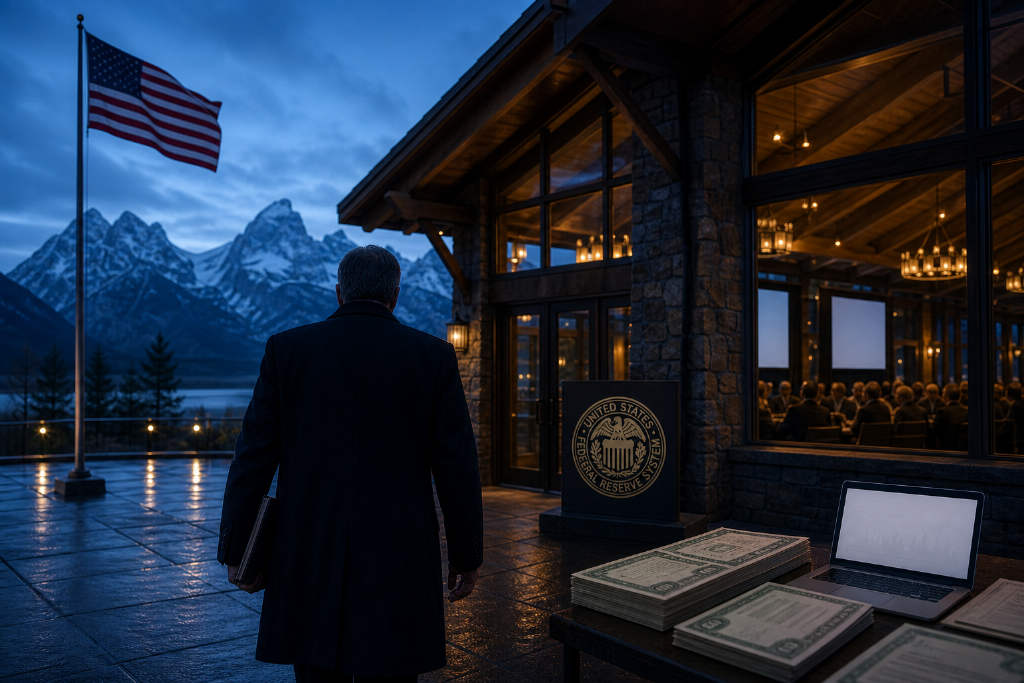
Federal Reserve Chair Kevin Warsh will make his first appearance as chair at the Jackson Hole Economic Policy Symposium on Friday, Aug. 29, a speech markets see as a key test for a U.S. Treasury market that has remained under pressure in recent months.
Investors are looking for Warsh to spell out the policy framework behind his sharp pullback in forward guidance. A clearer message could ease pressure on long-dated Treasury yields. If he does not offer one, the sell-off in long bonds could deepen. Treasury moves also feed through the dollar and global rate markets, giving the event relevance for risk assets including cryptocurrencies.
Less guidance, more concern about credibility
Since taking office in May, Warsh has repeatedly reduced guidance on the future rate path in public remarks and has also suggested that the inflation target could be adjusted. That shift has raised concern about the Fed’s transparency and policy credibility.
A survey of economists found that more than 60% of respondents believed the Fed’s credibility problem had significantly contributed to the surge in long-term Treasury yields. The market reaction has not been limited to the level of rates alone. It has also centered on how the Fed is communicating its policy path.
Long yields stay elevated as markets wait for a boundary
Since Warsh took over, yields on both short- and long-dated Treasuries have moved higher. The 30-year Treasury yield has hovered near its highest level since 2007, while the benchmark 10-year yield has stood at about 4.73%, close to recent highs.
Asset managers have grown more convinced that long-end yields may keep climbing. After the Federal Open Market Committee meeting in July, Warsh did not say under what conditions the Fed would raise rates, saying only that inflation was “unsettling.” Markets took that as a sign that higher long-term yields remained within the range the chair was willing to tolerate.
Loretta Mester, the former president of the Federal Reserve Bank of Cleveland, said in an interview that markets still have a limited grasp of Warsh’s reaction function. That uncertainty, she said, has turned into a reason for traders to demand a higher risk premium and push yields up.
Treasury raises buyback cap as attention turns to policy differences
U.S. Treasury Secretary Scott Bessent said on Wednesday that the cap on long-bond buybacks would rise from $2 billion to at least $4 billion per operation. The funding would come from reducing issuance of shorter-dated Treasuries.
Bessent also said, “we still have a bigger toolbox,” a remark that pointed to the possibility of additional measures aimed at lowering long-end yields.
Markets are also watching whether the Treasury Department and the Fed are diverging in policy direction. Bessent has consistently argued for rewriting the 1951 Treasury-Fed Accord so that the Treasury would have a greater say in adjustments to the Fed’s balance sheet. That has made the question of policy alignment between the two agencies a central market focus.
Friday speech could mark a turning point for bonds and crypto
Market observers have warned that if Warsh fails to provide a clear policy signal on Friday, investors may treat the speech as a disappointment, adding to the sell-off in long-dated Treasuries. If he sets clearer boundaries around inflation risks and the Fed’s policy line, term premium could fall and conditions in the bond market could ease.
For crypto markets, the link matters because a continued rapid rise in long-term U.S. yields can lend support to the dollar and compress valuations for risk assets. That leaves digital assets such as Bitcoin exposed to the next move in the Treasury market in the coming week.