
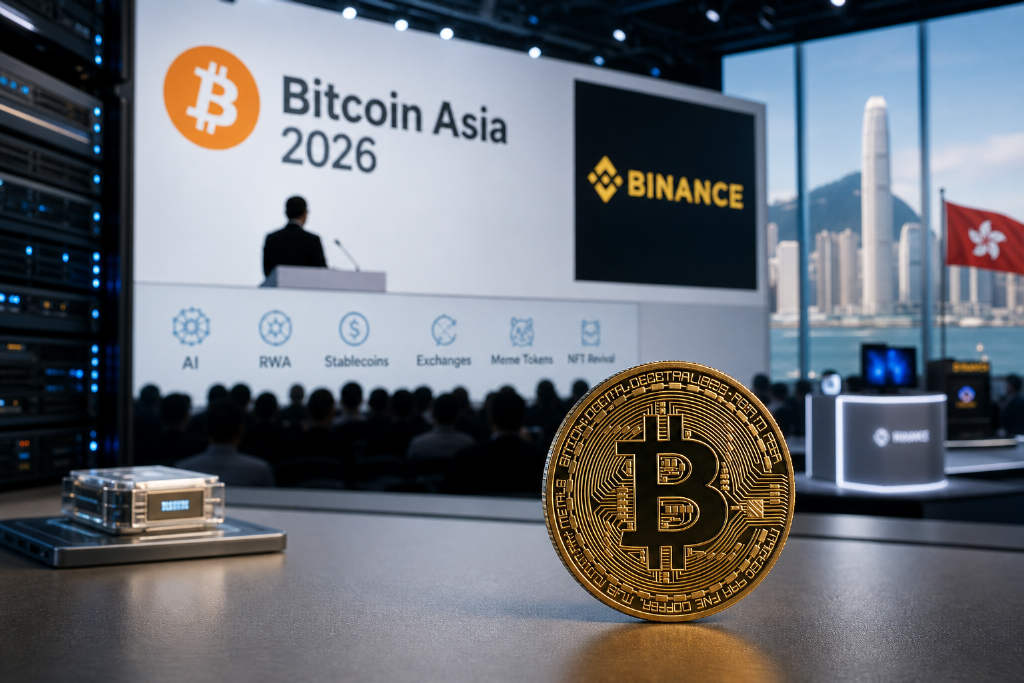
Speaking at Bitcoin Asia 2026 in Hong Kong, Changpeng Zhao said the real-world asset, or RWA, and AI segments currently have strong momentum. He added that sectors that had already been growing — including stablecoins, centralized exchanges, decentralized exchanges and meme tokens — are likely to continue expanding, while NFTs could return in some form.
Zhao said it is very difficult to predict where the next major breakout in the cycle will come from. He compared the current moment with early 2017, when the ICO boom was not yet visible, and with the NFT wave, which he said was also hard to foresee six months before it surged. Those opportunities, he said, need to be created by founders.
Crypto could become the default money for AI agents
Zhao also said that when billions of AI agents begin buying, selling, negotiating and trading automatically in the future, the funds they use will have to be cryptocurrency. In his view, that process will likely start with stablecoins and later expand to Bitcoin and other public-chain assets.
Token issuance has been discussed with top AI companies
He said he has already discussed the possibility of token issuance with several top AI companies. Zhao linked that idea to the cost of building data centers, saying 1 GW of compute capacity costs about $30 billion to $50 billion, while some AI companies plan to build hundreds of GW over the next few years.
Under that model, some companies are considering issuing data center tokens that would give holders the right to access computing power in the future.
Payments may come later than trading use cases
Zhao said payment use cases for AI agents may arrive later than trading applications. For now, AI companies are more focused on helping agents find the best trading route. Trading scenarios, he said, place a greater premium on rapid information processing, and AI can improve trading efficiency by about 10x.