
By David Yaffe-Bellany, a reporter for The New York Times; translated by Jiahuan for ChainCatcher
CZ after prison: wealth, power and political allies
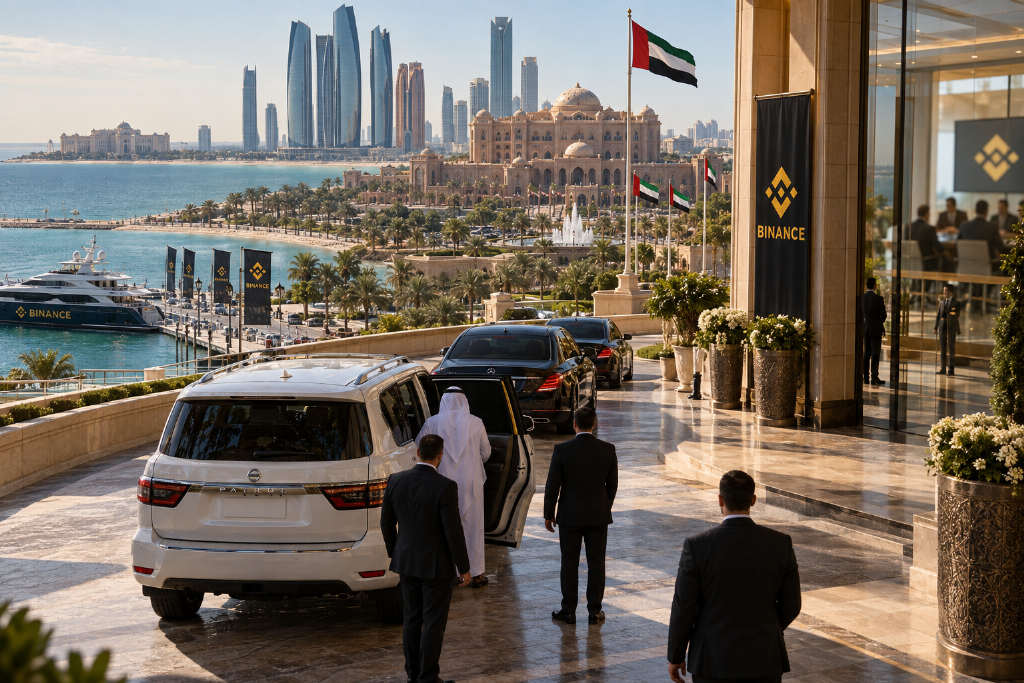
On a morning in June, Changpeng Zhao drove a white Nissan SUV to the St. Regis resort in Abu Dhabi. Zhao, the richest figure in crypto, is described in the report as having an estimated fortune of $114 billion. He lives in a nearby villa with nine bedrooms, four bodyguards, a chef and a yacht called Da Moon. He also likes to present himself as what he often calls an ordinary person. That day, he offered to personally drive the reporter around the city.
Outside the hotel, Zhao sat behind the wheel with an iPhone mounted on the windshield. As the reporter got in, he joked: 「My Lamborghini.」
The profile makes clear that Zhao is not ordinary. U.S. authorities recently brought a criminal case over the way he ran Binance. Court filings described the exchange as a haven for Russian money launderers, Iranian sanctions evaders and Islamic State terrorists. Zhao pleaded guilty, but kept his fortune. After serving four months in prison, he returned to Abu Dhabi, still Binance’s controlling shareholder and still one of the most powerful people in crypto.
Now 49, Zhao travels like a head of state, flying by private jet across Asia and advising governments on crypto regulation. After stops in Islamabad or Manila, Binance often announces new regulatory progress. He keeps two dogs at home, including a Taigan hound, a gift from the president of Kyrgyzstan, who is described as interested in crypto. The two went skiing together in February. Zhao said, 「He actually wanted to give me a tent, a really big tent. I didn’t take the tent, and then he insisted on giving me the dog.」
The report says Zhao’s most influential allies come from two powerful families. One is the ruling family of the UAE, which wants to build a technology power in the desert with his help. The other is the Trump family. Last year, Binance entered a business relationship with World Liberty Financial, the crypto startup founded by President Trump and his three sons. World Liberty generated $799 million in income for Trump last year, making it his single most profitable asset, ahead of his real estate holdings and social media business. In October last year, Trump pardoned Zhao, a move that drew broad criticism as a possible quid pro quo.
Zhao, widely known in the industry as CZ, usually avoids reporters. This year, though, he met with the Times several times, hoping people would view his Binance years more favorably, even as Binance still has not fully stopped illicit money from moving through the platform.
The article describes him as tall and thin, with short dark hair and a Binance tattoo on his forearm, lacking the swagger often associated with some crypto executives. He comes across as polite and focused, though with a narrow range of interests. This year he self-published a memoir, Freedom of Money, in which he wrote about receiving a private after-hours tour of the Louvre. It did not impress him. He wrote that the guide was 「casting pearls before swine.」
For years, the report says, Zhao excelled at what scholars call jurisdictional arbitrage: moving from country to country in search of legal systems loose enough to match his appetite for risk and growth. In Abu Dhabi, he may have found the ideal base.
As they drove into the city, Zhao chatted and checked directions with a bodyguard. The car passed grand buildings on the way to Qasr Al Watan, the presidential palace. Near the palace, Zhao said, 「For the past few hundred years, democracy has been held up as some kind of ultimate ideal, but democracy is not very efficient. If you have a benevolent leader, efficiency can actually be very high. There isn’t much debate, and you don’t waste time on many unimportant things.」
The article says this top-down model of business and politics, medieval in one sense and highly modern in another, has gained admirers in the United States. During a visit to Abu Dhabi last year, Trump called UAE leader Sheikh Mohammed bin Zayed Al Nahyan 「a very strong man」 and 「one of the few truly visionary people.」 At a crypto conference in Dubai in May last year, Zach Witkoff, the son of a senior Trump adviser, put it more bluntly: 「We really should learn from His Highness and the UAE. They have set an extraordinary example, leading with innovation while preserving family values.」
Zhao is already living in the kind of world those people admire, part of an elite circle where monarchs and billionaires mix easily. Driving away from the palace, he told the reporter about a private gathering at the nearby Emirates Palace Mandarin Oriental. Hedge fund founder Ray Dalio and Japanese billionaire Masayoshi Son were there. While Zhao sat in the audience, someone bent down to speak to him. It was Sheikh Mohammed. Zhao recalled: 「This is the king, kneeling right next to you.」
Binance’s rise and the compliance problem
Earlier this year, Zhao was working in bed when the windows started shaking. He has long dealt with chronic pain and often works lying on his back. He told the reporter he walked to the balcony and saw a trail in the sky. Zhao lives on Saadiyat Island in Abu Dhabi, across the Persian Gulf from Iran, and Iran had just fired a missile at the UAE.
It was the start of a geopolitical crisis that unsettled the region, but Zhao said he was not too worried. He went back to bed and kept working. Later he said, 「More people die in traffic accidents than from missiles. The protection here is very good.」
Before settling in the UAE, Zhao had no fixed home base. He was born in China and moved to Canada with his family at age 12. After attending McGill University, he worked in a series of technology jobs in New York, China and Japan. In July 2013, during a card game in Shanghai, a colleague suggested he look into 「this new thing called Bitcoin.」
The borderless nature of the technology fit his itinerant life. After studying it for a few months, Zhao made a bold bet. He sold a three-bedroom apartment in Shanghai, the home where he and his wife were raising two children, and put the entire $900,000 into Bitcoin. He saw it as a risk worth taking because, even if Bitcoin crashed, he believed he could easily return to a high-paying job in traditional finance.
He later worked at several crypto startups in Asia. During the 2010s, the crypto industry expanded quickly and hundreds of new tokens appeared, but the platforms where they traded were often chaotic and vulnerable to hacks. In July 2017, Zhao founded Binance. Within months, it became the world’s largest exchange and has held that position since.
The report says Binance’s success rested on two judgments. First, crypto investors liked risk and would never be satisfied simply exchanging dollars or yen for equivalent amounts of crypto. For years, Binance offered margin trading, allowing traders to borrow funds and make high-risk, high-reward bets on Bitcoin and other popular tokens.
The second judgment was simpler and more consequential. Many crypto investors did not want to reveal their identities, and Binance did not require them to do so. During the company’s first four years, customers opening accounts did not even need to provide basic know-your-customer information. KYC refers to the identity checks traditional businesses use to prevent financial crime.
Binance was not the only exchange offering risky services, but Zhao executed better than rivals. Austin Campbell, founder of a crypto consulting firm, said, 「There were a lot of MySpaces in the exchange business back then, and he built Facebook.」 The result was an enormously profitable and barely constrained platform: unvetted investment products open to unvetted traders. In boom times, Binance collected fees on every trade. According to Freedom of Money, company profits quickly reached $1 billion.
Zhao became a celebrity in crypto. Yet even after joining the small group of ultrawealthy founders with striking political influence, people outside the industry still knew little about him. Looking back on his most controversial years, he portrays himself as someone swept along by events: a crypto technologist intoxicated by success, an outsider who somehow ended up cast as a Bond villain.
The article says that version of events is not always convincing. In late June, sitting in his kitchen, Zhao told the reporter that during Binance’s explosive early growth he 「never really thought」 about breaking the law. At the time, the company’s loose controls allowed waves of bad actors to launder money. 「I just lacked experience in this area,」 he said. 「I’m a technical person. I used to live in China.」
That image does not match the evidence U.S. prosecutors gathered. In court, prosecutors cited a line Zhao said to subordinates: 「It’s easier to ask for forgiveness than permission.」 According to legal filings, even though Binance was not licensed in the United States, Zhao privately discussed how to hide the fact that the platform was serving U.S. users. 「Do not leave any written record,」 he told one subordinate.
In Abu Dhabi, Zhao described himself as 「a rule-following person.」 The profile argues that during a formative period, when a new generation of investors was taking shape and the rules themselves were flexible, he strategically chose to test legal boundaries.
When the reporter visited his home, boxes of Binance merchandise were stacked near the entrance. Zhao urged the reporter to pick a gift, such as a Binance backpack or a black-and-yellow Binance sweater. When told that journalists could not accept gifts worth more than $20, he laughed and said the clothing item was 「probably $19.」
Finding a base in the UAE and clashing with FTX
After years of moving around Asia, Zhao visited the UAE in 2021. In 2017, when China was preparing to ban crypto exchanges, he and Binance colleagues had to leave the country overnight. A stint in Japan did not work out. Singapore did not keep him either because work visas were hard to obtain. Then his friend Gabriel Abed suggested he take a look at Dubai.
Zhao quickly saw how the UAE treated wealthy and powerful people. On a Saturday morning in October, he arrived in Dubai. Within hours, minister Omar Sultan Al Olama came to see him and offered what is known as a golden visa, giving the holder an easy path to 10 years of residency. A doctor was brought in to perform the blood test required of all visa applicants. The process usually takes weeks. Zhao’s application was approved in less than 12 hours.
The welcome made a strong impression. 「On my fourth day in Dubai, I looked at two properties,」 Zhao said. 「I bought the second one.」 By the end of that year, Binance had signed a memorandum of understanding with the local government to help write rules for crypto businesses. The company sent three employees to assist in building the regulatory framework. A draft was completed in January 2022 and signed into law a few weeks later. Abed said, 「If the ship you are steering is heading in the right direction, the UAE wants you on its team. That is how they treated CZ. They stood by him from day one.」
The article adds that not everyone in the UAE receives such treatment. For years, the country’s rulers have carried out extensive surveillance and banned even mild dissent. Foreign workers in its labor market have also often faced exploitation and abuse.
For Zhao, though, this marked the start of a comfortable new life. Before founding Binance, he had separated from his wife, who moved to Tokyo with their children. He began a relationship with his colleague Yi He, a marketing executive known in China for hosting the travel show Beautiful Destinations. While Zhao’s older child attended college in the United States, he and Yi He were raising several younger children in the UAE.
That move brought Zhao into the top tier of billionaire society. He met UAE leaders interested in technology and called them 「crypto sheikhs.」 He later got to know Sheikh Tahnoon bin Zayed Al Nahyan, the brother of Sheikh Mohammed. Tahnoon, who likes jiu-jitsu, hosts powerful business figures in his palace. Zhao said that at these royal dinners he was treated as an honored guest. 「We would ask, how are the seats arranged? They would say, just sit anywhere.」
In their early meetings, the sheikhs explained the UAE’s advantages and asked what they could do for him. Soon Zhao was pitching the country to other billionaires. He encouraged Sam Altman to establish business operations there and warned him that other countries might be hostile. Over coffee, Zhao told him, 「You’re going to run into a lot of regulatory issues.」
Zhao was no stranger to risk in emerging industries. When he arrived in the UAE, he was locked in a fierce rivalry with Sam Bankman-Fried, founder of FTX. The article says Bankman-Fried, the son of Stanford Law School professors, was Zhao’s opposite in many ways: deeply connected, fluent in elite networks and close to U.S. political power. In his memoir, Zhao wrote, 「He had tools I didn’t have.」 Bankman-Fried poached Binance employees with salaries three to five times higher, and Zhao heard that he was speaking badly about him in Washington.
In November 2022, a CoinDesk report raised questions about FTX’s financial health. Zhao was in Dubai on his way to meet Abed for drinks when he decided to post on Twitter. He said he would sell $500 million worth of FTT, a digital token seen as a stand-in for FTX equity. The tweet triggered panic, and anxious investors rushed to withdraw funds from FTX.
But the money was no longer there. The article says Bankman-Fried had stolen $8 billion from customers. He had no choice but to seek rescue, and in crypto there was only one person who could plausibly save him. Two days after Zhao’s tweet, he announced he would acquire FTX. One day later, he walked away, pushing FTX deeper into crisis. To outside observers, it looked like a ruthless corporate war. One observer called it 「a bloodbath.」 Less than six weeks later, Bankman-Fried was arrested in his apartment in the Bahamas, extradited to the United States and later sentenced to 25 years in prison for fraud.
Zhao told the reporter he never intended to destroy FTX. He said he had planned to sell the FTT gradually over several months. 「I didn’t intend to make them collapse,」 he said. 「We lost $500 million.」 Bankman-Fried saw it differently. 「He played me,」 he said at the time, 「and he played me well.」
From guilty plea to release: four months in prison
The article says billionaires have their reasons for being drawn to the UAE. The country has no personal income tax and is seen as extremely safe, at a time when crypto investors in Europe and the United States have become targets for kidnappers. For Zhao, who had just watched his rival hauled across borders, the UAE offered another advantage: it has no extradition treaty with the United States.
Zhao recalled that in late 2022 or early 2023, a member of the UAE royal family asked him over dinner whether he wanted citizenship. He submitted documents and waited. Months later, a government messenger arrived at his home carrying a box with passports for him and his family. Zhao said the Emiratis 「would never extradite their own citizens」 and that 「there is a lot of security in that.」
He had reason to be cautious. The investigation into Binance was tightening. U.S. prosecutors were gathering evidence that the exchange’s loose controls allowed fraudsters, hackers and sanctions evaders to move money. In private messages obtained by the government, Binance employees spoke with startling candor about suspicious customers. One employee wrote, 「Is laundering drug money too hard now? Come to Binance, we have cake for you.」
Zhao hired a legal team to negotiate with the U.S. Justice Department. His new passport gave him leverage. After several years in Dubai, he moved south to Abu Dhabi, about an hour and a half away by car, closer to the country’s political center. During the talks, he seriously considered living as a fugitive. His travel would be limited, but in theory he would be safe if he stayed in the UAE.
In the end, his lawyers reached a deal with the U.S. government. Zhao would plead guilty to violating the Bank Secrecy Act and step down as chief executive. The company would pay a $4.3 billion fine. Even though the terms were relatively lenient, he remained unhappy with his lawyers and said he did not believe he should spend even a day in prison. 「I was sent to prison because we had a platform that didn’t do KYC properly,」 he said. 「You don’t need ID to vote for the U.S. president. I don’t know how that system came about. Based on what I went through, I think someone should go to prison for that.」
For Binance, though, it was an excellent outcome. At his sentencing hearing in spring 2024, Zhao offered a statement of remorse: 「I deeply regret my failures and I am deeply sorry.」 The judge sentenced him to four months and described him as 「a devoted family man and a giving person.」 As the sentence was read, Zhao’s college-age son quietly pumped his fist in celebration.
As a felon with unusual resources, Zhao had every advantage in making prison easier. He was assigned to Lompoc II in California, a low-security prison where Bankman-Fried was later also housed in the same prison complex. Before reporting, Zhao assembled an advisory team to coach him on the subtle social dynamics of prison life. One adviser, Michael Santos, corresponded with inmates who agreed to help Zhao adjust. Santos told him, 「CZ, you know how to deal with people. You managed thousands of employees. Walking in here does not take those abilities away.」
On the morning of May 30, 2024, Zhao arrived at Lompoc. He quickly joined an informal social group known as a car, the kind of grouping that often forms along ethnic lines. Other Asian inmates sat with him at meals and exercised with him in the yard. Jatton Agon, who was serving time at Lompoc, said, 「Everybody moved out of his way. It was like a king walking down the corridor.」
Zhao became friendly with a Vietnamese American bank robber who had once worked as an engineer. They talked in detail about the robberies and concluded they were far less elaborate than people might imagine from a movie like Ocean’s Eleven. Zhao said the man was 「very gentle」 and 「super easygoing.」 「He would just walk in, ask for money and leave. He did it 11 times and never got caught.」
The bank robber was one of the few inmates interested in business. He read Bloomberg and The Wall Street Journal and asked Zhao about Elon Musk’s huge Tesla pay package. Other inmates had business questions too. One wanted to understand crypto markets. 「He asked, why did Bitcoin go up?」 Zhao recalled. 「I said, wow, I’m not sure either.」 Zhao organized a study group to track stock prices, and a prison television was tuned to CNBC.
Not everything he said landed well. At Lompoc, Zhao struggled to persuade people of a view he strongly held: that the Binance case had no real victims, 「no fraud, nothing.」 When he explained the details, the response was dismissive. 「They said, yeah, everybody says that,」 Zhao recalled.
In August 2024, Zhao left Lompoc for a halfway house designed to help inmates reenter society. Immigration issues forced him to spend his final two weeks in a local jail. He passed the time doing pushups and situps in his cell. On the day of his release, an officer escorted him outside, where his mother, sister and assistant were waiting. They drove to a nearby airport and put him on a private jet bound for Abu Dhabi.
Only 26 minutes passed between the moment Zhao left custody and the moment his plane took off.
The $2 billion investment, USD1 and the pardon effort
Zhao returned to a world moving in his favor. A crypto-friendly administration was about to take power in Washington. Shortly before the election, Trump and the family of Steve Witkoff founded World Liberty. Witkoff, a real estate magnate, was preparing to become the White House envoy to the Middle East. Soon, these newly empowered Americans, mixing dealmaking with diplomacy, were making frequent trips to the UAE.
While driving the reporter around the city, Zhao pointed to the ADNEC Centre, which hosted a large crypto gathering in December 2024. 「That’s where I met Eric Trump,」 he said. He recalled that a Trump supporter named David Bailey introduced him to the president’s second son, who is also one of the leaders of World Liberty. Zhao said it was an informal conversation with no set agenda. 「He just said he was looking at a real estate project here.」
Their interests were about to converge. The UAE has been trying to transform itself from an oil state into a technology power, a plan led by Sheikh Tahnoon, who oversees $1.5 trillion in sovereign wealth. Before going to prison, Zhao had discussed selling part of Binance to the Emiratis with Xiao Peng, one of Tahnoon’s key aides. That would have tied his company most closely to the people who had given him political shelter.
Tahnoon chairs MGX, a venture fund focused on artificial intelligence. According to one person familiar with the matter, MGX agreed early last year to invest $2 billion in Binance, valuing the exchange at $75 billion. MGX saw Binance as an ideal bridge between crypto and AI, a high-tech money-transfer platform that could one day be used by autonomous AI agents to make payments on behalf of humans.
Zhao told the reporter he wanted the deal settled in Bitcoin. The Emirati side worried that Bitcoin’s price swings would complicate the transaction. They preferred to pay him in stablecoins, the type of crypto designed to hold a $1 price.
What happened next is the subject of broad dispute. The article says that if Democrats win control of Congress in November, the matter could become the subject of a congressional investigation. MGX said it evaluated several stablecoins and chose USD1, issued by World Liberty, for reasons of 「commercial suitability.」 The choice was striking because USD1 had no market track record at all. Last year, The Wall Street Journal reported that Binance had explicitly asked MGX to use USD1. Zhao said the decision was MGX’s. 「As long as the stablecoin is reputable and won’t disappear overnight, I don’t care that much,」 he said. 「There were no other considerations.」
Still, several parties had reasons to involve World Liberty. In January 2025, days before Trump’s inauguration, an investment company backed by Emirati capital bought a 49% stake in the startup, and Sheikh Tahnoon received a board seat at World Liberty. At nearly the same time, the UAE was negotiating with the White House for export approval on advanced computing chips used in AI. Binance also needed something from the Trump administration. As its legal troubles eased, the company wanted relief from some of the restrictions imposed by its 2023 settlement.
In May 2025, Zach Witkoff announced the deal and thanked Binance and MGX 「for their trust in us.」 Congressional Democrats denounced it as 「stablecoin corruption.」 The article says issuers like World Liberty make money by taking in cash from crypto traders, issuing stablecoins in return and investing the cash to earn yield. With the help of the $2 billion MGX-Binance transaction, World Liberty immediately became one of the world’s largest stablecoin companies, benefiting both the Trump and Witkoff families. Senator Richard Blumenthal, the Connecticut Democrat who had investigated Zhao and Binance, said, 「This is such a shameless act of ingratiation. The scope and scale of the corruption are unprecedented.」
Zhao insisted that nothing improper happened. He said he no longer held the USD1 and had used it to invest in Bitcoin and other assets. 「I think President Trump has very good lawyers, and the arrangement where the sons run businesses while the father serves as president is fully legal and compliant,」 he said. He suggested some of the anger reflected cultural differences. 「In Kazakhstan, we can eat horse meat,」 he said. 「In some other countries, people would say, that’s crazy.」 If the ruling families of two countries strike a business deal, why can’t that be a good thing? Zhao reached for a medieval analogy: 「If you marry a princess from one country to a prince from another, they can keep peace for 50 years.」
Two weeks after the $2 billion transaction was completed, the White House agreed to let the UAE obtain the chips, overriding concerns from some U.S. national security officials. Last spring, Steve Witkoff traveled with Trump to Abu Dhabi, where they celebrated the agreement with Emirati officials at the presidential palace.
According to a person familiar with the conversation, Witkoff also privately told an acquaintance that Zhao should receive a pardon. Zhao has submitted the paperwork and is waiting for the president’s decision. The outcome matters greatly for Binance. After Zhao’s guilty plea, the exchange’s dormant U.S. business lost state licenses. A pardon could help the company regain regulatory approval. A White House spokeswoman said Witkoff does not participate in the pardon process.
When Zhao described the process, he called it a 「black box」 handled by several lawyers who periodically sent updates from Washington. He said questionable middlemen sometimes approached him at social events and claimed they could arrange a meeting with Trump for the right price. 「There’s a small group of people who make money doing just that,」 Zhao said.
He said he ignored them. Zhao told the reporter he only began seriously considering a pardon application in March 2025, after other crypto executives received pardons and The Wall Street Journal reported that he was seeking one too. 「I thought, if the newspaper thinks I should apply for a pardon, maybe I should,」 he said.
But according to two people familiar with the matter, and documents reviewed by The New York Times, Zhao’s legal team had already been working with prominent pardon lawyer Brett Tolman as early as December 2024 to explore the possibility. Public filings show Binance ultimately paid $2.1 million to a lobbying firm run by Ches McDowell for services that included 「executive relief.」 McDowell is close to the president’s two older sons. A spokesperson for World Liberty said the company 「had absolutely no involvement in any pardon decision.」
When news of the pardon was announced in October last year, Zhao had just arrived in Kyrgyzstan for a meeting with President Sadyr Japarov. Japarov was interested in launching a digital token tied to Kyrgyzstan’s national currency. As his hosts welcomed him in Bishkek, Zhao posted a brief message of thanks on social media. That evening, he discussed stablecoins with the president over dinner.
Beyond the villa, Binance’s controversies remain
On a hot morning this summer, Zhao drove into the driveway of his $5 million villa. He and Yi He host visiting grandparents and siblings there on a rotating basis. His two dogs greeted him at the door. Besides the Taigan hound, he has a Belgian Malinois named Broccoli because, he said, the name sounds a bit like blockchain.
With a photographer following behind, Zhao moved quickly from room to room, pointing out photos of himself with his young children. In the middle of the children’s playroom sat a cream-colored piano surrounded by toys. A technician who came to maintain it was pained by how neglected it was. Zhao said it was a Steinway, 「the expensive kind,」 but added, 「I can’t play.」 In the home gym, he stopped to do a few sets of bench presses.
Zhao wanted to show that he does not live like a typical billionaire. Although Forbes estimates his wealth at more than $100 billion, he insisted the real number is much lower, around $10 billion to $30 billion. He said he only needs a small fraction of that, about $10 million, to live comfortably.
On crypto podcasts, Zhao is sometimes asked about his house. He often mentions a leak upstairs that has never been fixed. Sure enough, in the living room he pointed to a water stain on the floor and then gestured toward the ceiling. 「It’s right there,」 he said. 「I don’t know if you can tell the color difference.」
By billionaire standards, the villa is not especially lavish. Zhao said a nearby house was listed for $150 million. But the article argues that his cultivated modesty sits awkwardly beside the world of power and privilege he now inhabits.
At one group dinner, Zhao listened as Altman described an emerging area of biotechnology research. 「They can get sperm and eggs from the same person,」 Zhao recalled. 「Basically, one person can have a child alone.」 Zhao has his own ambitions to push beyond biological limits. He has invested in a startup working on artificial wombs.
Since leaving prison, Zhao has divided his time among several pursuits, including technology investing and a kind of crypto diplomacy. In many countries, he said, he is treated almost like royalty and helps promote the crypto industry. 「They always send someone with two cars right up to the plane,」 he said. 「And there’s a young woman holding local food, and you have to try a bite.」
Zhao has tried to downplay his role at Binance. Under the company’s plea agreement, he is barred from 「operating or managing」 the business. He made a point of criticizing Binance’s recent lawsuit against The Wall Street Journal over a report on changes in the compliance department, calling the case 「a huge waste of time.」 He said that even if Binance won, 「you don’t get much.」 The company dropped the suit last month.
Even so, Binance remains central to his life. One of the two co-chief executives who replaced him is Yi He, the mother of his three young children. Two years ago, in an effort to look more like a conventional company, Binance created a board with three so-called independent directors. One of them became chairman: Gabriel Abed, the same friend who first urged Zhao to move to the UAE. The two had ridden Jet Skis together, and Abed once gave Zhao a pair of orange high-top sneakers printed with the words 「Trump, Crypto President.」
More recently, Binance has faced fresh allegations of misconduct. Last year, four compliance staff members reported that nearly $2 billion had moved from customer accounts to entities linked to Iran, after which they were fired or suspended. That could suggest a repeat of the sanctions-evasion conduct that led to the U.S. criminal case in 2023. The company disputed the findings of those employees and denied that anyone was punished for raising concerns. The U.S. Justice Department later said two Chinese companies had used Binance to launder proceeds from Iranian oil sales, but it did not bring charges against the exchange.
Binance’s relationship with the UAE has also shown some strain. In December last year, the company received a license to operate in Abu Dhabi, and shortly afterward the city came under heavy Iranian missile attack. The exchange’s new regulator praised Binance as a model of 「regulatory progress.」 Yet this summer, two Binance employees were briefly detained in the UAE while local police investigated possible financial crime on the platform, an unusually forceful step.
The detentions unsettled Binance staff in the country. Zhao said he messaged a contact in the Emirati police and also reached out to an aide to Sheikh Tahnoon. 「I just said, listen, let’s figure out how to stop this from happening again. It’s not good for the country’s image, and it’s not good for us either.」 He insisted the UAE remains a friendly base for Binance. 「No one is in danger,」 he said.
The profile closes by saying Zhao’s confidence comes from repeated escapes. In his memoir, he spends about a page and a half explaining his belief in simulation theory, the idea that all of us may be living inside a reality designed by someone else. He encountered the concept early in his crypto career and now believes it is mathematically certain. 「In 20 years, we should be able to plug a rod into our brains like in The Matrix and enter a fully simulated world,」 he wrote. 「Billions of people will do it, and there will be billions of simulated worlds.」
That belief helps him keep some distance from the pressures of ordinary life. He wrote that we may all be versions of Super Mario, running around inside an artificial world. He tries to follow one simple maxim: 「It’s just a game.」