

ChangXin Memory Technologies, China’s best-known domestic DRAM maker, has taken another step toward the capital markets.
After its STAR Market IPO application was accepted in December 2025, the company completed review, registration, and offering preparations in about seven months. It formally opened online and offline subscriptions on July 16, accelerating its path to listing.
Its prospectus, released ahead of the listing, showed a sharp change in earnings. Net profit was -19.225 billion yuan in 2023, -9.051 billion yuan in 2024, and 7.144 billion yuan in 2025. For a memory-chip producer that has spent years relying on heavy capital investment while trying to catch up with overseas giants, the turnaround points to a new stage for the commercialization of its domestic DRAM business.
Whether that improvement can last is the question investors are watching most closely.
At an investor meeting on July 15, chairman Zhu Yiming told Phoenix Weekly Finance that growth since the second half of 2025 had been helped by an AI-led jump in DRAM demand and tight industry supply. He also said the DRAM business is highly cyclical, prices move sharply, and AI-related demand still carries uncertainty. If macro conditions worsen, AI demand falls short of expectations, or new capacity comes online in a concentrated wave, the industry could return to a downturn.
Huang Lichong, president of Huisheng International Capital, said, “The industry cycle lights the fire, while corporate capability turns that fire into profit.” He said investors should not judge the durability of earnings only by this year’s memory prices, but also by unit cost, the share of advanced products in revenue, and operating cash flow.
Profitability has recovered, but cyclicality remains
Memory chips are a capital-intensive business with strong cyclicality. The global DRAM market has long been dominated by Samsung Electronics, SK Hynix, and Micron, and profitability depends heavily on supply-demand balance and product mix. At present, high-end DDR5 and HBM are the main profit drivers.
ChangXin is the only manufacturer in China to achieve mass production of DRAM. It initially advanced domestic substitution through DDR4 products. Its current main lines are DDR5 and LPDDR5X, while HBM development is under way and older DDR4 products are being scaled back.
The global memory market went through a deep adjustment in recent years, with falling prices and elevated inventories weighing on the whole industry. ChangXin was not spared. The prospectus showed that as of Dec. 31, 2025, its accumulated uncovered losses stood at 36.65 billion yuan. The filing attributed that to the DRAM industry’s scale-driven nature, the need for continued capacity expansion, and the pressure from fixed-asset investment and depreciation tied to wafer-fab construction.
As the memory cycle turned, the company’s earnings recovered quickly. According to the prospectus, revenue growth in 2025 came mainly from two factors: higher DRAM prices and larger production and sales volume, alongside an improved product mix. The average selling price of its main DRAM products rose 33.69% year over year.
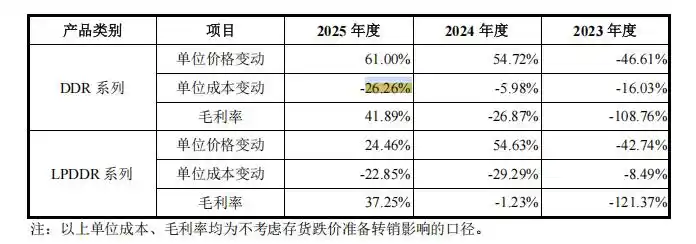
Huang said the cycle was only the external factor behind better earnings, while the company’s own execution determined whether profit could actually materialize. In his view, price increases alone would not have delivered such a rapid release of profit without the product, capacity, and cost structure to support it.
The filing showed that in 2025, unit prices for DDR products rose 61% while unit costs fell 26.26%. For LPDDR products, unit prices increased 24.46% and unit costs dropped 22.85%. Overall gross margin improved from -1.93% in 2023 to 40.99% in 2025, approaching the levels of overseas manufacturers including Samsung and Micron.
Huang said those figures suggest scale effects, higher yields, lean production, and product-structure upgrades are starting to show through, with rapid volume growth in higher-margin DDR5 products also supporting the earnings rebound.
Still, a stronger profit profile does not mean the company is insulated from future downturns. DRAM prices remain volatile, and fixed costs are substantial. The prospectus showed fixed-asset depreciation of 10.555 billion yuan in 2023, 14.875 billion yuan in 2024, and 24.68 billion yuan in 2025.
“Going through the cycle does not mean keeping high profits every year,” Huang said. “It means losing less at the bottom, avoiding a cash drain, keeping R&D going, and then releasing profit faster than in the previous cycle when recovery comes.”
29.5 billion yuan IPO plan marks another catch-up step
The company plans to raise 29.5 billion yuan through the STAR Market listing, according to the prospectus. Of that total, 7.5 billion yuan is earmarked for technology upgrades to wafer-manufacturing mass-production lines, 13 billion yuan for DRAM technology upgrades, and 9 billion yuan for forward-looking technology R&D.
The listing is more than a financing event. It also marks a key point in ChangXin’s effort to keep closing the gap with global memory leaders.
At the July 15 investor meeting, Zhu said ChangXin’s capacity ranks first in China and fourth globally, and that it has three 12-inch DRAM wafer fabs in Hefei and Beijing. As products including DDR5 and LPDDR5/5X penetrate downstream markets more quickly, he said demand for DRAM continues to grow across servers, mobile devices, personal computers, smart vehicles, and other applications, giving the fundraising projects solid development prospects.
On the global stage, though, the company is still in catch-up mode. Data showed that in the fourth quarter of 2025, ChangXin held about 7.67% of global DRAM sales revenue, while Samsung, SK Hynix, and Micron accounted for 33.96%, 34.48%, and 23.41%, respectively.
Guolian Minsheng Securities said ChangXin plans to use the 29.5 billion yuan IPO to begin large-scale capacity expansion. It said the company’s production scale still lags far behind overseas giants and existing capacity is already close to full utilization. With multiple bases being pushed forward over the medium to long term, Semianalysis forecasts the company’s global market share could reach 17% by 2028, implying considerable room for additional expansion compared with the production scale of established overseas manufacturers.
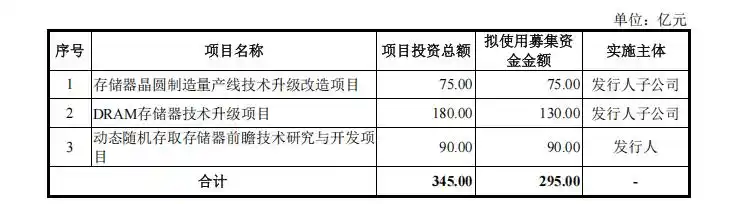
Huang said ChangXin has already crossed the “zero to one” stage for domestic DRAM, but it still has a way to go before joining the top global tier. “Technology without yield cannot become commercial profit; capacity with costs that are too high will translate into huge losses when the cycle turns down,” he said.
He added that the next major challenge is stable mass production using advanced processes, with yield and cost per bit at the center. ChangXin also needs to improve its mix of high-end products, its global customer base, and advanced packaging capability.
AI expands demand, but high-end competitiveness still needs proof
Huang said market-share growth is not the only target. What matters more is whether rising share comes with advances in technology generations.
As the AI industry develops quickly, memory chips are becoming a new competitive focal point. AI servers demand more memory capacity, higher bandwidth, and lower power consumption, pushing demand for DDR5, high-performance memory, and related storage products higher. For memory suppliers, AI is adding demand while also changing the structure of competition.
Overseas memory leaders have been positioning for the AI market in recent years through higher-value products such as HBM, aiming to reduce the effect of traditional DRAM cycle swings. ChangXin, by contrast, is still in the process of moving into the high-end memory segment. Its prospectus said AI-related revenue still accounts for a relatively low share of the total, and it did not disclose any large-scale revenue contribution from HBM.
Huang said that for some time, the company’s growth will still rely mainly on upgrades from DDR4 to DDR5, from LPDDR4X to LPDDR5/5X, and on a higher localization rate. “AI sets the ceiling for the industry, while conventional DRAM upgrades, process yield, and cost capability determine whether ChangXin can really climb to that ceiling,” he said.
In his view, ChangXin needs to keep its manufacturing scale advantage while improving the competitiveness of its higher-end products if it wants to capture more market room.
Zhang Yi, CEO of iiMedia Research Group, also said the AI wave has broadened the growth space for the memory industry and reshaped its growth logic. He said ChangXin will need a dual-track approach: in the short term, use DDR5 product upgrades to stabilize its core business and improve earnings quality; over the medium to long term, push industrialization of high-value AI memory products such as HBM. He said that would be an important direction for narrowing the gap further with international leaders.
This article was originally published by the WeChat account Phoenix Weekly Finance. The author is Wang Han and the editor is Cui Lupeng.