
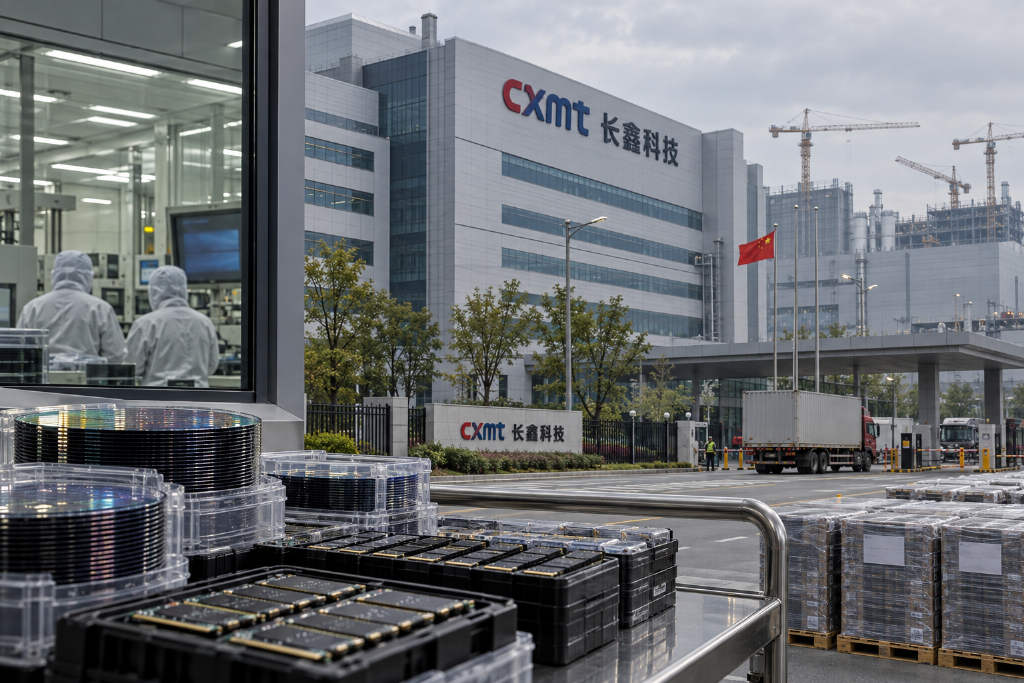
Changxin Technology on Oct. 16 released its earnings forecast for the first three quarters of 2026, saying it expects revenue of 2.65 trillion yuan to 2.70 trillion yuan, up by 2.32916 trillion yuan to 2.37916 trillion yuan from a year earlier. Net profit attributable to shareholders of the listed company is projected at 1.31 trillion yuan to 1.325 trillion yuan, an increase of 1.3628 trillion yuan to 1.3778 trillion yuan year over year.
The company said rapid growth in AI computing demand since the second half of 2025 lifted sentiment across the global DRAM industry, leaving products in short supply and pushing prices sharply higher. It said it steadily advanced capacity construction, product R&D and process upgrades, raising wafer output per unit and utilization rates while benefiting from scale. The company also said it kept optimizing operations, expanding its market reach and deepening coordination across the supply chain.
CXMT added that continued R&D spending and process iteration helped improve its product mix, kept utilization at a high level and drove a marked improvement in overall results.
On the same day, the company said Chairman Zhu Yiming had proposed a buyback of the company’s A-shares through centralized bidding, with a total repurchase amount of no less than 1 billion yuan and no more than 2 billion yuan, using its own funds or self-raised funds.
Third-quarter growth remained positive but slowed sharply
For the first half of 2026, Changxin Technology reported revenue of 150.31 billion yuan, up 873.64% year over year, and net profit attributable to shareholders of 77.605 billion yuan. Based on the nine-month forecast, third-quarter revenue comes to about 114.69 billion yuan to 119.69 billion yuan, up roughly 15.25% to 20.3% from the second quarter. Net profit for the quarter works out to about 53.395 billion yuan to 54.895 billion yuan, up around 1% to 3.9% sequentially.
That was a clear slowdown from earlier in the year. In the first and second quarters of 2026, the company’s quarter-over-quarter net profit growth rates were 246.09% and 113.4%, respectively. Revenue growth also cooled. Compared with a 95.5% quarter-over-quarter increase in the second quarter, the third quarter showed a much lower sequential gain.
Memory price increases moderated as industry bargaining intensified
The article says the slower third-quarter pace was tied to changes in the industry. Sigmaintell said the third quarter marked a period of bargaining between DRAM manufacturers and terminal-device makers. Demand from AI computing applications still offered support, but procurement demand from consumer end markets was restrained, intensifying negotiations and causing overall price increases to narrow sharply.
TrendForce also said that in the fourth quarter of 2026, DRAM makers would continue allocating advanced processes to high-performance products for server applications. Overall supply would remain tight, but contract price gains would slow, with conventional DRAM expected to rise 10%-15% quarter over quarter. In NAND Flash, the market was described as developing along two tracks: AI-related demand accelerating while consumer demand stayed weak, though prices were still rising in tandem. Overall contract prices there are expected to increase 15%-20% quarter over quarter.
Against that backdrop, the moderation in DRAM price gains is described as an unavoidable drag on Changxin Technology’s results. In 2025, the company’s DDR products saw unit prices rise 61% year over year, sales volume by capacity jump 282.22%, and operating revenue increase 515.36% to 19.531 billion yuan. For LPDDR products, unit prices rose 24.46%, sales volume by capacity increased 65.18%, and operating revenue climbed 105.59% to 40.704 billion yuan.
In the first half of 2026, DDR revenue reached 69.472 billion yuan and LPDDR revenue totaled 78.191 billion yuan. Combined revenue from the two product lines in six months had already exceeded the full-year level of 2025. The article says the pricing cycle in the first half delivered strong earnings elasticity, but by the third quarter, price increases for both categories had eased, directly pushing earnings growth from the rapid pace seen in the first half into a phase of moderation.
The article says this was not unique to Changxin Technology. Jiangbolong, another major domestic memory company, said in its own earnings forecast for the first three quarters of 2026 that the global memory market remained generally tight on supply and demand, but price increases in DRAM and NAND Flash had narrowed noticeably from earlier levels because of a high comparison base. As a result, the marginal contribution of rising memory prices to profitability had slowed significantly.
Capacity expansion continues as depreciation rises
The report says slower DRAM price gains could weigh not only on the earnings elasticity of existing products, but also on the returns from capacity expansion.
Changxin Technology has previously said DRAM is a highly standardized semiconductor product and that building capacity requires massive capital investment. Cost advantages created by scale are one of the company’s core competitive strengths.
That same buildout also brings pressure from assets and depreciation. In its 2026 interim report, the company said fixed assets had a book value of 181.563 billion yuan during the reporting period, accounting for 38.79% of total assets at period end. Depreciation on fixed assets reached 14.510 billion yuan, up 27.85% year over year. The company said continued capacity construction would generate large depreciation charges that would affect performance over the depreciation period.
In July 2026, Changxin Technology completed its listing and raised net proceeds of 66.31 billion yuan. The funds are earmarked for a technology upgrade and renovation project for memory wafer mass-production lines, a DRAM technology upgrade project, and a forward-looking DRAM R&D project. The article says these are not greenfield capacity additions. Instead, they are meant to upgrade production lines, accelerate DRAM capacity construction, improve the industry chain layout and strengthen R&D.
Hefei, Beijing and Shanghai projects remain in motion
Based on its current footprint, Changxin Technology operates two 12-inch DRAM wafer fabs in Hefei and one 12-inch wafer fab in Beijing. Monthly wafer capacity at a single plant can reach 100,000 wafers. The company is also continuing to build a new production line at its Feixi testing base in Hefei and is constructing new DRAM and HBM lines in Shanghai.
The Beijing wafer fab is operated by Changxin Jidian. According to Tianyancha, Changxin Jidian (Beijing) Memory Technology Co., Ltd. recently underwent an industrial and commercial registration change, with registered capital increasing from about 50.85 billion yuan to about 60.18 billion yuan, an increase of about 18%. Its shareholders are Changxin Technology, Beijing E-Town International Investment & Development Co., Ltd., China Integrated Circuit Industry Investment Fund Phase II Co., Ltd., Beijing E-Town Technology Co., Ltd., and Beijing Yitang Technology Co., Ltd.
The article says the capital increase at the operating entity for the Beijing wafer fab may indicate that Changxin Technology is still stepping up capital investment at its Beijing base.
Slower pricing and heavy spending are unfolding at the same time
Putting those factors together, the article says Changxin Technology is dealing with two pressures at once. DRAM price increases are slowing, which reduces the marginal return on new capacity and technology-upgrade spending. At the same time, fixed assets account for a large share of the balance sheet, depreciation is rising and capital expenditure is still moving ahead. If DRAM price gains continue to slow, both the return on capacity expansion and the pace of earnings growth could come under pressure.
From a longer-term industry perspective, the article says China’s DRAM sector continues to face technology and market barriers from overseas manufacturers. As a leading domestic memory-chip maker, Changxin Technology’s continued push on capacity construction and technology iteration is presented as necessary investment to break overseas dominance and capture local market share. Even if cyclical swings weigh on earnings and capital-spending returns in the short term, the article says the company’s long-term positioning still carries strategic importance for strengthening the domestic supply chain.
This article was originally published on the WeChat public account Zhentan Caijing and written by Wuren.



