

ChangXin Technology debuted on Shanghai’s STAR Market on July 27, with its market capitalization jumping straight to RMB 3 trillion. That made it the most valuable listed company in China’s A-share market and the largest technology company ever listed there by market value.

The company traces its roots to a domestic DRAM, or dynamic random-access memory, chip plan known internally as “506.” The goal was to break the long-running dominance of U.S. and South Korean memory giants and push a breakthrough in China’s homegrown storage-chip industry. In its early formation, Hefei state capital provided funding while Zhu Yiming, chairman of GigaDevice, brought the technical side. As ChangXin moved through research, development and capacity expansion, more investors joined with additional capital.
From its angel round in 2018 through the final pre-listing round in June 2025, ChangXin completed nine financing rounds and raised hundreds of billions of yuan in total, according to the report. By the date its prospectus was signed, the company had 60 shareholders behind it. With the IPO completed, three groups stood out in the capital structure: Hefei state capital as the earliest and heaviest backer, the investors that joined across nine financing rounds and the IPO strategic placement, and the founding team represented by Zhu Yiming.
Hefei state capital emerged as the largest winner
The report described Hefei state capital as the earliest major investor and the biggest funding source in ChangXin’s development.
On June 13, 2016, Hefei Construction Investment, under Hefei state capital, invested RMB 14.4 billion, while GigaDevice, controlled by Zhu Yiming, invested RMB 3.6 billion. The two sides put in RMB 18 billion in total as the phase-one plant startup investment, formally establishing ChangXin. Hefei state capital kept adding support afterward, helping fund DRAM research and capacity expansion.
After the IPO, Hefei state capital held ChangXin shares through multiple entities. Hefei Qinghui Jidian owned 13.04 billion shares, equal to 19.5%, making it the largest shareholder. Hefei ChangXin Jicheng held 7.048 billion shares, or 10.54%, ranking second. Hefei Chanto No. 1 held 1.111 billion shares, or 1.66%, ranking seventh. Hefei Jianchang Equity held 901.3 million shares, or 1.35%, ranking eleventh. Hefei Chanto High Growth held 38 million shares, or 0.057%. The report’s rough estimate put Hefei state capital’s combined holding at about 22.138 billion shares, or roughly 33.1%, making it the biggest shareholder bloc behind the company.
Using ChangXin’s first-day closing price of RMB 49 per share, that stake was worth more than RMB 1 trillion, reaching RMB 1.08476 trillion.
Official data cited in the report put Hefei’s full-year 2025 GDP at about RMB 1.421 trillion. On that basis, the gain from this single investment was roughly equal to 70% of the city’s annual GDP.
On the night of the listing, Hefei Construction Investment Group, one of the three major platform companies under Hefei state capital, published a statement on ChangXin’s IPO. It said that in 2016, under decisions made by the Hefei municipal party committee and city government, the group invested in ChangXin and helped it grow into what it called China’s largest, most technologically advanced, and most comprehensively laid-out integrated DRAM R&D, design and manufacturing company. The group said it would continue supporting ChangXin and help Hefei build a globally influential integrated-circuit industry hub.
Zhou Chunsheng, professor of finance at CKGSB and associate dean of executive education programs, told Caijing that Hefei state capital’s model of long-term support, early-stage hard-tech investment and industrial coordination has become a benchmark case for local state capital backing hard technology. He said the model matches the “technology-industry-capital” cycle promoted in China’s capital markets and that patient capital of this kind is one of the scarcest resources for hard-tech companies.
Yang Guang, founding managing partner of Yaotu Capital, told Caijing that memory chips are a capital-intensive, technology-intensive and long-cycle industry. Early investment is large, mass-production ramp-up takes time, and short-duration capital alone is usually not enough to absorb the full risk from zero to one. In his view, Hefei state capital did more than write checks. It provided continuous long-term funding and coordinated financing, talent and supply-chain resources to help the company get through plant construction and production ramp-up.
Miao Tianyi, executive partner at Puzhuo Capital, told Caijing that Hefei’s role in ChangXin is a typical example of combining local industrial attraction with a technology self-reliance strategy. He said local state capital took on the early risks of a heavy-asset, long-cycle and loss-making memory manufacturing business with supply-chain security and city-level industrial clustering in mind, though he added that such a model sets a high bar for local fiscal strength and industrial judgment.
Tian Lihui, dean of the Institute of Financial Development at Nankai University, told Caijing that the core of the Hefei model is abandoning short-term profit-seeking and acting as patient capital through high-risk periods such as R&D and capacity ramp-up. He said the approach differs from simple cash support because it combines sector selection, industrial-chain resources and staged capital injections. In his words, the model works when state capital acts as a strategic investor rather than a controlling shareholder and leaves room for market-based corporate operations.
Several interviewees in the report warned that the model is hard to copy. Yang said success depends on local industrial foundations, professional decision-making ability, matching talent and the capacity to stay with a company through a cycle. Without that, the model could slide into homogeneous investment promotion and repeated construction. Tian said hard-tech investment also needs technical understanding and an exit framework, or investors can end up in a “buy but never exit” trap. Zhou raised another question: if an investment fails, where should accountability end and how should tolerance mechanisms be designed? An investment banker quoted by Caijing said the Hefei model started with BOE and lasted a full decade, something many local governments would struggle to sustain.
Nine financing rounds brought in 60 shareholders before the IPO
The report said Hefei state capital was decisive at launch, but ChangXin’s eventual path to the capital market depended on a much broader investor base. Memory manufacturing is a heavy-asset business that keeps consuming cash, especially during cyclical downturns when the whole sector can run deep losses. The company’s listing, the report argued, was backed by dozens of institutions and industrial investors that joined in later rounds.
ChangXin started its angel financing in 2018 and completed its last pre-IPO round in June 2025. Over eight years, it completed nine rounds and raised hundreds of billions of yuan in total. Before the IPO, it had 60 shareholders. They included state-backed funds such as the second phase of the National IC Fund and the second phase of the China Structural Reform Fund, industrial investors including Alibaba, Tencent and Xiaomi, insurance-linked investors including Guoshou Investment and PICC Capital, and market-oriented institutions such as Yanchuang Capital, Jishi Capital and Hengxu Capital.
An industry source quoted by Caijing said most of ChangXin’s pre-IPO financing came from state-related institutions. Many of them joined while the company was still losing money, responding to the push to invest in hard technology. In the source’s words, the outcome now shows that those bets were “entirely correct.”
Guoshou Investment, under China Life, joined ChangXin’s Series A round in 2020. Before the IPO, it held 476 million shares, equal to 0.79% of the pre-IPO total share capital. A person familiar with the matter at Guoshou Investment told Caijing that even the boldest scenario imagined at the time fell well short of the current outcome, and that at today’s market price the investment had generated close to a 50x return.
The same person said the background at the time was clear. China had already made support for the real economy a policy priority, hard technology had become a focus area, and domestic chips were still in the early stage of moving from zero to one. The need for self-reliance was prominent. Companies capable of tackling DRAM were scarce, while ChangXin had already operated steadily for four years with support from the Hefei government and had built technical know-how plus mass-production experience.
Guo Chengwei, partner and investment head at Ningbo Yanchuang, told Caijing that in 2021, when DRAM was still dominated by international giants and the path for semiconductor localization remained uncertain, his firm decided to make a heavy investment of RMB 1.32 billion in ChangXin with support from Ningbo county and district state capital as well as local private capital. He said it was the biggest single investment in the firm’s history and reflected strong conviction in ChangXin as the pioneer of China’s breakthrough from zero to one in DRAM.
Guo gave four reasons for the decision. First, the DRAM market is large. Second, ChangXin is one of the few domestic companies to achieve large-scale production of general-purpose DRAM, giving it a major import-substitution opportunity and support from national and local industrial capital. Third, the company has strong technology and industrialization capability with a clear commercialization path. Fourth, its governance design is sound, and its management team is capable. He said support from Hefei state capital and the National IC Fund helped build a structure that combines government backing with market-based operations under Zhu Yiming’s leadership.
China Merchants Capital, which took part in ChangXin’s Series B in 2021, said it made a strategic investment and backed the company with both capital and industrial resources to help it break through key technologies and expand capacity. Huaan Jiaye, the private-equity arm of Huaan Securities, said it invested via direct special-purpose funds and fund-of-funds structures, framing the deal as part of China’s semiconductor self-reliance push and Anhui’s local industry cluster.
Industrial-chain capital also moved in. Hengxu Capital said ChangXin is the only newly emerged DRAM maker in the world in the past decade to achieve scaled mass production, and that the scarcity of its technology plus synergies between automotive-grade memory and the smart-car supply chain formed the core of its investment case.
Alibaba-related entities became one of ChangXin’s biggest outside investors. In the final Pre-IPO round, Alibaba Cloud Computing invested RMB 6.1 billion at RMB 2.63 per share, the largest industrial-ticket investor in that round. After the IPO, Alibaba Cloud Computing held 2.319 billion shares, or 3.47%, making it the sixth-largest shareholder. Alibaba Network held 676 million shares, or 1.01%. Alibaba Cloud Feitian also joined the IPO strategic placement and received 18 million shares. Combined, Alibaba-related entities held 3.013 billion shares, or about 4.51%. At RMB 49 per share, those holdings were worth RMB 147.6 billion on the first trading day.
At the IPO stage, ChangXin brought in 30 strategic investors with lock-up periods ranging from 12 to 36 months. The National Council for Social Security Fund subscribed RMB 7.5 billion through 36 products, while the second phase of the China Structural Reform Fund subscribed RMB 100 million. Together, those state-backed investors accounted for more than half of the total strategic placement amount at RMB 7.6 billion. Major insurance institutions, including PICC Property and Casualty, China Life, China Post Life and Taikang Life, were also on the list.
The strategic investor lineup also included semiconductor partners such as Advanced Micro-Fabrication Equipment, Piotech, Montage Technology and Shanghai Silicon Industry. Downstream end-market partners took part as well, including Alibaba Cloud Feitian, Shanghai Haoyu Information representing Tencent, Shenzhen Sankuai Network representing Meituan, Wuhan 1810 representing Xiaomi, Transsion Holdings, NIO Power and Chery Automobile.
NIO Power subscribed RMB 158 million with an 18-month lock-up. According to the report, NIO’s factory is also in Hefei and sits only a few hundred meters from ChangXin’s plant. The two companies are described as cornerstone strategic partners on DRAM, and they plan to work together on automotive-grade LPDDR4X and LPDDR5X products. On the night of July 26, NIO founder William Li appeared at ChangXin’s pre-IPO thank-you banquet and said cooperation was progressing smoothly and helping stabilize NIO’s supply chain.
On the eve of the listing, ChangXin held a thank-you banquet in Shanghai under the theme “Ten Years of Forging Ahead, Opening the Future.” People at the scene said more than 300 guests attended, including strategic investors and industrial partners. Zhu Yiming reviewed the company’s history and said there had been a large technological gap between ChangXin and international giants in the early days. With long-term capital support and sustained work by technology teams in China and overseas, the company eventually achieved a breakthrough in large-scale DRAM production in mainland China and thanked shareholders who had stayed with it for ten years. One attendee told Caijing that the atmosphere was energetic, many shareholders were present, and they broadly recognized what ChangXin had achieved over a decade and were optimistic about its future development space and post-listing market performance.
The founding team kept operating control under a dispersed ownership structure
Alongside Hefei state capital and outside investors, the report identified the founding team led by Zhu Yiming as another central force behind ChangXin. Under a dispersed shareholding structure with no controlling shareholder, the team retained operational leadership.
Before the IPO, 10 directors and senior executives, including Zhu, held a combined 2.012 billion shares, and each held more than 3.8 million shares. Based on the first-day close of RMB 49, the group’s holdings were worth nearly RMB 98.6 billion.
Zhu held 1.59 billion shares in total. Director, president and core technologist Cao Kanyu held 212 million shares. Executive vice president Zhu Wenju held 53 million shares. Those three ranked first, second and third among management holders. Zhu’s personal stake was worth RMB 77.9 billion at the first-day close.
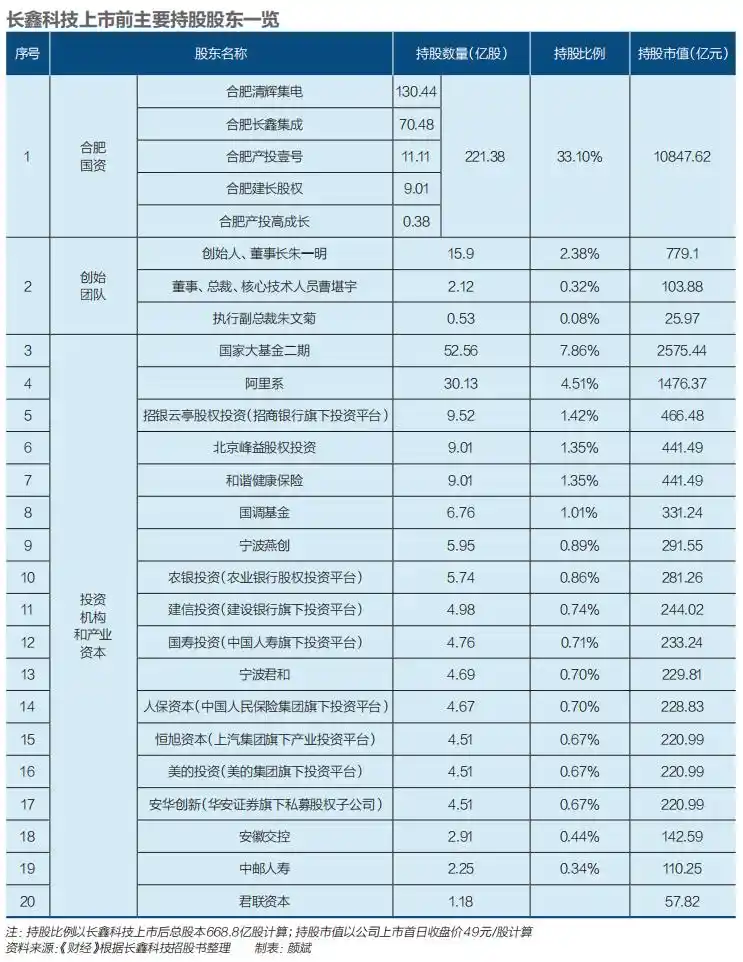
The prospectus showed that ChangXin had implemented two employee stock ownership plans before the IPO. Under the second plan, the board granted Zhu 1.536 billion shares in recognition of his contribution to a decade of work on domestic DRAM, at a grant cost of RMB 0.108 per unit of registered capital. Zhu also committed that, during the ten calendar years following the third anniversary of the company’s listing, he would use 768 million of his shares for employee incentives.
Through the two employee shareholding plans, ChangXin granted shares in 6,760 instances, covering managers, business backbone staff, core technical personnel and key workers in frontline production roles. The report said many employees had become multimillionaires through the listing.
Public information cited in the report shows Zhu graduated from Tsinghua University’s Department of Physics in 1997, later studied electronic engineering for a master’s degree at the State University of New York, and then worked in Silicon Valley on memory chip development. He returned to China in 2005 to found GigaDevice, a memory-chip design company. In 2016, with Hefei state capital’s support, he founded ChangXin, and in 2018 he stepped down as GigaDevice’s general manager to focus on ChangXin.
At the time ChangXin was founded, China’s DRAM industry was largely blank. Samsung Electronics, SK Hynix and Micron Technology had already entered scaled mass production of 10-nanometer-class DRAM, while ChangXin started from an older technology framework left by Qimonda, with a process gap of more than two generations. The report said Zhu did not choose incremental iteration. Instead, he led the company on a “generation-skipping” R&D path that went directly from the first-generation platform to mass production on the fourth-generation process platform.
The same Guoshou Investment source told Caijing that beyond timing and the import-substitution opportunity, the people factor was decisive. The source said Zhu paid close attention to intellectual property early on, used Qimonda-related IP as a starting point and built a substantial defensive patent portfolio. He also assembled an experienced technical team and managed to keep that talent in Hefei, which the source described as very difficult to do. Long-term investment in team-building and continued attraction of top industry talent were presented as major reasons for the company’s success.
The Guoshou source said the team was resilient and deeply rooted in industrial operations, staying focused on DRAM R&D and mass-production landing through the industry downturn. Guo Chengwei also told Caijing that ChangXin’s management left a strong impression on him for its long-term orientation, professional capability, practical style and emphasis on incentives that tie core members to the company.
No controlling shareholder remains a key governance question
As Hefei state capital, Zhu’s founding team and dozens of institutions pushed ChangXin to a public listing, the company’s no-controlling-shareholder structure also drew attention.
Yuan Yuan, ChangXin’s vice president and board secretary, said during the IPO roadshow that the company’s ownership would become even more dispersed after the listing. None of the top five shareholders would hold more than 30%, no single shareholder would hold more than 50%, and the company would maintain a no-controlling-shareholder structure after going public.
The report said the Hefei State-owned Assets Supervision and Administration Commission and the SASAC of Hefei Economic Development Zone, despite being behind the company’s largest investor bloc, play more of a financial-investor role and have stated that they do not seek actual control of Hefei Qinghui Jidian or ChangXin itself. Zhu, while serving as executive partner of Hefei Qinghui Jidian, does not actually control that entity either.
ChangXin has said that its no-controlling-shareholder status is closely tied to the internal checks-and-balances arrangement among the partners of Hefei Qinghui Jidian, its largest shareholder. According to the company, that mechanism fits the original intent of the two local state-capital platforms in Hefei: to pursue technological self-reliance rather than control, while respecting the operating leadership of the management team.
Zhou Chunsheng told Caijing that ChangXin’s model of “no controlling shareholder plus a balance between state capital and the founding team” represents an innovation in how large hard-tech companies can introduce state capital. In his view, it balances strategic goals on the state side with operating leadership on the team side. He said its advantage lies in replacing administrative intervention with resources, credit backing and strategic support while leaving technology and operations in the hands of the founders.
Miao Tianyi broke the advantages into four parts. First, strategic power and operating power are separated, with state capital focused on industrial security and large investment while staying out of day-to-day operations and technology choices. Second, a multilayer partnership balance means no single party can dominate the voting rights of the largest shareholder, which improves market-based governance. Third, risk and returns are tied together, with state capital carrying downside-cycle risk and management tied to performance and long-term equity value. Fourth, the structure fits IPO compliance by clarifying the boundary of state-capital rights and responsibilities while preserving room for market-based operation.
Still, the report said the structure carries risks. Zhou noted that memory is a strongly cyclical industry where pricing and capacity decisions often require quick responses. A governance system that relies on broad consultation could become a drag in downcycles. He also said that once the sector matures, state-capital priorities such as value preservation and industrial security could clash at times with management’s push for market expansion and short-term results. Miao added that a company without a controlling shareholder lacks a clear defensive center in the face of hostile takeovers or outside capital games. Stability depends on long-term trust among parties, while different stakeholder demands can raise governance costs and a multilayer ownership structure can make transparency more difficult.
The article was originally published via the WeChat account Dushuyizhi (ID: dushuyizhi007) and written by Kang Guoliang and Zhang Jianfeng before being republished by MarsBit.