
Changxin Technology rewrote two A-share records in a single trading session on July 27 after listing on the Shanghai Stock Exchange’s STAR Market.
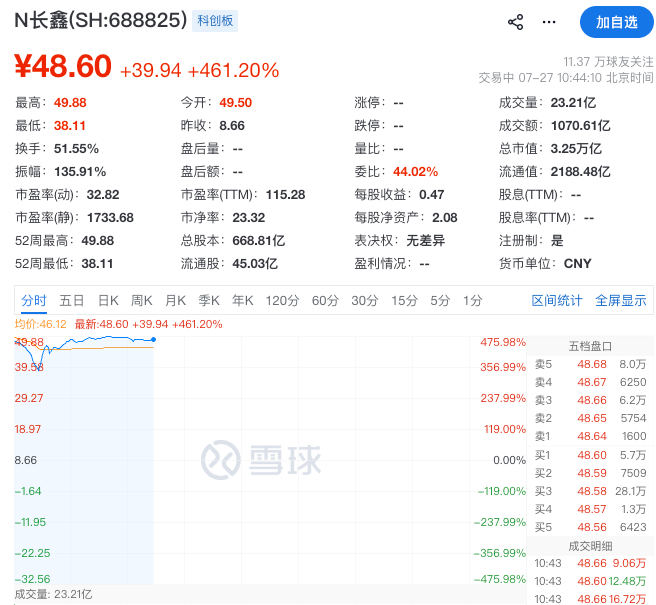
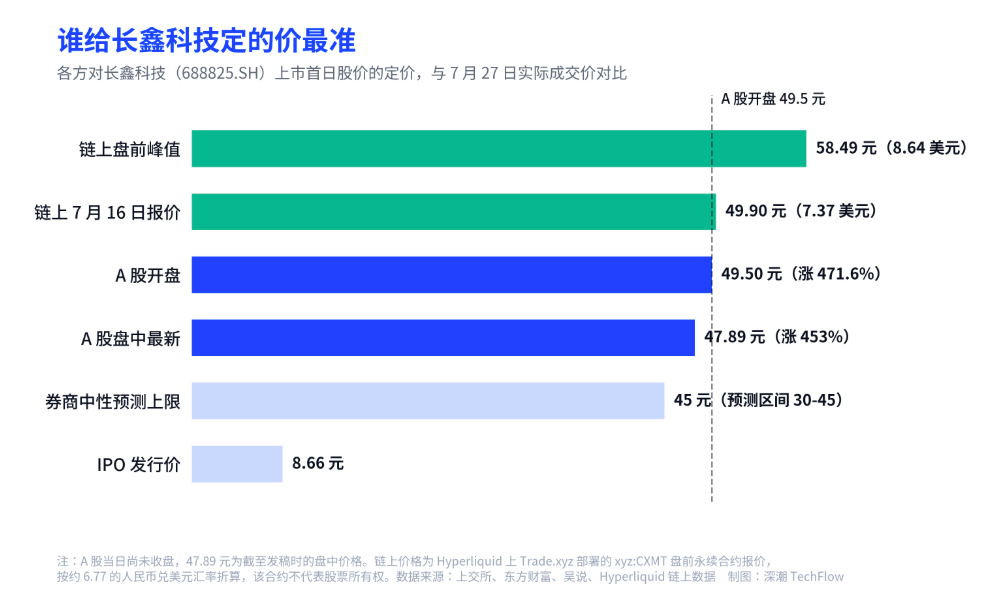
The company was offered at RMB 8.66 per share and opened at RMB 49.5, a gain of 471.59%. Its market capitalization reached RMB 3.31 trillion at the open, moving past Industrial and Commercial Bank of China to rank first in the A-share market by market value. It closed up 453%, and turnover for the day reached RMB 90.1 billion, topping the RMB 90 billion record set by East Money on Oct. 9, 2024.
An on-chain pre-market contract had pointed to a higher price
The line that drew the crypto market’s attention appeared before the stock ever started trading in China.
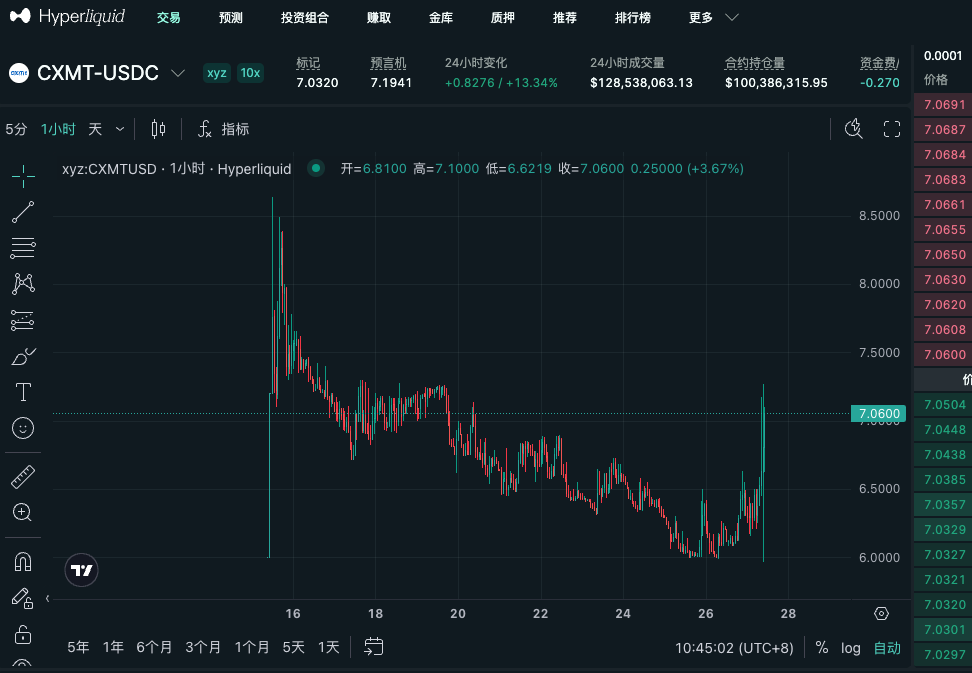
On July 14, Trade.xyz launched a pre-market perpetual contract for Changxin Technology through Hyperliquid’s HIP-3 framework under the symbol xyz:CXMT. The contract used $5 as its initial reference price, supported leverage of up to 5x, and settled in USDC. After going live, it traded at $6, then $7.2, and later touched $8.64.
Using the roughly 6.77 exchange rate cited in the report for mid-July, $8.64 worked out to about RMB 58.5 per share. That was 18% above the RMB 49.5 opening price seen 13 days later in the A-share market.
Record IPO size, heavy demand, and a tightly constrained float
The IPO itself was already record-setting. Gross proceeds came to about RMB 57.919 billion, and would rise to about RMB 66.607 billion if the overallotment option was fully exercised, making it the largest IPO in STAR Market history and larger than SMIC’s RMB 53.2 billion deal in 2020.
Investor demand also set a record. Valid online subscriptions totaled 9.4288 million accounts, with an allotment rate of about 0.47%. The online lottery generated 7.7022 million winning numbers, and each winning number entitled the holder to subscribe for 500 shares. Based on the opening price of RMB 49.5, one winning lot implied a paper gain of RMB 20,420. Based on the closing price of RMB 47.89, the gain came to about RMB 19,600.
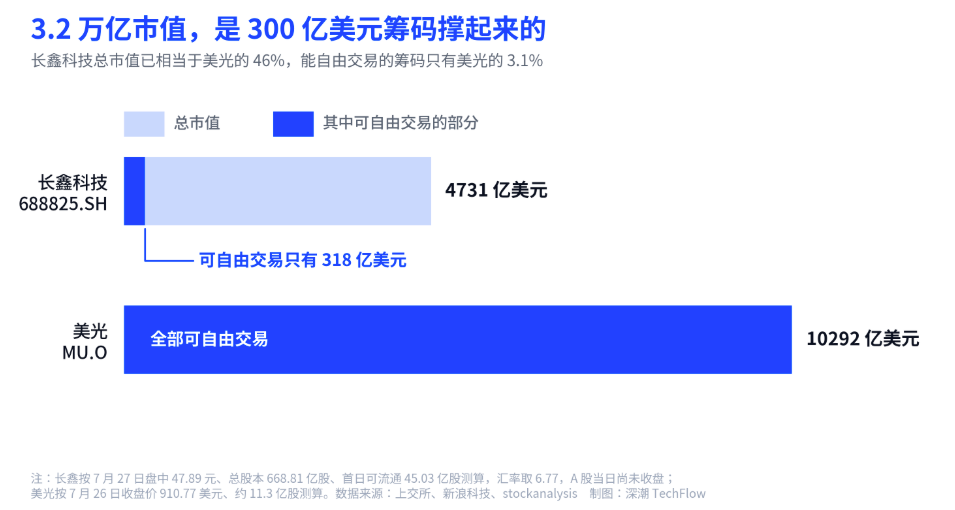
Supply, by contrast, was highly restricted. After the offering, total share capital stood at 66.881 billion shares, but only 4.503 billion shares were tradable on the first day, or 6.73% of the total. Under STAR Market rules, newly listed stocks have no daily price limit for the first five trading sessions, though temporary halts can be triggered at 30% and 60% volatility thresholds. The report says the combination of a small float and no price limit in the first five sessions helped produce the RMB 90.1 billion turnover, a figure that exceeded the previous record by only RMB 100 million.
Fundamentals support part of the move, but the prospectus also sounded a warning
On fundamentals, Changxin Technology reported first-quarter 2026 revenue of RMB 50.8 billion, up 719.13% year on year, and net profit attributable to shareholders of RMB 24.762 billion. The company said it expects first-half net profit attributable to shareholders to come in between RMB 50 billion and RMB 57 billion, more than 22 times higher than a year earlier.
By fourth-quarter 2025 DRAM sales, Changxin’s global market share rose to 7.67%, making it the world’s fourth-largest DRAM manufacturer, according to the report.
The company also included a note of caution in its prospectus, saying the DRAM industry is highly cyclical and volatile, current product prices are at elevated levels, and continued sharp price increases are not sustainable.
Valuation versus Micron: almost half the market cap, but only about 3.1% of the freely tradable stock
Using the closing price of RMB 47.89 and total share capital of 66.881 billion shares, Changxin Technology’s market capitalization worked out to about RMB 3.20 trillion, or roughly $473.1 billion. At the same time, Micron, identified in the report as the world’s third-largest DRAM producer, traded at $910.77 per share with about 1.13 billion shares outstanding, giving it a market capitalization of about $1.03 trillion. By that measure, Changxin reached 46% of Micron’s market value in one day.
The freely tradable portion was nowhere close in scale. Changxin had only 4.503 billion shares available for trading on day one. At the closing price, that translated into a float market value of about RMB 215.6 billion, or roughly $31.8 billion. Micron’s shares are described in the report as being largely freely tradable. In other words, Changxin’s total market capitalization reached 46% of Micron’s, but the portion that could actually trade was only 3.1% of Micron’s.
The report argues that this is where the RMB 3.2 trillion valuation came from: not from RMB 3.2 trillion of capital changing hands, but from a price discovered through RMB 90.1 billion of turnover against roughly $31.8 billion of floating stock.
Multiples expanded sharply while the cycle leader has already pulled back
Using the first-half net profit guidance of RMB 50 billion to RMB 57 billion and annualizing it in a simple way, the report places Changxin’s 2026 net profit in a range of roughly RMB 100 billion to RMB 114 billion. At the IPO price, the price-to-earnings ratio was about 5.8x, close to the level cited for Samsung and SK Hynix. At the closing price, that multiple jumped to about 30x.
Micron’s current forward P/E was listed at 6.77x.
The leader of the current memory cycle has already come off its peak. Micron’s 52-week high was $1,255, and it closed at $910.77 on July 26, about 27% below that high. The STAR 50 Index closed at 1,787.20 on July 24, down about 17% for July and about 19% below its June 30 high.
The report’s takeaway for secondary-market buyers is simple: a roughly 3% float can amplify moves in both directions, and a 30x earnings multiple already assumes the cycle keeps improving, even as the cycle’s leading stock has been moving lower.
How HIP-3 allowed Trade.xyz to build the market
HIP-3 is described as a permissions framework that Hyperliquid opened to third parties. Anyone posting sufficient margin can deploy a perpetual market, and the underlying asset does not have to be a cryptocurrency. Trade.xyz used that framework to create a pre-market venue for Changxin Technology.
The contract tracks market expectations for the dollar value of one common A-share in Changxin after listing. It is cash settled and references the value of a single share, not the company’s total market capitalization.
Holding the contract does not grant IPO allocation, dividends, or voting rights, and it cannot be converted into real shares after listing.
Trade.xyz manually set the initial reference price at $5, and after that, execution was driven mainly by buy and sell interest on the on-chain order book. With no spot shares trading before the listing, the contract did not need to stay close to the RMB 8.66 issue price. To prevent a single order from pushing the market too far, the contract used price guardrails: a 20% Discovery Bound per step, with up to seven re-anchors in both directions. That is why the price advanced in stages to $6, $7.2, and then $8.64.
What the on-chain market got right, and what remains uncertain
As of July 16, the CXMT mark price stood at about $7.37, with roughly $50.56 million in 24-hour volume and about $23.07 million in notional open interest. After the A-share market opened on July 27, the report says contract volume rose more noticeably.
Before listing, sell-side and institutional estimates had placed a neutral range at RMB 30 to RMB 45, implying gains of about 240% to 420%. A separate retail-style estimate was more conservative, arguing that even in a hot market, the short-term upside would likely stay below 400%, corresponding to about RMB 43.3. Both sets of estimates came in below the actual opening price of RMB 49.5.
The on-chain market gave a different answer. On July 16, Trade.xyz was pricing Changxin at around RMB 49.9, just 0.8% away from the A-share opening price of RMB 49.5 eleven days later. The peak of $8.64 converted to RMB 58.5, or 18% above the eventual open. In both direction and magnitude, the report says, the on-chain market came closer than the sell-side forecasts.
Still an early sample for A-share IPO pricing
The report notes that this was not the first time an on-chain pre-market had come close to an actual opening print. In May this year, a Hyperliquid pre-market contract for AI chip company Cerebras traded within 1.3% of its Nasdaq opening price. In June, on the day of SpaceX’s IPO, the on-chain contract recorded $1.38 billion in daily volume.
But for a STAR Market listing in China’s A-share market, this was the first case. For investors tracking IPOs, the on-chain curve now carries some reference value. Even so, the sample size is only three, and two of those cases were U.S. stocks. The report says it is still too early to treat this as a leading indicator for A-share pricing.