
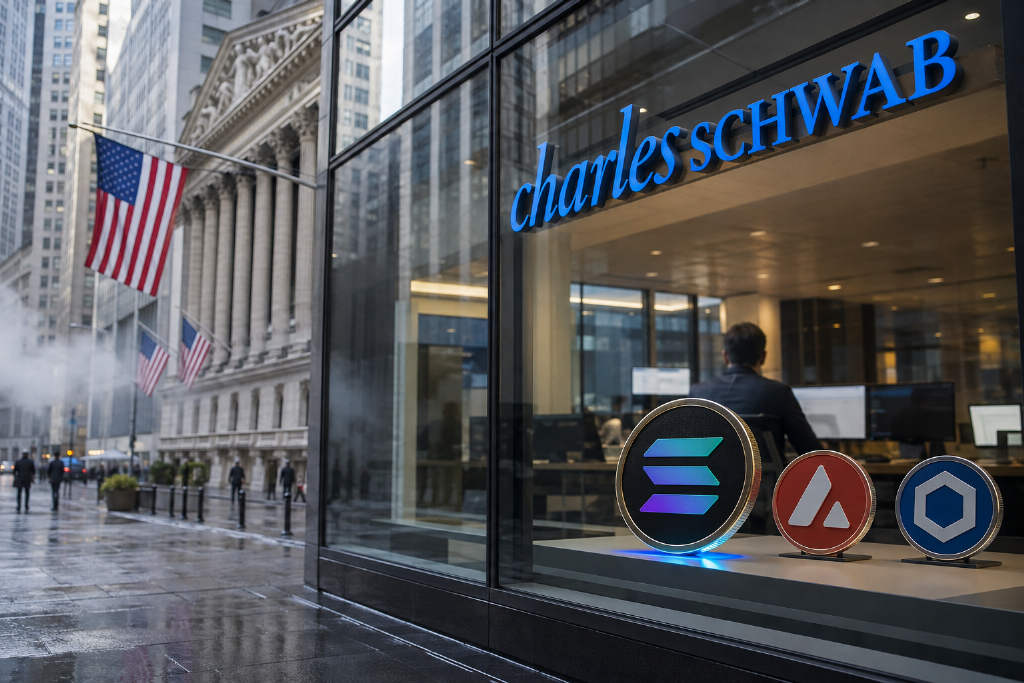
Charles Schwab plans to add Solana, Avalanche and Chainlink to its crypto trading platform in the coming months, extending the tradable lineup from two assets to five. After the news, SOL rose about 7% at one point, touched $109, and later eased back toward $106. For users already trading on Coinbase or Binance, that may look like another listing. For U.S. retail clients who keep stocks, bonds and cash inside Schwab, it would be the first time they could buy SOL inside a familiar brokerage interface instead of opening a separate crypto exchange account.
What Schwab said
According to the report, Schwab Crypto first opened spot Bitcoin and Ether trading to some retail clients in May. On Aug. 27, the firm said it would add SOL, AVAX and LINK over the coming months, taking the number of tradable tokens from two to five. It did not provide a launch date.
The company also left itself room to change course. If market, regulatory, operational or risk conditions shift, the rollout could be delayed, modified, or withdrawn even after assets have been announced.
Trading will run through Schwab’s website and mobile app. The fee is 0.75% of the transaction amount, or $7.5 on a $1,000 trade. Schwab said that pricing sits at the lower end of the industry range. The crypto account is held under Charles Schwab Premier Bank and linked to a standard brokerage relationship, though it remains a separate crypto account. Execution and sub-custody had already been connected to Paxos, the report said.
The service is available in most U.S. states, but not in New York or Louisiana. It is also unavailable to international users and U.S. territories, and not every client is automatically eligible.
Joe Vietri, head of digital assets, framed the move in conventional wealth-management terms: clients want access to a broader set of digital asset allocations inside the advisory and banking experience they already know. Schwab did not commit to proprietary buying, did not provide volume expectations, and did not identify the custody counterparty for the newly added tokens. As the report put it, a broker is putting products on the shelf, not using its balance sheet to lift prices.
Why the market treated it as a major development
As of July 31, 2026, Schwab had about $13.04 trillion in client assets and roughly 39.9 million active brokerage accounts. The report stressed that this is assets under custody, not Schwab’s own capital, so it should not be read as money that will flow into SOL overnight.
What changes is the cost of access. Previously, a user who wanted SOL had to register with an exchange, complete KYC, and learn how withdrawals worked. If Schwab clients can place the trade inside the same app where they already monitor their portfolio, the path starts to resemble buying an ETF.
One line of thinking in the industry is that Schwab is not mainly trying to win over crypto-native users. It is trying to stop existing clients from moving funds to Coinbase or Robinhood simply because they cannot buy tokens inside Schwab. Once that money leaves, bringing it back is difficult.
On fees, 0.75% is more transparent than the spread-plus-commission mix seen on many retail exchanges, though it still sits above some rivals. The report cited a Morgan Stanley-related channel that had previously shown pricing of 50 basis points. Price competition has now reached traditional brokerage shelves as well.
There are limits. Schwab’s spot crypto product does not currently offer the kind of unrestricted transfers that an on-chain wallet does. Clients can buy, hold and sell, but that is not the same as withdrawing coins to a personal Solana address. That makes the product a poor fit for users who want staking or DeFi access on-chain, but a workable one for investors who only want some SOL exposure next to equities in a brokerage account. The report added that crypto services for advisers are on a different timeline, with market chatter pointing to mid-2027, not the same retail product line involved here.
How SOL reached $109
Before and after the announcement, SOL moved back above the psychological $100 level for the first time in more than three months. It traded as high as $109 during the session before slipping back toward $106.
Different market data sources put the daily gain in a range of about 7% to 13%, while turnover expanded sharply. One cited figure said 24-hour trading volume was up by more than 60% from the previous day. Avalanche and Chainlink also advanced on the same day, but by less than SOL.
The report argued this was not just a Bitcoin sympathy move. Over the same stretch, SOL’s seven-day gain was noticeably stronger than BTC’s, so traders were more willing to read the move as a repricing specific to Solana rather than a broad beta trade.
Short liquidations clustered above $100 and added force to the breakout. As the market cleared that level, stop losses and leveraged shorts were taken out, steepening the move. But SOL did not immediately hold firm at $109, suggesting profit-taking and fresh supply both appeared in that area.
Traders are watching two nearby levels. The first is the $109-$110 zone, where a close above could keep $120 in play in the short term. On pullbacks, $100 is the first level in focus. It is both a round-number psychological marker and the resistance area that was just broken and may now act as support. Below that, the report said, the demand zone left by summer consolidation is still visible on charts.
Three forces hit in the same week
Schwab was the loudest headline, but not the only one. In the same time window, the market was also dealing with at least two other drivers.
One was continued net inflows into spot Solana ETFs. The report cited data showing that U.S. spot SOL ETFs recorded their largest single-day inflow of 2026 at about $60.91 million, with Bitwise’s BSOL contributing roughly two-thirds and becoming the first spot SOL product to pass $1 billion in assets. Another measure in the same report put seven-day net inflows at about $105 million, with cumulative inflows over a longer window above the $1 billion range.
The article drew a distinction between those channels. ETFs give advisers and institutions a wrapper that can sit inside model portfolios. Schwab gives retail users a spot buy button inside an existing account. The audiences are not identical, but both channels expand the number of ways investors can access SOL.
The second driver was on-chain governance. Validators approved proposals around the same day to steepen Solana’s deflation curve and raise the share of resource fees that get burned. Using prices at the time, the report made a rough estimate that issuance over the next six years could be lower by about 18.9 million SOL, equivalent to a potential supply reduction in the billion-dollar range.
If daily burn rises from roughly 600-800 SOL to around 7,500-9,000 SOL, token economics would tighten. But staking yields could also come under pressure, which means the change is not a simple positive for institutional money focused on income.
A third element was stronger network activity. The report cited data suggesting weekly non-vote transaction count reached about 1.32 billion, while daily active addresses also hit a peak reading. Fee burning needs usage to sustain it. If usage slows, the deflation narrative weakens with it.
That combination is what turned the break above $100 into a move with volume behind it rather than a thin spike.
What changes, and what does not
The main change is access. SOL is moving from something that often required a dedicated crypto account to something that can sit inside a regulated brokerage framework alongside stocks. For U.S. retail clients who have never used an on-chain wallet, friction drops meaningfully. For advisers already using SOL exposure through ETF models, Schwab spot access is another execution venue, not an automatic reason to add size.
What does not change is the larger supply structure. The governance vote alters future issuance over coming years, but circulating supply and the selling behavior of long-term holders are still determined by price. It also does not change the macro discount-rate backdrop. The report noted that Bitcoin remains stuck processing Treasury yields and ETF turnover inside a range, and Solana is unlikely to carve out a completely unrelated bull market on its own.
Schwab’s planned listing, ETF inflows and the deflation vote help explain why SOL managed to clear $100 ahead of the broader market. They do not explain every dollar of trading above $109.
Before the product goes live, translating Schwab’s $13.04 trillion in client assets directly into future buying pressure is a category error. The figures that matter come later: daily trading once the product launches, net buying, and whether additional licensing in places such as New York leads to a second wave of account openings. Until then, $109 remains a trader’s line. Hold above it, and the current narrative may stay in use for a while. Slip back below $100, and the Schwab story starts to look like news that has not yet been cashed in.