
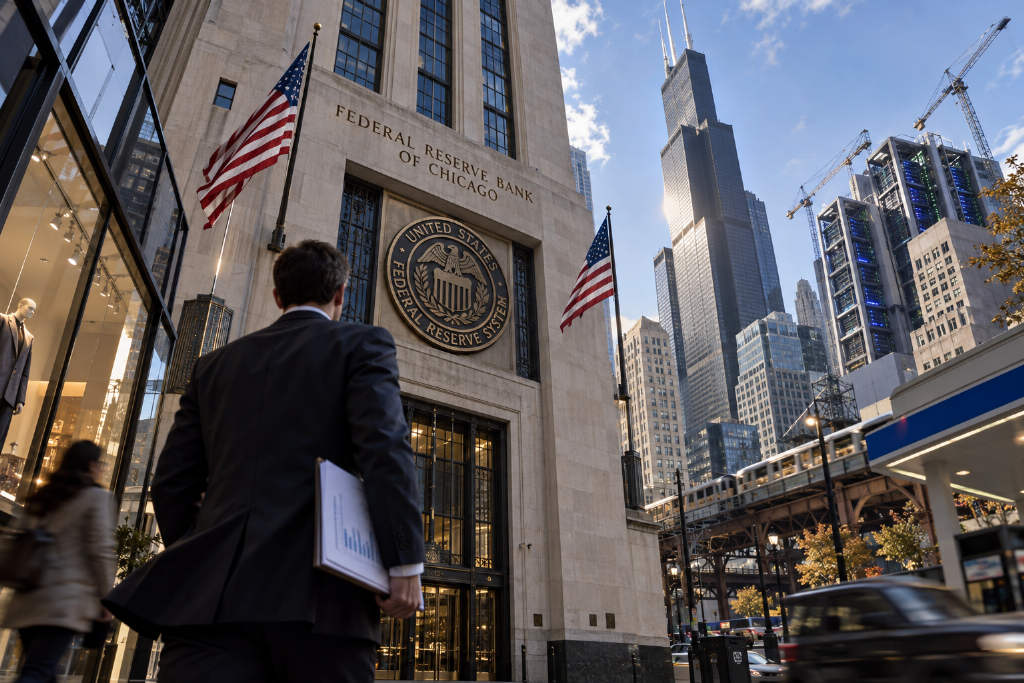
Chicago Federal Reserve President Austan Goolsbee said the Federal Reserve has effectively chosen to trust hard economic data over sour public sentiment as it sets interest-rate policy, even though the disconnect between the two remains stark.

Goolsbee made the remarks in a conversation with financial scholar Kyla Scanlon during a Chicago Fed and University of Chicago NORC seminar titled “Why do consumers and economists view the economy so differently?” The discussion focused on the break between consumer confidence and actual spending, the indicators the Fed now prioritizes, conditions in the labor market, and whether the boom in AI infrastructure is creating overheating risks.
Fed policy is now anchored more heavily to hard data
Looking back to a conversation a year ago, Goolsbee said the clash between data and public “vibes” had not faded. In his view, it is still playing out. Inside the Fed, though, hard data has “basically won,” because rate policy over the past year to year and a half has been built on actual macroeconomic numbers rather than on how discouraged consumers say they feel.
That does not mean the public mood has improved. Goolsbee said the economy continues to post solid and respectable readings while people still report that things feel bad. That mismatch, he said, is the reality policymakers are dealing with now.
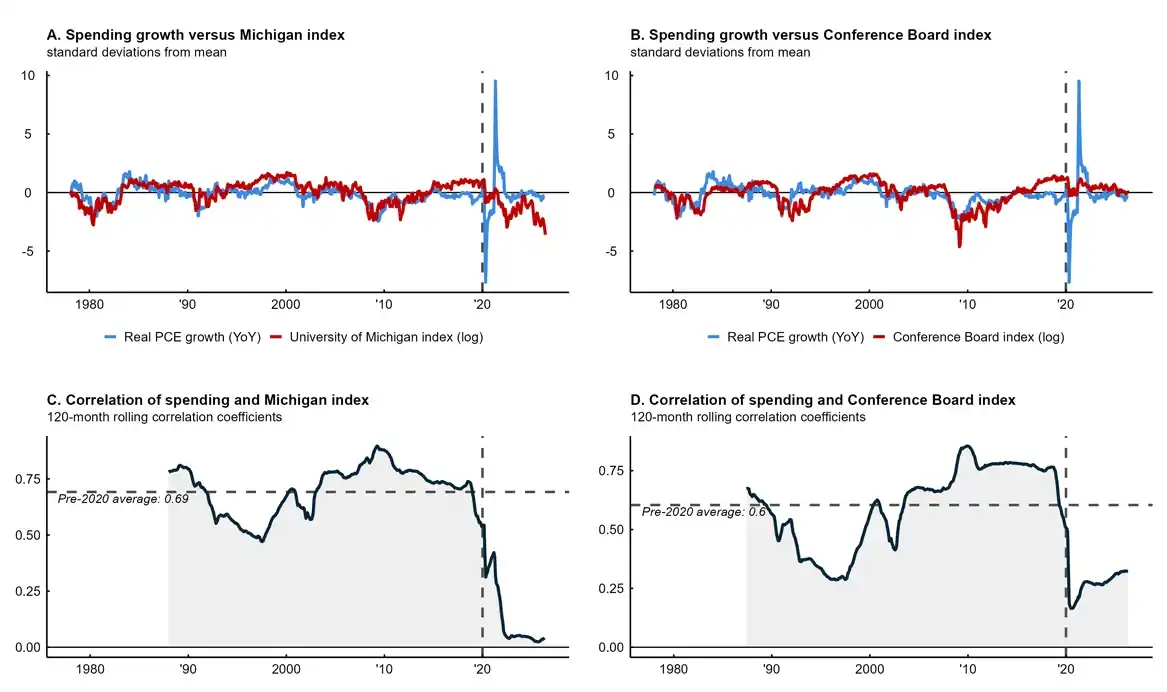
Asked whether consumer behavior lined up with confidence readings, Goolsbee said spending has been surprisingly resilient compared with the frustration people express. He said researchers at the Chicago Fed have been tracking the mapping between sentiment and spending for years, and the relationship did not suddenly break. Instead, the correlation has been weakening over a long period and has now fallen close to a floor.
He said sentiment still matters in many social and political contexts. But if confidence indexes were once treated as a key leading indicator for consumer spending, the current breakdown means they deserve less weight in policy judgment. Goolsbee said he would not throw out any dataset entirely, though consumer confidence has clearly moved lower on his own decision list.
At the top of that list, he said, are core labor-market ratios rather than the headline monthly nonfarm payroll gain. He prefers ratio-based gauges because the payroll number can be affected by questions around immigration flows and statistical definitions. The metrics he watches most closely are the unemployment rate, the job-openings rate, the layoff rate, and the hiring rate.
On the consumer side, he said he keeps a close eye on hard retail-sales figures. Forecasting the macroeconomy with firm, observed indicators still offers the best guide, he said. Economic forecasting is never free of noise, but in the current environment the extra value from layering sentiment data on top of hard data appears very small.
Scanlon asked whether weak sentiment could eventually become self-fulfilling and drag the economy down. Goolsbee replied that consumer sentiment is highly dramatic by nature and tends to swing much more sharply than underlying real-economy variables. Historically, collapses in confidence often served as an early warning for recession, which is why markets become extremely sensitive when sentiment reads poorly.
Still, he noted that in the years when confidence measures have repeatedly flashed recession warnings, the widely forecast downturn never actually arrived. That, in his view, is one reason the debate has shifted toward hard data. If confidence surveys are no longer doing a good job of predicting current or future activity, he said, they may be more useful as a reference point for longer-term inflation expectations, an area the Fed is studying more closely.
Why the public still feels bad: visible prices hurt more
When asked why consumer sentiment remains weak despite better macro data, Goolsbee pointed to salience. Some prices are simply harder for households to ignore.
Gasoline is one of the clearest examples, he said. People drive past posted prices every day, and when they see diesel at $6 a gallon, the immediate reaction is that the economy is in terrible shape. Grocery prices carry a similar effect. Even when inflation slows, high absolute price levels continue to show up in how consumers answer surveys.
Goolsbee also said political polarization is contaminating economic perceptions. In his telling, some sentiment surveys now function almost like political polls. On election day, even when respondents are asked a straightforward factual question such as whether unemployment rose or fell over the prior year, the answer can track their partisan identity and the president’s party rather than the underlying data.
He added that households did go through a period in which real wage income was shrinking. Public frustration during that stretch was entirely understandable. Nominal wages later caught up, and tax relief also helped, but once people have seen everyday bills rise faster than their paychecks, the psychological damage can linger.
Scanlon said many people feel as if there has been no breathing room since the pandemic, with social media constantly pushing price increases in every part of daily life into view, while AI has brought a new layer of job anxiety.
Goolsbee said the dissatisfaction has a solid basis. Filling a tank can cost $70, $80, or even $90, he said, and anyone living in that environment is going to get tired of it.
To illustrate how broad discontent can shape survey responses, he recalled his 30 years teaching at the University of Chicago. MBA students rated professors across categories such as organization, clarity, and whether the class was interesting. If students liked a professor, scores could stay strong across the board even after a chaotic first lecture. If they disliked a demanding professor, every category could get marked down. Goolsbee said some consumer mood readings now show a similar all-around “bad grade” effect: when households feel intense pressure, they do not just give the current economy poor marks, they also report more aggressive inflation expectations for the future.
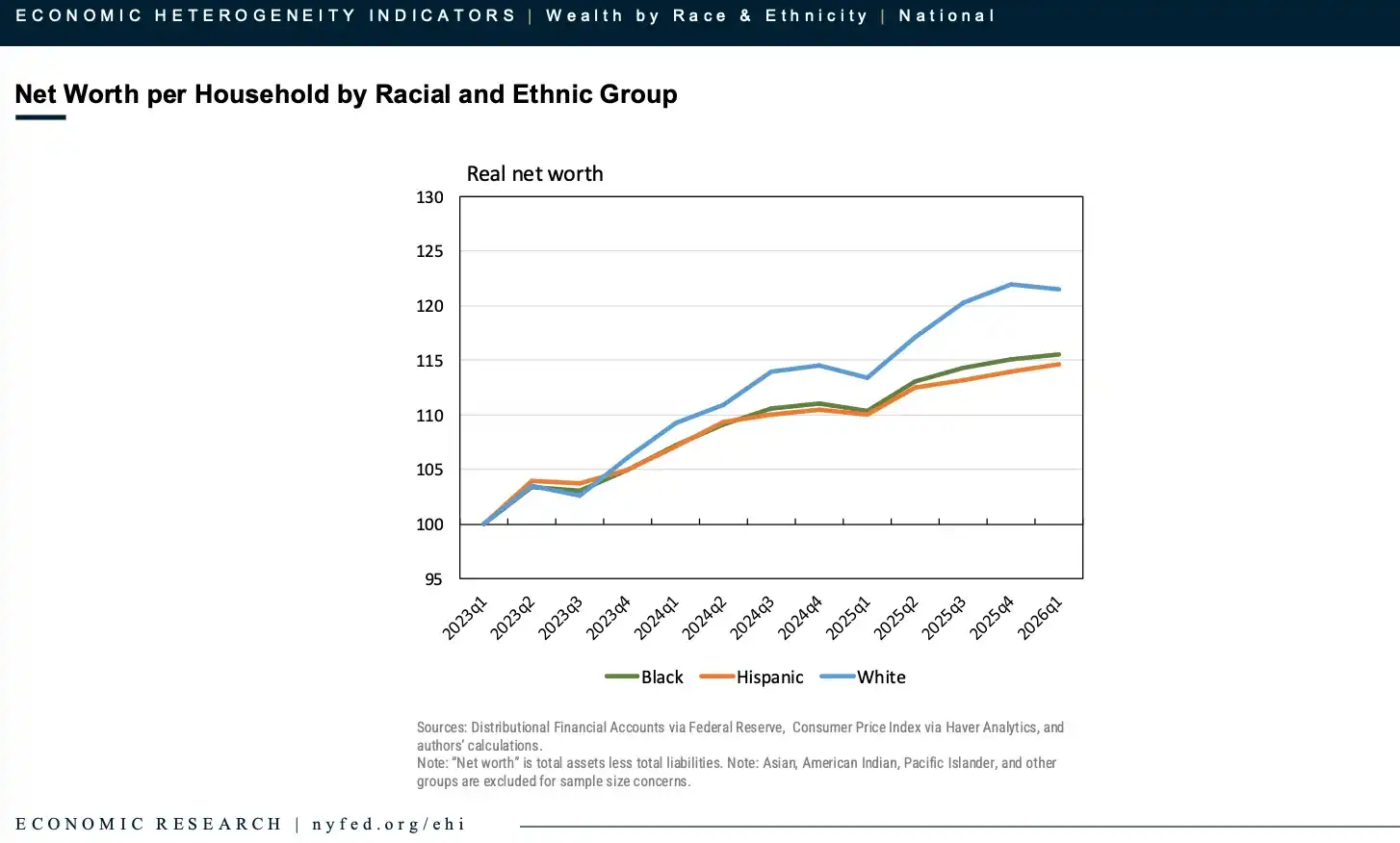
The report also cited New York Fed data showing that the gap in real consumption growth across income groups is about 1 percentage point, suggesting a slow-moving K-shaped divergence.
Low hiring and low layoffs still define the labor market
On employment, Goolsbee said the unusual combination of low hiring and low layoffs is still in place. A year ago he described the labor market that way, and he said the pattern has persisted. At first he thought the setup was mainly a response to macro uncertainty, with firms choosing to wait. But if the condition lasts for years, he said, it can no longer be explained as a short-lived pause.
In the hard data, the hiring rate looks as weak as it does in recessionary periods, while the layoff rate looks as low as it does in boom times. Both are unusually steady. That suggests the labor market is not sliding into a clear downturn, but is instead stuck in a sticky equilibrium with limited movement.
Even so, Goolsbee said conversations with businesses in Illinois point to tightening in parts of the market, especially for skilled technical workers. A major reason is the construction wave tied to AI data centers, which is creating cross-industry competition for labor. Some firms are now being forced to offer wages well above what they had budgeted six months earlier.
Goolsbee sees overheating risk in a $1.5 trillion AI buildout
Asked whether the capital-spending surge around AI data centers could overheat parts of the economy, Goolsbee said he sees the issue through two cautious lenses.
First, the larger the future vision being sold to investors, the stronger the incentive for companies to turn high valuations into immediate capital spending by building data centers now. That can lift short-term demand and increase overheating risk, making inflation harder for the central bank to control.
Second, he said the crucial question is whether the boom stays within its lane or spills into the broader economy. If aggressive AI data-center expansion merely crowds out investment elsewhere, then aggregate demand may not be overheating overall; the economy would be seeing a reallocation of capital weight instead. But if the AI boom starts pulling up hiring, electricity use, and raw-material costs across the chain, and that feeds into wider inflation, then the Fed would have to do what central banks do in classic demand management.
Goolsbee put the arithmetic plainly: no one commits $1.5 trillion in capital spending and plans to give the end product away for free. Either future pricing for AI software and compute services will be very high, or the sector’s valuation structure will face a deep reset. If that spending fails to produce an explosive jump in real productivity, he said, the kind of pain seen after the 2000 internet bubble burst could return in a new form.
Five main takeaways from the discussion
Sentiment is no longer a reliable leading signal for spending. The Fed once watched confidence readings closely because pessimism often came with weaker consumption. That chain has now dulled, and policymakers have reduced the forecasting weight of sentiment measures in favor of hard indicators such as retail sales and labor-flow ratios.
Households feel the level of prices, not just the rate of change. A University of Michigan survey showed that 53% of U.S. households in August blamed a high cost of living for worsening finances, up from 7% in 2019. Even though CPI growth has fallen to 3.7%, the overall price level is still up nearly 30% from early 2020. Economist Brian Fabes was quoted as saying, “People live in the level of prices, not in the rate of inflation.”
Sentiment surveys and aggregate data are measuring different things. University of Michigan director Joanne Hsu said sentiment surveys are counted on a one-person, one-vote basis, while GDP, equity markets, and retail data are effectively one-dollar, one-vote. Since 2023, real retail spending by households earning more than $125,000 a year has risen 7.6%, while spending growth for households earning less than $40,000 has stalled at zero. Strong demand from higher-income households can mask the strain lower-income households face.
The labor market has moved into a low-flow state. The hiring rate stands at 3.3%, close to the 3.5% average seen in past recessions, while the layoff rate is 1.0%, below the 1.3% average in historical expansions. Employers are reluctant to let go of experienced workers but are highly selective in adding new staff, freezing much of the economy’s fresh job creation.
The Fed will not set policy to satisfy mood readings, but it remains committed to the 2% inflation target. Goolsbee said the central bank’s job is not public relations. Its task is to restore price stability through monetary policy. Only when long-run inflation moves firmly back toward 2%, he said, can cost-of-living anxiety and deeper feelings of insecurity start to ease.
The discussion laid out a clear divide. In policymaking, the Fed is leaning harder on hard data. In lived experience, high price levels, income divergence, low labor mobility, and the AI investment boom are still widening the gap between what the statistics say and what households feel.