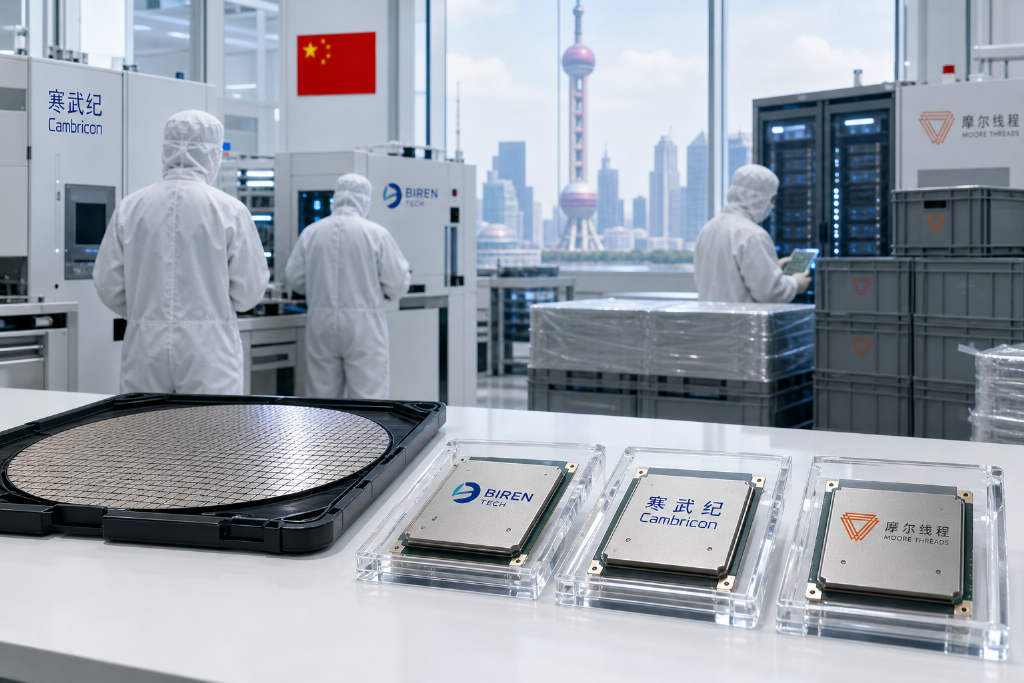
Chinese AI chip companies are reporting strong revenue growth as demand for high-end computing power continues to outpace supply. According to a BlockBeats brief citing Beating AI, several leading domestic chip firms released their half-year results in August, with Biren Technology posting nearly 20x revenue growth. Cambricon and Moore Threads were also reported to have delivered major increases in revenue.
The report links the performance surge to persistent shortages across the high-end compute supply chain. It said tightness now spans the full supply side, with some companies' orders scheduled as far as three years out. The imbalance is not limited to chip vendors. Downstream intelligent computing center resources remain undersupplied, while orders are also being released intensively in the midstream system integration segment.
Industry survey data cited in the report projects demand for domestic AI chips at about 4 million units in 2026, against actual deliveries of roughly 3 million units, leaving a production gap on the order of 1 million chips. The report added that many Chinese chip companies have recently posted results showing a collective breakout, and that the industry broadly sees domestic chips in high-end AI applications as being in a strong upward cycle.
Several Chinese AI chip companies released half-year results in August, highlighting a widening gap between demand and supply in high-end computing power.
According to a BlockBeats brief citing Beating AI, Biren Technology reported nearly 20x revenue growth in earnings released last Friday. Other leading firms, including Cambricon and Moore Threads, also posted sharp revenue increases.
Revenue gains track tight supply in high-end compute
The report said the jump in performance comes as high-end compute remains in short supply. On the supply side, shortages now stretch across the full chain, with some companies already booked out as far as three years ahead. The report described this as a snapshot of the current strength in the high-end compute market.
The imbalance is not confined to one segment. Resources at downstream intelligent computing centers are also in short supply, while orders are being released intensively in the midstream system integration market.
Industry survey points to a million-chip gap in 2026
Industry survey data cited in the report shows demand for domestic AI chips reaching about 4 million units in 2026, while actual deliveries are expected to total around 3 million units. That implies a gap of roughly 1 million chips between demand and supply.
The report also said a number of domestic chip companies have recently disclosed financial results showing signs of a broader collective surge. Industry participants broadly view domestic chips as entering a strong upward cycle in the high-end AI chip segment.
This article was originally published by Bit.Fan. For more cryptocurrency news and market insights, visit www.bit.fan. Disclaimer:
The market information, project data, and third-party content displayed on this platform are for industry information sharing only and do not constitute any form of investment advice or return commitment.
Cryptocurrency trading carries high risks. Users should fully assess their risk tolerance and make independent decisions. All profits, losses, and legal responsibilities are borne by the users themselves.