
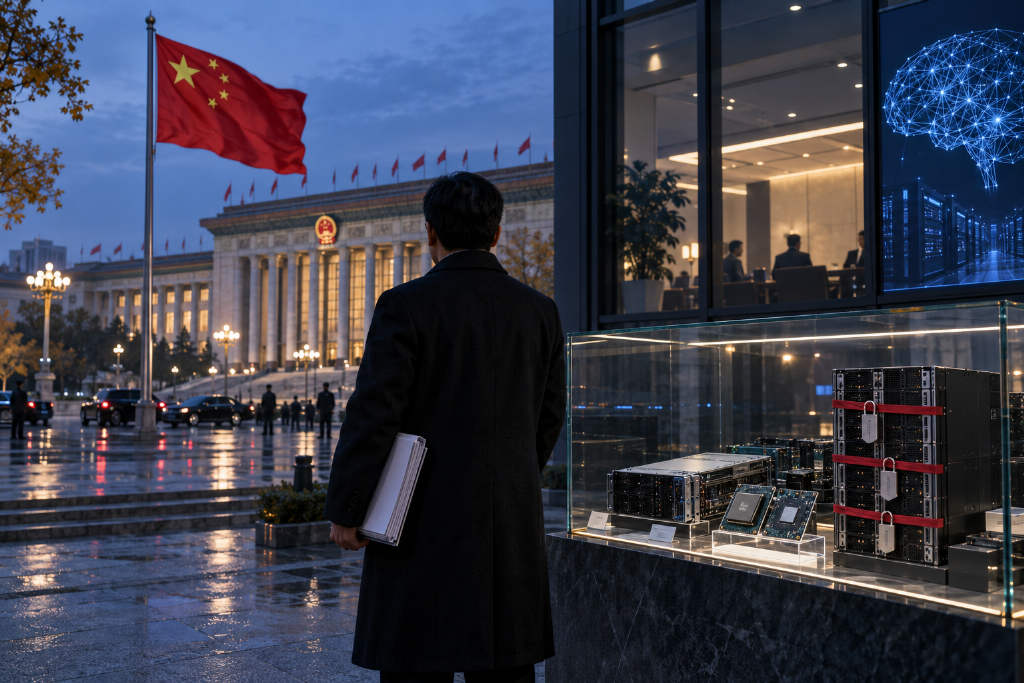
China is moving to tighten export controls on selected AI technologies. On Oct. 16, the Ministry of Commerce and the Ministry of Science and Technology issued 2026 Notice No. 48, opening a public consultation on revisions to the Catalogue of Technologies Prohibited and Restricted from Export. The proposal would add 40 technologies across artificial intelligence, biomedicine, and solar photovoltaics, with 23 of them in AI, covering large models, AI agents, computing clusters, and information processing.
Bloomberg said the move could limit outbound transfers of AI models and chip design technology and strengthen Beijing’s control over key technologies.
14 technologies would be banned from export, 26 would face restrictions
According to The Paper, 14 of the 40 newly added technologies are proposed for outright export bans, while 26 are proposed for restricted export status.
Outside AI, the draft includes five biomedicine items, including cell and gene therapy and oligonucleotide drugs. Another 12 items fall under solar photovoltaics, covering polysilicon, silicon wafers, battery manufacturing technology, and the key equipment used to carry those technologies.
In the AI section, officials gave two examples: “AI-driven malicious code generation and mutation technology” is proposed for a ban, while “AI-assisted vulnerability mining technology” is proposed for restricted export treatment. The public comment period runs from Oct. 16 through Nov. 15.
Ministry says the scope is narrow and open-source remains outside the rules
According to the notice text carried by Xinhua, technologies that have already entered the public domain through open-source release or academic publication would not be included in export controls.
A spokesperson for the Ministry of Commerce said the range of AI technologies covered is “precise and limited,” adding that “the vast majority of artificial intelligence technologies can still be freely exported” and that China will “encourage open-source openness, cooperation and sharing.”
The spokesperson also said that supplying large-model services through API calls, app or web interaction, SaaS applications, and lightweight local deployment does not fall within the scope of export management for large-model technology. Cases involving open-source AI technology, self-built overseas computing centers, overseas chip tape-out, joint research and development, and participation in international standards-setting would qualify for facilitation measures such as automatic licensing, described as allowing matters to be handled with essentially immediate filing and release.
The Ministry of Commerce also said the revision is part of routine technology trade management work and “does not target any specific country, region, or entity.”
Registration will be required before the revised catalogue formally takes effect
Although the catalogue is still in the consultation stage, one part of the notice takes effect immediately. From the date of publication until the formal implementation of the revised catalogue, companies must register in the Ministry of Commerce’s business system before exporting covered technologies.
The requirement applies to transfers of technology ownership, authorization for overseas use, and transfers of control to foreign entities. Ongoing exports that have not yet been completed are also included. Registration information must cover both parties, the destination, the intended use of the technology, and the estimated export amount.
China’s move came the same day as a Taiwan measure mentioned in the source material
The source material said China’s proposal surfaced on the same day as a policy move in Taiwan. It cited an earlier report by Chain News saying Minister of Economic Affairs Kung Ming-hsin confirmed that Taiwan would restrict exports of AI chips to China in line with a Taiwan-U.S. trade agreement.
Past AI export controls have largely been driven by the United States. The source material said China’s decision to place technologies such as large models and AI agents on the control list shows that AI is now being treated by governments as a strategic resource that warrants tighter control.
Industry focus is likely to center on the final list and technical thresholds
For companies, the main question is what appears in the final catalogue and how the technical criteria are defined. Because open-source technologies are excluded, the source material said the strategy of Chinese AI companies continuing to open-source models may remain unaffected. Cross-border cooperation involving non-public model technology, computing clusters, or chip design, however, may need registration or approval before proceeding, while overseas companies working with Chinese partners could face greater uncertainty.