
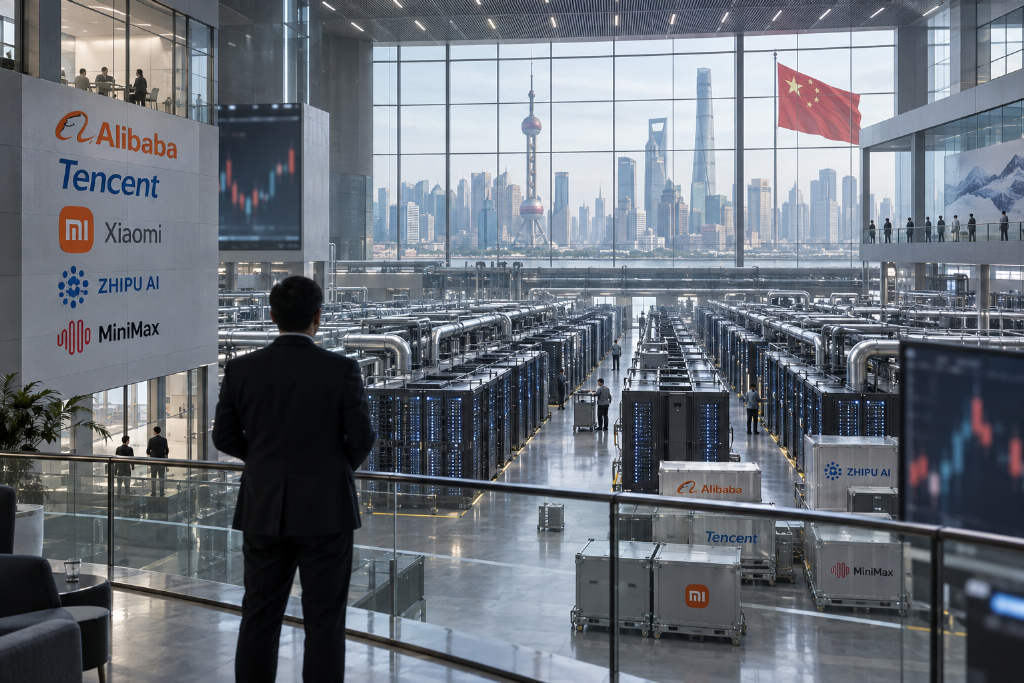
Chinese AI model vendors still have not shown that selling model access can pay for the models themselves, according to a TechFlowPost article published on Oct. 3 and translated from a report written by Robonaissance in collaboration with Inside China's Machine.

The article reviews 19 Chinese model developers and says none of the companies with disclosed financial statements or operating data has demonstrated that model revenue can fully cover construction, operating and research costs. In the cases where a parent company exists, the shortfall is absorbed by profits from other business lines. Independent labs, by contrast, are still being financed by investors.
Xiaomi and Zhipu open the comparison
The report starts with Xiaomi and Zhipu. Xiaomi said that close to 30% of its RMB 18.2 billion research and development budget for the first half went to AI. The article estimates that at roughly RMB 5.5 billion, or $800 million, and notes that the figure covers all AI work, including language models.
Over the same six-month period, Hong Kong-listed lab Zhipu reported total R&D spending of RMB 2.13 billion, or $316 million. On that basis, Xiaomi’s AI spending was more than double Zhipu’s.
On the Artificial Analysis Intelligence Index, Xiaomi’s MiMo-V2.6-Pro scored 46 and Zhipu’s GLM-5.3 scored 45. Running the full index cost buyers $207 on MiMo and $2,503 on GLM. The article says that is the customer bill, not a direct measure of what the model costs the vendor.
The report frames the issue in accounting terms: a model can only stand on its own if revenue exceeds the cost of building and operating it, with research included. By that standard, the authors say they did not find a single case in disclosed accounts where a model pays for itself.
Only a handful of companies disclose enough to analyze
Of the 19 companies mapped in the article, only five filed financial statements that included model-related information: Zhipu, MiniMax, SenseTime, and the AI business lines of Alibaba and Baidu. Tencent, Xiaomi and Kuaishou provided some model data in earnings releases or calls. For the rest, the article says readers are left with company statements and media reports.
The report also explains its reliability labels. “Filed financials” refers to company-submitted accounts. “Company” refers to disclosures made in earnings calls or press releases. “Reported” refers to named media, insiders or unconfirmed filing documents and should be treated as unverified. “None” means no disclosure. H1 refers to the first half of 2026, and ARR refers to annual recurring revenue. The article adds that run-rate figures are not comparable across companies.
It excludes telecom operators, which host and distribute models but do not disclose model revenue, as well as ModelBest and the Shanghai AI Laboratory, which it describes as a nonprofit institution.
Near-identical scores, sharply different customer bills
As of Oct. 1, five Chinese models sat in the 44 to 46 score range on the Artificial Analysis leaderboard: Xiaomi’s MiMo-V2.6-Pro, Alibaba’s Qwen3.8 Max, Zhipu’s GLM-5.3, Moonshot AI’s Kimi K3 and StepFun’s Step 5 Preview. The article says these were the top five Chinese models on the board at that time.
The best U.S. model on the same index scored 58, 12 points above the top Chinese score. Other Chinese vendors ranked lower or were not listed.
Customer cost varied far more than score. A full benchmark run ranged from $207 on MiMo to $4,935 on Qwen3.8 Max, a spread of nearly 24x within the same score band. GLM’s $2,503 bill was about 12x MiMo’s. Kimi K3 came in at $3,658.
The article says token volume may matter more than posted rates. Models charge separately for input and output text. Qwen’s output price was lower than Kimi’s, but Qwen still cost more to run on the benchmark because the test consumed 9.9 billion input tokens on Qwen versus 2.6 billion on Kimi. Operators, the article says, should evaluate pricing against their own workloads.
The report includes U.S. reference rows as well. Claude Opus 5.5 at a high setting scored 54 and cost $2,172 to run, lower than the $2,503 cost of GLM-5.3 despite GLM’s score of 45.
MiMo’s output list price was $0.87 per million tokens. The article says buyers cannot tell from that number alone whether the low price reflects low cost or a customer-acquisition strategy.
Two listed labs show positive gross margin, but not enough
Zhipu and MiniMax are presented as the clearest pure-play model labs because their filings are largely centered on model businesses and they do not have a parent company to absorb losses.
Zhipu reported first-half revenue of RMB 954 million, or $142 million, and a net loss of RMB 2.07 billion, or $308 million. Its gross margin was 26.4%, down from 50.0% a year earlier. The article says revenue rose quickly, but profitability thinned.

MiniMax reported revenue up 283% to $116.6 million, a net loss of $358 million, R&D spending of $296.9 million and a gross margin of 17.9%.
Using company filings and reported figures, the article estimates Zhipu’s gross profit at about RMB 252 million against RMB 2.13 billion in R&D expense. For MiniMax, it estimates gross profit at about $21 million against $296.9 million in R&D. That puts R&D at roughly 8x gross profit for Zhipu and 14x for MiniMax. The report says research spending is the main source of the gap.
SenseTime, developer of the SenseNova model, is also listed in Hong Kong. The article says generative AI accounted for 79.9% of its total revenue and visual AI for 17.1%, but its filings do not provide model-level cost data, so they cannot show whether a model can support itself.
The authors’ bottom line is blunt: in every set of accounts they reviewed, customer payments did not cover the cost of building and running the models, and the gap widened once research expense was included.
Parent groups can carry the burden, if core businesses hold up
The article says only three parent companies disclosed enough to estimate a coverage multiple, defined here as profit after AI spending divided by that spending: Alibaba, Xiaomi and Tencent.
Tencent said second-quarter operating profit before certain items, on its own adjusted basis, rose 9% to RMB 75.6 billion. That figure already included about RMB 10.5 billion, or $1.56 billion, in costs tied to new AI products, including the Hunyuan model, Yuanbao assistant and coding tools. The article notes that this cost line includes some revenue and that Tencent does not separately disclose AI revenue.
Cash flow showed the pressure more clearly. Tencent’s free cash flow, a company-defined cash metric, was negative RMB 13.8 billion, or $2 billion, because of prepayments for computing capacity. Excluding those prepayments, it would have been positive RMB 37.6 billion. The article also notes that Hunyuan 3 scored 25 on the index, well below the 44 to 46 range of the leading Chinese models, while the newer Hunyuan 4 preview had not been ranked.
Alibaba’s newly created AI Labs and Applications segment combines its model labs with Tongyi consumer apps and the QwenWork product, so the revenue line is not limited to model sales. In the June quarter, that segment posted an adjusted EBITA loss of RMB 13.86 billion, or $2.06 billion, on revenue of RMB 3.34 billion, or $500 million.
Alibaba’s commerce group posted adjusted EBITA of RMB 39.7 billion, or $5.9 billion, about three times the AI segment loss. Group-wide adjusted EBITA, including the AI loss, fell 30% to RMB 27.3 billion, or $4.1 billion, about twice the AI segment loss.
Xiaomi reports profit after R&D expense. Its adjusted net profit for the first half was RMB 12.3 billion, or $1.83 billion, down 42.8% year over year. Using the article’s estimate of up to RMB 5.5 billion in AI R&D spending, Xiaomi’s coverage multiple was at least about 2.2x, close to Alibaba at the group level and below Tencent.
The report says Xiaomi told analysts that model-access sales had started to generate revenue, but monetization was not yet the main goal. In that context, it argues, a company with profitable parent operations can choose to hold a $0.87 output price regardless of service cost.
On the article’s calculations, coverage multiples were about 7x for Tencent, about 2x for Alibaba at the group level and at least 2.2x for Xiaomi, though the periods and accounting bases differ. It adds that, with AI spending unchanged, profit after AI spending would have to fall another 50% at Alibaba group level, at least 55% at Xiaomi and 86% at Tencent for the multiple to drop to 1x.
Baidu and ByteDance could not be measured the same way. Baidu disclosed AI-related revenue lines but not AI cost data. Its online marketing revenue fell 19% in the second quarter, while its AI-related business lines, mainly AI cloud infrastructure, grew 25%. ByteDance does not file public financial statements. The article says the company reported Doubao processes 180 trillion tokens per day, while The Information cited insiders saying profit is declining.
Independent labs rely on financing, and pricing of the next round matters
Without other business lines to draw on, labs fund themselves with equity and debt, the article says. Zhipu is the main example.
According to the report, Zhipu’s share price closed at a peak on June 22. In July, media reports said it completed a share sale worth about RMB 27 billion, or $4 billion. By Sept. 9, the stock had fallen 62% from the peak close.
On Sept. 12, Zhipu agreed to a placement worth about RMB 13.5 billion, or $2 billion, and a convertible bond worth RMB 20.14 billion, or $3 billion. The combined RMB 33.6 billion was agreed after the stock had already dropped, and the article says the transactions had not yet shown up as completed.

The company said 60% of the placement proceeds would go to R&D and infrastructure, 15% to expansion and strategic investment, and 25% to working capital. By Sept. 30, the stock was down 73% from its peak close.
The article totals Zhipu’s funds raised or agreed at about RMB 61 billion, or $9 billion, from July to mid-September. That is close to 30x its first-half loss. If the September transactions close, the report says, Zhipu would not be short of cash at the first-half spending pace and could fund operations for years.
Still, losses are not stabilizing. The article says Zhipu’s adjusted loss, excluding items such as share-based compensation, widened 12.1% from the first half of 2025. The unresolved question is the price of the next sale. At the Sept. 30 close, any new issuance would be priced off a stock that had already fallen 73% from the peak.
MiniMax, the article says, raised about $2 billion in July through a placement and convertible bonds, roughly 5.6x its first-half loss.
Run-rate claims and private labs remain hard to verify
The report says some of the numbers that accompany fundraising are difficult for outside readers to verify. Zhipu said in August that its model-access platform was running at $1.6 billion in annualized revenue. The article compares that with first-half total product revenue of RMB 954 million, or $142 million. Doubling the half-year figure gives about $283 million, making the annualized figure close to six times larger.
The authors note that annualized run rate extrapolates a recent period and can sit well above a half-year average in a fast-growing business. Zhipu’s full-year accounts, they say, will test that claim.
Private labs disclose even less. Citing other media summaries, the article says The Information reported on Sept. 24 that DeepSeek’s API generated an 82.9% gross margin in the first seven months of the year. The report stresses that this is a token-selling margin that excludes research and training costs, differs from the 26.4% and 17.9% gross-margin figures disclosed by Zhipu and MiniMax, and was not confirmed by DeepSeek.
It also cites Caixin as saying DeepSeek’s first funding round valued the company at RMB 350 billion, or $52 billion, after about RMB 50 billion, or $7.4 billion, in capital came in. Bloomberg, the article says, reported that Moonshot AI completed a $3.5 billion financing in July at a $35 billion valuation. Neither financing came with filed accounts, so neither proves that any model covers its own cost.
What would count as proof
The article ends by setting a strict standard. What would settle the issue is a filing that shows model revenue above model construction and operating cost, with research included. Alibaba’s AI cloud and computing segment does not qualify because it sells computing power and cloud services, the report says.
It points to three nearer-term indicators. First, Zhipu and MiniMax will have full-year accounts due next year, which will show whether gross profit is rising relative to research spending. In the first half, Zhipu’s gross profit covered about one-eighth of research expense and MiniMax’s covered about one-fourteenth.
Second, if full-year gross profit reaches research expense, or if a model-level filing shows revenue above cost, the proposition would be broken. Third, if the coverage ratio merely doubles from first-half levels but stays below 1x, that would show the gap is narrowing, not that it has closed.
Two practical questions for operators and investors
Before those accounts arrive, the article says durability can be judged from two things: how much support a vendor gets from a parent company’s other businesses, and what price an independent lab can get the next time it sells stock.
It gives Moonshot AI as an operating example. On July 19, the company said it had paused new consumer subscriptions because request volume for Kimi K3 was nearing the limit of its compute cluster. The statement did not mention the API, so operators relying on Kimi should ask whether API capacity is also constrained, the article says.
For investors, the report reduces the risk check to two questions: how much of the vendor’s AI spending is covered by other business lines, and when it will next need to sell equity.
The article closes by returning to Xiaomi and Zhipu. Xiaomi, the vendor with the lowest benchmark bill in the comparison, covered its AI research by at least 2.2x with adjusted net profit even after that profit fell 42.8% in the first half. Zhipu, meanwhile, has raised or agreed to raise close to 30x its first-half loss, while customer gross profit covers only about one-eighth of research spending. On the article’s reading, its staying power now depends on whether those financings close and at what price the next sale is done.
