
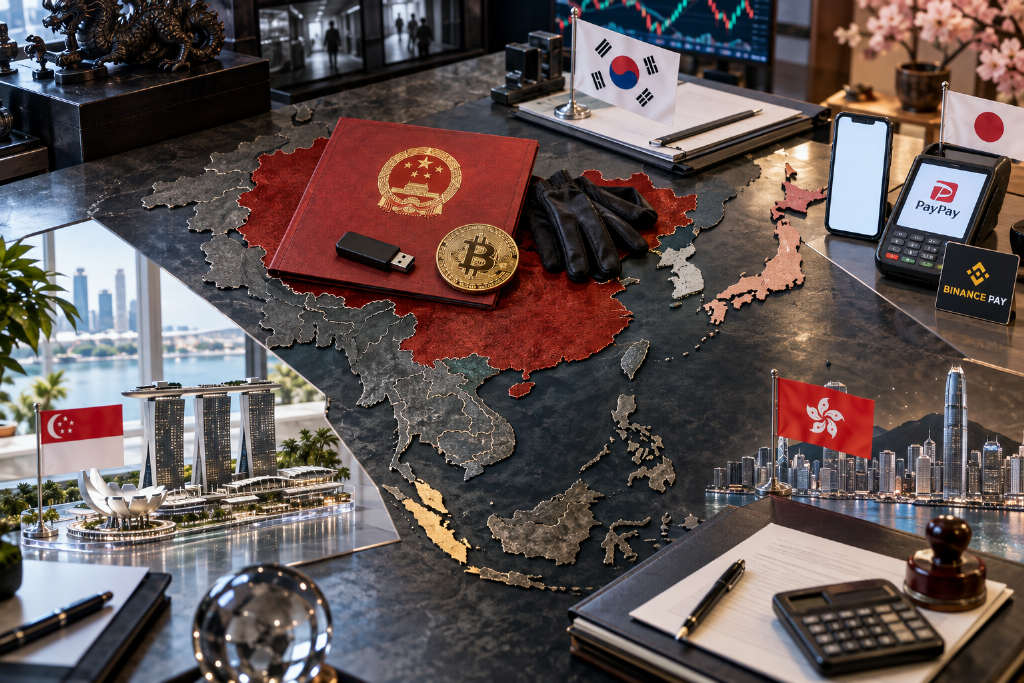
China’s security warning, Singapore’s renewed lead in regional crypto activity, South Korea’s review of market-making rules, Japan’s expanding crypto payments rails and tighter audit coordination in Hong Kong were among the main developments across Asia this week.
China says cryptocurrencies can act as espionage “accomplices”
China’s Ministry of State Security has sharpened its language on cryptocurrency risks, highlighting their use in crime and arguing that transactions are not truly anonymous.
According to the South China Morning Post, the ministry published a social media article saying cryptocurrencies are used to facilitate money laundering and cyberattacks and can serve as “accomplices” in espionage.
The MSS also said crypto is often used by “overseas anti-China hostile forces” to disrupt financial order and endanger national security.
The warning centered on traceability. The message was that crypto is not as anonymous as many people assume, and the article appeared to serve as a warning to would-be foreign spies who may believe they can send or receive payments without being detected: authorities can watch activity on the blockchain.
The report added that this applies to most cryptocurrencies, including Bitcoin and Ethereum, while Monero and Zcash can be fully private when used correctly.
China has repeatedly moved against the sector, first with a sweeping ban on exchanges in 2017 and later with a mining ban in 2021. It has also declared all crypto businesses illegal.
Singapore’s crypto economy grows 55.4% while the wider region shrinks
Singapore’s crypto activity rose 55.4% to $284 billion in the year ended June 2026, according to Chainalysis. The increase came even as the broader Central and Southern Asia and Oceania, or CSAO, region contracted, allowing Singapore to regain its position as the largest crypto economy in the region.
Across the wider CSAO market, total crypto economic activity fell 6.8% over the same period.
Chainalysis said much of Singapore’s growth came from institutional platform activity, which climbed 94% to $60 billion. That activity was concentrated among a small group of market makers, over-the-counter trading firms and institutional brokerages.
“The growth in Singapore’s institutional platform ecosystem was very concentrated and marked by mostly high-volume activity by existing platforms rather than the dynamic entry of new services,” Chainalysis told Cointelegraph.
South Korea reviews market-making after JPYC spike on Upbit
South Korea’s Financial Services Commission said it is considering a market-making system for digital assets after a yen-linked stablecoin briefly traded at as much as four times its peg on a major local exchange earlier this month.
Upbit opened trading in JPYC on Sept. 17. The market opened at 12 Korean won per token, then reached 37.6 won about an hour later, more than four times its market value. The spike was attributed to limited liquidity on the platform.
Yoo Young-joon, director of digital finance policy at the FSC, said: “We will also review the need to introduce systems such as market-making activities to increase the efficiency and stability of the digital asset landscape.”
South Korea’s Virtual Asset User Protection Act currently does not exempt market-making from market manipulation provisions, which prevents market makers from supplying liquidity in the country’s crypto markets.
MoonPay opens South Korean subsidiary
US payments and infrastructure company MoonPay has launched a South Korean subsidiary. The business plans to work with local financial institutions on remittances, payments, settlements and digital asset distribution.
It has not yet secured the approvals required to operate.
Binance Pay to reach PayPay merchants in Japan through HIVEX
Starting Wednesday, Binance Pay will allow eligible overseas users visiting Japan to spend more than 100 cryptocurrencies at the vast majority of merchants that support PayPay.
The service will run through HIVEX, a payment interoperability framework that connects overseas QR payment services to PayPay-supported merchants in Japan. Binance Pay uses Tether USDt (USDT) as its backend settlement layer. HIVEX settles with PayPay, and PayPay then settles merchants in yen.
Binance told Cointelegraph it is the first crypto payment service to access PayPay-supported merchants through HIVEX. Merchants will not need to opt in separately, the company said.
PayPay is a Japanese cashless payment service accepted at millions of locations nationwide, including major chains, smaller retailers, vending machines, taxis and public transportation. It lists nine other overseas payment services supported through HIVEX, mainly from Hong Kong, China and Taiwan, China.
Hong Kong regulators expand oversight of financial reporting at licensed crypto firms
Hong Kong regulators have signed an agreement to deepen cooperation on financial reporting and audits involving licensed crypto firms.
The Securities and Futures Commission and the Accounting and Financial Reporting Council agreed to coordinate on audit and assurance work and to establish a framework covering information sharing, case referrals, mutual assistance and coordinated inspections and investigations for licensed crypto companies.
HSBC’s Hong Kong dollar stablecoin will be called RedCoin
HSBC plans a phased rollout of RedCoin, its new Hong Kong dollar stablecoin. The bank will begin with person-to-person transfers and merchant payments before expanding into corporate and institutional use cases.
It is also launching a public education campaign aimed at reducing the risk of scams that could cost users their coins.