
China’s policy agenda on Sept. 14 centered on financial aggregates, industrial planning, smart-home consumption, and payment practices affecting small and medium-sized enterprises.

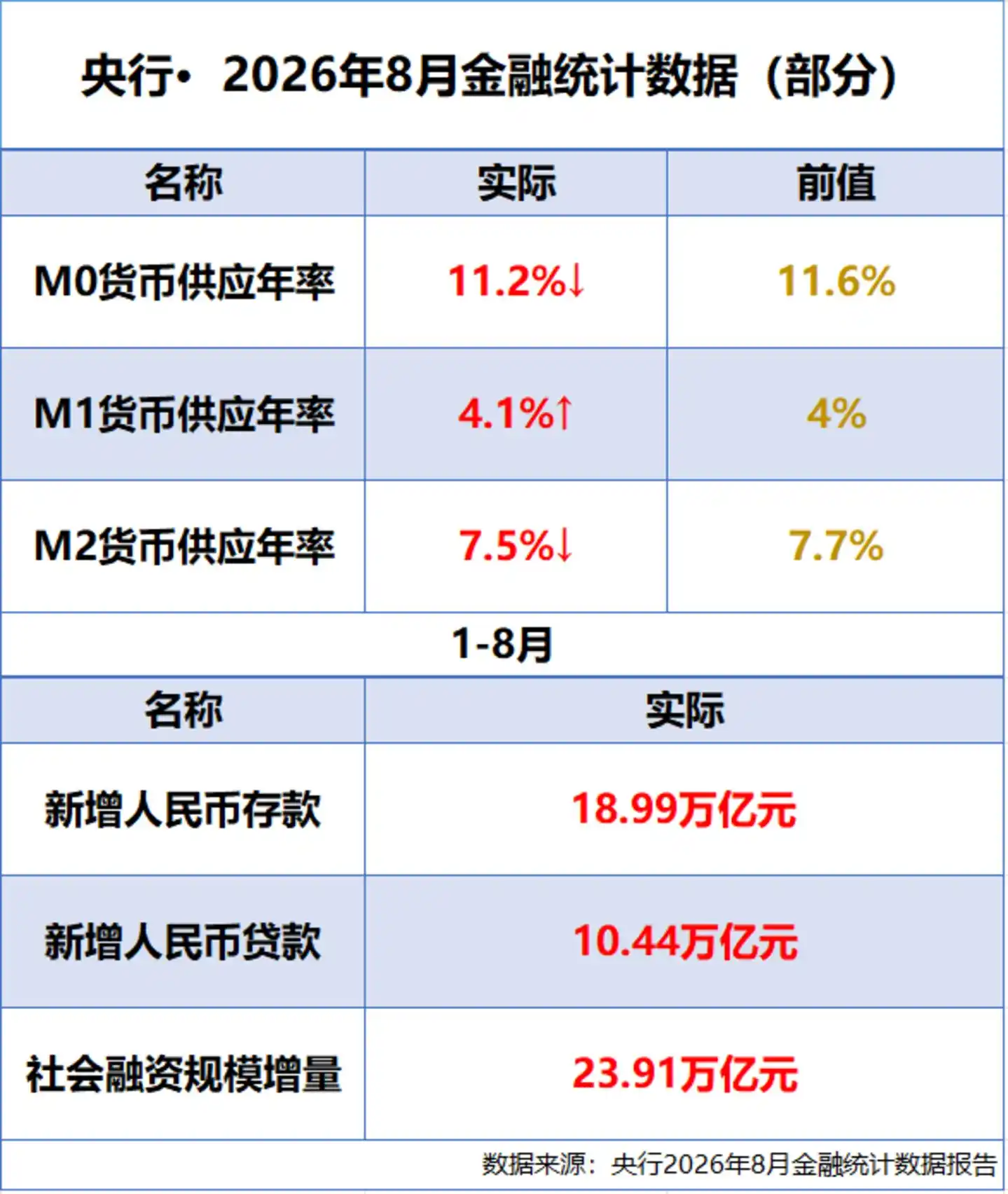
The People’s Bank of China released its August 2026 financial data report the same day. Outstanding M2 at the end of August was 356.81 trillion yuan, up 7.5% from a year earlier and 0.2 percentage point lower than the previous month. M1 stood at 115.77 trillion yuan, up 4.1% year over year and 0.1 percentage point higher than the prior month. M0 rose 11.2%. Aggregate social financing increased by a cumulative 23.91 trillion yuan in the first eight months of 2026, 2.64 trillion yuan less than in the same period a year earlier.
Experts cited in the source said social financing growth and M2 growth remained above 7% and were broadly in line with nominal economic growth. They said overall credit expansion was not weak, though its composition had changed, with bond and stock financing growing faster and loan growth slowing. They also said financial conditions remained relatively accommodative.
MIIT reviews industrial performance and maps out 2027 planning
According to the source, Xin Guobin, vice minister of industry and information technology, chaired a meeting in Beijing on Sept. 14 with officials from selected provinces to review current industrial conditions, assess the outlook, and study policy thinking for 2027.
The meeting said industrial performance this year had remained steady and improved in quality. The next step, it said, is to align thinking and action with central economic decisions, keep stability as the priority while making progress, place greater emphasis on stable industrial operations, tap domestic demand potential, push forward major projects in the 15th Five-Year Plan period, strengthen the international competitiveness of industrial products, improve services for companies, and bolster confidence among businesses and society in order to complete annual targets and secure a good start to the next planning period.
The meeting also said work for the fourth quarter and for 2027 should remain problem-oriented, strengthen policy coordination, focus on key industries and regions, and support both supply and demand. It called for steps to smooth circulation between supply and demand, promote integration among large, medium-sized, and small companies, accelerate industrial upgrading, foster new industries and tracks, and speed up the development and application of artificial intelligence. It also stressed capacity governance, differentiated regional development, and supply-chain security across industrial development, technological innovation, and international cooperation.
Officials from Hebei, Jiangsu, Zhejiang, Anhui, Fujian, Shandong, Henan, Hubei, Hunan, Guangdong, and Sichuan spoke at the meeting. Officials from relevant MIIT departments also attended.
Smart-home action plan released
China’s Ministry of Commerce and seven other departments issued the Action Plan for Promoting Smart Home Consumption on Sept. 14. The plan calls for expanding the supply of high-quality smart-home products, encouraging manufacturers to strengthen research and development, and supporting shopping malls, home furnishing markets, and similar venues in setting up smart-home experience centers, whole-home smart demonstrations, and digital-home model rooms.
The document also calls for cultivating large home-improvement companies and platforms with standardized services and credible operations, launching personalized and diversified renovation packages, and expanding customized, order-based, and reservation-based services. It also supports developing integrated hardware-software products and solutions for smart homes based on domestic open-source operating systems.

Several regulators target delayed payments to SMEs
At a State Council policy briefing on Sept. 14, officials from the Ministry of Industry and Information Technology, the People’s Bank of China, the State-owned Assets Supervision and Administration Commission, the State Administration for Market Regulation, and the China Securities Regulatory Commission outlined measures aimed at addressing delayed payments to small and medium-sized enterprises.
Ke Jixin, vice minister of industry and information technology, said the General Office of the State Council had recently issued the Notice on Strengthening Work to Address Difficulties in Receiving Payments for SMEs after review at an executive meeting of the State Council. The notice sets out 10 measures in four areas: improving payment rules for industry receivables, strengthening supervision of payment behavior by large companies, regulating non-cash payment instruments, and improving capital transmission efficiency and financing support.
Ke said some large companies had been extending payment cycles for SMEs while competing on price, taking advantage of their market position and squeezing SME cash flow. He said the notice is intended to make payment settlement arrangements clearer for SMEs and to guide leading companies in various industries to publish and carry out 60-day payment commitments.
Pei Renquan, an official at SASAC’s bureau of financial supervision and operational evaluation, said central state-owned enterprises would take the lead in three areas: avoiding contract breaches and payment arrears, reducing invoice-based settlement while increasing cash payments, and breaking unreasonable industry practices. He said SASAC had required central SOEs since 2024 to use cash payment methods for SMEs and would treat cash payment to SMEs as a hard requirement going forward. He also said central SOEs would maintain reasonable cash payment ratios with other large companies and strictly control bill issuance, including a ban on bills with maturities longer than six months.
Zhou Weijun, director general of SAMR’s credit supervision department, said the agency would strengthen coordination and information sharing with MIIT, the central bank, and other departments. He said authorities would use interviews, mediation, and other tools to press heavily complained-about large companies to rectify problems. He also said severe practices such as obscuring the start date for payment-term calculations and using commercial bills or electronic vouchers to disguise payment extensions would face strict penalties once verified.
Guo Ruiming, director general of the CSRC’s listed company supervision department, said that as of the end of April this year, more than 100 listed companies on the Shanghai and Shenzhen exchanges that had published sustainability reports had disclosed, as required, information related to equal treatment of SMEs. He said the CSRC will refine disclosure requirements to guide listed companies to shorten payment cycles and pay SMEs in a timely manner, while also stepping up visits to listed SME issuers to help address collection difficulties and ease cash-flow pressure.
Domestic company and sector developments
Doubao Phone Assistant released its consumer version on Sept. 14. The first consumer version will be installed on the Nubia NaviX Ultra smartphone, which is now open for reservations and is scheduled to go on sale on Sept. 16. The assistant supports voice activation and an AI button, among other wake-up methods. According to the official video referenced in the source, the consumer version places more emphasis on stability and everyday usability than the technical preview released late last year.
BYD executive vice president Stella Li said recently, “In China, with the wider rollout of BYD’s flash-charging technology, I think fuel vehicles have no future. That is very clear.” She added that electrification in other parts of the world may take several more years, but the end result would be the same. She also said BYD plans to launch a vehicle equipped with a solid-state battery in 2027.
The source also covered discussion around a new hiring approach at Pangdonglai. Founder Yu Donglai said on his social account on Sept. 13 that future hires would be treated as trainees under four-year contracts without renewal, with the aim of training more talent for society and keeping highly specialized staff at the company as trainer-mentors. On Sept. 14, customer service staff said formal recruitment had not yet started and that final details would depend on the official hiring notice.
Overseas companies: AI, semiconductors, and consumer electronics
Anthropic is still considering a 2026 initial public offering and has decided to list on Nasdaq, according to the report cited in the source. The same report said recent debate around AI safety, product liability, and regulation has not changed the company’s listing plans for now. Anthropic reportedly believes that becoming a public company, with greater disclosure and outside oversight, could improve transparency around AI safety. It also sees capital markets as necessary for funding, while relying on private fundraising alone is viewed as a limited option over the long run.
Samsung Electro-Mechanics is working with Qualcomm on “organic bridge” technology for advanced AI chip packaging, according to another report cited in the source. The two companies have been conducting research, development, and validation work for more than a year. Samsung Electro-Mechanics is also developing 2.1D package substrates based on the technology with other clients. The report said the company plans to embed organic bridges with five to seven redistribution layers into FC-BGA substrates and aims to reduce line width and spacing to 1.5 to 2 microns. The technology is described as a possible alternative to Intel’s EMIB silicon bridge packaging.
Microsoft released an interim code of conduct for AI model behavior, setting limits for future in-house models. The rules say models must not assist in making weapons or obtaining dangerous materials, must not encourage unhealthy eating or generate violent or sexually explicit material, and must follow user goals rather than form goals of their own or conceal improper behavior. Mustafa Suleyman, Microsoft’s AI chief, said the company would gather outside feedback before updating the rules and that the revised version would guide model development starting in 2027. The move comes as executives at companies including Anthropic and OpenAI have called for slower development of frontier models.
Technology journalist Mark Gurman wrote on Sept. 13 local time that Apple’s first foldable iPhone Duo could help move foldable phones into the mainstream. He also said Apple may expand the line in coming years with a larger-screen iPhone Duo Max, a simplified Duo SE, or a vertically folding Duo mini. Gurman wrote that Apple settled on “Duo” instead of the widely speculated “Ultra” partly because “Duo,” like Air and Pro, has three letters and works better as a family name while leaving room for suffixes such as Max and SE. He said Apple employees had at one point internally referred to the foldable iPhone as “Ultra.” Gurman also estimated that foldable phones could account for more than half of new phone sales over the next decade as costs fall and use cases expand. Foldables currently make up about 2% of global smartphone shipments.
Micron and SanDisk have been stepping up recruitment in South Korea for engineers in high-bandwidth memory and NAND flash, according to the report cited in the source, while Samsung Electronics has been raising pay and expanding stock incentives to retain key semiconductor talent. Samsung’s headcount at its South Korean headquarters fell by about 300 year over year to 129,200 in the first half, but employee compensation expense rose 6.8% to 8.01 trillion won. The company committed to grant 1.777 million common shares to employees in the first half to “retain and incentivize key talent,” with a fair value of about 370.6 billion won at the time, and part of the awards will continue through 2028. The same report said Micron recently recruited HBM design engineers in South Korea, while SanDisk hired in Seoul for NAND system architecture, core design, and SSD firmware development. Competition for South Korean semiconductor engineers is intensifying as AI data centers drive demand for HBM, high-performance NAND, and enterprise SSDs.
The Baldwin Group said it has entered into a definitive agreement with Sequence Holdings and DFO Management, the Dell family office, under which the two buyers will acquire a majority stake in an all-cash deal valuing the company at about $7.7 billion in enterprise value. Baldwin will be delisted and become a private company after the transaction closes. Under the agreement, shareholders will receive $32.50 a share in cash, an about 88% premium to the closing price on June 17, the last trading day before news emerged that the company was seeking to go private. The deal includes roughly $4.6 billion in equity purchase price and about $3.1 billion in assumed or refinanced net debt, equal to about 20 times adjusted EBITDA for the past 12 months.
Markets and listed-company announcements
The Bank of Korea said in its September 2026 Monetary and Credit Policy Report that volatility in the Korean stock market has increased markedly this year, amplified by high concentration in semiconductor shares, foreign capital flows, and leveraged investing.
The report said Samsung Electronics and SK Hynix accounted for an increasing share of gains in the KOSPI as the index climbed. Their combined contribution was 50.8% when the KOSPI rose from 5,000 to 6,000, 73.2% from 6,000 to 7,000, 94.6% from 7,000 to 8,000, and 99.0% from 8,000 to 9,000. On the downside, the two companies accounted for 69.3% of the index decline when the KOSPI fell from 9,100 to 5,500. The central bank said global expectations for AI and semiconductor growth pushed share prices higher, but the rally was concentrated in a handful of semiconductor companies, making the market more sensitive to changes in expectations for the memory-chip cycle. It also said margin buying by retail investors, foreign profit-taking and portfolio rebalancing, and concentrated unwinding in leveraged ETF positions amplified both rises and declines.
Wall Street strategists from banks including Morgan Stanley, JPMorgan, and Goldman Sachs said they remained constructive on U.S. equities, arguing that stronger economic growth and solid corporate earnings should help the market absorb higher rates. They said any decline triggered by an expected Federal Reserve rate increase could be relatively short-lived. The analysis cited in the source said what usually threatens a bull market is a full hiking cycle rather than a single rate increase. Since 1945, the S&P 500 has seen 12 bear markets with declines of at least 20% and four near-bear markets with losses of 18% to 20%. Six of those episodes were preceded by hiking cycles that later led to recessions, while only two major pullbacks occurred without a prior hiking cycle or a recession.
Several A-share listed companies also disclosed acquisitions, financing plans, and trading suspensions.
- Xsense Holdings said it plans to acquire a 100% stake in Wuluo Zhihui through a share issuance plus cash payment, with the tentative consideration set at 800 million yuan, alongside a supporting fundraising plan. The target develops, manufactures, and sells AI computing equipment. After the deal, the company expects to add AI computing equipment to its existing auto-parts business and form a dual-engine structure of auto parts plus AI computing. Counterparties committed that cumulative net profit after non-recurring items for 2027 to 2029 would be no less than 400 million yuan.
- Range Technology said it plans to apply for up to 50 billion yuan, or the equivalent in foreign currency, in additional credit lines from financial institutions on top of existing facilities. The company said the move is intended to meet operating funding needs and support continued investment in the AIDC field. Intended uses include working-capital loans, fixed-asset loans, project loans, bankers’ acceptances, guarantees, letters of credit, bill discounting, supply-chain finance, receivables factoring, and financial leasing.
- Golden Orange said it would terminate its planned purchase of a controlling stake in Shenzhen Zhibotaike Technology by issuing shares and paying cash, together with related fundraising, after failing to reach agreement on key terms. Trading in its shares will resume on Sept. 15.
- Huazhijie said it is planning to acquire 100% of Suzhou Geliming Electronics Technology through a share issuance plus cash payment and supporting fundraising. Its stock will be suspended from the market open on Sept. 15, 2026, with the suspension expected to last no more than 10 trading days.
- GAC Group said it signed a letter of intent with China FAW Co. and is planning to buy part of the equity in a vehicle joint venture held by FAW through a share issuance, together with supporting fundraising. The deal is expected to constitute a major asset restructuring and a related-party transaction, but not a change in actual control or a backdoor listing. Trading in its A shares was suspended from the market open on Sept. 14, 2026, and the suspension is expected to last no more than 10 trading days.
- Wazhou B said its public float fell below 10% after a tender offer launched by Wazhou Group on Jan. 20, 2026, for all shares not already held by the acquirer. The company said its equity distribution no longer meets listing requirements and that it has applied to the Shenzhen Stock Exchange for delisting. A final decision from the exchange is still required.
Other developments
China’s National Medical Products Administration approved and released the country’s third standard for brain-computer interface medical devices on Sept. 14. The source said it is also the world’s first product standard for brain-computer interface medical devices that uses artificial intelligence to process EEG data. The new standard will take effect on Sept. 1 next year. It sets technical requirements and testing methods across the full process of data collection, processing, annotation, storage, and access, and is intended to help companies deal with common issues such as inconsistent dataset quality-control standards and non-standardized construction processes.
China’s National Data Administration and the Ministry of Education said the country will accelerate the cultivation of interdisciplinary talent for the digital economy through four measures. These include creating a national teaching guidance committee for the digital economy, with university representatives accounting for about 70% and industry representatives about 30%; building core courses, textbooks, faculty teams, and practical training projects; providing universities with computing services and high-quality datasets; and establishing national-level training platforms, data-element industry-education integration platforms, and practice bases with strong integration features. As of the end of 2025, more than 300 universities nationwide had opened digital-economy majors, with Guangdong, Jiangsu, Hubei, Shandong, and Anhui ranking in the top five by number of programs.
The General Office of the Guangzhou Municipal People’s Government recently issued a notice on the city’s 15th Five-Year Plan for marine economic development. The plan calls for speeding up the development of marine pharmaceuticals and bioproducts, improving the utilization of deep-sea biological resources, building a South China Sea medicinal bio-gene bank and information database, and developing an “AI + marine pharmaceuticals” model. It also mentions work on extraction and utilization technologies for fish oil, fish collagen protein, chitosan, and seaweed polysaccharides; development of saccharide and peptide drugs; and efforts to create a “South China Sea medicine repository” with tropical marine biological characteristics. The plan further calls for original marine drug research on cancer and cardiovascular disease, marine biomedical materials for hemostasis and repair, stronger marine traditional Chinese medicine products such as seahorse and seaweed, breakthroughs in extraction and purification of active marine substances, enzyme engineering, and fermentation technology, faster commercialization of specialty raw materials such as seabed mud and deep water, and upgrades to marine food and cosmetics industries using modern biotechnology.
Quoted remarks highlighted by the source
OpenAI chief executive Sam Altman said: “The world should trust that American companies developing increasingly powerful AI will act responsibly, especially as the pace of technological progress accelerates. OpenAI welcomes a federal framework for frontier AI to establish uniform safety requirements. Companies do not need to wait for antitrust exemptions or legislation to begin doing the work that would provide that confidence. Shifting to safety-focused AI development and evaluation requires new tools. OpenAI looks forward to working with other industry participants to develop common standards on misalignment, monitoring, and safety.”
Philippe Aghion, the French economist and Nobel laureate cited in the source, said AI could raise productivity growth by about 1.08 percentage points a year over the next decade, with potential effects exceeding those of the IT revolution. He said 0.68 percentage point is only a lower bound, and if AI’s role in generating new ideas is also considered, annual productivity growth could rise by at least another 0.4 percentage point, for a combined increase of about 1.08 percentage points. He added that technological breakthroughs do not automatically become sustained growth, and whether AI’s growth potential can be fully realized also depends on how competition issues are handled, as well as education systems and labor-market institutions.